
# 8 Free Generator Tools Every Developer Needs in 2026
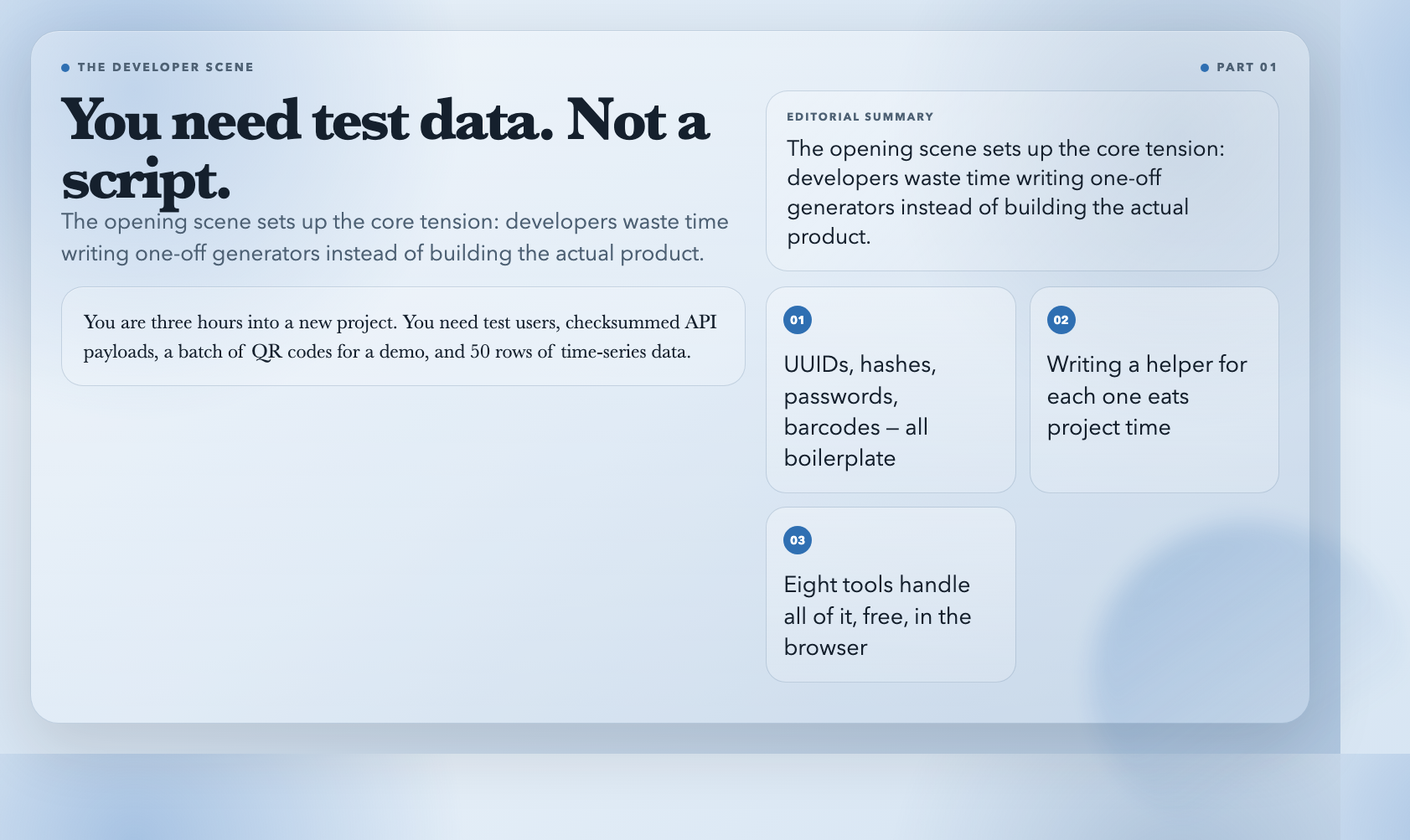
You are three hours into a new project. You need test users, checksummed API payloads, a batch of QR codes for a demo, and 50 rows of time-series data for your frontend. You could write helpers for all of it. Or you could stop, and use eight tools that generate all of it in seconds — free, in your browser.
—
1. UUID Generator
UUID v4 (random) covers most use cases. But distributed systems often need v1 (time-based) for sortable IDs, or v5 (namespace-based) for deterministic keys that stay the same across runs. This tool handles all three — generate one or up to 100 at once.

When to use this: Database primary keys, correlation IDs across microservices, offline-first record identifiers.
Try it → UUID Generator
—
2. Hash Generator
MD5 is broken for security. SHA1 is deprecated. But legacy integrations still require them, and teaching hash theory requires generating examples. This tool produces MD5, SHA1, SHA256, and SHA512 from any text — with both hex and base64 output side by side.
When to use this: Verifying file integrity, debugging HMAC implementations, generating etag values for caching layers.
Try it → Hash Generator
—
3. Password Generator
Most generators give you random characters. This one gives you control: length from 4 to 128 characters, toggles for uppercase/lowercase/numbers/symbols, and options to exclude ambiguous characters (0/O/l/I) and specific symbols. Generate one password or a batch of 100.
When to use this: Test user accounts, temporary credentials for demos, rotating API keys for CI environments.
Try it → Password Generator
—
4. Random String Generator
Passwords are one use case. But CSRF tokens need alphanumeric-only strings. Random filenames sometimes need to exclude slashes. Custom character sets are useful when generating promotional codes or coupon strings. This tool handles all of those patterns in one place.
When to use this: CSRF tokens, one-time-use coupon codes, random filenames that avoid special characters.
Try it → Random String Generator
—
5. Random Number Generator
Most random number tools give you uniform distribution. Real-world data does not. This tool generates numbers from six statistical distributions — uniform, normal (Gaussian), exponential, Poisson, binomial, and integer — with configurable parameters for each.
When to use this: Monte Carlo simulations, statistical test data, generating time-series with realistic noise for dashboard demos.
Try it → Random Number Generator
—
6. QR Code Generator
Encode URLs, text, or any data in a QR code. Choose size from 50 to 1000px, error correction level (L/M/Q/H), margin width, and foreground/background colors. Output as PNG for raster use or SVG for scalable print materials.
When to use this: Mobile login via TOTP QR codes, linking physical products to documentation, event badge scanning.
Try it → QR Code Generator
—
7. Barcode Generator
Generate CODE128 (most flexible), CODE39 (legacy numeric), EAN-13 and EAN-8 (retail products), UPC-A (US retail), ITF-14 (inventory cases), MSI, and Pharmacode formats. EAN and UPC formats validate and calculate check digits automatically.
When to use this: Product SKUs for inventory demos, shipping label barcodes, testing barcode scanner hardware.
Try it → Barcode Generator
—
8. Array Generator
This one goes beyond scalar values. Generate arithmetic sequences (1, 2, 3…), geometric sequences (1, 2, 4, 8…), random number arrays, random string arrays, and date sequences. Output as JSON for direct integration into test fixtures or database seed files.

When to use this: Seeding test datasets, creating time-series for chart components, generating batch fixture files.
Try it → Array Generator
—
The Pattern Behind These Tools
These eight generators solve one underlying problem: boilerplate code you write once, use once, and forget. The time per tool is small. The accumulation across a project is not. Instead of writing a UUID helper, you paste the output. Instead of installing a faker library for one distribution, you pick from six in a dropdown.
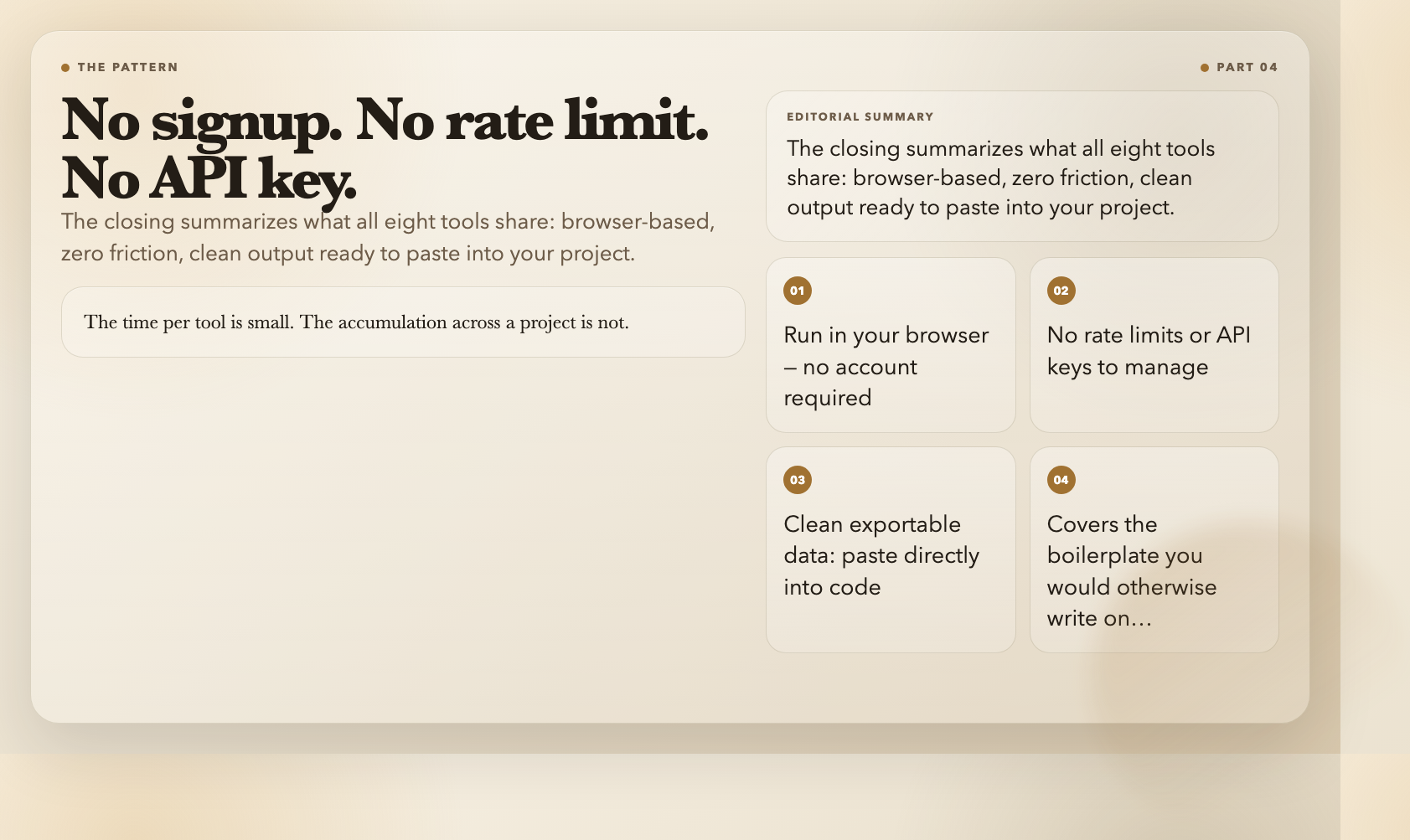
What they share: no signup, no rate limit, no API key. They run in your browser and export clean data you can paste directly into your project.
Start exploring → Browse all generator tools on ElysiaTools