8 Free Finance Calculators That Will Transform How You Think About Money
Here’s something nobody tells you about personal finance: the math is not the hard part. The hard part is making yourself care enough to do it.
Most people avoid financial calculators because they associate them with debt, regret, and the quiet anxiety of not knowing where they stand. But there’s a version of these tools that does something different—it makes abstract money concepts viscerally real by the time you close the tab.
These eight calculators are the ones I return to whenever I’m facing a financial decision that matters. They don’t make the choice for you, but they make the choice impossible to avoid.
#
1. Compound Interest Daily Calculator
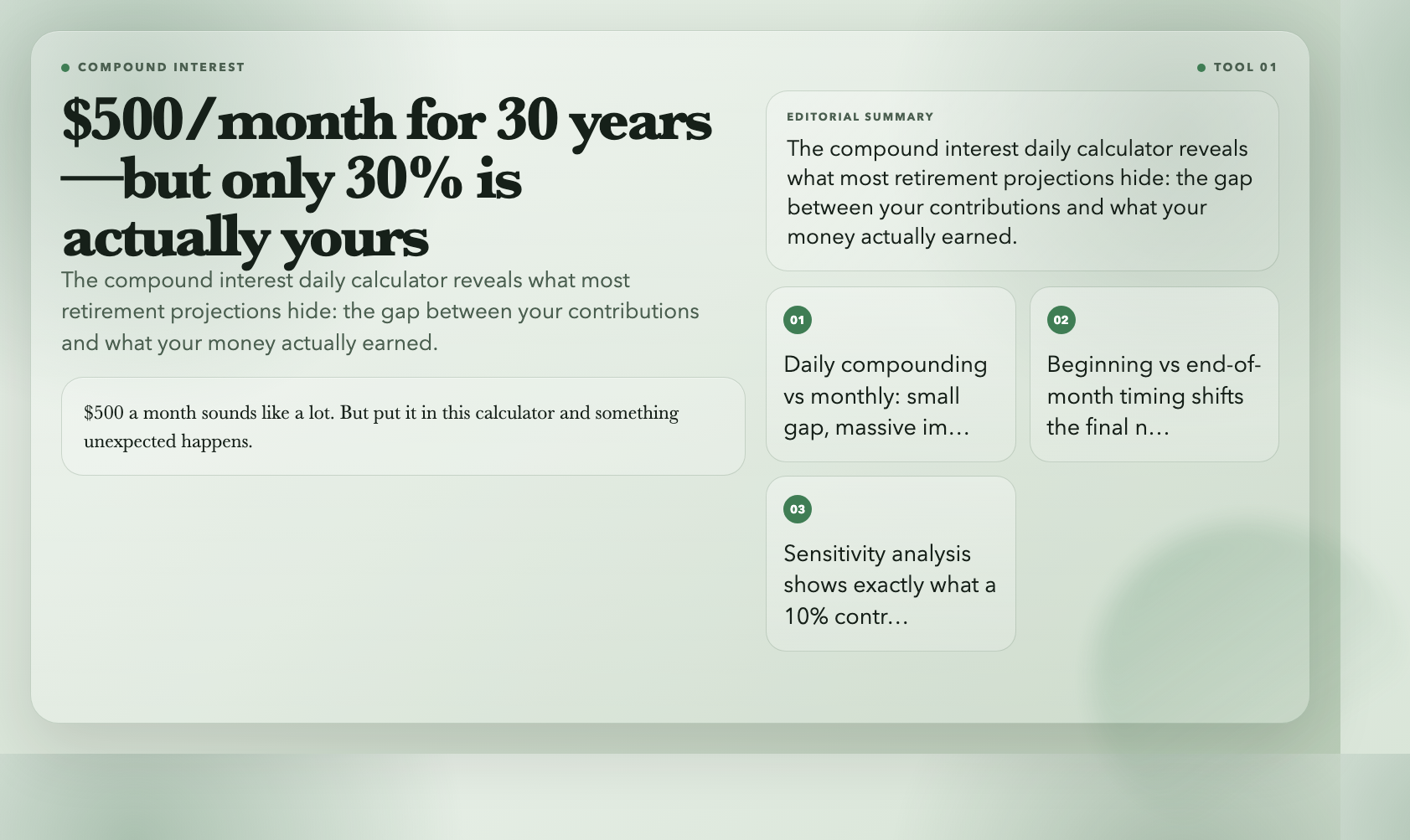
Here’s the number that changed how I think about saving: $500 a month for 30 years sounds like a lot. But put it in this calculator and something unexpected happens—you see exactly how much of your final balance is your contributions versus interest earned.
This calculator compounds daily, not monthly. That difference sounds academic until you run it over three decades. It also lets you compare beginning-of-month versus end-of-month contribution timing, which reveals how much a simple timing shift costs—or saves—you over time.
The most useful feature is the sensitivity analysis: what happens if you increase your contribution by 10%? What if you earn 1% more annually? These small adjustments, visualized over 30 years, will make you want to call your HR department and increase your 401(k) today.
What to use it for: Retirement readiness checks. If you’ve ever wondered “am I on track?”—this is your answer.
Try the Compound Interest Daily Calculator
#
2. Future Value Calculator
The future value calculator inverts the question: instead of asking where you are, it asks where you’re going.
Plug in your current savings, your expected annual return, and your monthly contribution. It shows you what that money becomes—not as a vague projection but as a specific number with a specific date. The version I keep using has one feature that most simple FV calculators skip: it models regular contributions, not just lump sums.
If you’re a typical worker building wealth through a 401(k) or brokerage account, this calculator separates what you actually saved from what your money made for you. That distinction—your contribution versus the bank’s or market’s contribution—is one of the most motivating things you can see.
What to use it for: Figuring out what “15% of income” actually becomes in 30 years. Then deciding if that’s enough.
Try the Future Value Calculator
#
3. Present Value Calculator
Would you rather have $100,000 today or $150,000 in ten years? The answer sounds obvious until you run the math—and then it depends entirely on what you could earn elsewhere.
The present value calculator applies a discount rate to future cash flows and tells you what they’re worth in today’s dollars. The discount rate is the critical input: it’s the return you could reasonably get if you invested that money today. A $150,000 inheritance in 10 years is worth significantly less than $150,000 if your alternative is a 7% annual return in the stock market.
The sensitivity table is what makes this tool worth using. It shows you the present value at 4%, 6%, and 8%—and watching those numbers diverge sharply teaches you something textbooks take pages to explain: the discount rate matters more than almost anything else in financial mathematics.
What to use it for: Comparing job offers with signing bonuses versus higher base salary. Evaluating pension lump-sum buyouts. Deciding whether to take a windfall now or later.
Try the Present Value Calculator
#
4. Loan Calculator
Most people sign car loans and mortgages without running the full numbers. They know their monthly payment. They don’t know how much total interest they pay over the life of the loan—or how much impact an extra $100/month makes.
This loan calculator has a feature that should be legally required: payment breakdown. It shows you, month by month, how much of every payment goes to principal versus interest. In the early years of a 30-year mortgage, typically 70–80% of your payment is interest. That single visualization has convinced more than one person to push for a 15-year term or make extra principal payments from day one.
What to use it for: Before you sign anything. Run it with minimum payment, then with an extra $100/month. The difference in total interest paid over 30 years is the price of not asking.
Try the Loan Calculator
#
5. Amortization Schedule Generator
If the loan calculator shows you the summary, this shows you the full story—every payment, every month, until the loan is gone.
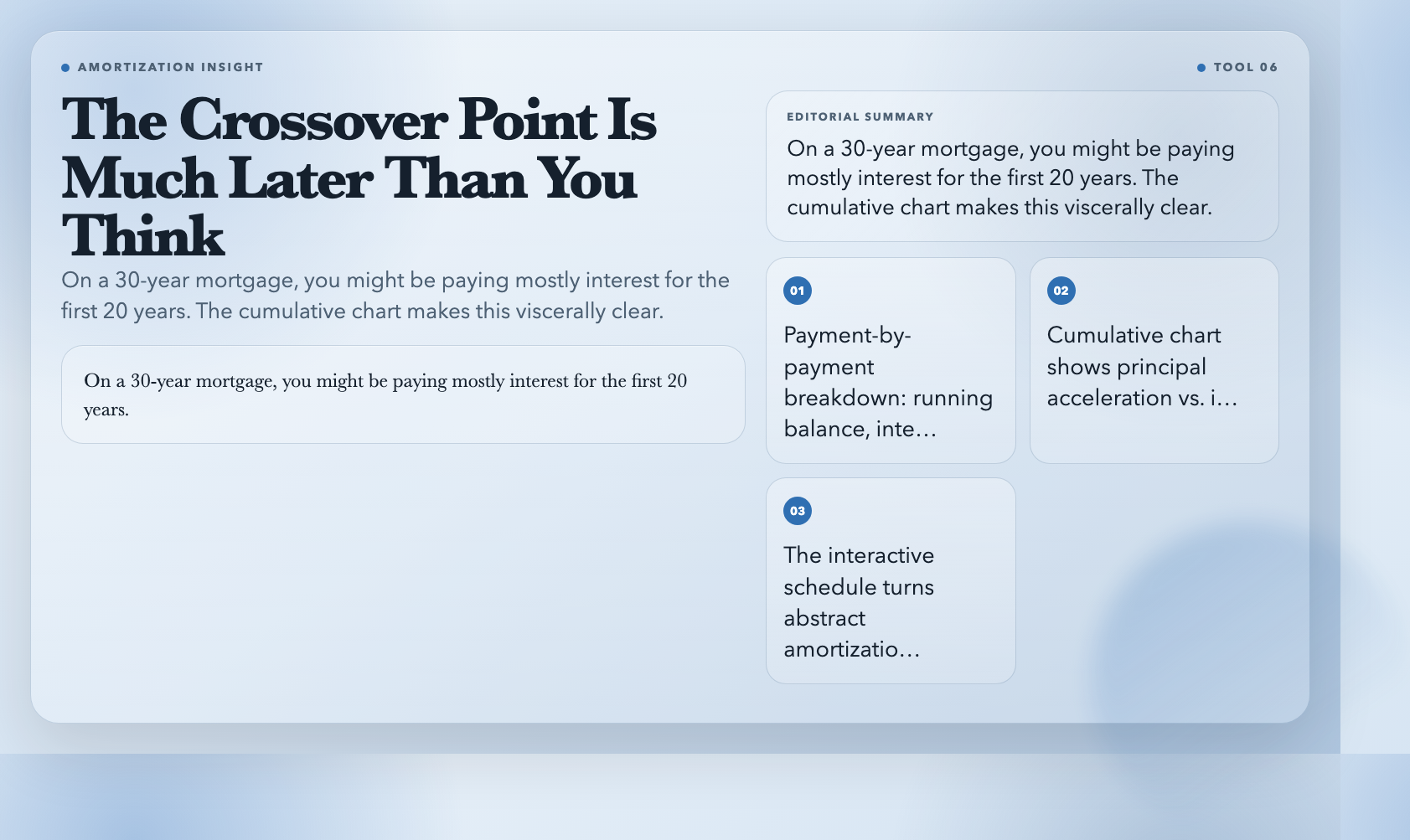
The amortization schedule generates a complete month-by-month breakdown of any loan. You can see exactly when you cross the 50% principal threshold, when your balance drops below 50% of what you borrowed, and how every extra payment accelerates your payoff date. It also reveals something counterintuitive: paying off a loan early in year 3 saves far more interest than paying extra in year 28, because of how amortization front-loads interest charges.
This is the tool I wish I’d had when I bought my first house. I thought I understood my 30-year mortgage. Then I saw the schedule: after five years of payments, I still owed 94% of the original balance.
What to use it for: Mapping out debt payoff strategy. Understanding the real cost of minimum payments versus extra principal payments.
Try the Amortization Schedule Generator
#
6. Capital Gains Tax Calculator
This is the one most people skip—and it’s the one that costs them the most when they sell.
The capital gains tax calculator handles the distinction between short-term and long-term capital gains rates. Hold an asset for more than a year and you pay the lower long-term rate, sometimes less than half the ordinary income rate. Sell too soon and your gains are taxed as ordinary income—which can nearly double your tax bill on the same investment.
It also factors in your filing status, annual income, and country-specific rules. One feature that reveals the progressive nature of capital gains: as your income rises, your long-term capital gains rate climbs—and at certain thresholds, long-term gains start getting taxed at the same rate as short-term gains. If you’ve never seen your capital gains rate jump from 15% to 20% to 23.8% based on income, this calculator will show you exactly how it works.
What to use it for: Before selling any stock, investment property, or business stake. The difference in tax liability can be larger than the gain itself.
Try the Capital Gains Tax Calculator
#
7. Rule of 72 Calculator
The Rule of 72 is finance’s most useful mental shortcut: divide 72 by your interest rate, and that’s roughly how many years it takes your money to double. But the Rule of 72 calculator goes far beyond the shortcut itself.
It shows you the exact doubling time versus the Rule of 72 approximation, so you can see how accurate (or inaccurate) the shortcut is at different rates. It also calculates the Rule of 69.3 and Rule of 70—alternative versions that are actually more precise for different compounding frequencies.
The feature I find most valuable is the reverse calculation: instead of asking “how long to double at 6%?” it tells you “what return do I need to double my money in 10 years?” The answer—7.2%—is useful context when evaluating investment promises. If someone tells you an investment will double your money in 5 years, you can instantly calculate that requires a 14.4% annual return. That number should raise immediate questions.
What to use it for: Fact-checking investment claims in real time. Quick estimates during conversations about money.
Try the Rule of 72 Calculator
#
8. Rent vs Buy Calculator
This is the decision that keeps most middle-class families up at night—and it’s one where conventional wisdom is often dead wrong.
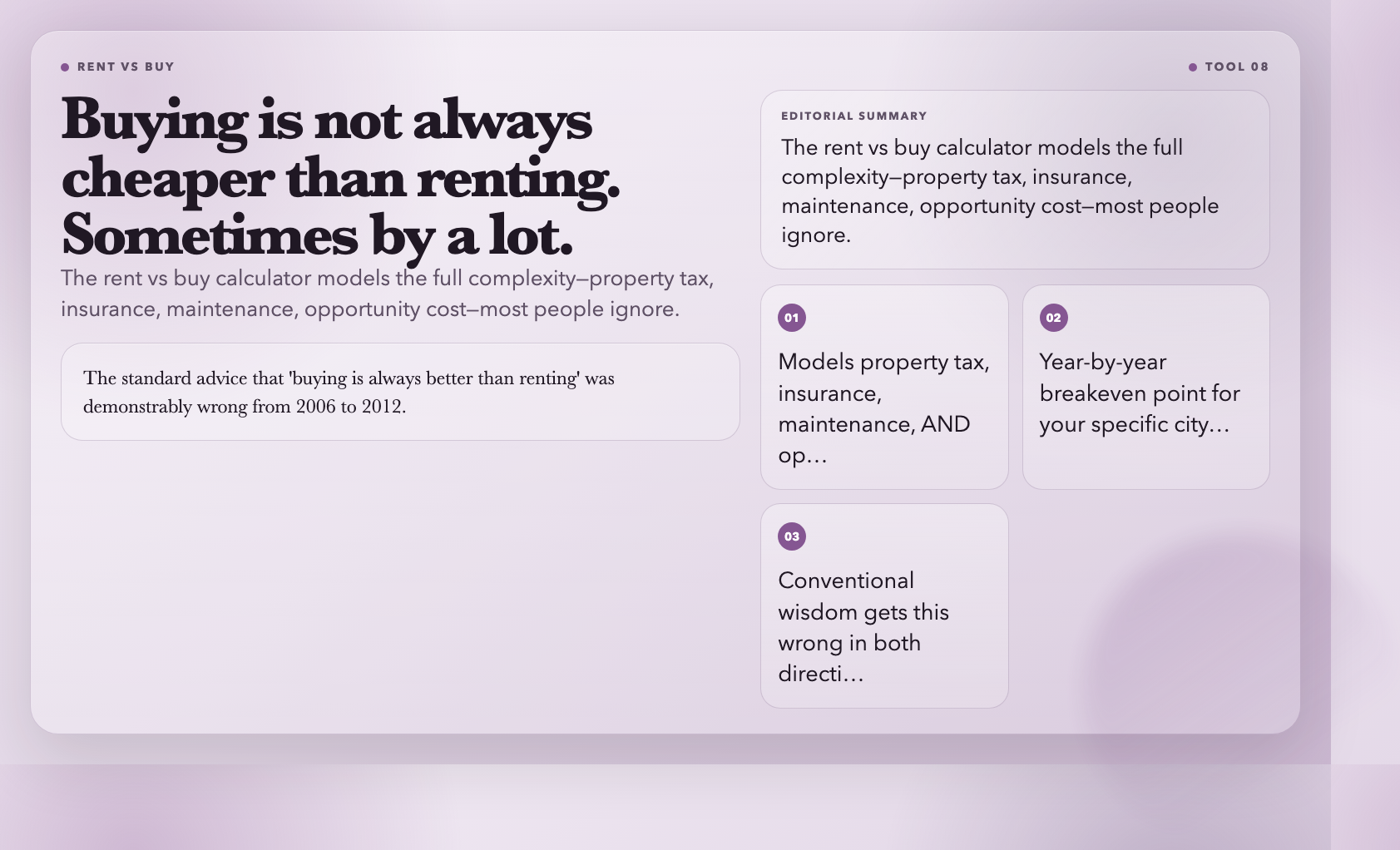
The rent versus buy calculator is the only tool that models the full complexity of this decision. It doesn’t just compare your monthly rent to your potential mortgage payment. It accounts for property taxes, home insurance, maintenance costs, closing costs, home appreciation rates, investment returns on your down payment, and rent inflation over time.
The output is a year-by-year comparison showing when (if ever) buying becomes financially advantageous versus renting and investing the difference. This is crucial because the standard advice that “buying is always better than renting” was demonstrably wrong in many U.S. markets from 2006 to 2012—and it’s wrong again in some markets today.
What to use it for: The biggest financial decision most people will make in their 20s and 30s. Run it for your specific city and timeline before you fall in love with a house.
Try the Rent vs Buy Calculator
#
The Pattern Behind All of These
Notice what’s missing from this list: budget trackers, expense managers, investment dashboards. These eight tools are all forward-looking. They help you answer the question that actually matters, which is never “what happened to my money” but “what should I do with my money next.”
Financial decisions are emotional. That’s why people avoid tools that force them to confront the numbers. These calculators don’t make the decision for you, but they make the decision real. The moment you see how much interest you’ll actually pay on a 30-year mortgage—rather than just knowing the monthly payment—is the moment the decision changes.
Run these before any major financial decision. Your future self will either feel relief or urgency—both are useful.