
# 8 Free Math Calculators That Save Your Brain When Numbers Get Ugly
You are staring at 0.3333333 and someone asks you to convert it to a fraction. Or you need the inverse of a 3×3 matrix before Friday’s deadline. Or you need to explain why the Fibonacci sequence matters to the product roadmap.
These are not hypothetical edge cases. They are Tuesday.

There is a whole category of math that your brain can do with enough time and a whiteboard — but that does not mean you should. The eight tools below handle calculations that are conceptually tractable but computationally tedious. All are free, browser-based, and live at ElysiaTools.
1. Fraction Decimal Converter — Stop Guessing
The theory is simple. The practice is annoying. 7/16 is 0.4375, and doing that mentally while debugging a CSS layout is a waste of cycles.
The Fraction Decimal Converter goes both ways. Input 5/8, get 0.625. Input 0.625, get 5/8. It handles mixed numbers (3 1/4), improper fractions (13/4), configurable decimal precision, and optional step-by-step working for when you need to show your process.
A concrete case: I spent five minutes in a code review arguing about whether 22/7 or 3.141 was closer to π. The converter settled it immediately. 22/7 ≈ 3.142857, error = 0.001264. 3.141 = 3.141000, error = 0.000593. 3.141 wins. That code review ended faster.
2. Matrix Calculator — 13 Operations, No Scratch Paper
Every developer eventually runs into a problem that is secretly matrix math. Computer graphics, coordinate transformations, ML data pipelines — the operations are the same whether you recognize them or not.
The Matrix Calculator handles 13 different operations. Addition, subtraction, multiplication. Transpose, determinant, inverse, rank, trace. Eigenvalues for 2×2 and 3×3 matrices. Hadamard product, Kronecker product, scalar multiply and divide. Output formats include standard matrix brackets, plain array notation, and LaTeX for academic documents.
A real example: I needed the inverse of [[2,1],[4,3]] for a coordinate system transform in a game engine. The calculator returned [[-3, 1], [4, -2]] divided by the determinant (2). I verified it by multiplying [[2,1],[4,3]] × [[-3,1],[4,-2]] and got the identity matrix. Correct. No textbooks opened.
3. Fibonacci Sequence Generator — The Golden Ratio in Numbers
The Fibonacci sequence is not just a rabbit breeding model from 1202. Its consecutive ratios converge on φ ≈ 1.618, appear in sunflower seed spirals, and show up in financial retracement tools, algorithm complexity analysis, and generative art.
The Fibonacci Sequence Generator lets you set custom starting values, choose output format (array, comma-separated, indexed), and toggle golden ratio analysis. Generate F(1) through F(30) starting from 0,1 and watch the ratio of consecutive terms: F(30)/F(29) = 832040/514229 ≈ 1.61803399. By F(12) you are already within 1% of φ. By F(30) you are within 0.00003%.
I used this to explain the golden spiral in a product design meeting. Showing the numbers made the abstract tangible. The conversation shifted from “this sounds made up” to “where can we use this in the layout.”
4. Continued Fraction Calculator — Best Approximations Explained
Continued fractions produce the best rational approximations to any number. This is not an approximation trick — it is a mathematical fact. π ≈ [3; 7, 15, 1, 292] gives you 355/113 with error < 0.0000003. Truncating the decimal 3.141592653 gives you 3.14 with error 0.00159. The continued fraction approximation is 500 times more accurate.
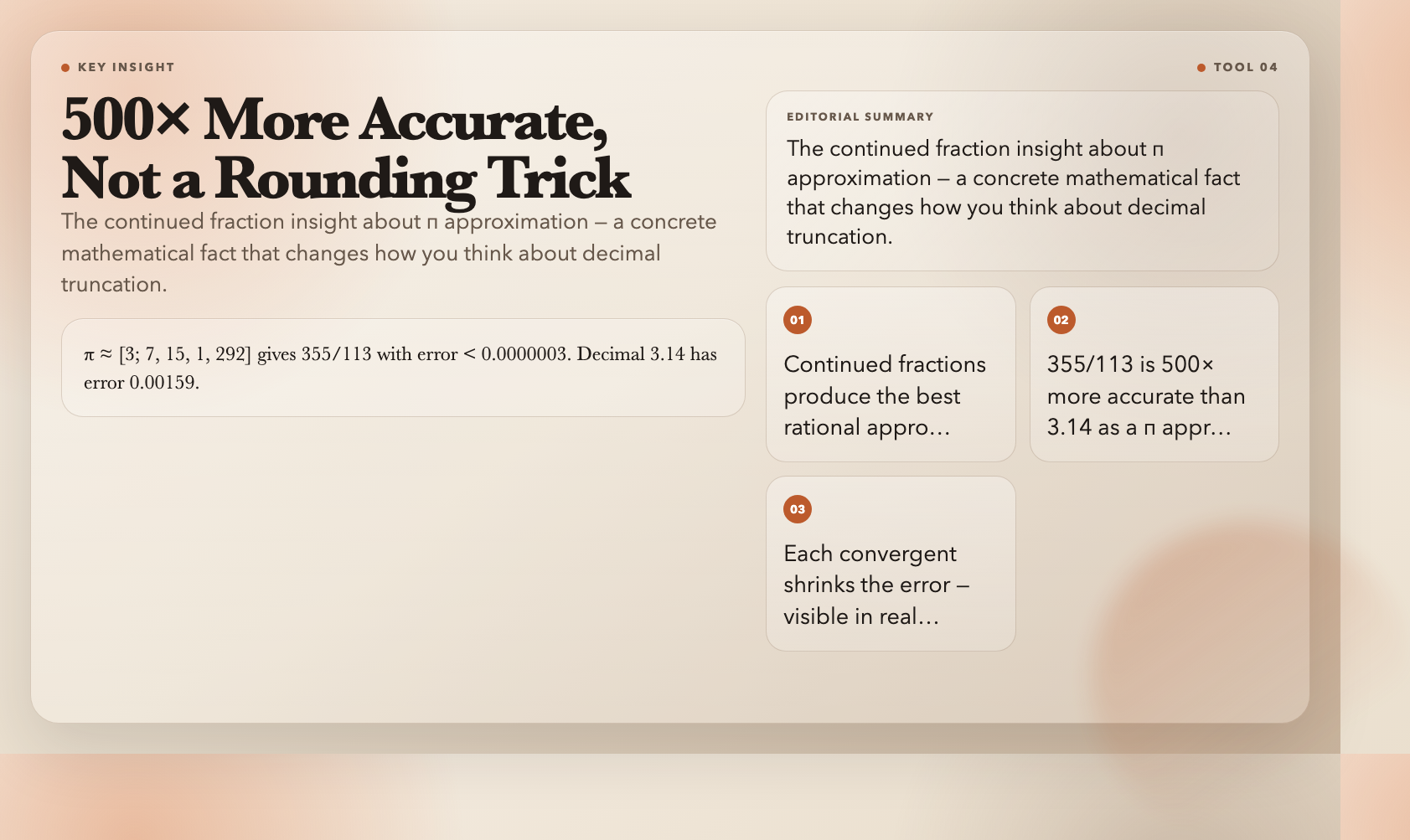
The Continued Fraction Calculator accepts a decimal or fraction, generates the full continued fraction expansion, and shows every convergent with its approximation error at each step. You control how many terms. The convergents are the actual rational numbers being produced — 3/1, 22/7, 333/106, 355/113 — and you watch the error shrink in real time.
This is the tool for teaching why some approximations are genuinely better than others, not just rounding artifacts.
5. Prime Factorization Calculator — The Divisor Map
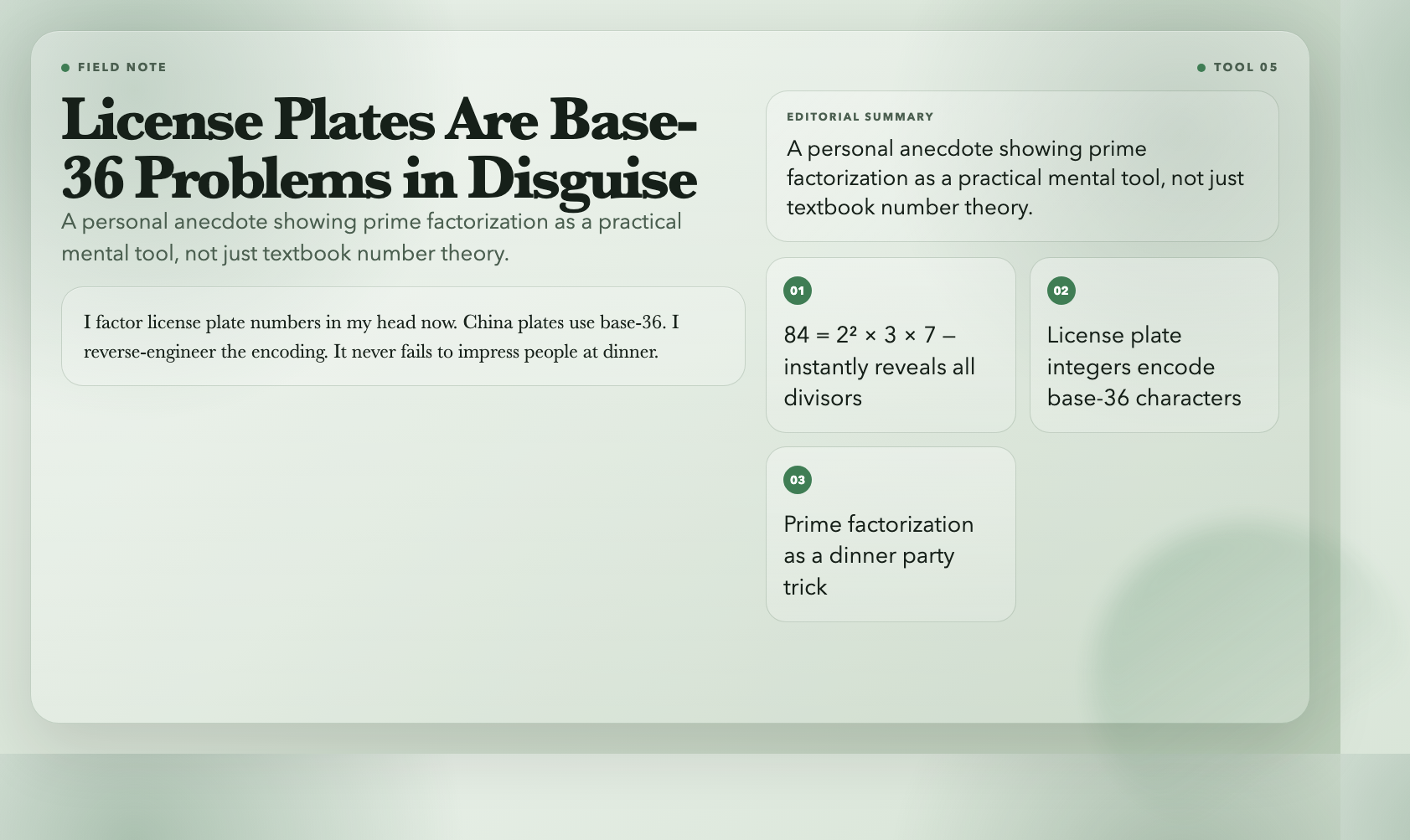
Primes are the atoms of number theory. Factor a number into its primes and you instantly know its divisors, GCF, and LCM. Factor 84 and you get 2² × 3 × 7. That decomposition tells you 84 is divisible by 2, 3, 4, 6, 7, 12, 14, 21, 28, 42 — without checking any of them manually.
The Prime Factorization Calculator returns the complete prime factorization with exponents for any integer. Enter 13195 and it gives you 5 × 7 × 13 × 29 — which Project Euler Problem 3 has been asking for since 2001.
The practical version: I factor license plate numbers in my head now. China plates use a base-36 system (A-Z, 0-9) compressed into integers. When I see a long integer in a parking lot, I can reverse-engineer the plate encoding with prime factorization. It is absurdly specific and it never fails to impress people at dinner.
6. Prime Number Checker — Yes or No, Instantly
Sometimes you do not need the full factorization. You just need a verdict.
The Prime Number Checker answers in milliseconds. Enter a number, get yes or no, and if no, see the smallest divisor that proves it. No explanation of what a divisor is. No unnecessary complexity.
Testing with known primes and composites is a useful programming exercise. Testing with 2^61 – 1 (2305843009213693951) is a better one. It looks prime. It is not — it is divisible by 7,855,071,759. The checker finds the witness instantly. You learn something about Mersenne primes and their divisors without having to derive the factorization yourself.
7. Quadratic & Linear Equation Solver — The Formula, Executed
The quadratic formula is on every student’s tip of tongue until they need it under pressure. The discriminant (b² – 4ac) tells you about the roots, but you still have to calculate it. Under stress, errors happen.
The Quadratic & Linear Equation Solver handles ax² + bx + c = 0 and bx + c = 0 with full working: both roots (real or complex), discriminant value and interpretation, vertex coordinates, and step-by-step derivation.
Last month I used it to debug a parabolic trajectory calculation in a game. My formula was right. My arithmetic was wrong — I had transposed two digits in the determinant. The tool caught the error in 10 seconds and I did not ship a physics bug to production.
8. Perimeter Calculator — The Practical Anchor
Not all math is abstract. A perimeter calculation applies to fence installation, photo border sizing, CSS bounding box calculations, and any scenario where the total edge length of a shape matters.
The Perimeter Calculator handles squares, rectangles, triangles, circles, ellipses, and regular polygons. Pick the shape, input your known values, get the result. It covers the practical end of geometry — the kind of calculation that shows up in design tools, construction, and frontend layout more often than most people expect.
I calculated the perimeter of a hexagonal badge design for a client in under a minute using this tool. The client was impressed with the turnaround. The math was not hard. The tool removed the one place where it could have gone wrong.
The Common Thread
These eight tools eliminate cognitive friction for calculations that are conceptually tractable but computationally tedious. You do not need to memorize the Laplace expansion for matrix inverses to get one. You do not need to know the continued fraction derivation for π to see why 355/113 is a better approximation than 3.14. You do not need to factor 2^61 – 1 by hand to know it is not prime.
Mathematics should be a reliable tool, not a memorization contest. These eight tools treat it that way — and they are all free at ElysiaTools.
Pick one. Use it today. See what changes about how you think about the problems worth solving.