# The Math Behind Every Thought You Have: 3 Interactive Visualizations That Make Neuroscience Make Sense
In 1952, two mathematicians took a giant squid nerve, ran current through it, and found that every thought you have is a differential equation — but they needed a Nobel Prize before anyone believed them. Sodium opens. Potassium follows. A spike travels. You decide. I am describing four equations, and your last decision.
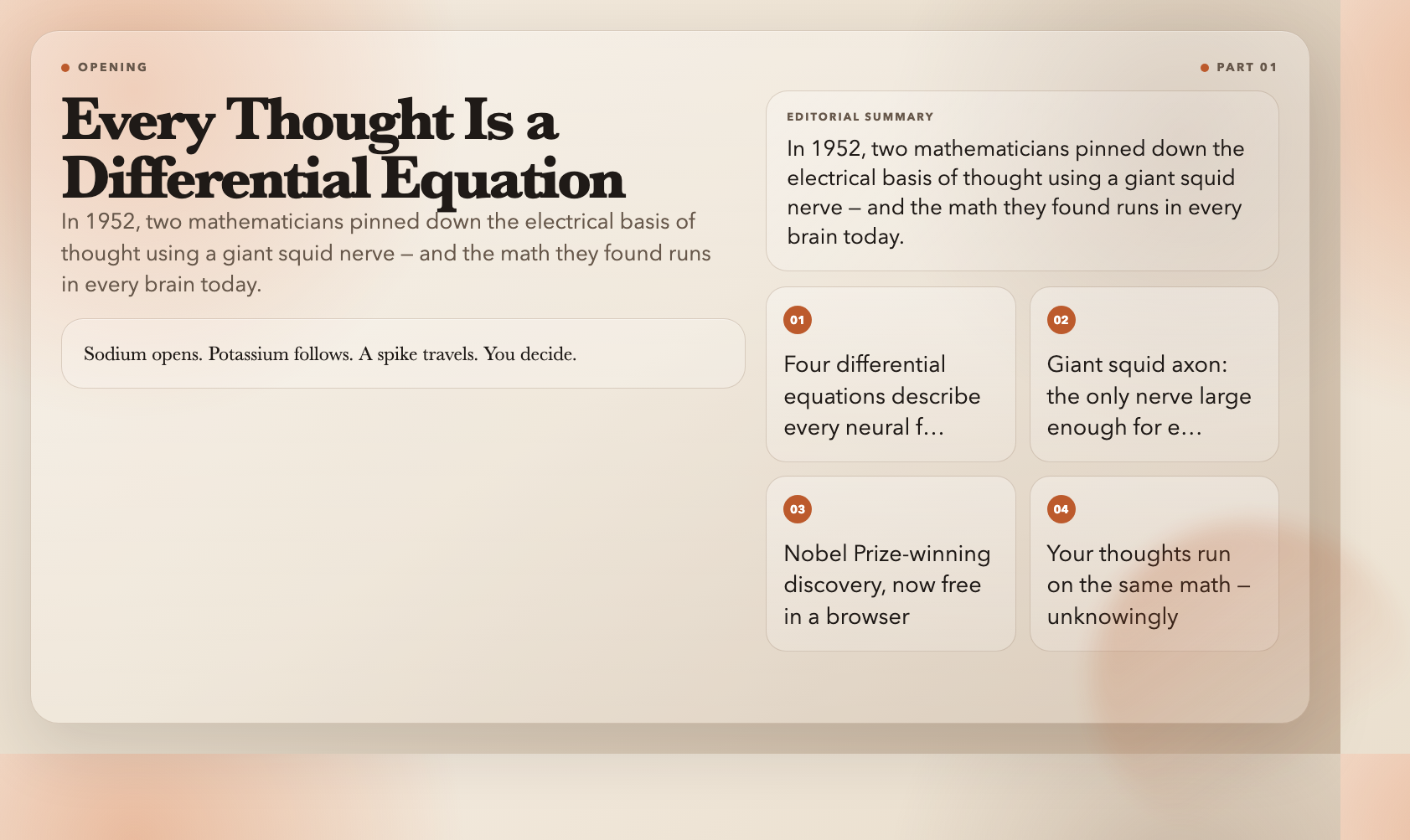
That process follows four differential equations. Two mathematicians cracked it in 1952 using a giant squid axon — the only nerve large enough for electrodes. They won a Nobel Prize. Today, their model runs in a browser tab, and you can reshape every parameter and watch the equations prove themselves in real time.
Every thought you have runs on the same math.
Hodgkin-Huxley Neuron Model: The Four Equations Behind Every Thought
A neuron fires when sodium rushes in and potassium rushes out. What makes this precise is that every step follows mathematical rules.
Three voltage-sensitive gates — named m, h, and n for reasons that belong in a history book — open and close based on the membrane potential at each instant. Each gate’s behavior is a differential equation. Change the sodium conductance, and the entire firing pattern shifts. Change the potassium conductance, and the same thing happens. There are no exceptions. There are only equations.
The Hodgkin-Huxley Neuron Model visualization puts you in control. Move the sliders and watch the action potential waveform change instantly. You become the voltage clamp — minus the squid.
The broader insight: the same equations govern electrical circuits, chemical reactors, and predator-prey population cycles. These four equations are a language. Learn them once, and you can read dozens of different systems.
Perceptron: The Single Neuron That Birthed Modern AI
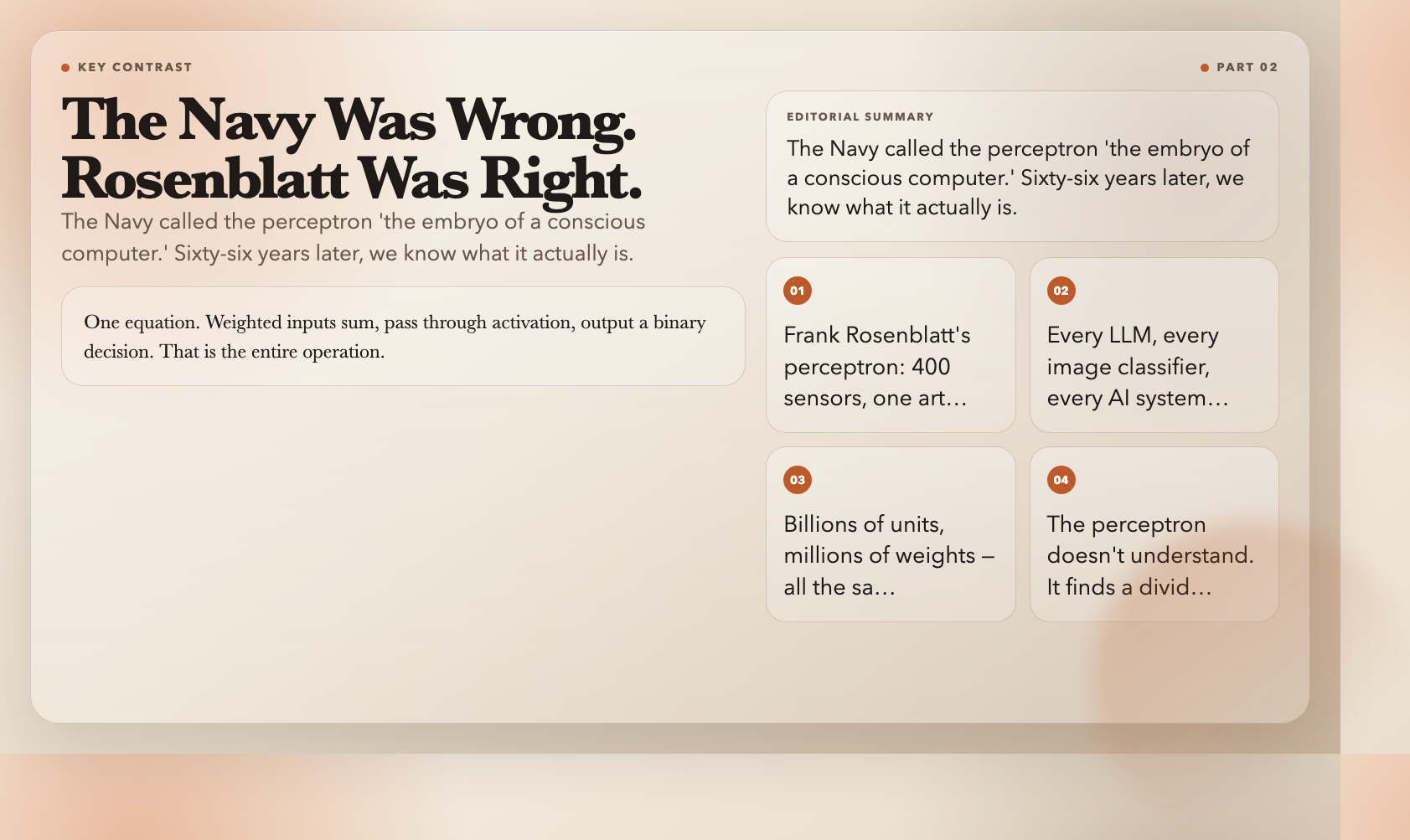
In 1958, Frank Rosenblatt built a machine with 400 light sensors connected to one artificial neuron. It learned to recognize letters. The Navy called it “the embryo of an electronic computer that will be able to walk, talk, see, write, reproduce itself and be conscious.”
The Navy was wrong about consciousness. Rosenblatt was right about everything else.
The Perceptron Neuron visualization shows how it works: weighted inputs sum together, pass through an activation function, and produce a binary output. One equation. That is the entire operation.
Every large language model, every image classifier, every AI system today runs variations of this calculation — billions of units stacked in layers, tuned through millions of examples. Each weight is a number. Each neuron is an equation. Intelligence, in this view, is not mysterious. It is numerical.
The Question Both Models Leave Open
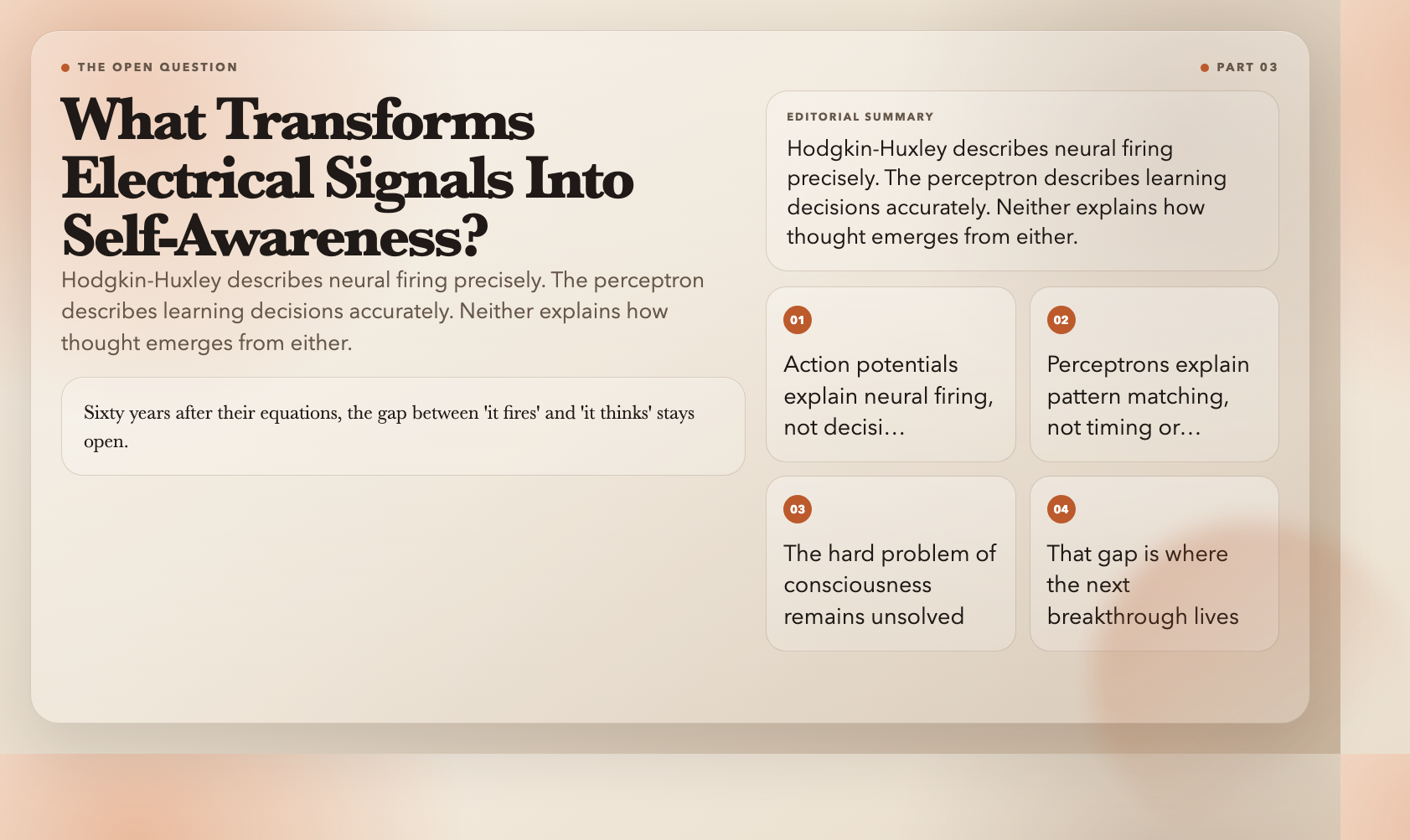
Neither model answers the hard question: how does a thought emerge from their equations?
Hodgkin-Huxley describes neural firing with remarkable accuracy. But a single action potential tells you nothing about decision-making or memory. The distance from “sodium gates opened” to “I decided to order coffee” is enormous.
The perceptron describes how neural networks learn decisions. But it says nothing about timing, context, or motivation — the things that separate human cognition from a pattern-matching algorithm.
What transforms electrochemical signals into self-awareness? Why does identical sensory input produce different perceptions on different days? These questions sit in the space between what the equations describe and what the brain actually does.
Sixty years after Hodgkin and Huxley published their equations, and sixty years after Rosenblatt built his perceptron, the hard problem of consciousness remains unsolved. The models grow more powerful. The gap between “it fires” and “it thinks” stays open. That gap is not a failure of the models. It is a sign that the most interesting questions in neuroscience and AI have not been answered yet. That is where the next breakthrough lives.
These visualizations give you the foundation to understand those questions. That foundation is rarer than it should be.
Run the Models Yourself
No account. No download. No payment. Open the links, change any parameter, watch the graphs update in real time. The mathematics running under every thought you have is one click away. All you have to do is look.
What will you discover when you see the equations behind your own thinking?