Why Magnets Magically Align at a Certain Temperature
In 1920, Wilhelm Lenz handed his student Ernst Ising a problem. Ising was supposed to solve it, publish it, and move on with his career. He did — but the solution went badly wrong, and Ising spent decades regretting his own name attached to it.
The answer to why he was wrong reveals something genuinely strange about how order emerges from nothing — and you can watch it happen right now, for free, in your browser.
The Puzzle Nobody Could Solve
Imagine a chessboard. Each square holds a tiny arrow pointing either up or down. Each arrow interacts only with its immediate neighbors: if two neighboring arrows point the same way, the system gains a little energy; if they disagree, it costs energy. You can also apply an external magnetic field that pushes all arrows to point up or down.
This is the Ising model — the Hamiltonian is clean and simple:
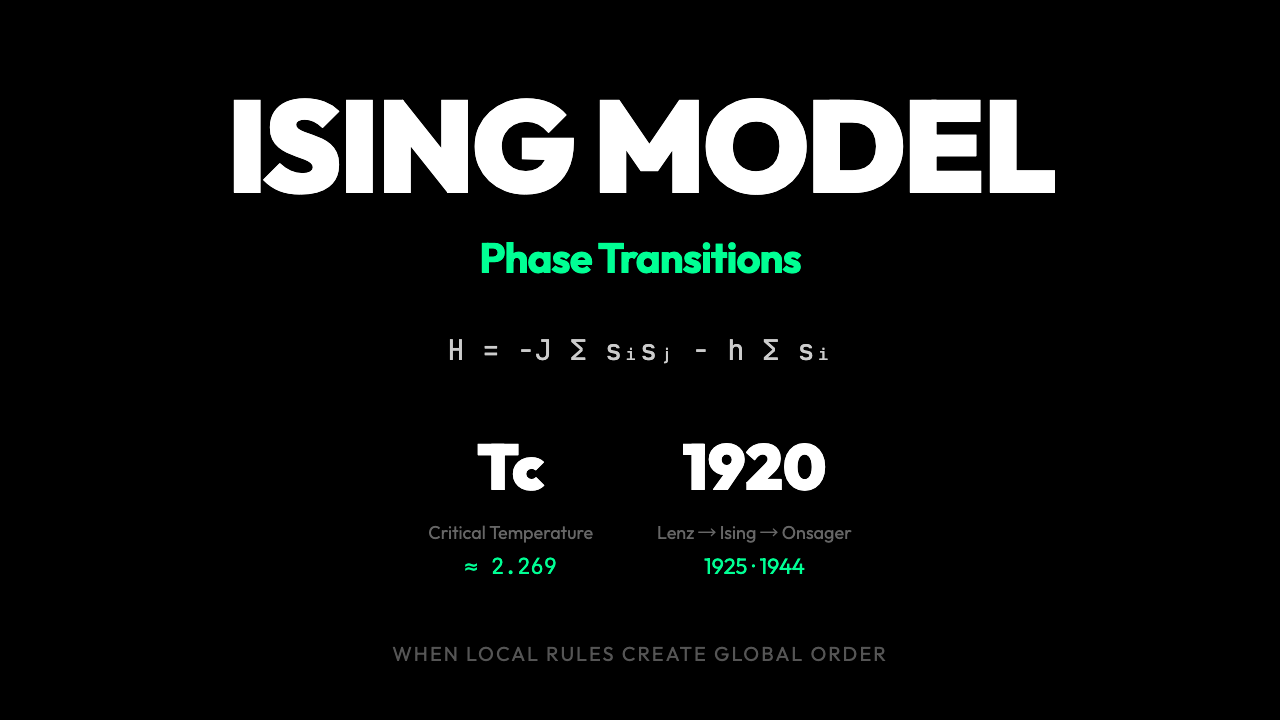
H = −J Σ sᵢsⱼ − h Σ sᵢ
Where J is the coupling between neighbors, h is the external field, and each sᵢ is just +1 (up) or −1 (down).
The question is: at thermal equilibrium, what does the whole system do?
At high temperature, heat dominates. Every arrow flips randomly, buffeted by thermal noise. Neighbor agreements are constantly broken. The system is disordered — physicists call it a paramagnet.
At low temperature, the interaction term dominates. Neighboring arrows want to agree. Large domains of aligned arrows form. The system spontaneously breaks symmetry — it “chooses” a direction even though the physics doesn’t favor either. You get ferromagnetic order.
At some critical temperature Tc, something extraordinary happens. The system sits on a knife-edge between order and disorder. Fluctuations reach all scales simultaneously. A single flip can cascade through the entire lattice. The magnetization drops discontinuously. A phase transition.
This is what Ising was supposed to find.
The Disaster That Made History
In 1925, Ising solved the one-dimensional version of his own model. He found no phase transition. As temperature increases, the system smoothly goes from ordered to disordered. No discontinuity. No critical point.
Ising reasonably concluded the model wasn’t interesting in higher dimensions either. He published it, left physics, and taught high school math in Germany for the rest of his career.
He was almost completely wrong.
Twenty years later, in 1944, Lars Onsager solved the two-dimensional Ising model with zero external field. He found a genuine phase transition with an exact critical temperature:
Tc = 2/ln(1 + √2) ≈ 2.269
The magnetization doesn’t drop smoothly. It disappears discontinuously at Tc. The specific heat blows up with a sharp cusp — the first exact calculation of a critical exponent in statistical mechanics.
Onsager’s solution was so difficult that only a handful of physicists in the world could verify it. It remains one of the most celebrated exact results in theoretical physics.
And Ising — who died in 1998, still a high school teacher in Germany — never saw any of it.
Why It Matters Beyond Magnets
The Ising model’s real genius is that the lattice doesn’t have to be spins. It can be anything with two states and short-range interactions:
– Epidemiology: Each site is healthy or infected; neighbors transmit disease
– Opinion dynamics: Each person votes Yes or No; neighbors influence each other
– Neuroscience: Each neuron fires or doesn’t; connected neurons couple
– Urban growth: Each cell is developed or empty; development attracts development
– Stock markets: Each trader is bullish or bearish; social influence propagates
This is why the Ising model is taught in departments from physics to economics to sociology. It is the minimal model for collective behavior emerging from local rules.
At the critical point, something remarkable happens: long-range correlations emerge from purely short-range interactions. Flip one spin at Tc, and the effect propagates across the entire system. This is the fingerprint of a phase transition — the same phenomenon behind:
– The sudden onset of superconductivity
– The tipping point in a viral social media cascade
– The moment a cooling material becomes magnetic
Watch It Happen Right Now
Head over to the Ising Model Visualization on ElysiaTools and run three experiments:
1. Low temperature (T ≈ 1.5)
Start with a random configuration and watch. Large domains of aligned spins form. This is spontaneous symmetry breaking in action.
2. The critical point (T ≈ 2.27)
The interesting things happen here. Large clusters of same-color spins form and dissolve. The system can’t decide between order and disorder — and it takes a long time to reach equilibrium. Physicists call this critical slowing down, and it’s the most fascinating regime to watch.
3. High temperature (T ≈ 4.0)
The system stays in perpetual disorder. No large domains survive. Each spin is effectively independent of its neighbors at large scales.
You can also adjust the coupling constant J (swap between ferromagnetic J>0 and antiferromagnetic J<0 for stripe patterns) and the external field h to see how the system responds.
The visualization uses the Metropolis-Hastings algorithm — the same Monte Carlo method that underlies computational physics, materials science, and large portions of machine learning.
The Model That Outlived Its Creator
The Ising model is exactly solvable in 2D — Onsager solved it in 1944 with a 70-page proof that remains one of the hardest pieces of mathematics in physics. But the 3D case — which is what real magnetic materials actually do — remains unsolved. Not unsolved in the sense that nobody has tried. Unsolved in the sense that every serious attempt breaks something fundamental.
This gap between 2D and 3D is not a minor technical gap. It is the gap between mathematical tractability and physical reality. And in that gap live most of the interesting unsolved problems in statistical mechanics: superconductivity, the liquid-gas critical point, the phase behavior of complex fluids.
The Ising model quietly colonized half of science while its creator taught arithmetic to teenagers. Epidemiologists use it to model disease spread. Economists use it to model market tipping points. Neuroscientists use it to model cortical state transitions. In each case, the question is the same: given only local rules, when does global order emerge?
That’s the question Ernst Ising was handed in 1920. He answered it too narrowly. The model answered it far more broadly than he ever imagined.
Try the visualization and run through the three temperature regimes. Then ask yourself: what other systems in my life are sitting right at their critical point — one small push away from complete reorganization?
Try it: Ising Model Visualization — Phase Transitions in Statistical Mechanics
Tags: #physics #statistical-mechanics #phase-transition #ising-model #visualization