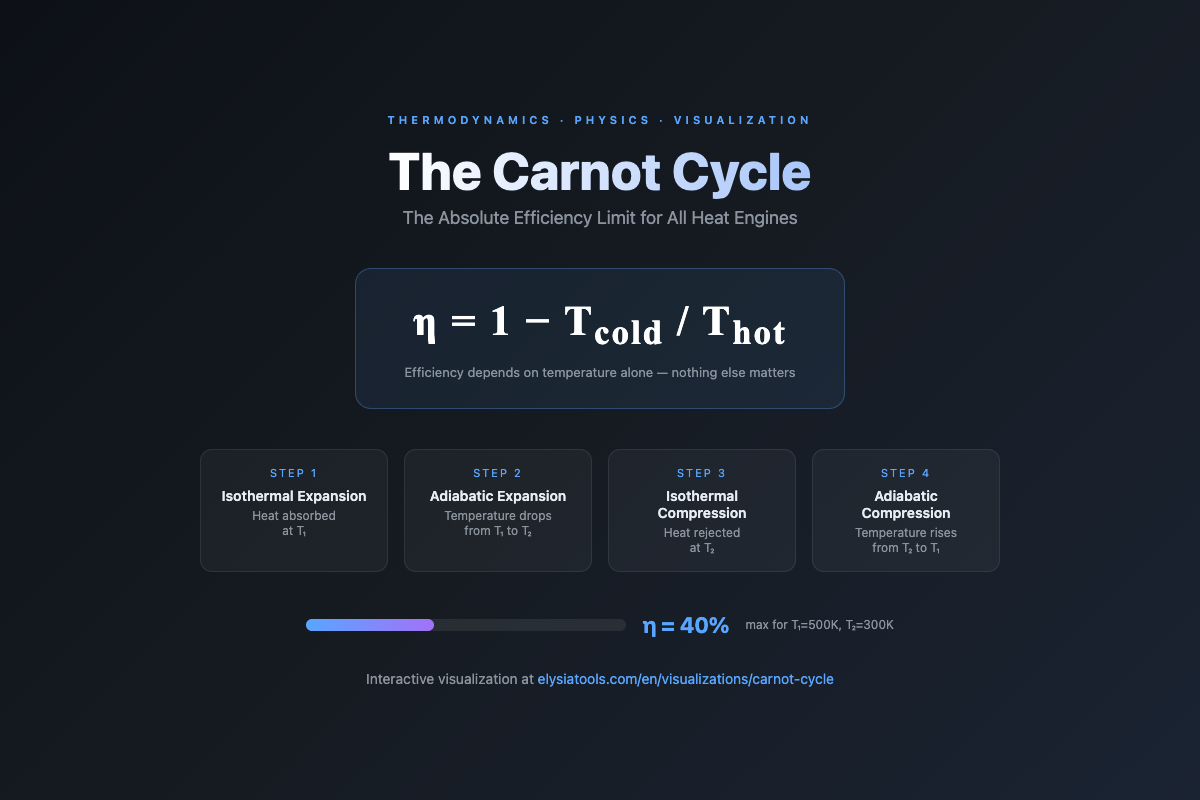
In 1824, a 28-year-old French physicist named Sadi Carnot asked a deceptively simple question: *what is the most efficient possible heat engine?*
Not a better engine. Not a more practical one. The *most efficient* one — in principle, given the fundamental laws of physics.
His answer changed thermodynamics forever. And strangely, it still sets limits on everything from coal-fired power plants to the refrigeration in your kitchen to the hypothetical engines of an advanced civilization.
Here’s the surprising part: the maximum efficiency isn’t determined by engineering. It’s determined by temperature alone.
The Carnot Efficiency Formula
Where temperatures are in Kelvin. That’s it.
If your hot reservoir is 500K (227°C) and your cold reservoir is 300K (27°C), the maximum possible efficiency is:
No matter what fuel you burn. No matter what materials you use. No matter how cleverly you engineer the valves, pistons, and heat exchangers. 40% is your absolute ceiling — and that’s only if you build a perfectly reversible engine, which is itself impossible.
This is Carnot’s theorem: *all heat engines operating between the same two temperatures are limited by the same theoretical maximum, and reversible engines achieve it.*
The practical implication: the only way to push efficiency higher is to increase the temperature difference between your hot source and cold sink. Raise the hot side, lower the cold side, or both. Everything else is noise.
The Cycle in Four Steps
The Carnot cycle consists of four reversible processes — two isothermal (constant temperature) and two adiabatic (no heat exchange). On a pressure-volume (P-V) diagram, it looks like a rounded rectangle:
        ┌───────────────────────┐
        │                       │
   P    │   1 → 2: Isothermal  │   Hot reservoir T₁
        │      (Heat in)       │
        │                       │
        │   2 → 3: Adiabatic   │
        │                       │
        │   3 → 4: Isothermal  │   Cold reservoir T₂
        │      (Heat out)      │
        │                       │
        │   4 → 1: Adiabatic   │
        └───────────────────────┘
              V₁    V₃    V₂    V₄
Step 1 — Isothermal Expansion (Heat Absorption): The gas touches the hot reservoir at T₁. It expands, absorbing heat Q₁, doing work. Temperature stays constant because the heat inflow exactly balances the work output.
Step 2 — Adiabatic Expansion: The gas is isolated. It continues expanding, consuming its own internal energy. Temperature drops from T₁ to T₂. No heat enters or leaves.
Step 3 — Isothermal Compression (Heat Rejection): The gas touches the cold reservoir at T₂. It’s compressed, rejecting heat Q₂ to the cold side. Temperature stays at T₂.
Step 4 — Adiabatic Compression: The gas is isolated again. Compression raises its temperature from T₂ back to T₁. No heat exchange.
The net work done is the area enclosed by the curve: W = Q₁ − Q₂. The efficiency is W/Q₁.
Why 40% Sounds Low — But Is Actually Devastating
A modern coal power plant like the Rankine-cycle units common in the US operates at 33–42% efficiency. Mitsubishi’s latest combined-cycle gas turbine systems (the M501JAC) hit 64% — still nowhere near 100%, and that ceiling is mathematically guaranteed by Carnot’s equation. Your car’s gasoline engine manages 25–30% on a good day. The diesel engine in a container ship: around 50%.
All of them are losing more energy to heat than they convert to work.
And here’s the thing: the heat they reject has to go somewhere. The second law of thermodynamics doesn’t just limit efficiency — it mandates that waste heat must be expelled to a colder reservoir. You can’t recycle it. You can’t make it disappear. Entropy always increases.
This is why large power plants need cooling towers capable of handling gigawatts of rejected heat. It’s why car engines require radiators and can’t be made 100% efficient no matter the design. It’s why there is no such thing as a 100% efficient engine — not now, not ever, not with any future technology.
Carnot proved it mathematically in 1824, working from first principles and thought experiments, years before Kelvin formalized the concept of absolute temperature and decades before Clausius gave the second law its standard formulation. He was doing physics with pen and paper that matched what engineers would later discover empirically.
The Entropy Connection
Carnot’s cycle also provides one of the cleanest illustrations of entropy in physics.
For a reversible Carnot cycle, the heat transferred at each reservoir divided by the temperature is equal:
This means the system’s total entropy change over a complete cycle is zero. But the *universe’s* entropy still increases: the hot reservoir loses entropy Q₁/T₁, the cold reservoir gains entropy Q₂/T₂, and since T₂ < T₁, the cold side gains more entropy than the hot side loses.
The net result is a positive entropy production — exactly as the second law requires. The Carnot cycle traces a path where the system’s entropy returns to its starting point, but the universe as a whole is left slightly more disordered.
What You Can Actually Do With This
The Carnot Cycle Visualization lets you manipulate the four key parameters:
– Hot temperature (T₁): 300K to 800K — raise it to increase efficiency
– Cold temperature (T₂): 200K to 500K — lower it to increase efficiency
– Working substance: monatomic, diatomic, or polyatomic gas — changes the specific heat ratio γ
– Expansion ratio: controls how much the gas expands
As you adjust these, watch the P-V diagram update in real time and the efficiency η recalculate instantly. You’ll notice that no matter what gas type you choose, the efficiency formula η = 1 − T₂/T₁ gives the same result — the working substance genuinely doesn’t matter, just as Carnot claimed.
This is a beautiful demonstration of why the formula is so powerful: it’s completely agnostic to the engineering details. Raise the furnace temperature, lower the cooling water temperature, and you get efficiency gains — regardless of whether you’re running a 19th-century steam engine or a 21st-century gas turbine.
Why This Matters Beyond Textbooks
The Carnot limit shows up in places you might not expect:
– Refrigerators and heat pumps are essentially Carnot engines run in reverse. Their coefficient of performance is also temperature-limited: a refrigerator pulling heat from a 250K freezer compartment and dumping it into a 300K room has a maximum COP of T_cold/(T_hot − T_cold) = 250/50 = 5. No engineering can beat it.
– Nuclear power plants are constrained by the temperature limits of their fuel cladding. Even with unlimited reactor fuel, you can’t exceed the Carnot ceiling without melting the reactor.
– Carnot’s reasoning inspired Kelvin’s formulation of the second law, Clapeyron’s development of the concept of entropy, and ultimately the entire field of statistical mechanics. The cycle is a gedankenexperiment that yields fundamental truth.
– Future energy limits for any civilization are ultimately Carnot limits. This is why theoretical megastructures like Dyson spheres matter: they allow you to tap into a hotter star (raising T_hot) while rejecting waste heat to cold space (lowering T_cold), pushing efficiency toward 1.
The Carnot efficiency formula is one of those results that feels almost too clean to be true:
> Every heat engine, regardless of design, is fundamentally limited by the temperatures of its hot and cold reservoirs. Nothing can surpass the Carnot limit. Nothing ever will.
But understanding this limit does more than just tell engineers when to stop pushing — it reveals *why* the universe charges an entropy tax on every energy transformation. The second law isn’t a design flaw. It’s the price of doing business in a world where heat always flows downhill and reversible processes are idealizations that no real machine can achieve.
The interactive Carnot cycle visualization lets you feel this in your hands. Drag the temperature sliders, adjust the expansion ratio, switch between monatomic and diatomic gases. Watch the P-V diagram trace the four processes in real time. The formula η = 1 − T₂/T₁ never breaks. No matter what you try, you cannot beat it — and after five minutes of playing, you won’t want to. Because the insight isn’t just that the limit exists. It’s that it depends on *nothing* except two temperatures. That’s the kind of truth that doesn’t go stale.