8 Free Fitness Calculators That Actually Work in 2026
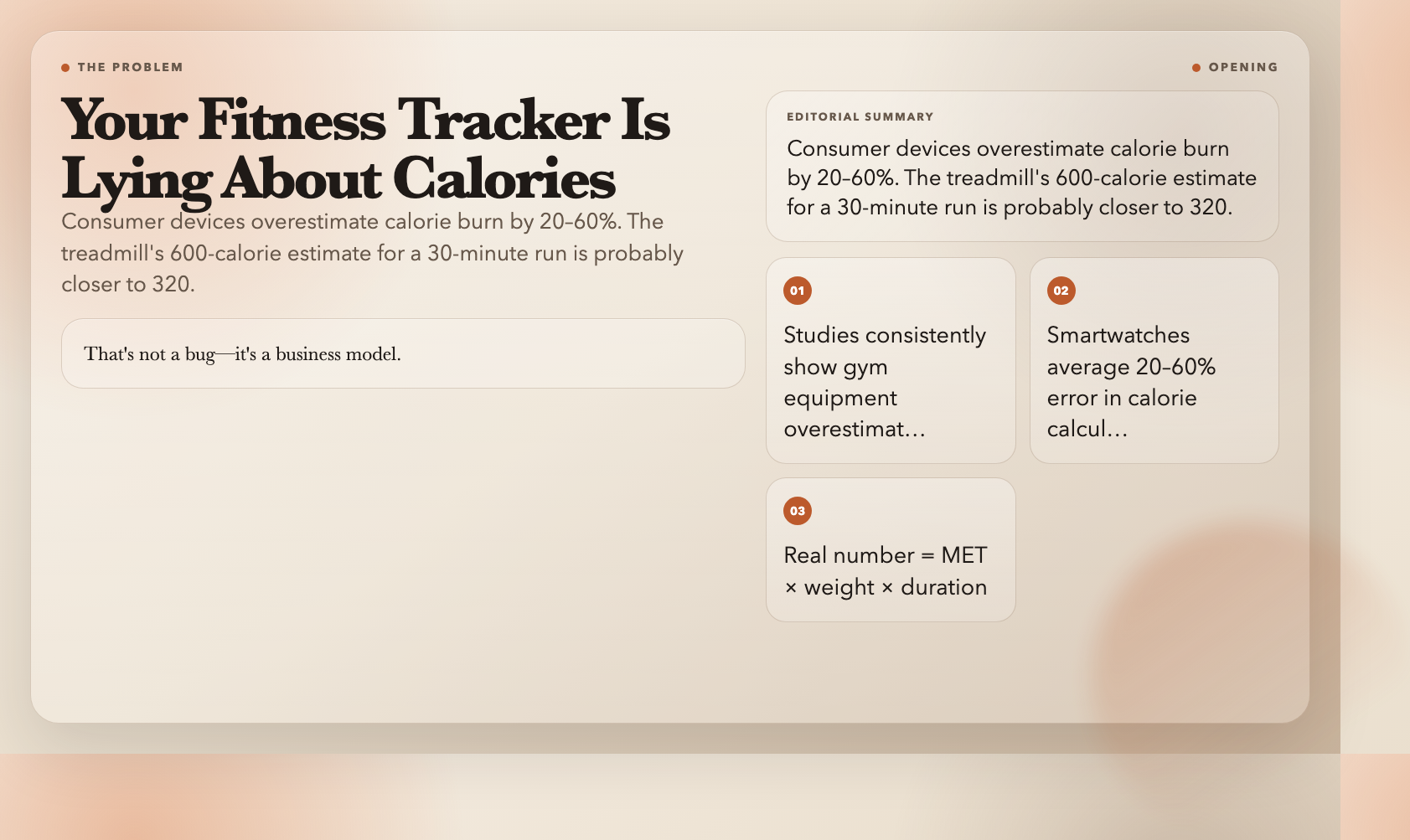
Your fitness tracker says you burned 600 calories on a 30-minute run. The treadmill says 400. Your smartwatch split the difference at 500. The real number? Probably closer to 320. Every credible study on exercise calorie estimates shows consumer devices err by 20–60%. That’s not a bug—it’s a business model.
The tools that actually work are free, take 60 seconds to use, and are built on peer-reviewed formulas. Eight of them sit at ElysiaTools. Here’s what each one does and when to use it.
—
#
1. BMI Calculator
BMI divides your weight in kilograms by the square of your height in meters. It’s not body fat measurement—it’s a population-level screening tool. But for a 30-second self-assessment, it correlates surprisingly well with health risk.
What it does:
The BMI Calculator accepts weight, height, age, and gender. It returns your BMI score, category (Underweight / Normal / Overweight / Obese), and an ideal weight range for your height.
| Category | BMI Range |
|———-|———–|
| Underweight | < 18.5 |
| Normal | 18.5 – 24.9 |
| Overweight | 25 – 29.9 |
| Obese | ≥ 30 |
Limitation: A 100kg powerlifter with 12% body fat scores “obese” on BMI. Muscle is denser than fat. Use it as a screening flag, not a diagnosis.
—
#
2. Target Heart Rate Calculator
Your max heart rate is not “220 minus your age.” That’s the Fox formula from 1970—a rough average that overestimates max HR for fit people and underestimates it for older adults. The Tanaka formula (208 − 0.7 × age) is more accurate for adults over 30.
What it does:
The Target Heart Rate Calculator calculates your max HR using your choice of three formulas, then partitions it into five training zones:
| Zone | % Max HR | Purpose |
|——|———-|———|
| 1 | 50–60% | Warm-up, cool-down, active recovery |
| 2 | 60–70% | Fat burning, aerobic base building |
| 3 | 70–80% | Cardiovascular endurance |
| 4 | 80–90% | Lactate threshold, speed work |
| 5 | 90–100% | VO2 max intervals, elite athletes only |
If you input your resting heart rate, the Karvonen formula gives you heart rate reserve (HRR)-based zones, which are more accurate for people with high fitness or on beta-blockers.
When to use it: Before starting any structured training plan. Training in zone 2 when you think you’re in zone 3 is one of the most common training errors in endurance sports.
—
#
3. Calorie Burned Calculator
The treadmill’s calorie estimate is a joke. Studies show gym equipment overestimates actual expenditure by 30–50%. The Calorie Burned Calculator uses MET (Metabolic Equivalent of Task) values from the Compendium of Physical Activities—a research-standard database with measured energy costs for hundreds of activities.
The formula:
Calories burned = MET × weight (kg) × duration (hours)
Real example: A 75kg person cycling moderately for 45 minutes burns approximately 7 METs × 75 × 0.75 = 394 calories. The gym bike might say 650.
When to use it: Building a weight loss nutrition plan. To lose 0.5 kg per week, you need a daily deficit of ~500 calories. If you don’t know what you’re actually burning, you’re guessing—and most people eat back 60–80% of “exercise calories” because they overestimate what they burned.
—
#
4. Daily Calorie Needs Calculator
Your body burns energy even when you’re doing nothing. That’s BMR (Basal Metabolic Rate)—the calories your organs require to function. Multiply BMR by an activity multiplier and you get TDEE (Total Daily Energy Expenditure): the real number of calories you burn in a day.
What it does:
The Daily Calorie Needs Calculator uses the Mifflin-St Jeor equation (validated against indirect calorimetry) to calculate BMR, applies your activity level, then adjusts for your goal.
Example: A 35-year-old male, 80kg, 178cm, moderate exercise 3–4 days/week:
– BMR: 1,790 cal
– TDEE: 2,775 cal
– Weight loss (−0.5 kg/week): ~2,275 cal/day
It also breaks down macros: 30% protein (180g), 40% carbs (227g), 30% fat (75g).
When to use it: Any time you start a diet. Most people underestimate their TDEE by 20–30%, which means they’re eating at maintenance while “cutting.”
—
#
5. VO2 Max Calculator
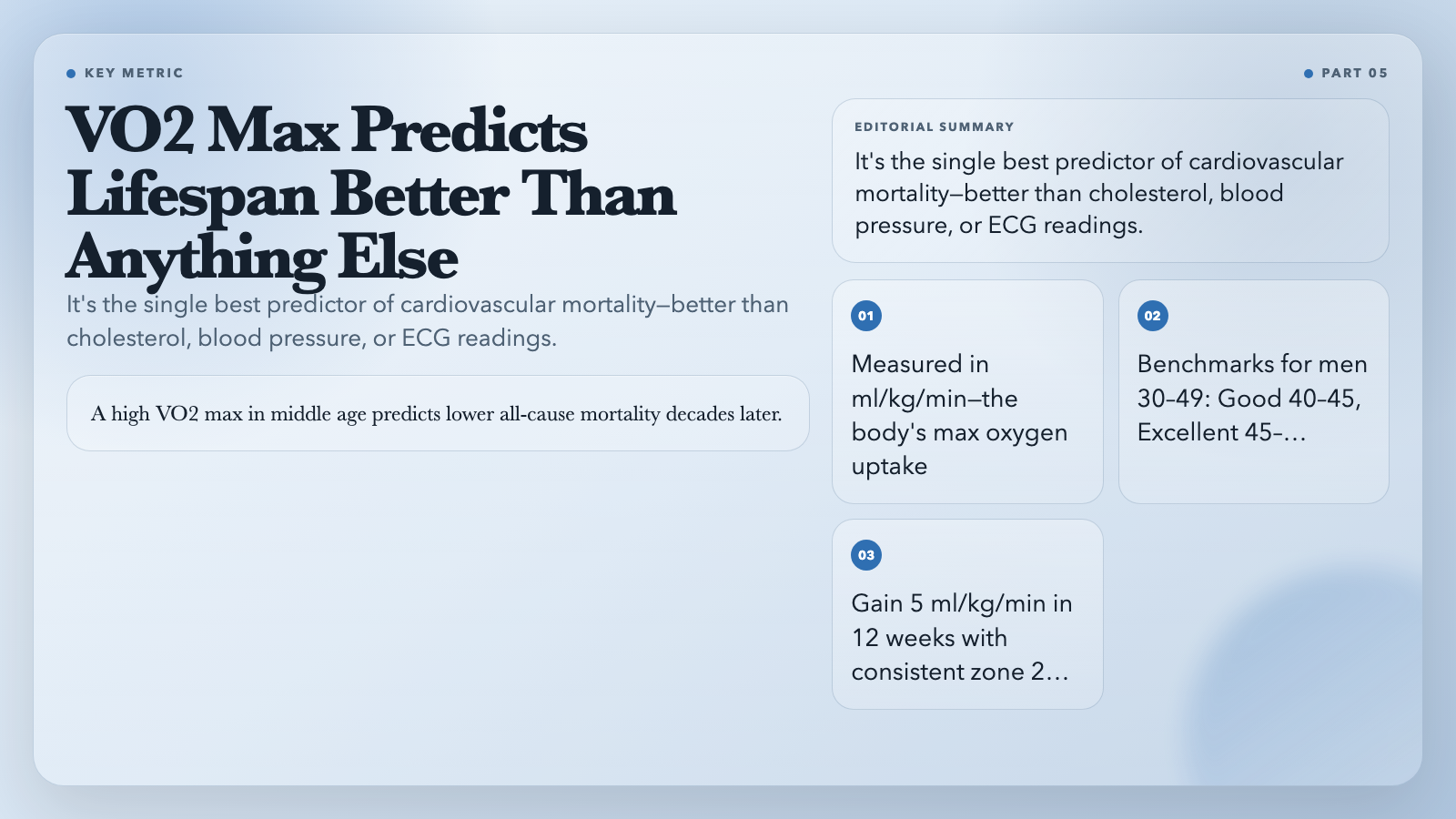
VO2 max is the maximum rate at which your body can consume oxygen during intense exercise—measured in milliliters of oxygen per kilogram of body weight per minute (ml/kg/min). It’s the single best predictor of cardiovascular mortality, better than cholesterol panels, blood pressure, or ECG readings. A high VO2 max in middle age predicts lower all-cause mortality decades later.
What it does:
The VO2 Max Calculator accepts three test types:
1. Resting HR method — Enter resting heart rate, age, gender. Uses the Uth-Sørensen formula. Good for anyone who can reliably measure resting HR.
2. Rockport 1-Mile Walk — Walk 1 mile as fast as possible (no running). Record time and post-exercise heart rate. Ideal for beginners or returning exercisers.
3. 1.5 Mile Run — Run 1.5 miles as fast as possible. Best for runners with a baseline fitness level.
Benchmarks for men aged 30–49:
| Level | VO2 Max (ml/kg/min) |
|——-|———————|
| Poor | < 35 |
| Fair | 35–40 |
| Good | 40–45 |
| Excellent | 45–50 |
| Superior | 50+ |
When to use it: Baseline assessment and every 8–12 weeks. A gain of 5 ml/kg/min in an untrained individual over 12 weeks is realistic with consistent zone 2 training.
—
#
6. Running Pace Calculator
Pacing is the skill that separates a good runner from a great one. Run too hard in a training run and you accumulate fatigue instead of fitness. Run too easy and you’re leaving adaptation on the table.
What it does:
The Running Pace Calculator operates in two modes:
– Pace from Time: Input a distance and finish time, get your pace per km and mile
– Time from Pace: Input a distance and target pace, get your finish time
It also projects race times across standard distances:
| Distance | Projected from 5:30/km pace |
|———-|——————————-|
| 5K | 27:30 |
| 10K | 55:00 |
| Half Marathon | 1:56:28 |
| Marathon | 3:52:55 |
When to use it: Before every training run and race. If you’re targeting a 1:25 half marathon, your zone 2 training pace should be 6:00–6:15/km—not whatever “feels comfortable” on the day.
—
#
7. Protein Calculator
The RDA for protein is 0.8 g/kg body weight—designed to prevent deficiency, not optimize health or performance. Research consistently shows 1.2–2.2 g/kg is superior for muscle protein synthesis, body recomposition, and preserving lean mass during caloric restriction.
What it does:
The Protein Calculator takes weight, activity level, and goal, then calculates your target intake:
| Activity Level | Goal | Grams per kg/day |
|—————-|——|—————–|
| Sedentary | Maintain | 0.8 |
| Moderate exercise | Maintain | 1.2 |
| Strength training | Build muscle | 1.6–1.8 |
| Fat loss | Preserve muscle | 1.8–2.2 |
| Endurance athlete | Support recovery | 1.4–1.6 |
It also distributes your protein across 4 meals (optimal for absorption rates) and lists food sources to hit your target.
When to use it: Any time you change your training or body composition goal. Protein is the most satiating macronutrient and the only one with a clear “more is better up to a point” dose-response curve for active individuals.
—
#
8. Body Fat Calculator (US Navy)
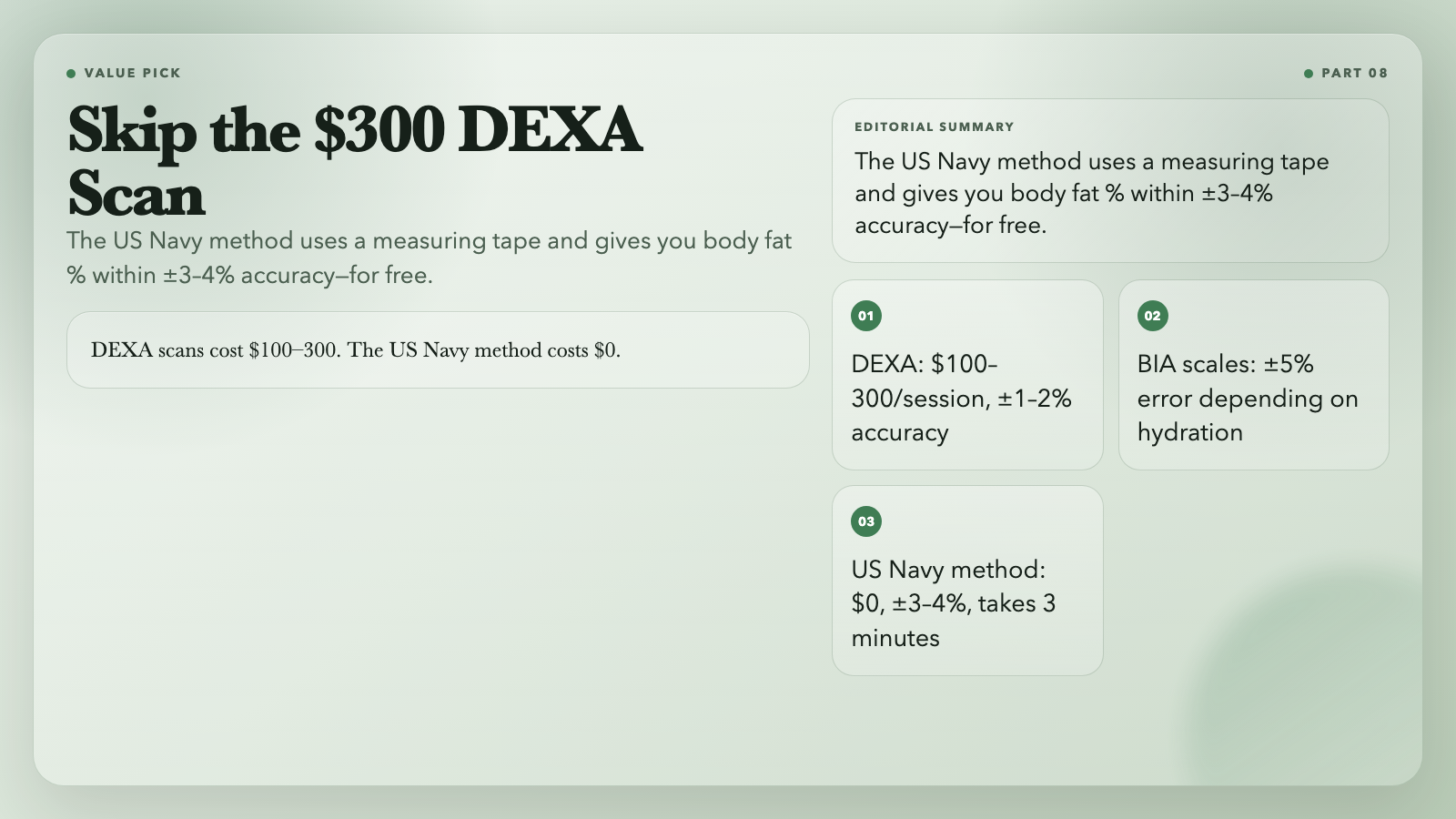
DEXA scans cost $100–300 per session. BIA scales are +/- 5% depending on hydration. Hydrostatic weighing requires getting wet. The US Navy method costs $0 and requires a measuring tape.
What it does:
The Body Fat Calculator (US Navy) uses circumference measurements in the US Navy formula:
– Men: neck + waist circumference, height
– Women: neck + waist + hip circumference, height
It returns body fat percentage, category, and estimated fat mass and lean mass.
Categories (men):
| Category | Body Fat % |
|———-|———–|
| Essential fat | < 6% |
| Athletes | 6–14% |
| Fitness | 14–18% |
| Average | 18–25% |
| Obese | > 25% |
Accuracy: ±3–4% for most people. Error increases with very high or very low body fat percentages.
When to use it: Monthly tracking during body recomposition. Weight is meaningless if you’re losing fat and gaining muscle simultaneously—the scale stalls but your body fat is dropping.
—
#
What to Track and When
| Goal | Tools to Use | Retest Frequency |
|——|————-|—————–|
| Weight loss | Calorie Needs, Calorie Burned | Weekly weigh-in + daily calorie log |
| Build aerobic base | Target HR, VO2 Max | Every 8 weeks |
| Build muscle | Protein Calculator, Body Fat | Every 4 weeks (body fat), daily (protein log) |
| Run faster | Running Pace, Target HR | Every 2–4 weeks |
| General health screening | BMI, Body Fat | Every 3–6 months |
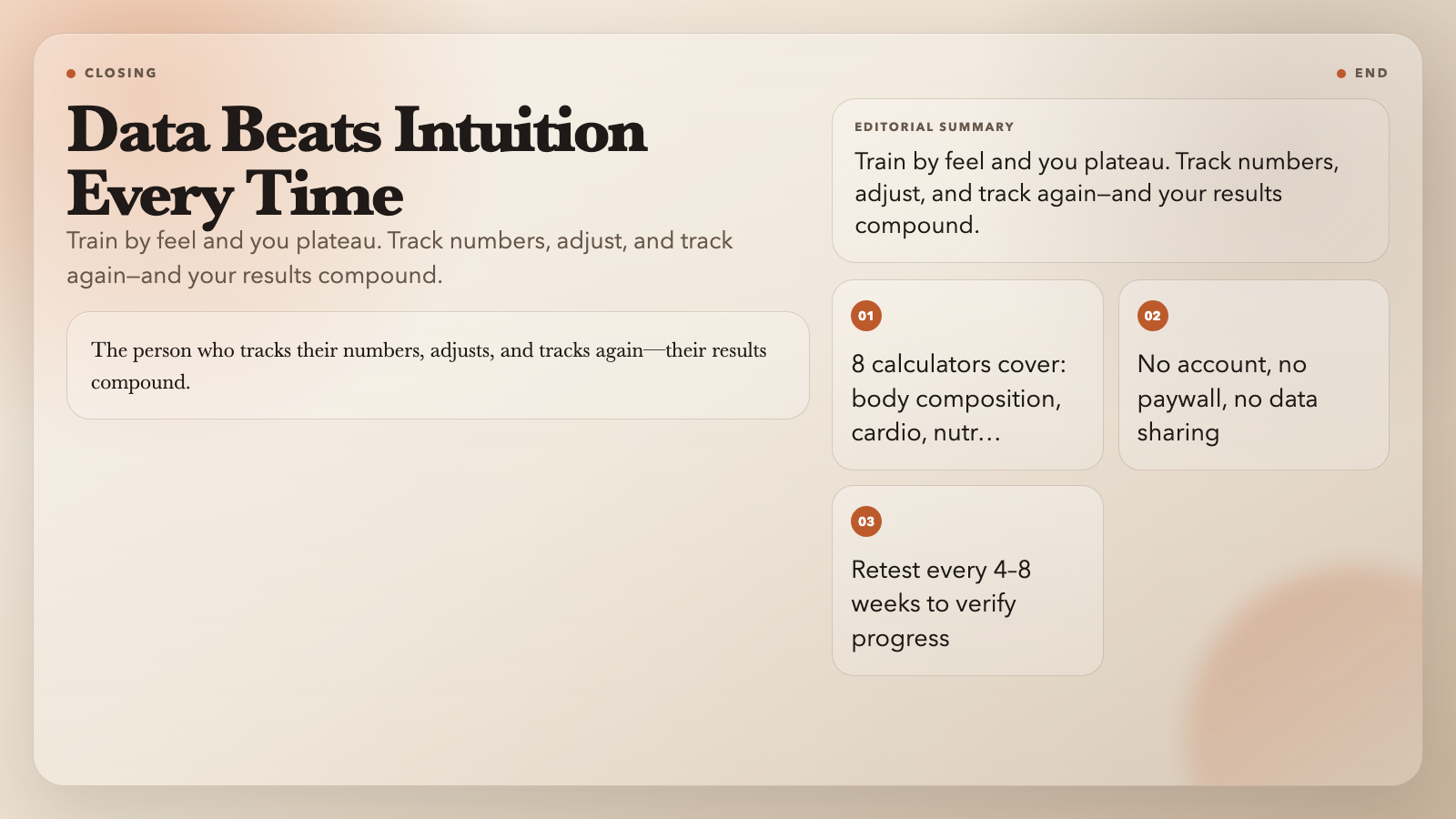
These eight calculators share one trait: they replace opinion with measurement. The person who trains by feel and eats by habit gets the same results year after year. The person who tracks their numbers, adjusts, and tracks again—their results compound.
Bookmark ElysiaTools. No account required. No paywall. Pick one calculator that matches your current goal, run the numbers today, and check back in 4–8 weeks to see if the numbers moved.