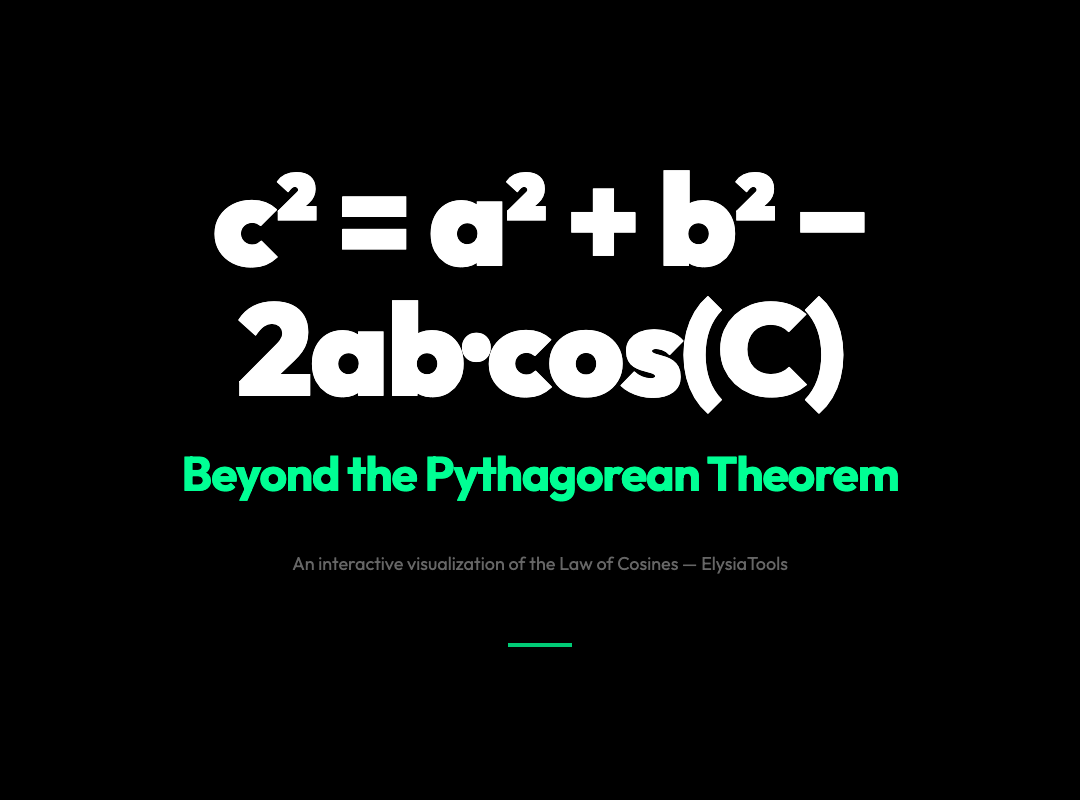
The One Triangle Formula You Learned in School Was Just a Special Case
The Pythagorean Theorem haunted middle schoolers for 2,500 years. a² + b² = c². Right angle. 3-4-5 triangle. It lodged itself in memory because it’s elegant, easy to check with graph paper, and works — for right triangles.
The catch: almost no triangles in the real world cooperate.
Bridges don’t meet the ground at 90 degrees. GPS satellites don’t orbit in right triangles. Game engines don’t calculate collisions only inside right-angled boxes. The world runs on slanted, messy, non-right geometry.
The tool that handles reality is the Law of Cosines. Pythagoras’s famous formula is merely its special case.
The Formula That Generalizes Everything
The Law of Cosines states:
c² = a² + b² − 2ab·cos(C)
Three sides, one angle, one equation. Solve for the missing piece.
Here’s the part that makes mathematicians smile
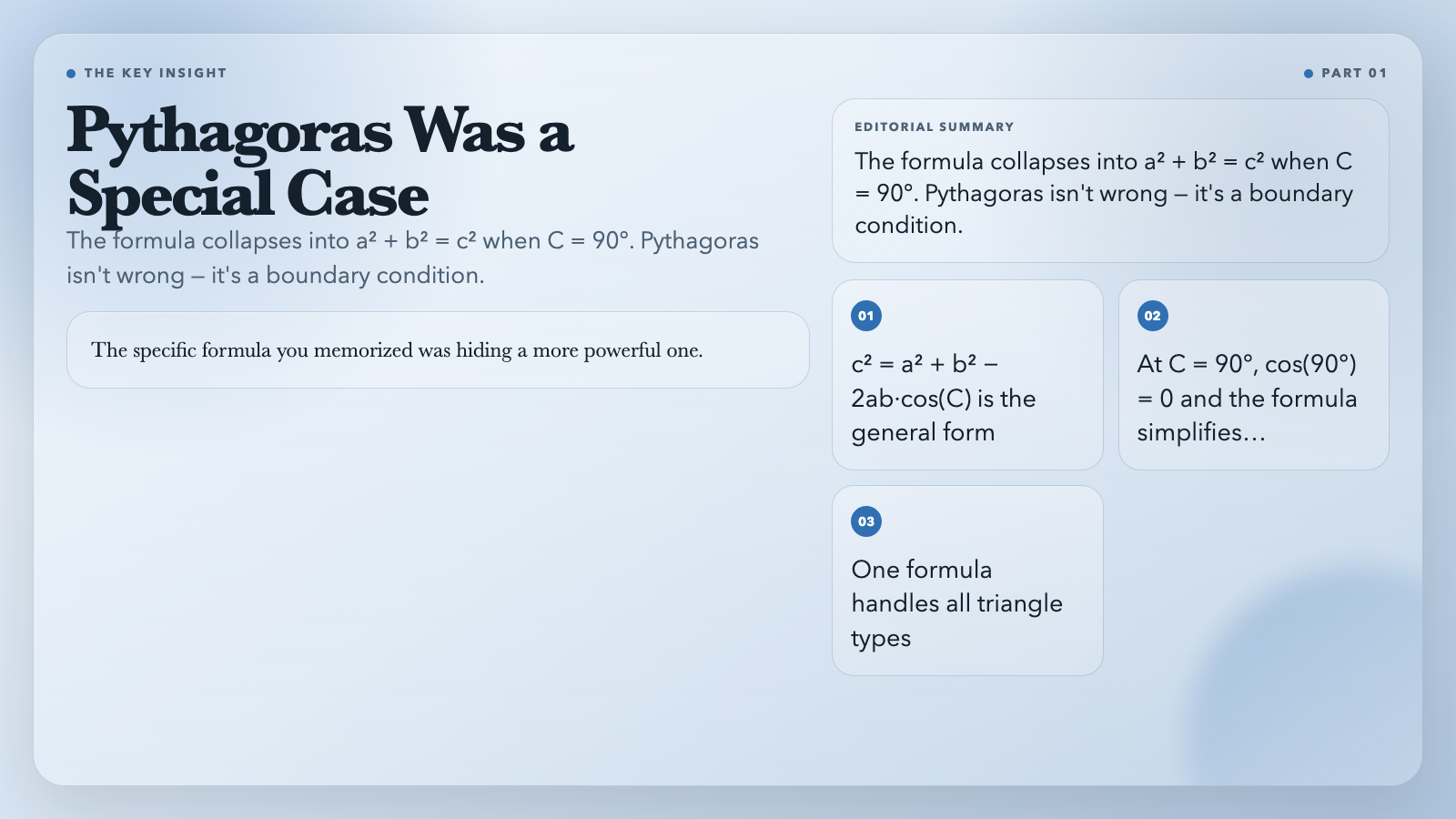
: when C = 90°, cos(90°) = 0, and the formula collapses exactly into a² + b² = c². Pythagoras isn’t wrong — it’s a boundary condition of a deeper truth.
This is how generalization works in mathematics. The specific formula you memorized was hiding a more powerful one.
The Obtuse Triangle’s Dirty Secret
The behavior shifts sharply when C exceeds 90°.
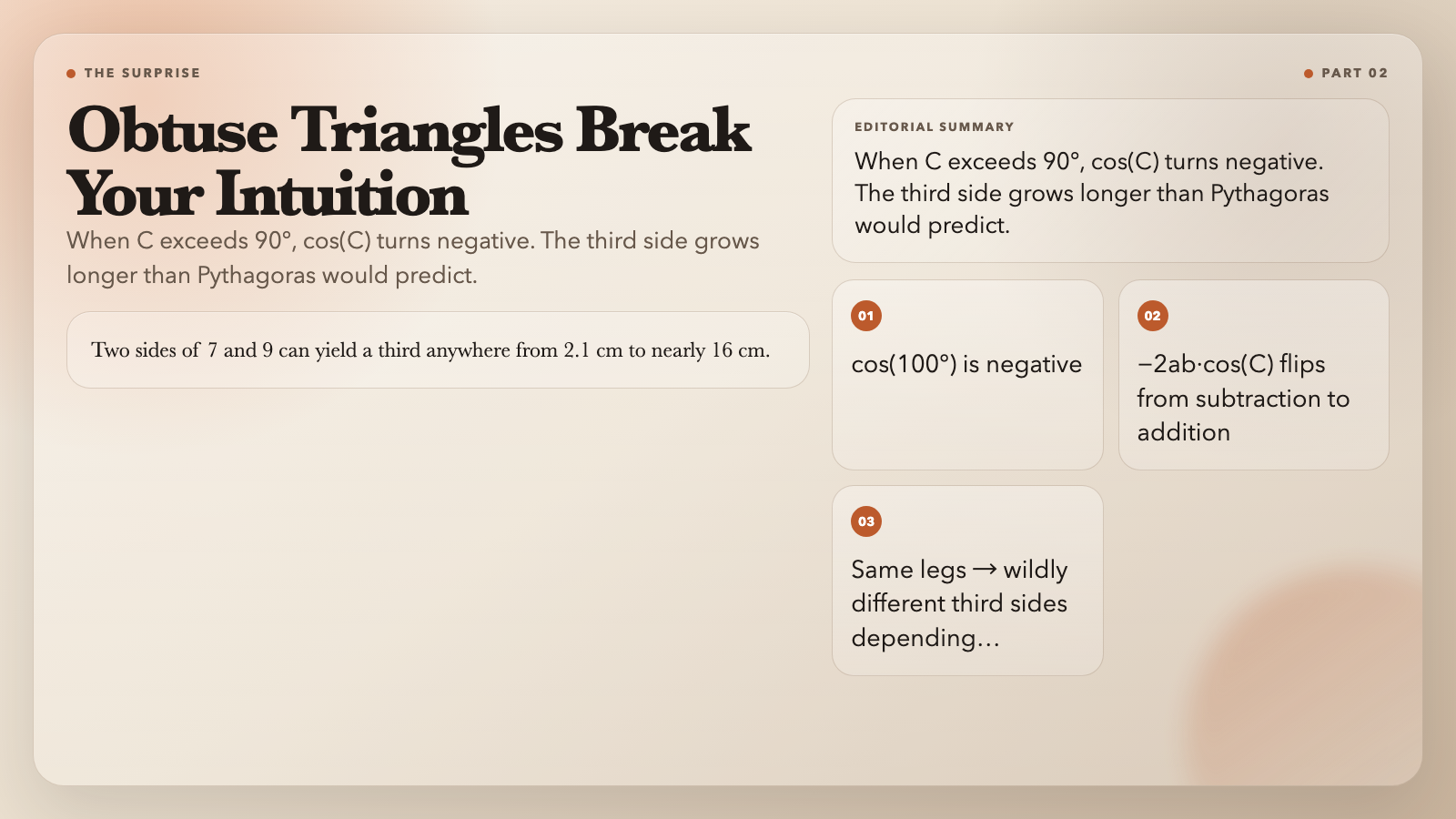
cos(100°) is negative. The term −2ab·cos(C) flips from subtraction to addition. The third side grows longer than it would be in a right triangle with the same two legs.
This is why guessing fails on non-right triangles. Two sides of 7 and 9 centimeters don’t determine the third uniquely — they could produce a side of 2.1 cm in a very flat acute triangle, or nearly 16 cm in a nearly straight line. The Law of Cosines gives the exact answer every time.
If you’re computing distances where the included angle isn’t guaranteed to be 90°, Pythagoras will mislead you. This formula won’t.
Where It Shows Up in the Real World
Surveying and navigation depend on this daily. Given two legs and the angle between them, the Law of Cosines delivers the direct distance — the core calculation behind GPS triangulation. Every time a phone locks onto a satellite signal, this formula is running underneath.
In 3D game engines, it powers dot products, camera culling, and collision detection across arbitrary angles. Structural engineers use it to resolve load vectors in bridge trusses and roof spans. Astronomers apply it to stellar parallax — the primary method for measuring distances to nearby stars, involving triangles with sides measured in light-years and an angle of mere arcseconds.
These aren’t obscure applications. They are foundational tools in their fields.

The Six-Step Proof That Closes the Loop
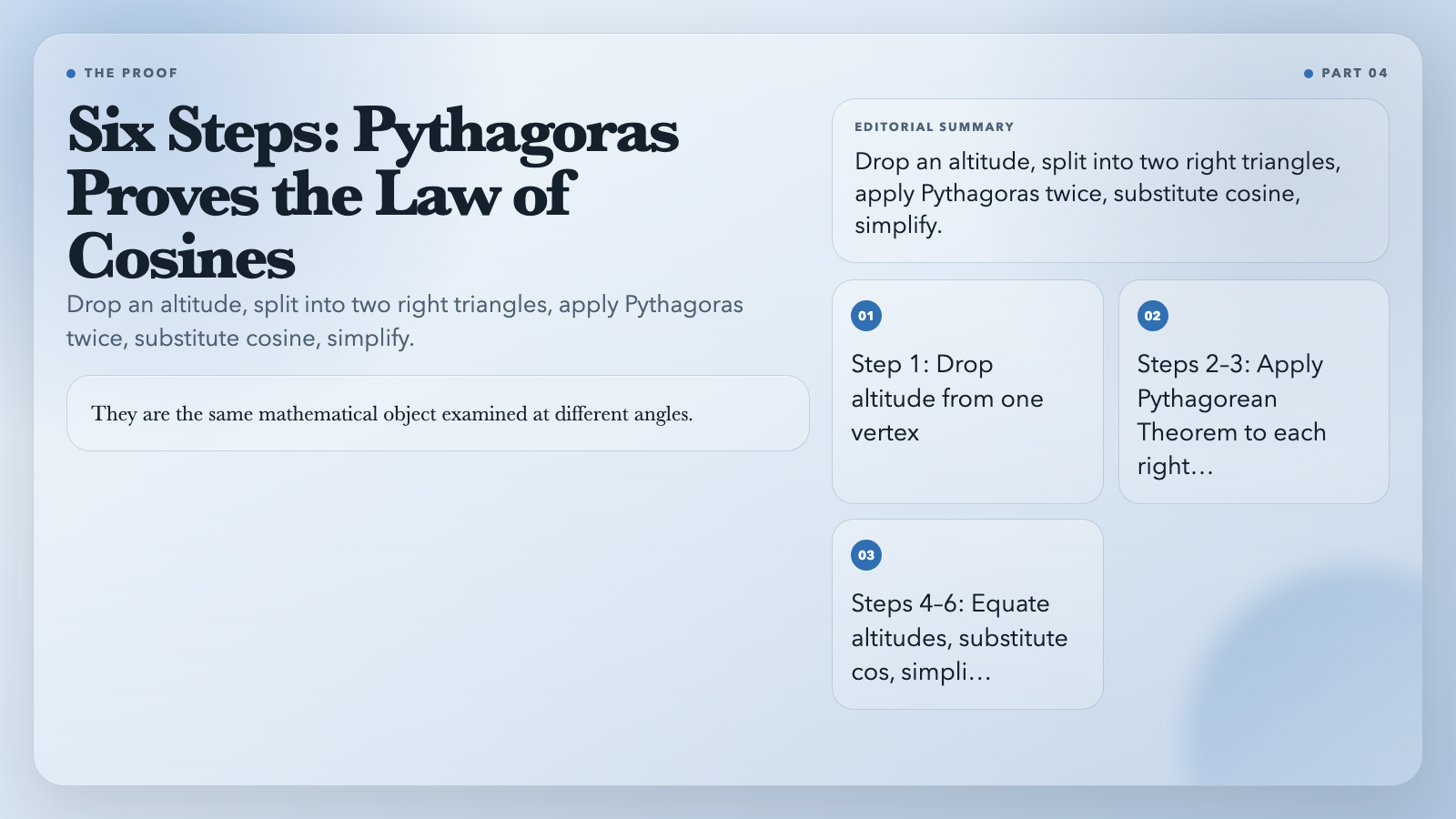
What makes the Law of Cosines particularly satisfying: you can derive it straight from the Pythagorean Theorem in six steps.
Drop an altitude from one vertex, splitting the triangle into two right triangles. Apply Pythagoras to each. Equate the two expressions for the shared altitude. Substitute the cosine definition (adjacent over hypotenuse). Simplify.
Out pops the formula you started with. Pythagoras proves the Law of Cosines. The Law reduces back to Pythagoras at C = 90°. They are the same mathematical object examined at different angles.
You can walk through the interactive step-by-step proof and drag a live triangle to watch its side lengths and angles update in real time at ElysiaTools Law of Cosines.
Why It Feels Less Familiar
The Pythagorean Theorem dominates because it’s ancient, visually obvious, and requires only arithmetic. The Law of Cosines demands trigonometry — encountered later, practiced less, forgotten faster.
The cost of that gap is real. The student who can recite a² + b² = c² often freezes on the practical variant: “Two sides are 7 and 9 centimeters. The included angle is 47°. Find the third side.” The answer sits 17 lines of arithmetic away, inside a formula they already know.
The question worth carrying forward: what other “complete” tools are you using only at their constrained boundaries? The Law of Cosines works across the full range of triangle geometry. The interesting cases usually live outside the special case.