On December 21, 2022, a teacher in rural Alaska stood before a group of elementary students with a flashlight and a globe. It was the winter solstice — the shortest day of the year in the Northern Hemisphere — and she was trying to explain why 4 PM already felt like midnight. “The Earth’s axis is tilted 23.5 degrees,” she said, angling the flashlight at the globe. “Today, the North Pole tilts away from the Sun as much as it ever does.”
Half the kids nodded. The other half were still confused. And honestly, they had a point. Solstices and equinoxes sound simple until you start asking real questions: Why do the dates shift slightly every year? Why is the December solstice summer in Sydney? Why does the March equinox sometimes fall on March 20 and sometimes March 21? The Solstice & Equinox Calculator answers all of this in three seconds, without requiring a single prior knowledge of orbital mechanics.
What a Solstice Actually Is
The shorthand version: summer solstice is the longest day, winter solstice is the shortest. Equinoxes are the days with equal day and night. That’s accurate enough for most conversations, but it misses the interesting parts.
A solstice is an *instant* — a specific moment when Earth’s axial tilt reaches its maximum inclination toward or away from the Sun. It isn’t a day, it’s a moment. The June solstice typically occurs on June 20–22. The December solstice usually lands on December 21–22. But those dates are expressed in UTC. Depending on your time zone, the moment might fall on a different calendar day.
An equinox is the moment the Sun crosses the celestial equator — the projection of Earth’s equator into space. On those two days, nearly every place on Earth receives approximately 12 hours of daylight and 12 hours of darkness. The word “equinox” comes from the Latin *aequus* (equal) and *nox* (night).
The complexity accumulates quickly. Earth’s orbit is elliptical, which means we’re closer to the Sun in January than in July. This, combined with the axial precession (a 26,000-year wobble in Earth’s orientation), causes the solstice and equinox dates to drift slightly year to year. Most people don’t notice or care. But for anyone tracking seasonal patterns — farmers, photographers, event planners, people with seasonal mood shifts — that drift has real consequences.
What the Solstice & Equinox Calculator Does
This tool takes the astronomy out of solstice and equinox tracking and replaces it with clean, instant output. You pick a year (1900–2100), select your hemisphere, and the tool calculates:
– All four events for the year: March equinox, June solstice, September equinox, December solinox — each with the exact date and hemisphere-specific description
– The next upcoming event with a countdown in days
– Current season displayed simultaneously for both hemispheres
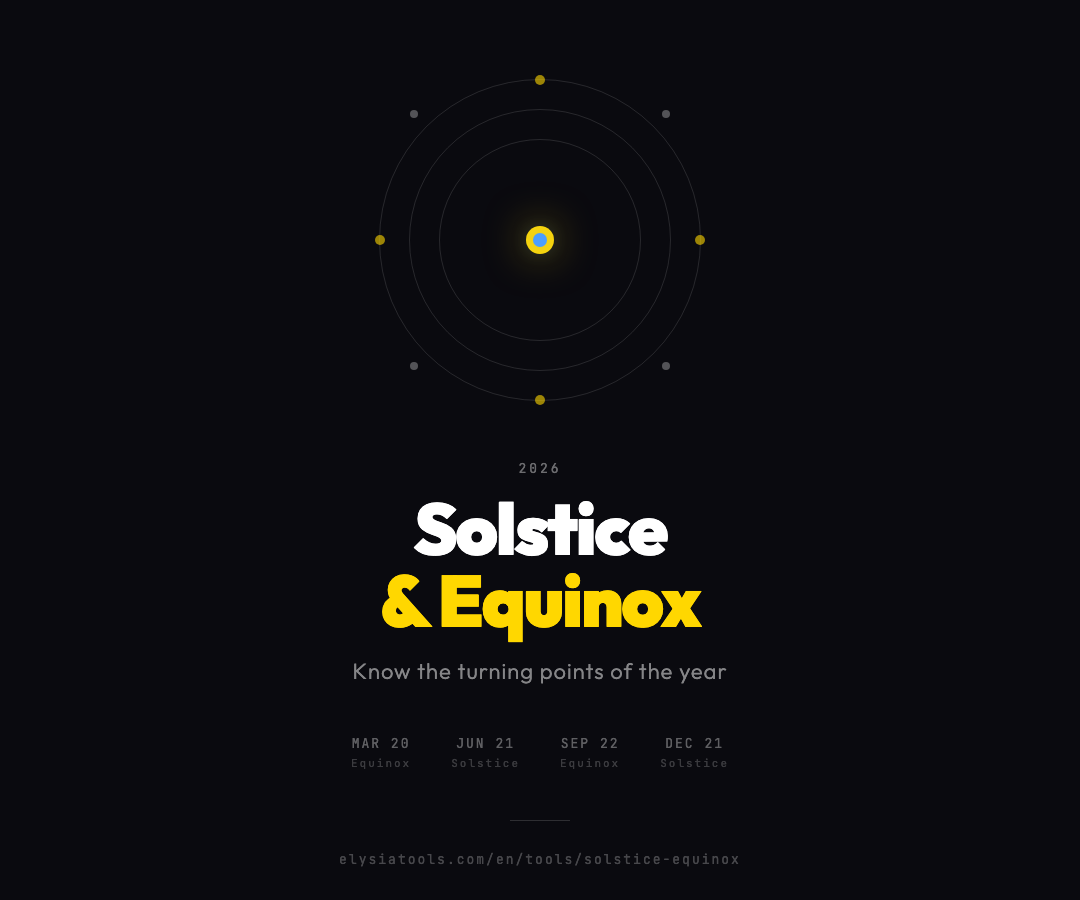
The March 2026 equinox fell on March 20. From that point, Northern Hemisphere days began shortening again, sliding toward the June solstice on June 21. In the Southern Hemisphere, the opposite was true — days were lengthening toward their December solstice in June. The same astronomical moments, producing mirror-image human experiences on opposite sides of the planet.
Why You Might Actually Care
The obvious audience for this tool is astronomers, educators, and science enthusiasts. But the real-world use cases extend much further.
For photographers: The summer solstice offers the year’s longest golden hour windows — ideal for outdoor portrait sessions, landscape photography, and architecture shots with extended twilight. The winter solstice gives photographers the longest dark-sky windows of the year, critical for astrophotography and Milky Way shooting.
For gardeners and farmers: Growing seasons aren’t just about frost dates. Knowing when to plant frost-sensitive crops depends on understanding seasonal progression. The Mayans aligned their entire agricultural calendar with solstices and equinoxes — not from mystical devotion, but because the sky told you when the rains would come.
For mental health awareness: Seasonal Affective Disorder peaks around the winter solstice, when the days are shortest. Knowing exactly when the days will start lengthening — having a concrete, dated answer to “how much darker will it get?” — is more than trivia. It’s information with psychological weight.
For event planning: Midsummer festivals, winter solstice celebrations, spring equinox gatherings. If you’re organizing anything with a seasonal theme, the astronomical date matters. And if your event crosses hemispheres, the inversion matters even more.
For travel planning: A December wedding in Sydney is a summer wedding. A June trip to Iceland means 20+ hours of daylight. The solstice and equinox frame these experiences — understanding *when* they occur and *what* they mean in each hemisphere changes how you plan.
The Hemisphere Problem
Most solstice calculators assume you’re in the Northern Hemisphere. If you’re in Australia, South Africa, Argentina, or Chile, you either get wrong information or no information at all.
The Solstice & Equinox Calculator handles both hemispheres explicitly. Select “Southern Hemisphere” and the tool tells you that the December solstice marks the *start of summer*, not winter. It sounds trivial when stated plainly, but it’s genuinely rare to find a tool that gets this inversion right.
This matters for international users, remote-first teams spread across continents, and anyone who travels with any frequency. A photographer planning a December shoot in Cape Town needs the Southern Hemisphere calculation — not the Northern Hemisphere one the typical tool defaults to.
The Current Picture: Late April 2026
As of this writing, we’re in late April 2026. The next major event on the astronomical calendar is the June solstice, falling on June 21, 2026.
For someone in London, that day will bring roughly 16 hours and 38 minutes of daylight. The Sun won’t fully set until after 9:30 PM. For someone in Cape Town, the same day brings only about 9 hours and 42 minutes of daylight — a difference of nearly seven hours from London on the same calendar date.
The tool shows these numbers side by side. Not as abstract statistics, but as lived experience differences. That’s the value: it makes the astronomical concrete.
Conclusion: The Sky Doesn’t Wait
Try this: open the Solstice & Equinox Calculator and type in your birth year. Hit calculate. Now you know exactly how many solstices and equinoxes have happened in your lifetime — every June shift, every December reversal, every spring and autumn balance point, all of them stacking up behind you like rings in a redwood trunk.
That’s a strange feeling, isn’t it? A quiet reminder that the Earth’s axial tilt doesn’t pause for human events, doesn’t care about elections or pandemics or anniversaries. It just keeps tilting 23.4 degrees relative to its orbital plane, year after year, solstice after solstice, for as long as the system runs.
The calculator won’t change that. Nothing will. But it makes the schedule visible. And sometimes that’s enough — to know when the light is coming back, or when it starts to fade, even if you can’t do anything about it.