You ran the numbers. You checked the models. You had the data. Then you watched five smart people disagree with you — and you changed your mind.
This is not a character flaw. It is Bayesian inference doing exactly what it should. The problem is what that logic produces when you zoom out.
In 1992, three economists formalized something everyone had watched happen but no one had named: information cascades. Their model describes how rational people following rational signals can produce collectively irrational outcomes — and why the people inside the cascade are not making mistakes.
The Logic That Builds a Bubble
The mechanism is simple. Imagine you face a binary choice: Option A or Option B. You have private information favoring A. But five people before you all chose B.
If you are Bayesian and your private signal is weak, you follow the crowd. Five people’s aggregate information probably outweighs your single signal. This is rational. The problem is what happens next: each person who follows makes the crowd larger. A larger crowd signals stronger consensus. Stronger consensus overrides the next person’s private signal. The cascade builds.
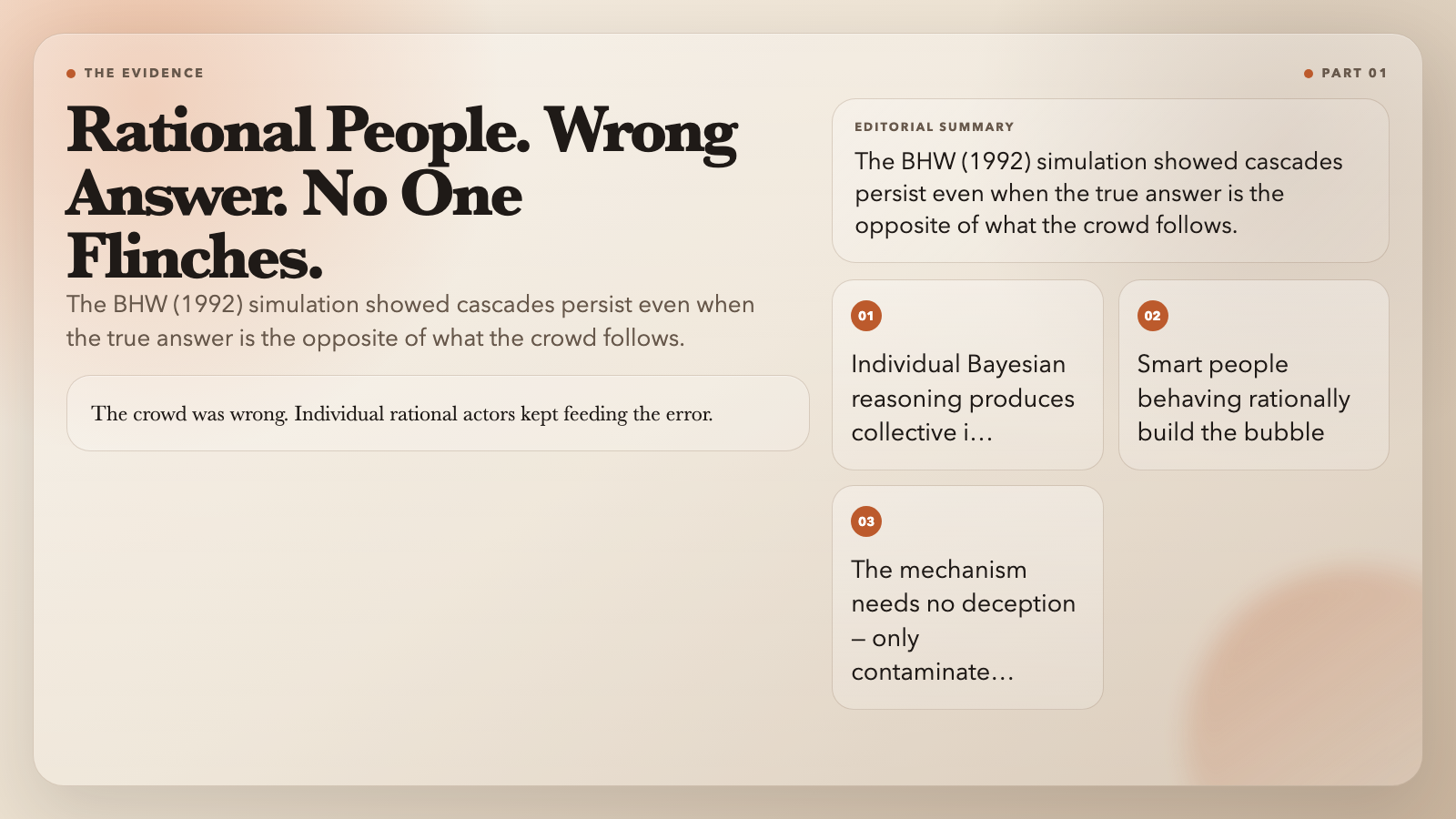
In the original Bikhchandani-Hirshleifer-Welch simulation, cascades routinely persisted even when the true answer was the opposite of what the crowd was following. The crowd was wrong. Individual rational actors kept feeding the error.
The mechanism does not require deception, manipulation, or irrationality. It runs on honest Bayesian reasoning applied to contaminated data.
Where You Have Already Seen This
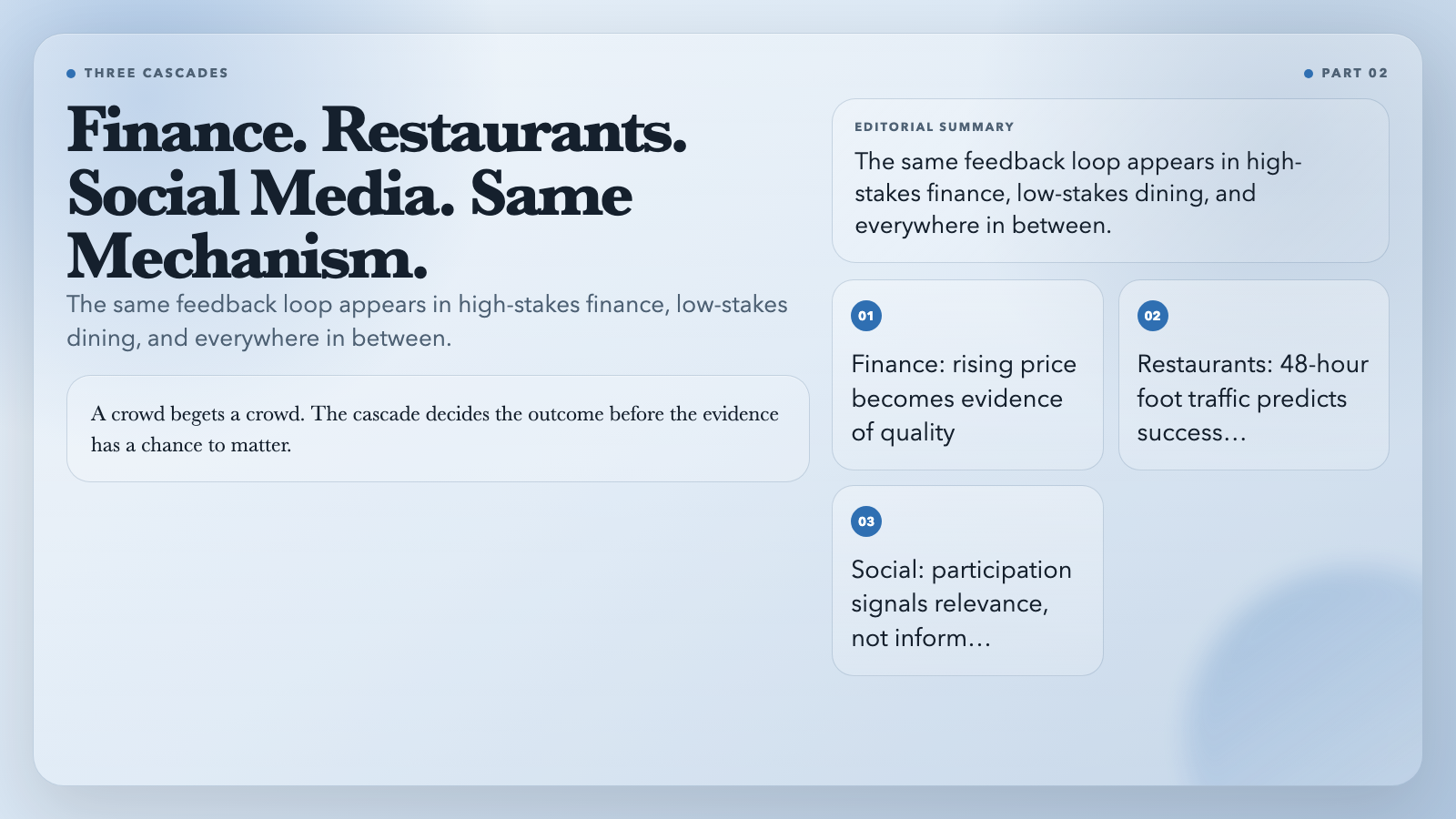
Finance. An asset climbs for no clear fundamental reason. Analysts with private doubts watch their peers recommend it. Each one updates: perhaps I’m missing something the group sees. Each one recommends it. The price climbs further. Rising price becomes evidence of quality. More analysts follow. This is not fraud. It is smart people behaving rationally. It is also how bubbles form.
Restaurants. The most reliable predictor of a new restaurant’s success is foot traffic in the first 48 hours — not food quality, not pricing, not concept. A crowd begets a crowd. The cascade decides the outcome before the food has a chance to matter.
Social platforms. A post gets early engagement. The algorithm surfaces it. More people see it, engage, signal relevance. The algorithm amplifies further. The content quality matters less than the cascade of attention. This is why the same five takes appear across dozens of accounts within 72 hours of any major event — each person joins because participation signals relevance, not because they have new information.
The Structural Fix
Standard advice — “trust your research” — fails here because Bayesian logic says to weight crowd consensus over weak private signals. The advice is correct for individuals with weak signals. It is catastrophic for systems.
What actually disrupts cascades: sequential disclosure rules. Force people to commit to their choice before seeing what others chose. Make private signals public before public consensus forms. Jury systems, prediction markets with revelation mechanisms, and some peer review designs try to build this separation.
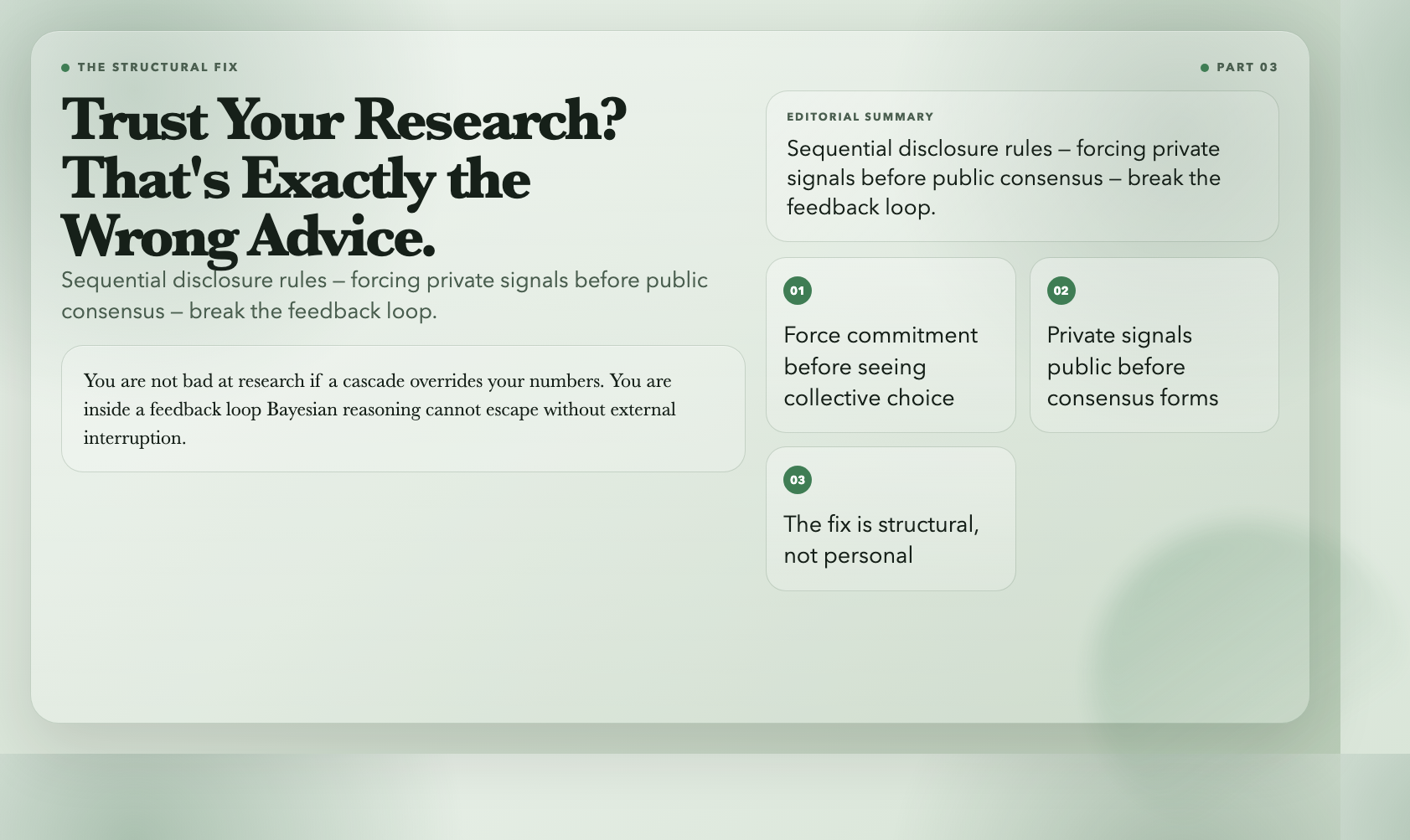
The insight is structural, not personal. You are not bad at research if a cascade overrides your numbers. You are inside a feedback loop that Bayesian reasoning cannot escape without external interruption.
The Sanjay Problem
Sanjay had a PhD in economics from a top school. In 2008, he read the housing data, ran his own models, and concluded the crash was inevitable. He held. He was right — eventually. He lost his job first.
His private signal was correct. The crowd was wrong. But the crowd was full of people making rational inferences from public data, and rational inference from public data pointed toward the herd. The cascade was populated by smart people doing everything right.
The Bayesian logic never stopped working. The inputs were contaminated before the reasoning started.
The Question Worth Sitting With
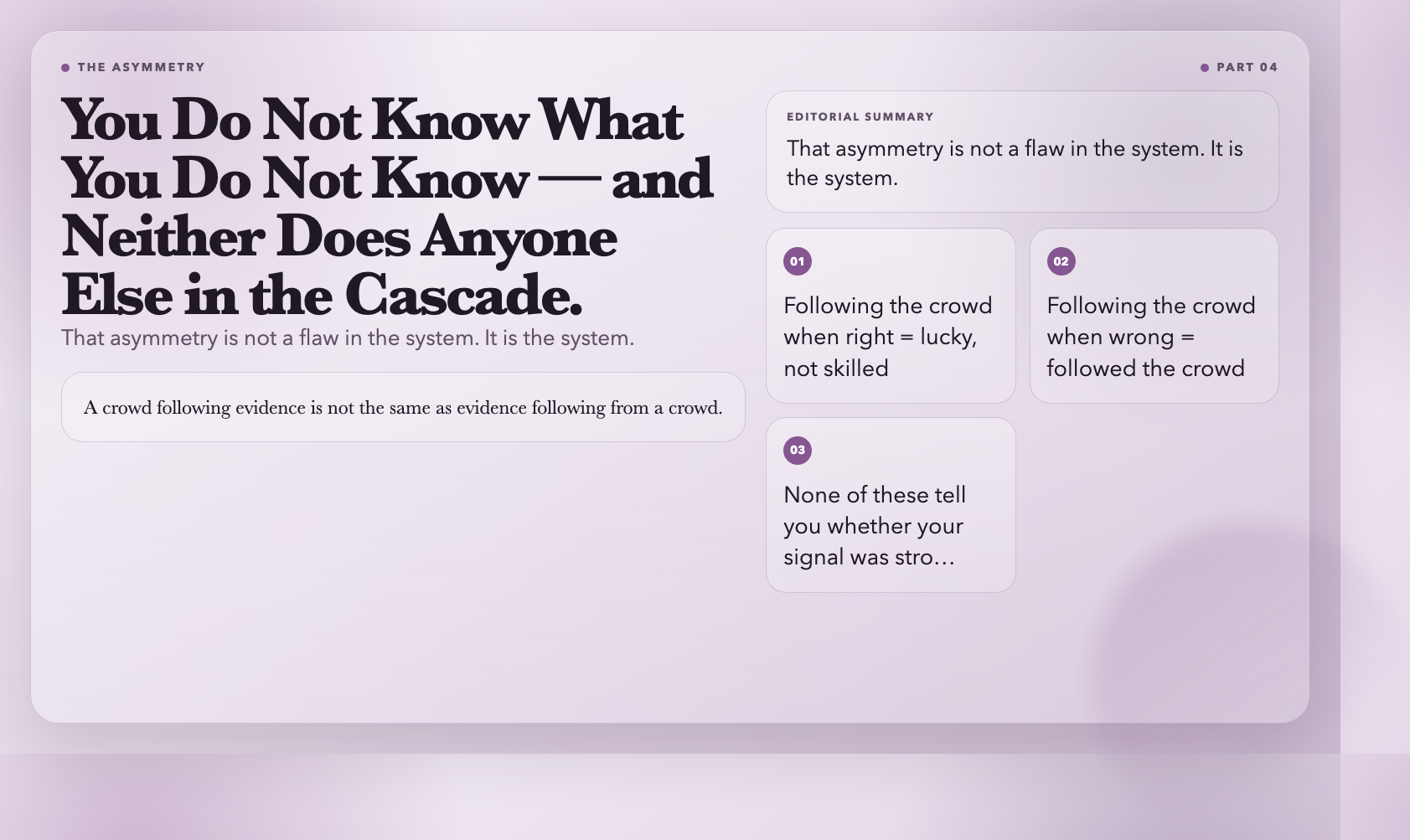
Here is what nobody tells you: if your private signal contradicts the crowd, and you follow the crowd, you may be Bayesian. If you follow the crowd against your private signal and you are right, you got lucky. If you follow the crowd and you are wrong, you followed the crowd.
None of these outcomes tell you whether your original signal was strong or weak. You do not know what you do not know — and neither does anyone else in the cascade.
That asymmetry is not a flaw in the system. It is the system.
The next time you find yourself overriding your own data because everyone else seems confident, check what you are actually looking at. Evidence. Or evidence of people looking at evidence.
A crowd following evidence is not the same as evidence following from a crowd.
Run your own cascade simulations at Information Cascade Simulator — see how quickly rational herding produces collective error, and what it takes to break one.