# Why the Pill That Lowers Your Blood Pressure Is Also a Math Problem
Your doctor prescribed lisinopril. You picked it up at the pharmacy for $4. What happens next is a battle at the molecular level — and the battle was designed on paper before the drug existed.
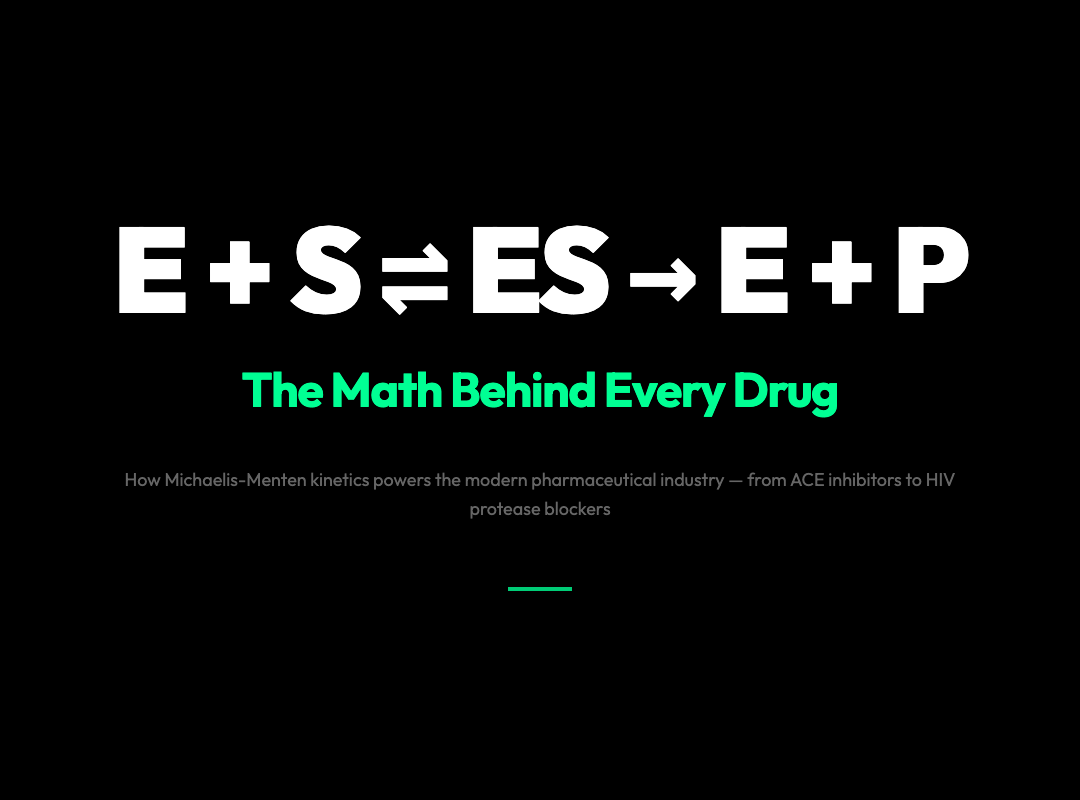
More than 700 drugs on the global market work the same way: they bind to an enzyme and slow it down. Blood pressure medications, statins, antibiotics, chemotherapy agents — all enzyme inhibitors. Leonor Michaelis and Maud Menten published their equation in 1913, derived from the mechanism E + S ⇌ ES → E + P. It took another 75 years before pharmaceutical companies routinely used it to design drugs. The first protease inhibitors for HIV — saquinavir, approved in 1995 — were designed around Michaelis-Menten kinetics. Within two years of their introduction, HIV mortality in treated patients dropped by nearly half.
The equation:
v = Vmax[S] / (Km + [S])
Two parameters govern the entire behavior. No calculus required. Just a hyperbola, and the mathematical framework behind roughly half of all modern pharmaceuticals.
What Enzymes Actually Do
Before the math, the biology. An enzyme is a protein that accelerates a chemical reaction — sometimes by a factor of a million. It does this by binding to a specific molecule called a substrate, forming a temporary enzyme-substrate complex, and releasing the product.
The mechanism is: E + S ⇌ ES → E + P
Enzyme plus substrate reversibly binds, forms the complex ES, which then produces product P and frees the enzyme to start again. This cycle is the engine of essentially every biochemical process in your body: digestion, energy production, DNA replication, neurotransmitter signaling.
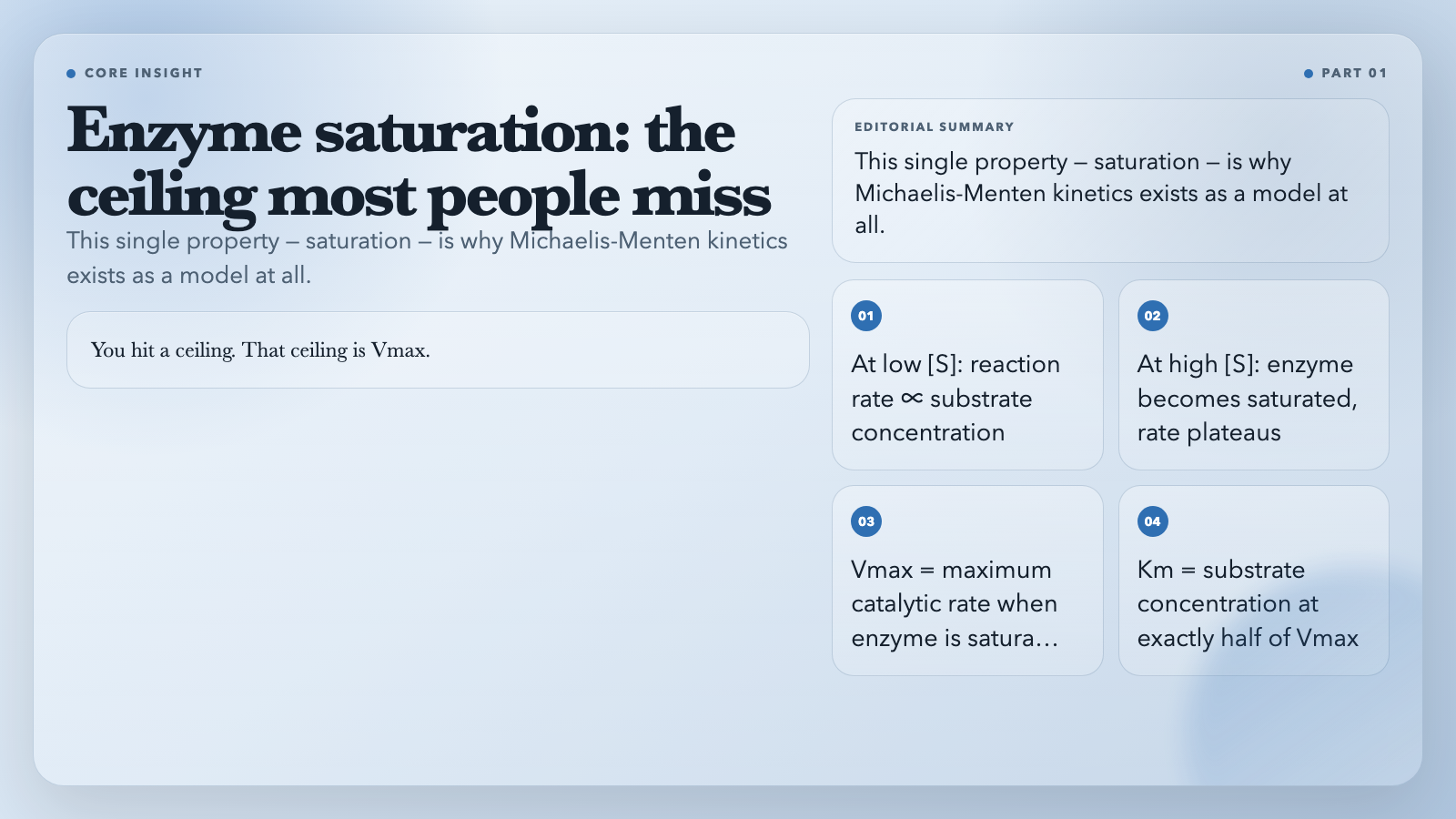
Here’s what most people miss: enzymes don’t keep accelerating forever. Once substrate concentration gets high enough, the enzyme becomes saturated — every molecule is busy catalyzing reactions, and adding more substrate doesn’t speed things up. You hit a ceiling. That ceiling is Vmax. This is why Michaelis-Menten kinetics matters — it describes exactly how enzymes saturate, and exactly what happens before and after.
The Michaelis-Menten Equation
Michaelis and Menten derived their equation by making one elegant assumption: at low substrate concentrations, the reaction rate is roughly proportional to [S]. At high concentrations, it plateaus. The transition between these two regimes is governed by Km, the Michaelis constant.
Km is the substrate concentration at which the reaction rate is exactly half of Vmax.
This single number tells you almost everything. A low Km means the enzyme is highly efficient — it reaches half its maximum speed even at tiny substrate concentrations. A high Km means you need a lot of substrate to get the enzyme moving.
Knowing both Vmax and Km for an enzyme is like knowing both the top speed and the acceleration curve of a car. Together, they define the complete kinetic fingerprint of that enzyme.
The Three Ways to Stop an Enzyme
This is where it gets interesting — and where the math becomes medicine.
Competitive Inhibition
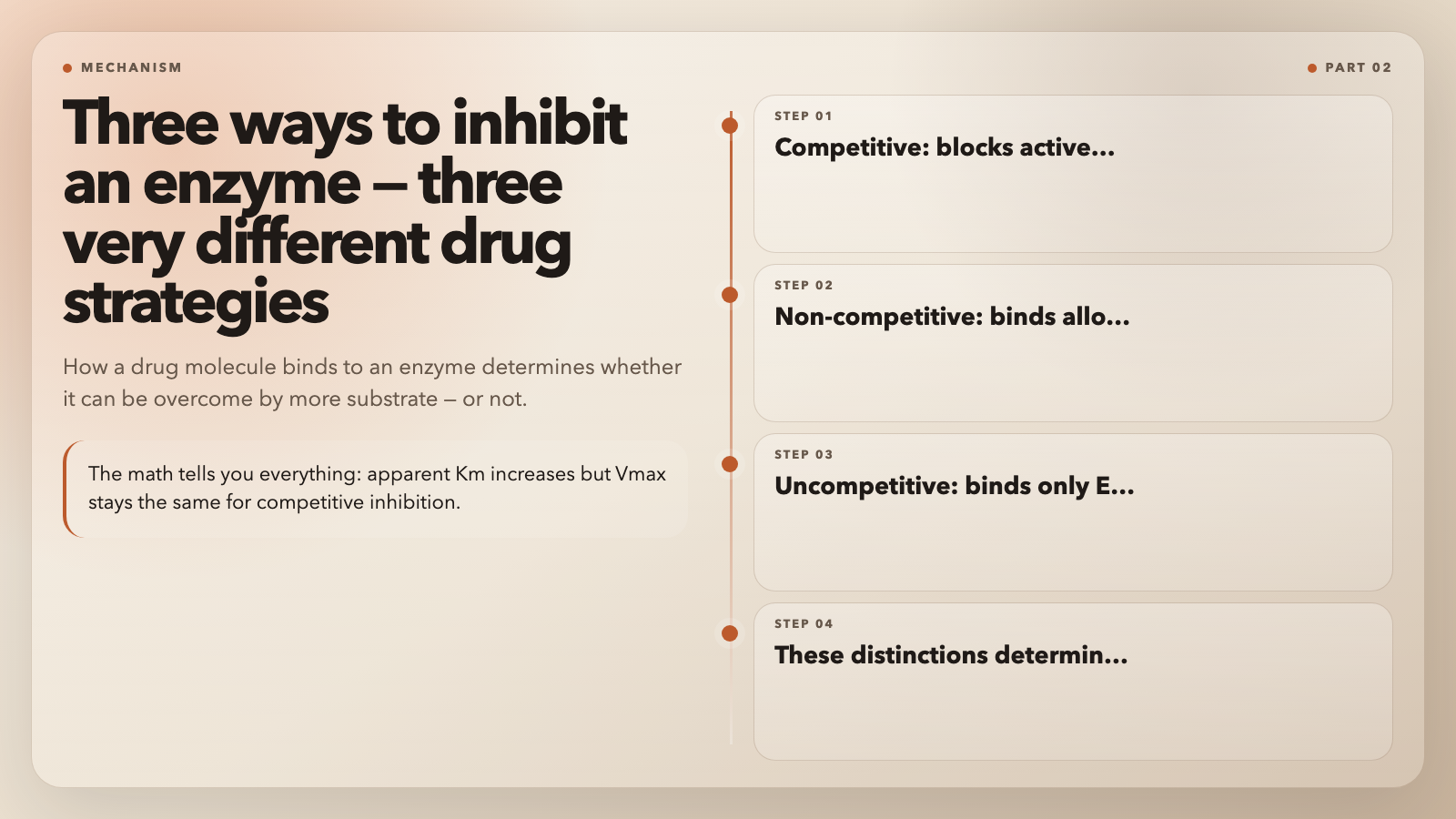
Two molecules fight for the same parking spot. The inhibitor looks enough like the substrate to bind to the enzyme’s active site, but it doesn’t get converted to product. It just blocks real substrates from getting in.
The math: apparent Km increases. Vmax stays the same. You need more substrate to reach the same reaction speed.
The drug example: ACE inhibitors like lisinopril and enalapril are competitive inhibitors. They block angiotensin-converting enzyme, which is involved in blood vessel constriction. By inhibiting this enzyme, blood vessels relax and blood pressure drops. The math says: increase the inhibitor concentration, and the enzyme increasingly sits idle, regardless of how much substrate is present.
Non-Competitive Inhibition
The inhibitor binds somewhere else on the enzyme — not the active site, but an allosteric site — and changes the enzyme’s shape in a way that reduces its activity. The substrate can still bind, but the enzyme’s catalytic power is diminished.
The math: Vmax decreases. Km stays the same. The enzyme simply can’t work as fast, no matter how much substrate you throw at it.
This matters in antibiotic design. Some antibiotics are non-competitive inhibitors of bacterial enzymes. The bacteria cannot develop resistance simply by pumping more substrate into its system — the inhibitor’s effect doesn’t depend on substrate competition.
Uncompetitive Inhibition
The inhibitor only binds to the ES complex — the enzyme-substrate pair. It cannot bind to free enzyme alone. This is rarer in nature, but pharmacologically significant.
The math: both Vmax and Km decrease proportionally. The Lineweaver-Burk plot shows parallel lines — a unique signature.
The drug example: some chemotherapy agents work this way. By binding only to the enzyme-substrate complex, they can selectively interfere with rapidly dividing cells, where substrate concentrations are high.
The Lineweaver-Burk Plot: How Scientists See What They Can’t Measure
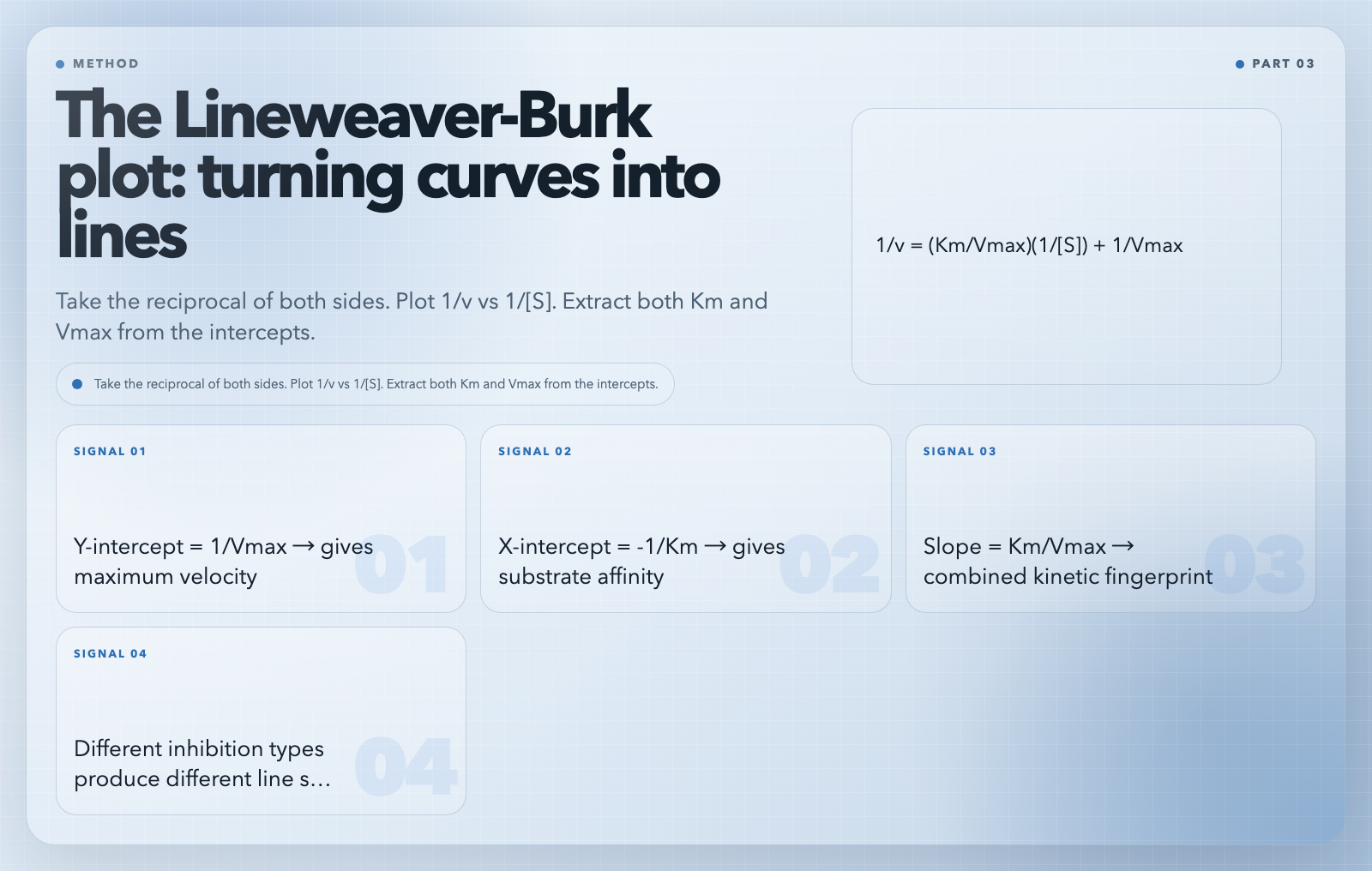
You cannot directly measure Km or Vmax from a simple reaction curve — they’re fitted parameters. But you can linearize the problem. Take the reciprocal of both sides of the Michaelis-Menten equation:
1/v = (Km / Vmax) · (1/[S]) + 1/Vmax
Plot 1/v against 1/[S], and you get a straight line. The slope is Km/Vmax. The y-intercept is 1/Vmax. The x-intercept is -1/Km. From a handful of data points, you can extract both kinetic parameters.
The Lineweaver-Burk plot is also the fastest way to identify the type of inhibition: competitive inhibition shifts the y-intercept but keeps the same slope; non-competitive keeps the same slope but shifts the y-intercept; uncompetitive changes both. In drug discovery, this plot is a diagnostic tool as much as a theoretical construct.
Why This Matters Beyond the Textbook
Every drug that works by enzyme inhibition was designed around Michaelis-Menten kinetics. The ACE inhibitors lowering your blood pressure. The statins blocking HMG-CoA reductase to reduce cholesterol synthesis. The MAO inhibitors used in depression treatment. Proton pump inhibitors for acid reflux. HIV protease inhibitors that transformed AIDS from a death sentence to a manageable condition.
Each of these drugs exists because someone understood, quantitatively, how an enzyme worked — and designed a molecule to change its kinetic parameters in a specific, predictable way.
The mathematics of enzyme kinetics is not an abstraction. It is the engineering blueprint for roughly half of all modern pharmaceuticals.
Try It Yourself
You can explore the Michaelis-Menten equation, switch between inhibition types, and watch how the Lineweaver-Burk plot changes in real time — no biochemistry degree required.
Enzyme Kinetics Interactive Visualization →
Adjust substrate concentration, toggle competitive, non-competitive, and uncompetitive inhibition, and watch the graphs respond. It’s the same tool drug researchers use to understand mechanism — free and interactive in your browser.
The Equation Behind the Pharmacy
One hundred and twelve years after Michaelis and Menten published their paper, their equation still appears in the first chapter of every biochemistry textbook. Not because it’s historical — because it’s still the correct model.
Understanding enzyme kinetics won’t tell you which drug to prescribe. But it will tell you why the pharmaceutical industry — worth $1.6 trillion globally — functions the way it does. Every pill you take is a product of Michaelis-Menten thinking, even if the equation never appears on the label.
And if you’ve ever wondered why some antibiotics stop working over time while your blood pressure medication keeps working for decades — the difference is in the math. Competitive, non-competitive, uncompetitive. The three types of inhibition, and three very different fates for the drugs that use them.