How Alan Turing‘s Dying Equation Explains Why Leopards Have Spots
In 1952, a mathematician famous for breaking Enigma codes submitted a paper that asked a strange question: can the same equation that describes how chemicals mix in a jar explain why a leopard has spots?
He died four years later, before anyone could answer. Today, that question sits at the heart of developmental biology — and you can watch it play out on your screen right now.
The Problem That Started Everything
Turing was obsessed with a question that sounds almost too basic to be science: how does a single fertilized egg — a sphere of identical cells — become a creature with a head, a tail, fingers, and eyes?
The classical explanation was genetics. If you had the genes for spots, you got spots. But Turing suspected something deeper. He proposed that genes only provided the raw ingredients. The actual pattern — where the spots went, how big they were, whether you ended up with stripes or dots — was carved out by something far more physical: the mathematics of diffusion.
His insight was this: when two chemicals interact, and one diffuses faster than the other, patterns can emerge spontaneously. No genetic instruction required. The geometry of life, he argued, was partly a product of reaction-diffusion systems.
He called this morphogenesis — the birth of form.
The Gray-Scott Model: Two Chemicals, Infinite Patterns
Turing’s original equations were theoretical. In the 1990s, researchers Pearson and Cramer distilled his ideas into a cleaner system now known as the Gray-Scott model.
It describes two chemical species — an activator (U) and an inhibitor (V) — feeding, reacting, and diffusing across a surface:

dU/dt = Du · ∇²U − U·V² + f · (1−U)
dV/dt = Dv · ∇²V + U·V² − (f+k) · V
Where:
- f is the feed rate — how fast U enters the system
- k is the kill rate — how fast V is removed
- Du and Dv are the diffusion rates of each chemical
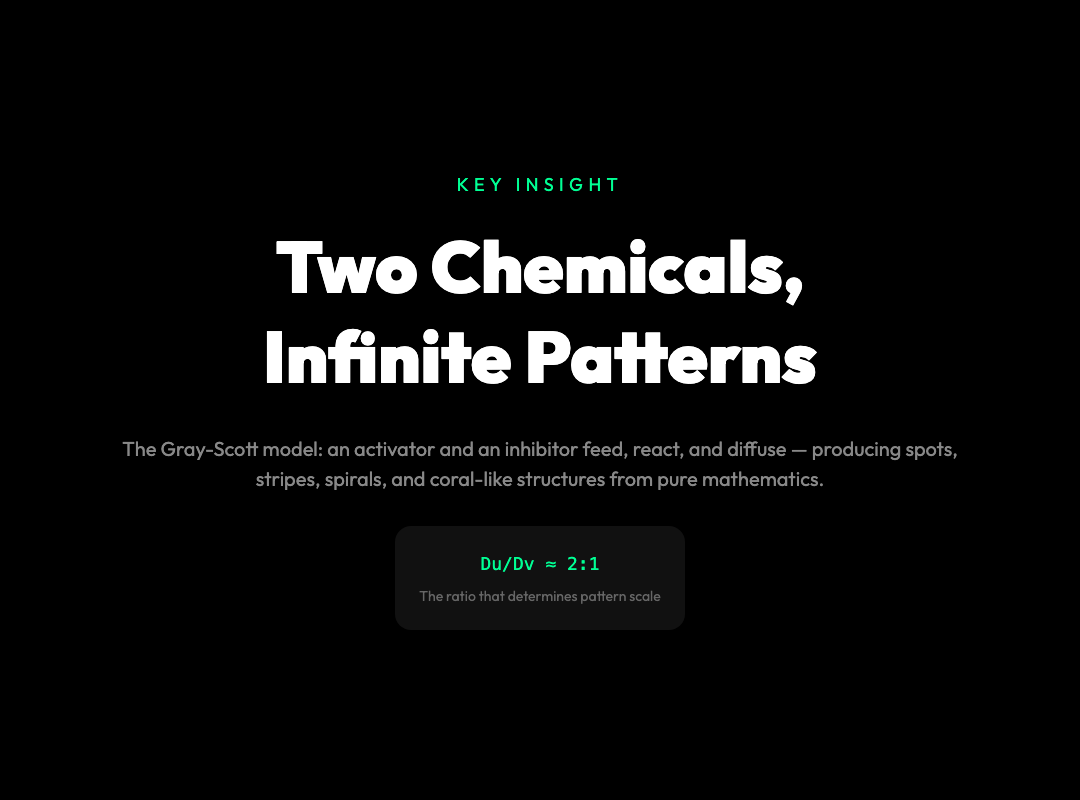
The ratio Du/Dv is typically set to approximately 2:1. Change this ratio, or tweak f and k, and the entire character of the pattern shifts.
The Parameter Space
Different values of f and k produce radically different structures:
| Pattern Type | Feed Rate (f) | Kill Rate (k) |
|---|---|---|
| Spots | 0.035 | 0.065 |
| Stripes | 0.039 | 0.058 |
| Coral | 0.055 | 0.062 |
| Mitosis (splitting cells) | 0.060 | 0.062 |
| Turbulence | 0.065 | 0.055 |
Move by increments of 0.001 in either parameter and the pattern transforms entirely. It is one of the most dramatic examples in applied mathematics of parameter sensitivity — a tiny change in control variables produces a fundamentally different outcome.
What This Has to Do With Your Body
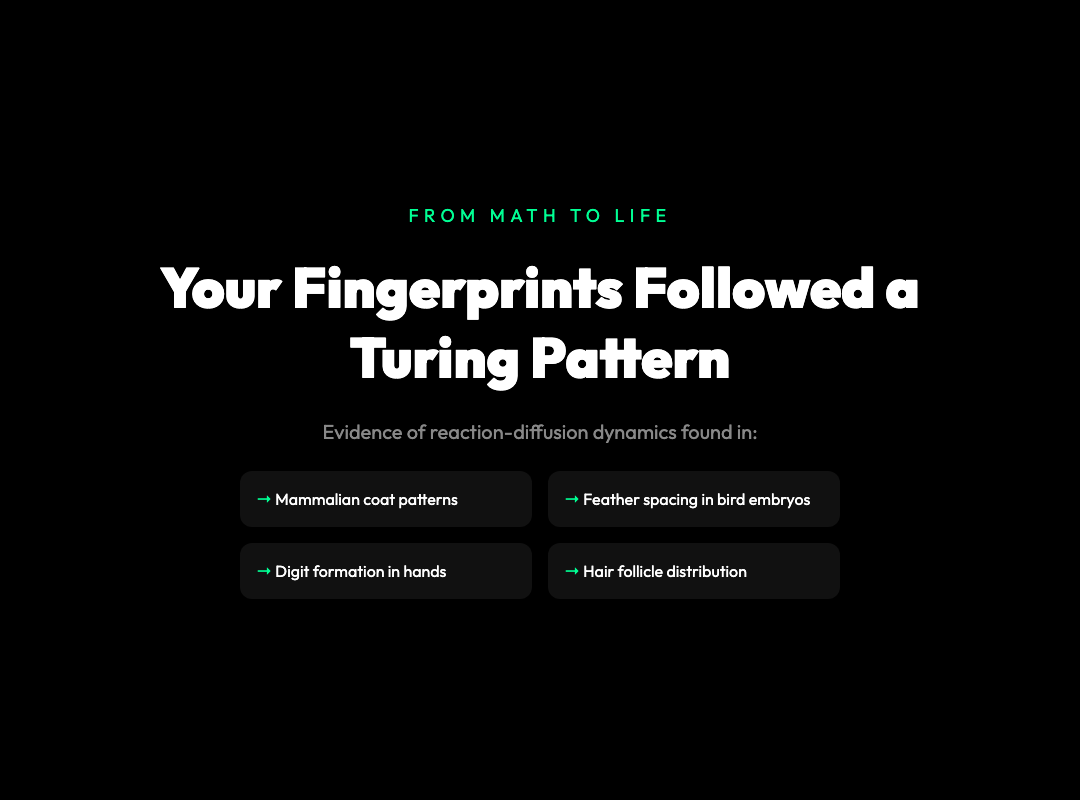
Turing patterns aren’t just a curiosity in computer graphics. Biologists have found evidence of reaction-diffusion dynamics in:
- Mammalian coat patterns — the spacing of spots in leopards, stripes in zebras, and the distinctive markings of marine reef fish all show statistical signatures consistent with Turing mechanisms
- Feather buds in bird embryos — the regular spacing of feathers follows a Turing-like gradient
- Limb bud formation — the digits in your hand formed along a concentration gradient that resembles a Turing pattern
- Hair follicle distribution — the regular spacing of hair follicles in mammalian skin is thought to use a similar mechanism
The same math that produces coral-like swirls in a browser simulation also guided the development of your fingerprints.
This is what Turing meant when he wrote that “the laws of physics need not have been particularly suited to the development of living organisms” — the patterns of life emerge from the same mathematics that governs ink diffusing in water.
Why the Model Still Matters
Turing died in 1954, before the molecular biology revolution could test his ideas. It wasn’t until the 1990s that biologists identified the chemicals — genes like SHH (Sonic Hedgehog) and BMP — that act as activators and inhibitors during embryonic development.
What made Turing’s prediction remarkable wasn’t the specific chemicals involved. It was that he derived the geometry of development from first principles, thirty years before anyone knew what the molecules were.
Modern researchers are using Turing-like models to understand:
- How cancer tumors develop irregular boundaries
- How synthetic biologists program pattern formation in lab-grown tissues
- How desert ecosystems maintain regular spacing between vegetation patches
See It For Yourself
The Turing Pattern simulator on ElysiaTools lets you run the Gray-Scott model in real time. Click the presets to see spots, stripes, and coral-like growths. Drag your mouse across the canvas to inject new perturbations — watch how the system responds, splits, and re-organizes.
Notice how a single perturbation spreads outward and creates self-organized structure from chaos. That is not a programmed behavior. It is mathematics doing what mathematics does: extracting pattern from the absence of pattern.
Turing’s equation didn’t just explain leopard spots. It revealed something unsettling and beautiful about the nature of biological form: much of what we call “design” in living systems has no designer. It is the inevitable output of two chemicals doing what two chemicals do — feeding, reacting, diffusing — and accidentally creating the conditions for life.