Three Bodies Are All It Takes to Break Determinism
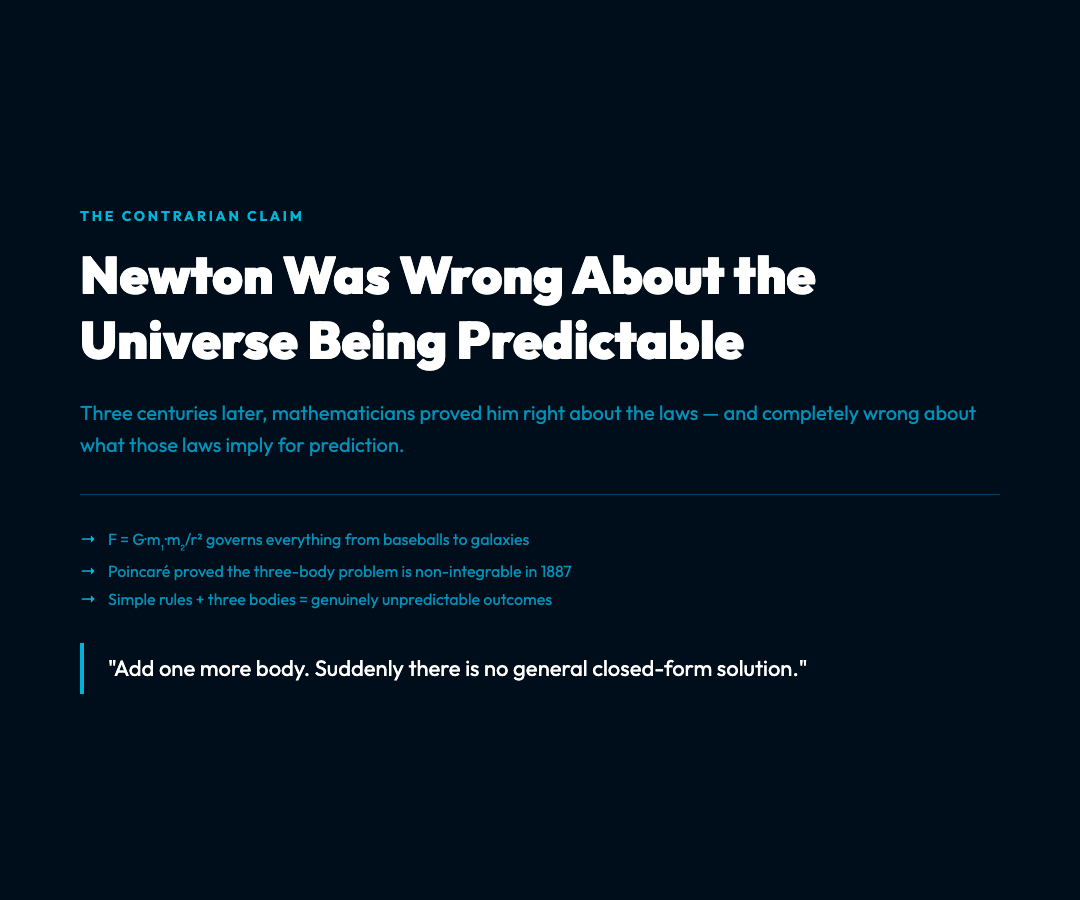
In 1687, Isaac Newton wrote down an equation so elegant that philosophers assumed the universe was a clock — predictable, mechanical, fully determined. Give Newton the positions and velocities of every particle in the solar system, and in principle he could tell you where every planet would be a billion years from now. The math was simple: F = G·m₁·m₂/r².
Three centuries later, mathematicians proved him wrong. Not with new physics — with the same equation.
The trick isn’t the force law. It’s the three-body problem.
The Equation That Runs the Universe
Newton’s law of universal gravitation is one of the cleanest equations in physics: every mass in the universe attracts every other mass with a force proportional to the product of their masses and inversely proportional to the square of the distance between them. You learned it in high school. It governs the arc of a baseball, the orbit of the ISS, and the path of Voyager 1 as it coasts toward the heliopause.
For two bodies — say, a single planet orbiting one star — the equation is solved exactly. The planet traces a perfect ellipse, the same ellipse, forever. Kepler derived the rules empirically in 1609; Newton proved why they work in 1687. Two-body systems are deterministic and stable.
Add one more body. Suddenly there is no general closed-form solution. This isn’t a gap in human cleverness. In 1887, Henri Poincaré proved that the three-body problem is non-integrable — no formula exists that can predict the long-term behavior of three mutually attracting masses. Not because we haven’t found it, but because it doesn’t exist.
What replaced the formula was something stranger: chaos.
Chaos Is Not Randomness — It’s Sensitivity
When people hear “chaotic,” they think “random,” “unpredictable,” “no pattern.” That’s wrong. Chaos is far more interesting.
Chaotic systems are deterministic — the rules are fixed, no dice are rolled, nothing is random. What makes them chaotic is sensitivity to initial conditions: tiny differences in starting positions compound exponentially until the predicted state bears no resemblance to the actual state.
The classic illustration is the butterfly effect — not the pop culture version (a butterfly flaps its wings and causes a hurricane), but the mathematical version: two trajectories that differ by a millimeter in initial position will, after enough time, diverge as wildly as if one had a butterfly and the other didn’t.
In the three-body problem, this divergence is fast and inevitable. Three bodies of roughly equal mass, started from nearly identical positions, will evolve along entirely different paths. Run it again with initial positions shifted by 0.0001%, and you get a completely different dance — a different ellipse, a different ejection, a different collision.
This is why we can predict solar eclipses a thousand years ahead but cannot design a stable long-term orbit for three comparable masses. The mathematics that governs galaxy clusters is the same mathematics that breaks our predictions.

RK4: Why This Simulator Gets It Right
Most browser-based gravity simulations use a technique called Euler integration — fast, simple, but catastrophically inaccurate for orbital mechanics. After a few hundred time steps, total energy drifts, orbits spiral, and the simulation diverges from real physics.
The N-Body Gravity Simulation on ElysiaTools uses RK4 integration (fourth-order Runge-Kutta method). Without getting into the calculus: RK4 samples the gravitational acceleration four times per time step — at the current position, at a halfway point, at a full step, and at another midpoint — then combines those samples with carefully chosen weights. The result is a trajectory that’s accurate to the fourth power of the time step. For orbital mechanics, this means energy is conserved to remarkable precision even over simulated millennia.
You can see this in real time: the simulation tracks total energy (kinetic + potential) and displays how well it’s being conserved. With RK4, the drift is negligible. Euler integration, for comparison, will show energy growing or collapsing monotonically until the system flies apart or crashes.
This matters because validated numerical accuracy is the only way to trust long-term simulations. Whether you’re simulating a space mission trajectory or the formation of a galaxy cluster, the integrator’s fidelity determines whether your results reflect reality or numerical artifacts.
What You Can Actually Do With This
The simulation ships with four preset scenarios that illustrate the range of N-body behavior:
Earth-Moon-Sun: The real system, approximately. The Moon’s orbit is stable on human timescales but would eventually drift. This preset is useful for building intuition about scale — the Sun’s mass dominates completely, and the Moon’s influence on Earth’s orbit is a perturbation, not a driver.
Binary Star: Two bodies of comparable mass orbiting their common center of mass. These systems are stable but dynamic — the stars trace elaborate rosette patterns rather than simple ellipses because each one accelerates under the other’s gravity rather than sitting at a focus.
Chaotic Three-Body: Three masses of equal order. This is where things get violent. Small changes in initial position produce wildly different outcomes: sometimes one body gets ejected at high speed, sometimes two collide and merge, sometimes all three settle into a chaotic dance that never quite repeats. Run the same initial configuration twice and watch the trails diverge.
Gravity Assist: The preset that connects chaos theory to real space missions. A small body (a spacecraft, or a comet) skims past a massive body and steals orbital energy — slowing down relative to the Sun if it passes “behind” the planet, or accelerating if it passes “ahead.” This is how Voyager 2 visited Jupiter, Saturn, Uranus, and Neptune with minimal fuel. The spacecraft’s trajectory is chaotic in the sense that tiny differences in approach angle produce large differences in the gravity assist received. Mission planners need to thread a very precise needle.
Why This Still Matters in the Age of Supercomputers
You might think: we have exascale supercomputers simulating galaxy formation. Why does any of this chaos stuff matter?
Because chaos sets a fundamental limit on prediction, not just a practical one. A supercomputer can simulate the solar system with extraordinary precision — for the next ten million years. But beyond that, the cumulative effect of tiny integration errors and genuine sensitivity means the prediction degrades. Not because our computers are weak, but because the system is genuinely unpredictable beyond a certain horizon.
This has real consequences. Long-term climate models are chaotic. Financial markets are chaotic. Neural networks trained on chaotic systems are chaotic. Understanding that these systems are deterministic but unpredictable changes how you design around them — you stop trying to predict the exact state and start designing for resilience, basins of attraction, and statistical properties.
The three-body problem is, in this sense, a crystal clear model of limit-case predictability: given the same laws and the same initial conditions, the outcome is fixed. Given slightly different initial conditions, the outcome is completely different. The universe is simultaneously deterministic and surprising.
The Simplest Version of the Hardest Problem
What the N-body simulation lets you do is see chaos instead of just reading about it. You can add bodies with a click and drag — the line you drag sets the initial velocity, its direction sets the direction of motion. Watch trails trace through space. Notice how the moment you add a third body, the trail pattern becomes irregular and never settles into repetition.
The simulation displays real-time statistics: total energy, kinetic energy, potential energy, and the ratio between them (a measure of how well energy is conserved). The difference between a good integrator and a bad one is visible in the energy plot within seconds.
This is not just a physics demo. It’s a way to develop physical intuition for one of the deepest results in mathematics: that simple, fully determined laws can produce outcomes that cannot be predicted, even in principle. The equation is on one page. The consequences take centuries to fully understand.
And you can run it in your browser, add a third body, and watch determinism break in real time.
Try it: N-Body Gravity Simulation — explore chaotic three-body orbits, binary star systems, and real gravity assist trajectories with RK4-precision integration.