The One Equation That Explains Why You Keep Failing at New Habits
Every January, millions of people make the same promise to themselves: this year, I’ll finally stick to a morning routine. I’ll work out more. I’ll read before bed. By February, most have quietly abandoned the mission. By March, the gym membership sits unused. The new app gets deleted.
We’ve been taught to blame— willpower, discipline, motivation. We tell ourselves: I just didn’t want it badly enough. I’ll try harder next time.
But what if the problem isn’t you? What if it’s the equation you’ve never seen?
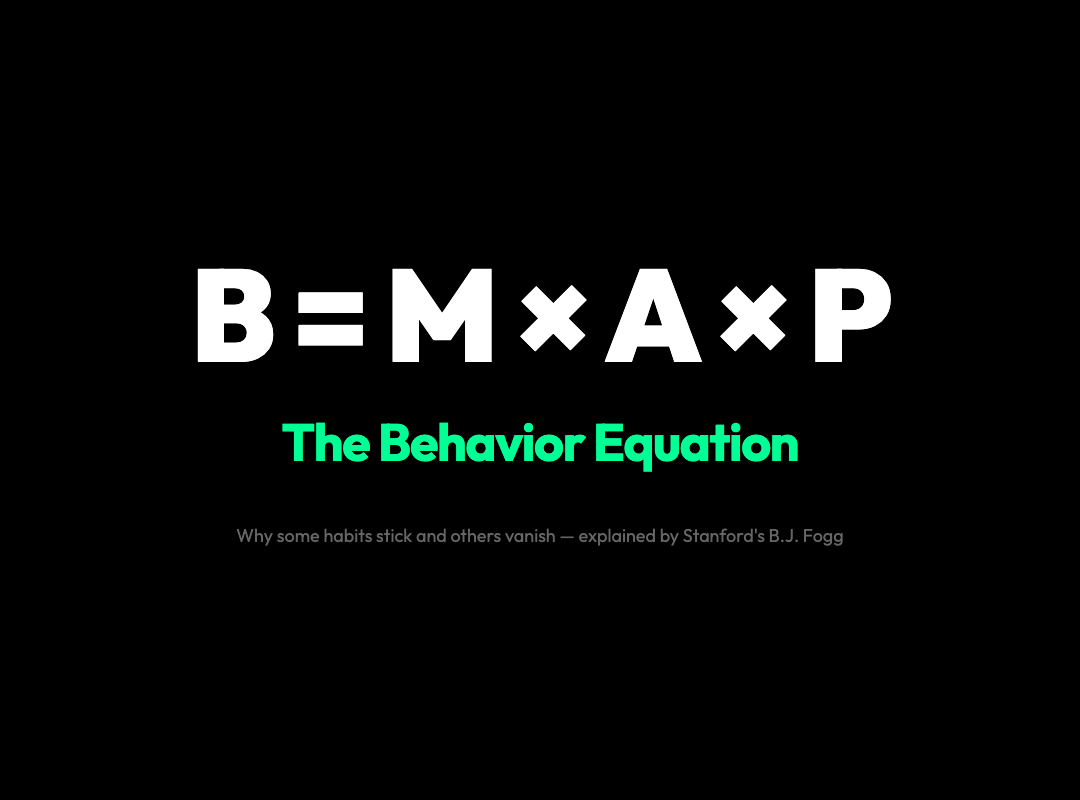
B = M × A × P
In 2009, a behavioral scientist named B.J. Fogg at Stanford University published what would become one of the most influential frameworks in psychology and product design. His thesis was simple, almost embarrassingly obvious in hindsight:
Behavior happens when three elements converge at the same moment: Motivation, Ability, and a Prompt.
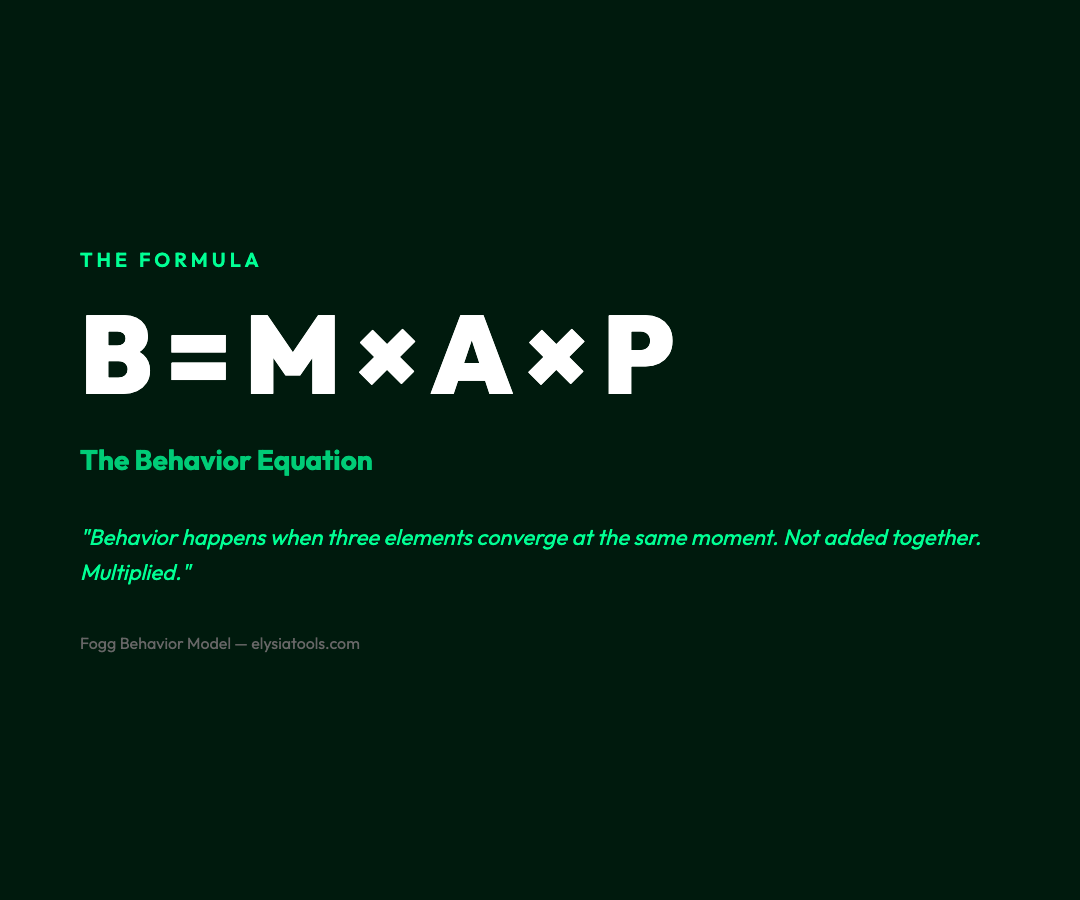
Not added together. Multiplied.
B = M × A × P
If any one of these is zero, the behavior doesn’t happen. Motivation could be at 100, Ability at 80, Prompt at 0 — the result is still zero. No behavior fires.
This seemingly simple multiplication is the reason most habit-change efforts fail. People pour everything into motivation — inspirational videos, accountability partners, sheer determination — while ignoring the two other legs of the stool.
Why Motivation Is Overrated
Think about the last time you really, genuinely wanted to do something. Maybe it was exercising. Maybe it was calling your parents. Maybe it was starting that side project you’ve been dreaming about for months.
Your motivation was high. You were ready. And then… nothing happened.
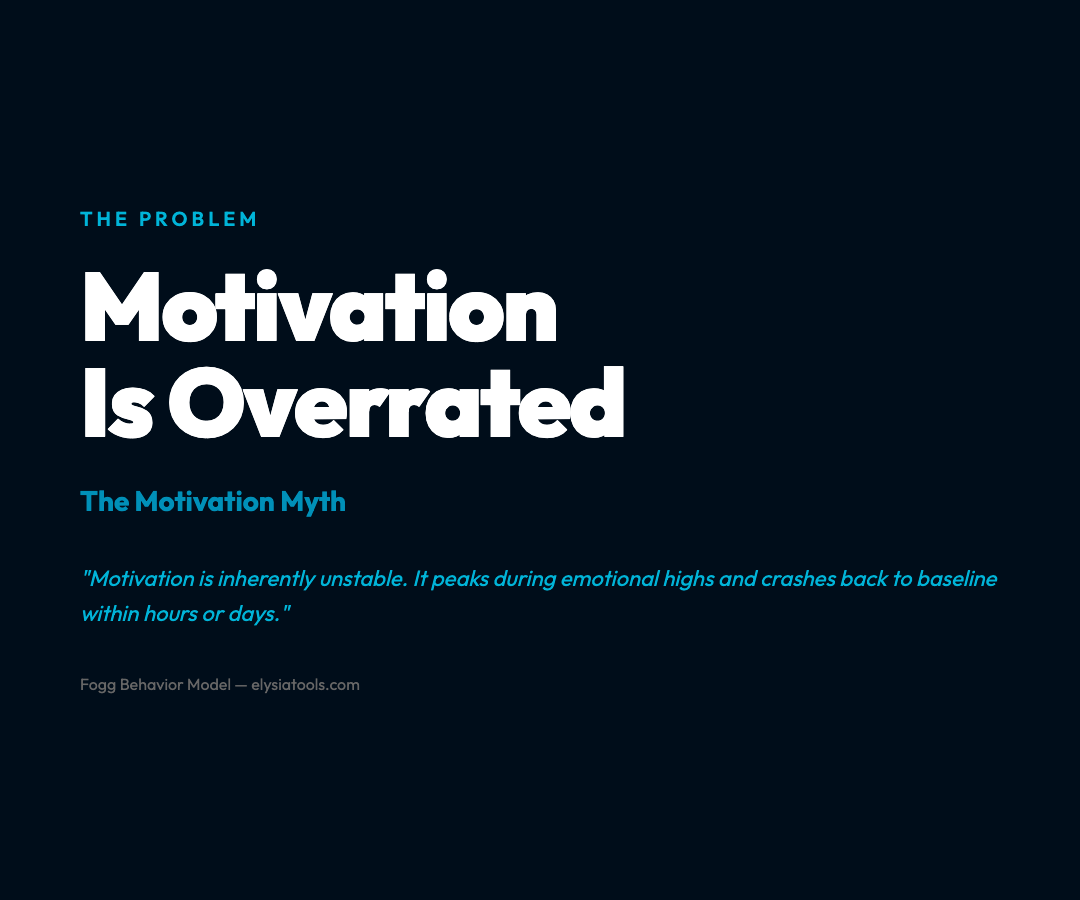
This is the Motivation Myth in action. Fogg’s research, backed by years of experimental data, shows that motivation is inherently unstable. It peaks during emotional highs — the New Year, the inspirational podcast, the late-night epiphany — and crashes back to baseline within hours or days.
The irony? When motivation is highest, people tend to set the most ambitious goals. They take on massive behavior changes that require enormous amounts of Ability. Then when motivation inevitably dips — and it always does — the behavior becomes impossible to execute.
The result: a cycle of ambition, failure, and guilt.
Fogg’s prescription is counterintuitive: don’t start with motivation. Start with tiny behaviors.
The Power of Making It Stupidly Easy
In Fogg’s framework, Ability is about making a behavior easy to do — not about becoming a more disciplined person. And the path to easier is often obvious once you stop and think about it.
There are five ability factors:
– Time — Does the behavior take two minutes or twenty? – Money — Does it cost anything to participate? – Physical effort — Is it physically demanding? – Mental effort — Does it require heavy thinking or planning? – Routine — Does it fit naturally into your existing habits?
Each of these is a lever you can pull. Want to exercise more? Don’t start with an hour at the gym. Start with putting your running shoes by the door. The shoes-by-the-door behavior requires zero motivation to execute. It’s just there, waiting.
This is what Fogg calls a “tiny habit” — a behavior so small it almost feels ridiculous. But tiny habits compound. And they build identity: I’m the kind of person who puts on running shoes every morning, not I’m the kind of person who needs to force themselves to exercise.
The Missing Element Nobody Talks About
Here’s the part that most habit advice completely ignores: Prompt.
Prompts are the trigger that tells your brain to act right now. Without a prompt, even high motivation and easy ability lead to nothing. The behavior just… doesn’t fire.
Fogg categorizes prompts into three types:
– Spark — A motivational trigger when ability is high but motivation is low (an emotional ad, a compelling story) – Facilitator — A trigger that makes the behavior easier when motivation is high but ability is low (a step-by-step wizard, a simplified interface) – Signal — A simple reminder when both motivation and ability are already sufficient (a notification, an alarm, a calendar reminder)
The signal is what most people rely on — and what most people get wrong. They set a vague reminder like “exercise more” and then wonder why nothing happened. A proper signal needs to be specific, timed, and contextual.
“After I pour my morning coffee, I will do one push-up.” That’s a signal. It’s tied to an existing routine, happens at a specific moment, and requires zero decision-making.
Why Some Apps Make It Impossible to Not Use Them
If you’ve ever wondered why some apps are seemingly addictive while others — often better-designed ones — gather dust, the Fogg model explains it.
The most engaging apps are engineered around B = M × A × P:
– Motivation is boosted through notifications that appeal to loss aversion (“Your streak is about to break!”), social proof (“Your friends are already on it”), or immediate reward. – Ability is maximized through onboarding flows that remove friction, one-tap interfaces, and default behaviors that require zero effort. – Prompts are perfectly timed: when you’re most likely to act, right when the app sends that notification.
Instagram doesn’t make you scroll for two hours because you’re extremely motivated. It makes it extremely easy (infinite scroll, autoplay) and triggers you at moments when you have nothing competing for your attention.
This is also why removing social media apps from your phone is so effective. It doesn’t reduce your motivation to check — it reduces your ability to do so at the exact moments the prompt fires.
Tiny Habits, Massive Compound Interest
Perhaps the most powerful application of Fogg’s model is in behavior design for personal change.
Fogg’s own research shows that the most sustainable behavior changes start absurdly small:
– After I pee, I will do one squat. – After I close my laptop, I will put my workout clothes on the bed. – After I brush my teeth, I will write one sentence in my journal.
One squat. Clothes on the bed. One sentence.
These behaviors are so tiny they require essentially no motivation and no ability. But they’re hooks. They create a pattern. And once the pattern is established, it’s natural to scale up — one squat becomes five, then ten, then a full workout.
The compounding effect is what makes this approach devastatingly effective. A 1% improvement every day produces 37x improvement over a year. But you don’t even need 1% improvement. You need 0.1%. You just need to show up.
The Model That Changed How Silicon Valley Thinks About Behavior
Fogg’s behavior model has been adopted by some of the world’s most successful technology companies. The same framework that explains habit formation also explains how to design products that people can’t put down.
But its real power is in personal application. Once you see the equation, you start noticing it everywhere:
– Why your morning routine keeps failing (no signal, or ability too low after a long day) – Why your productivity app sits unopened (motivation was high during download, ability is low because you’re already overwhelmed) – Why that “accountability partner” didn’t help (you had motivation and prompts, but ability was still too hard)
The fix is never to try harder. It’s always to engineer the equation differently.
Try it right now. Pick one behavior you keep failing at. Ask yourself three questions:
- Motivation — Is there a way to make myself want this more, without relying on willpower?
- Ability — Can I make this behavior 10x easier before I try to do it?
- Prompt — What existing routine can I anchor this to, so the trigger is automatic?
B = M × A × P. All three, at the same moment. That’s the whole game.