The Most Counterintuitive Prediction in Physics: Black Holes Slowly Evaporate Into Nothing
For decades, black holes were the simplest objects in the universe. Fall in, and you never come out. Not light, not information, not energy — nothing crosses the event horizon and returns. That was the definition. That was the rule.
Then, in 1974, Stephen Hawking showed it was all wrong.
The insight came quietly. Hawking was studying quantum fields near the boundary of a black hole when he noticed something strange: the vacuum itself — empty space, nothing in it — was not empty at all. Pairs of virtual particles were constantly flickering in and out of existence, particle and antiparticle, born from nothing and immediately annihilating back to nothing. This is a core prediction of quantum field theory, and it happens everywhere in the universe, all the time.
But at the edge of a black hole, the event horizon changes everything.
One particle falls in. The other escapes.
The escaping particle carries real, positive energy — measurable radiation streaming outward from the black hole. The infalling particle, meanwhile, carries negative energy relative to infinity. When it disappears into the singularity, it doesn’t just vanish. It subtracts from the black hole’s mass.
The black hole loses weight. Very slowly. Very quietly. But it loses weight.
This is Hawking radiation — and it means black holes are not eternal. They evaporate. They shrink. Given enough time, every black hole in the universe will eventually disappear.

The Temperature Nobody Expected
What Hawking derived is deceptively simple. The temperature of this radiation is inversely proportional to the black hole’s mass:
T = ℏc³ / 8πGMk
where ℏ is the reduced Planck constant, c is the speed of light, G is the gravitational constant, M is the black hole’s mass, and k is Boltzmann’s constant.
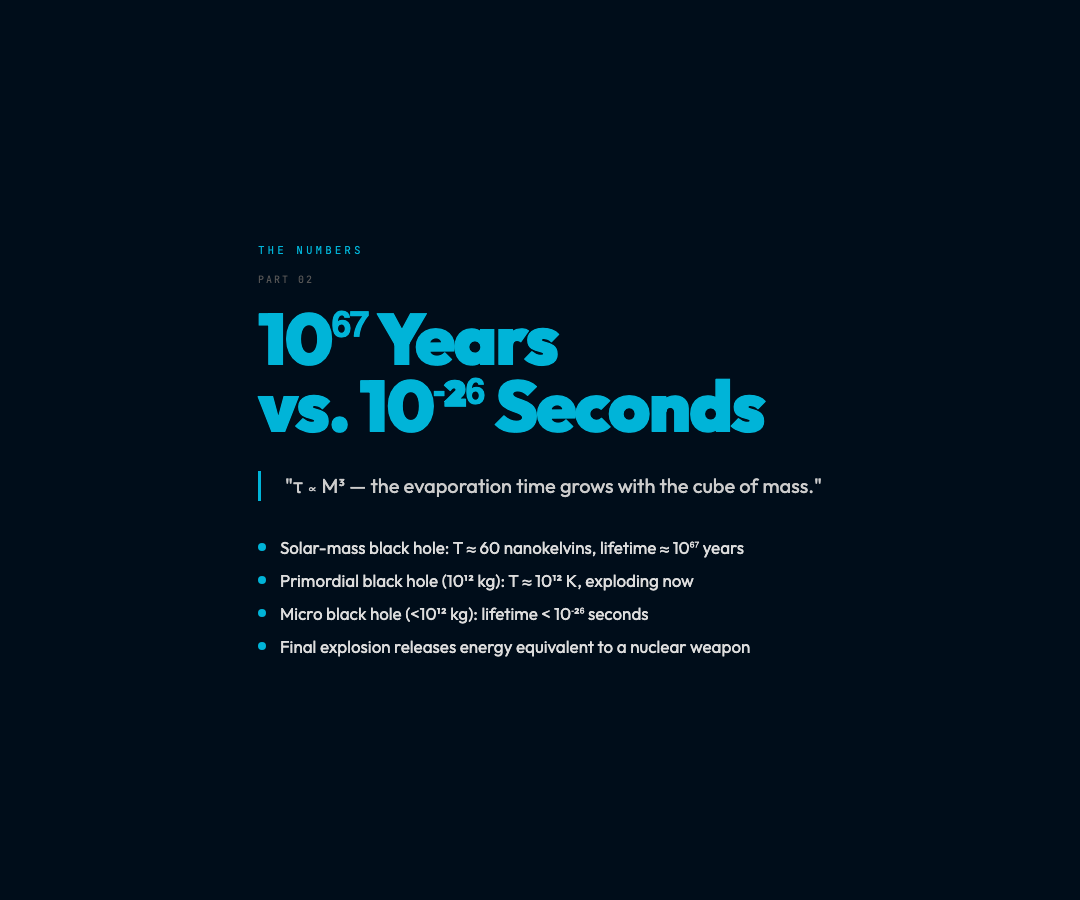
Plug in the numbers for a black hole with the mass of our Sun, and you get a temperature of about 60 nanokelvins — colder than the cosmic microwave background that fills the entire universe. For comparison, interstellar space has a temperature of about 2.7 kelvins, and the coldest place ever measured on Earth was 38 picokelvins. A solar-mass black hole is radiating at 60 nanokelvins. It is extraordinarily cold, and losing energy so slowly it is effectively stable.
Now take a black hole with the mass of a small asteroid — about 10¹² kilograms. Its Hawking temperature is roughly 10¹² kelvins. That is hotter than the surface of any star. It is blazing. And it is evaporating violently.
The relationship is stark: the smaller the black hole, the hotter it is. The hotter it is, the faster it radiates. The faster it radiates, the more mass it loses. The more mass it loses, the smaller it gets. The smaller it gets, the hotter it is. The evaporation accelerates.
A stellar-mass black hole with 10 solar masses will live for approximately 10⁶⁷ years — far longer than the current age of the universe, which is about 1.4 × 10¹⁰ years. Our Sun will die in about 5 billion years. The black hole will still be there, slowly radiating, long after every star in the Milky Way has burned out.
But a primordial black hole — the kind that might have formed in the violent conditions of the early universe — with a mass of 10¹² kilograms would be finishing its life right now. Its final second is a blaze of gamma rays. Hawking predicted that small black holes might be detectable as sources of gamma-ray bursts — explosions of high-energy radiation marking their death.
No such burst has been conclusively linked to a primordial black hole. But the search continues.
The Final Explosion
As the black hole shrinks to planck-scale masses, the evaporation rate becomes extreme. In the last fraction of a second, the black hole releases the equivalent energy of a nuclear weapon — all in the final instant before it vanishes.
What happens at that moment? General relativity offers no answer. Quantum mechanics offers no answer. The intersection of the two — where gravity becomes as strong as the other fundamental forces — is uncharted territory that physicists call quantum gravity. Hawking radiation points directly at this gap in our knowledge. It is one of the few places where we know our current theories break down, even though we cannot yet see the new ones.
This is what makes the effect so remarkable: it was derived by applying quantum field theory in curved spacetime — a hybrid framework that does not claim to be the final theory of everything. And yet it produced a prediction that sits at the absolute frontier of physics.
The Information Paradox
There is a deeper wound Hawking’s calculation inflicted on physics. In quantum mechanics, information is never destroyed. If you know the complete quantum state of a system at one moment, you can in principle predict its state at any future moment. This unitarity — the reversibility of quantum evolution — is foundational to all of quantum physics.
But Hawking radiation is thermal radiation. A perfect blackbody spectrum with a temperature determined solely by mass. Two black holes with the same mass, whatever they swallowed — one made of iron, one made of gold, one made of pure radiation — produce identical Hawking spectra. The information about what fell in appears to be lost forever.
If black holes evaporate completely, and the radiation carries no information, then information has been destroyed. Quantum mechanics has been violated.
Hawking famously declared that “black holes ain’t as black as they were painted” — but he initially concluded they really do destroy information. He later changed his mind, as did much of the field. Today, most physicists believe information must be preserved — and that the resolution of the paradox will reveal something profound about the nature of space, time, and quantum gravity.
The holographic principle, string theory, and various proposals for black hole complementarity all attempt to resolve this. The basic idea of complementarity is that what falls in never actually crosses the horizon from the infalling observer’s perspective — it appears to hover at the surface, encoded in subtle correlations in the radiation. The information never enters the black hole. It is on the horizon all along.
If true, Hawking radiation is not just thermal noise. It carries a faint imprint of everything the black hole ever consumed.

What You Can See and Explore
The ElysiaTools Black Hole Hawking Radiation visualization lets you experiment with this physics directly. You can:
- Set the initial mass of the black hole from a solar-mass stellar black hole down to a primordial micro black hole
- Watch the evaporation in real time as the mass decreases and the temperature rises
- Observe the relationship between mass, temperature, power output, and remaining lifetime
- Toggle visualization layers including the accretion disk, relativistic jets, virtual particle pairs, and the event horizon
- See the information paradox indicator and how it evolves as the black hole shrinks
The visualization shows the Hawking temperature equation, the Schwarzschild radius formula, the evaporation rate, and the full set of equations governing this process — each rendered with interactive controls so you can develop genuine intuition for the physics.
Follow this link to explore: Black Hole Hawking Radiation
Why It Matters
Hawking radiation is one of the most consequential theoretical predictions in modern physics — not because we have seen it, but because it is a concrete, calculable bridge between quantum mechanics and general relativity. It tells us that black holes are not endpoints. They are temporary structures in a universe that is slowly evaporating.
It tells us that even at the event horizon — the most notorious boundary in physics — quantum mechanics refuses to be silent.
And it tells us that the final theory of quantum gravity, whatever form it takes, will have to explain where the information goes when a black hole disappears. Hawking spent the last decades of his life on that question. He did not solve it. Nobody has. But the question itself is now one of the most important open problems in all of science — and it all started with the quiet realization that black holes aren’t perfectly black, and never were.
The Schwarzschild radius of a black hole is r_s = 2GM/c². For a one-solar-mass black hole, this is about 3 kilometers. For a 10¹² kg primordial black hole, it is about 10⁻¹⁵ meters — roughly the size of a proton.