The Wave That Survives Every Collision
In 1834, a young Scottish engineer named John Scott Russell was riding alongside the Edinburgh-Glasgow canal on horseback when he saw something that would haunt him for the rest of his career.
A boat stopped suddenly. The water it had been pushing piled up at the bow, then slid off and kept going — a single, smooth mound of water, about a foot high and thirty feet long, traveling down the canal at roughly eight miles per hour. Russell spurred his horse and rode alongside it for several miles before it finally died out against the canal wall.
He called it “the wave of translation.” Modern physics calls it a soliton.
The Problem With Ordinary Waves
Most waves are fragile. Drop a stone in a pond and you get ripples — they spread out, grow weaker, and disappear. This is dispersion: different wavelengths travel at different speeds, so the wave packet that started as one coherent shape soon becomes a smeared-out wash of water.
Now imagine a different kind of wave. One that doesn’t disperse. One that travels for miles without changing shape. One that, when it collides with another wave of the same kind, passes through — unharmed, unchanged, as if the other wave never existed.
That’s a soliton. And the fact that it exists at all is a genuine miracle of mathematics.
The Equation That Shouldn’t Have a Solution
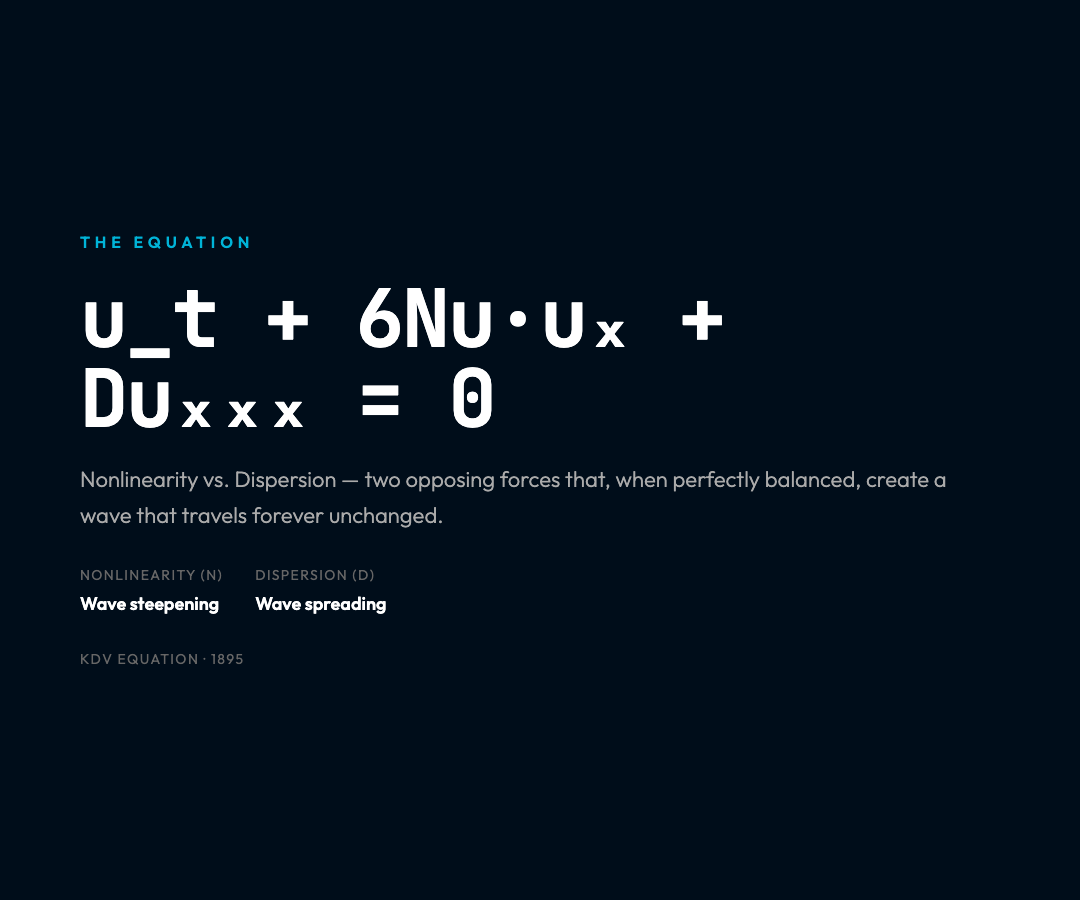
In 1895, Dutch mathematicians Diederik Korteweg and Gustav de Vries wrote down an equation to describe waves in shallow water. It looked like this:
u_t + 6N × u × u_x + D × u_xxx = 0Where N controls nonlinearity (how much taller parts of the wave outrun shorter parts) and D controls dispersion (how much the wave spreads out). The equation was interesting, but most mathematicians assumed its solutions would behave like ordinary waves — they would spread, weaken, and dissipate.
Then someone actually solved it.
What emerged from the math was a solitary wave that maintained its shape exactly. The nonlinear term (6N × u × u_x) tries to make the wave peak taller and steeper. The dispersive term (D × u_xxx) tries to smear it out. When N and D are perfectly balanced, they cancel — and the wave neither sharpens nor spreads. It just… travels.
The Collision That Shouldn’t Be Possible
Here’s the part that sounds impossible: when two solitons collide, they pass through each other.
Not metaphorically. Not approximately. Exactly.
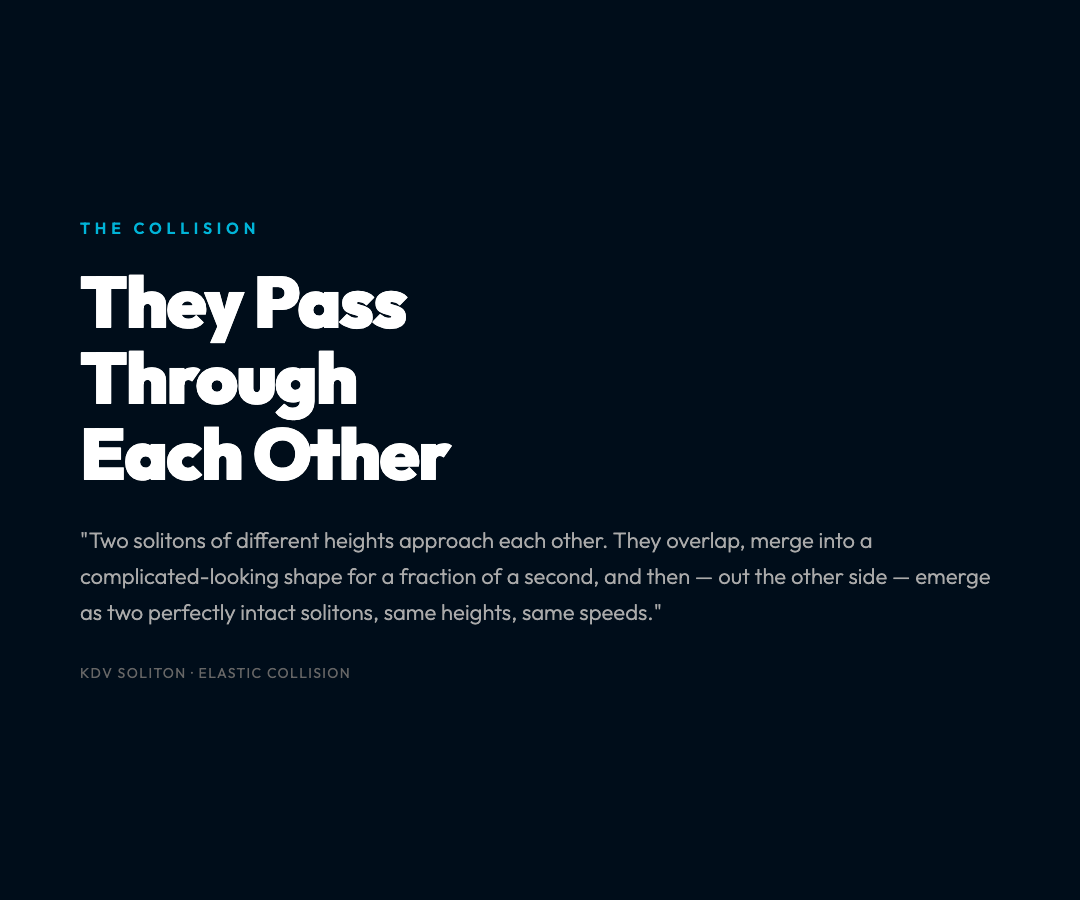
Watch the animation closely. Two solitons of different heights approach each other. They overlap, merge into a complicated-looking shape for a fraction of a second, and then — out the other side — emerge as two perfectly intact solitons, same heights, same speeds, just slightly phase-shifted.
The taller (faster) soliton has moved a little ahead of where it would have been without the collision. The shorter (slower) one has fallen a little behind. But their shapes? Identical. Their speeds? Exactly what the math predicted.
This is what physicists call an elastic collision — no energy lost, no shape distorted. The same property that particles have in particle physics. But these are waves. In water.
The KdV Soliton Visualization
The KdV Soliton visualization on ElysiaTools lets you play with this directly.
In Single Soliton mode, adjust the amplitude and dispersion sliders. Watch how the wave’s speed changes — taller solitons travel faster, exactly as the math predicts (speed is proportional to the square root of amplitude). Watch how the width changes inversely — taller solitons are narrower.
In Two-Soliton Collision mode, set two solitons of different amplitudes on a collision course. Observe the brief moment of overlap, then watch them emerge intact.
In Space-Time Diagram mode, you see the full history. Each horizontal slice is a snapshot of the wave at a given moment in time. A soliton appears as a diagonal line. Where two solitons cross, the lines momentarily merge — then continue on their separate diagonal paths, just phase-shifted.
Where Solitons Actually Exist
This isn’t just a mathematical curiosity. Solitons appear everywhere.
Fiber optics: When Bell Labs wanted to send light pulses across the ocean, they faced a problem: ordinary light pulses spread out over distance, until the signal becomes noise. Soliton pulses solve this. A pulse shaped as a soliton maintains its shape indefinitely — no dispersion, no loss. Modern long-haul fiber optic cables use soliton-like pulses.
Tsunami: A tsunami in deep ocean is approximately a soliton. It travels across thousands of miles of open ocean without significantly dispersing, then steepens dramatically when it hits shallow water — which is why it arrives as a wall of water rather than a gradually rising tide.
Bose-Einstein condensates: In ultracold atomic gases, matter waves can form soliton-like structures. A “bright soliton” in a BEC is a self-trapped clump of atoms that doesn’t spread out, even though quantum mechanics normally causes wave packet spreading.
Plasma physics: Ion-acoustic solitons occur naturally in space plasmas, from the solar wind to the magnetospheres of planets.
Molecular biology: Some researchers hypothesize that energy transport along protein molecules involves soliton-like mechanisms — a packet of vibrational energy that travels without dissipating, delivering energy exactly where it’s needed.

The Deeper Pattern
What makes solitons so profound isn’t just their practical utility. It’s what they represent as a pattern in nature.
Most systems have a tendency toward disorder. Waves disperse. Heat flows from hot to cold. Entropy increases. This is the Second Law, and it’s one of the most iron-clad rules in physics.
But solitons are a counter-example. They are pockets of permanent order emerging from the interaction of opposing tendencies — nonlinearity and dispersion, steepening and spreading. The disordering tendency (dispersion) doesn’t win. Neither does the ordering tendency (nonlinearity). They reach a perfect stalemate — and the result is something that travels forever, unchanged.
This is why John Scott Russell rode after that wave on horseback for miles. He knew he had seen something that shouldn’t exist. He was right. It took sixty years for mathematicians to prove him correct.
The KdV Soliton visualization lets you prove it to yourself — in about thirty seconds of clicking sliders.
Try the KdV Soliton interactive visualization on ElysiaTools — free, no sign-up required.