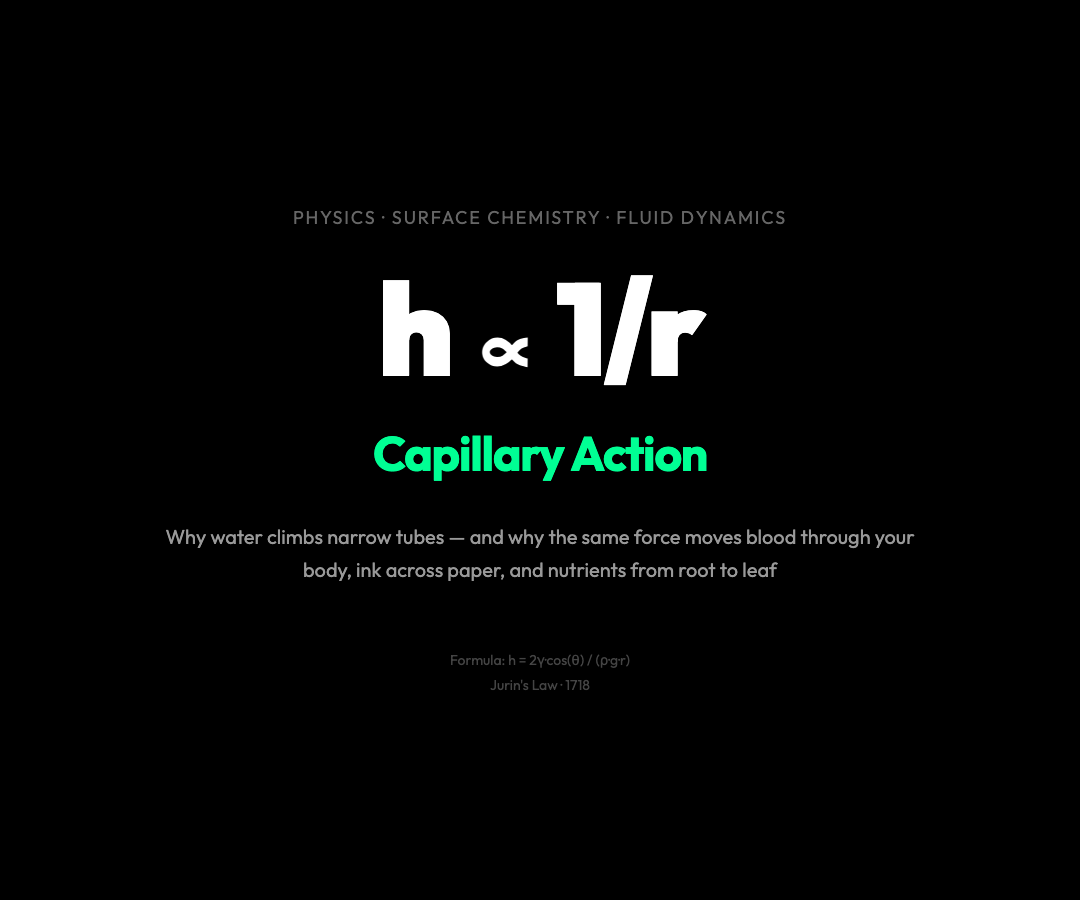
Why Water Defies Gravity in Thin Tubes — And Why It Matters More Than You Think
Every introductory physics textbook mentions capillary action in a single paragraph, then moves on to more dramatic phenomena. Gravity, electromagnetism, quantum mechanics — those get the headlines. Capillary action gets a footnote.
This is a mistake. The same force that makes water climb a few millimeters up a glass tube is also the reason your body can move water from your toes to your brain without a pump, why plants survive, and why pregnancy tests work at all.
The physics is simple. The implications are not.
The Setup: A Thin Tube and a Pool of Water
Place a glass tube with a radius of 0.5 millimeters vertically into a dish of water. The water will rise inside the tube, sitting about 3 centimeters higher than the water in the dish. No pump. No vacuum. No visible mechanism pushing it up.
This was documented as early as 1718 by James Jurin, who showed that the rise height is inversely proportional to the tube radius. Halve the radius, and the water climbs twice as high. In a tube 100 micrometers across — roughly the width of a human hair — water can rise over a meter.
The formula is clean:
h = 2γ·cos(θ) / (ρ·g·r)
Where h is the rise height, γ is surface tension, θ is the contact angle between water and the tube wall, ρ is water density, g is gravitational acceleration, and r is the tube radius.
What makes this equation interesting isn’t the algebra. It’s the three forces it balances: surface tension pulling upward along the circumference of the meniscus, gravity pulling the water column downward, and the contact angle determining whether the liquid even touches the wall in a way that enables climbing.
The Meniscus Is Where the Action Happens
The curved surface at the top of the water column — the meniscus — is not just an interface. It’s a mechanical structure.
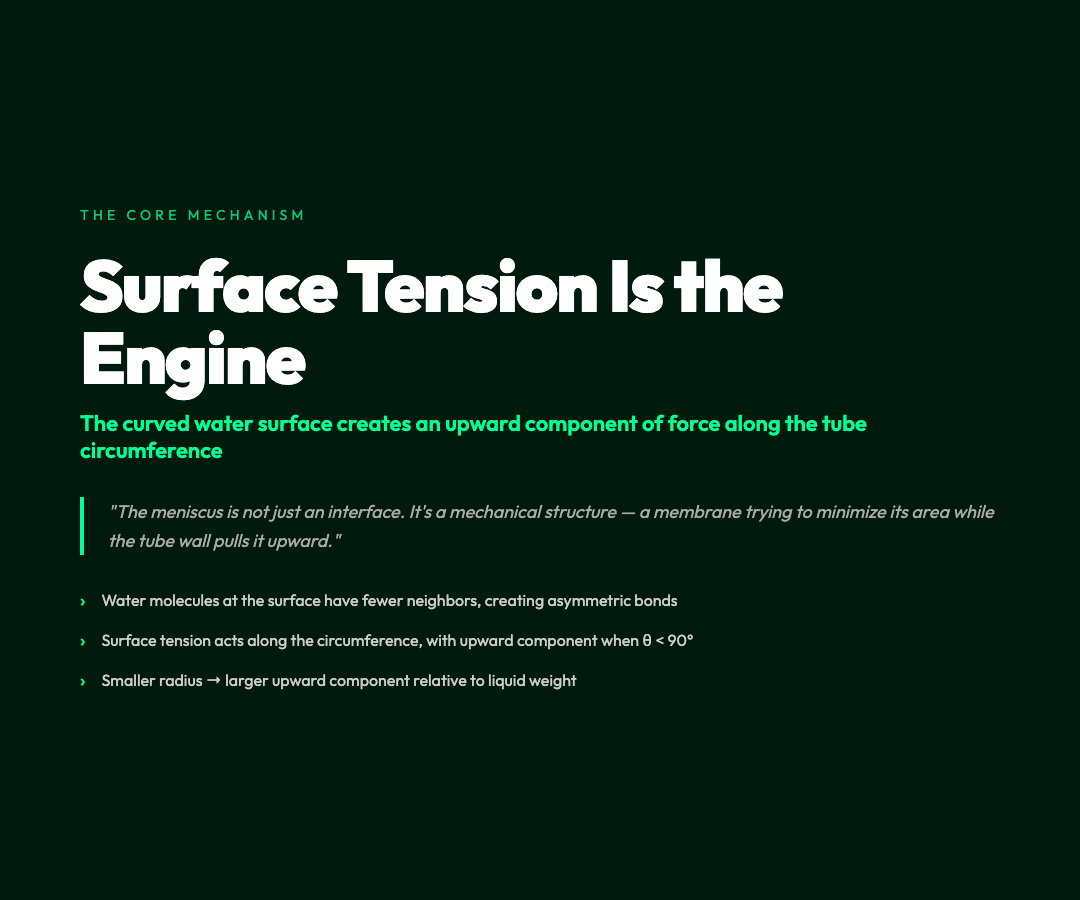
Water molecules at the surface experience a different environment than those in the bulk. Inside the liquid, each water molecule is surrounded by other water molecules making roughly equal bonds in all directions. At the surface, molecules have fewer neighbors. This asymmetry creates surface tension: the surface behaves like a stretched membrane trying to minimize its area.
In a capillary tube, that “membrane” is curved. Surface tension acts along the circumference of the curve, with a component pointing upward whenever the liquid wets the tube wall (contact angle less than 90°). The smaller the radius, the larger this upward component relative to the weight of the liquid column.
The contact angle itself is determined by the relative strength of two forces: adhesion between water and the tube material versus cohesion within the water itself. Water strongly adheres to glass — the contact angle is around 30°, and water climbs. Mercury does the opposite on glass — it contacts at 140°, the meniscus convexes downward, and the liquid level inside the tube drops below the external level. Same glass, opposite behavior, entirely because of whether the adhesive or cohesive forces win.
Why Plants Are Hydraulic Marvels
A redwood tree can be over 100 meters tall. The crown is 30 stories above the roots. No pump circulates water upward — there’s no mechanical heart in the xylem.

What exists instead is a column of water pulled upward by evaporation from the leaves. As water transpires from leaf stomata, it creates negative pressure (tension) in the xylem vessels. That tension is transmitted down through the continuous water column all the way to the roots, pulling water upward against gravity.
The mechanism is identical to capillary action, scaled up. Xylem vessels range from 10 to 100 micrometers in diameter — within the range where capillary forces become significant. More importantly, the same cohesion that creates surface tension also keeps the water column intact under tension. Water’s strong hydrogen bonding network allows it to withstand negative pressures that would vaporize other liquids.
This is why plants wilt rather than bleed when you cut them. The tension collapses, the column separates, and no blood-equivalent flows. The system is elegant and fragile in equal measure.
The Pregnancy Test You Already Used
Flip over a standard lateral flow pregnancy test and you see a small window with a nitrocellulose strip inside. That strip contains antibodies linked to colored particles. When urine flows across the strip via capillary action —wicking from one end to the other — it carries the sample with it.
If the sample contains hCG (human chorionic gonadotropin, the hormone produced by a developing placenta), it binds to the antibodies at the “test line” region, creating a visible colored band. No pump. No electricity. Just the physics of water climbing a narrow fiber matrix by adhesion and surface tension.
The same principle powers most modern diagnostic strips: COVID antigen tests, blood glucose meters, drug screening assays. They all rely on capillary-driven flow to move a precise volume of fluid across a precise distance in a precise time. The engineering of those strips — fiber diameter, channel geometry, flow rate — is an exercise in controlling capillary forces.
The Space Context: Capillarity Dominates at Small Scales
In microgravity, buoyancy-driven convection disappears. Heated fluids don’t rise and sink — they stay put. This breaks most traditional heat transfer systems.

Capillary-driven flow, however, works identically in orbit. Surface tension doesn’t depend on gravity. Capillary-driven cooling systems (loop heat pipes) are used on satellites and the International Space Station precisely because they function without mechanical pumps or gravity. The fluid is moved by wicking structures and evaporation-condensation cycles that operate on molecular forces alone.
There’s a more dramatic implication. If you tried to grow plants in a spacecraft using traditional irrigation, the water would ball up into floating spheres rather than flowing through soil. But plant roots have evolved to exploit capillary action specifically — water clings to soil particles and moves between them by capillary forces. The same mechanism that makes water rise in a glass tube is what lets terrestrial plants colonize any land environment on Earth, and potentially, off it.
What Jurin Couldn’t Have Predicted
Jurin worked with glass tubes and water. His equation assumed perfectly cylindrical tubes and static equilibrium. Real-world capillaries are neither.
In plant xylem, vessels have irregular cross-sections, occasional air embolisms (cavitation), and variable wall chemistry. In medical diagnostics, the “tubes” are porous polymer fibers with complex geometry. In microfluidics, the channels are etched into silicon wafers with dimensions measured in microns.
All three domains still obey Jurin’s law as a first approximation, but the deviations are where the interesting engineering happens. controlling capillary flow in irregular, branching, or chemically patterned surfaces is the core challenge of modern lab-on-a-chip design.
A 2019 paper in Nature Communications described a capillary-driven microfluidic system that could perform a complete blood cell count analysis using no external power — just the physics of wetting and wicking. The device separated plasma from whole blood, counted cells, and measured hematocrit, all through carefully designed channel geometry that exploited contact angles and surface energy gradients.
That’s not a footnote. That’s a revolution in medical instrumentation quietly happening because of an equation James Jurin wrote down in 1718.
The Invisible Infrastructure
Most physical phenomena we teach in schools have an engineering analog: electrical circuits map to hydraulic systems, heat transfer maps to diffusion, quantum tunneling maps to nothing in daily life.
Capillary action is different. It’s not an analogy — it’s the actual mechanism. Water in soil, in paper, in porous rock, in biological tissue, in polymer fiber matrices. All of it moves by the same molecular forces Jurin quantified.
We built our entire civilization on top of it. Paper absorbs ink because of capillary action. Cotton fabrics wick sweat. The ink in fountain pens climbs fibers to reach the tip. Groundwater replenishes aquifers through capillary forces in soil. Oil migrates through porous rock formations to accumulate in reservoirs.
None of this requires a mechanism. It all happens because of water’s tendency to stick to surfaces and minimize its free surface energy. Capillary action isn’t a curiosity. It’s the plumbing of the natural world — and increasingly, the engineering of our machines.