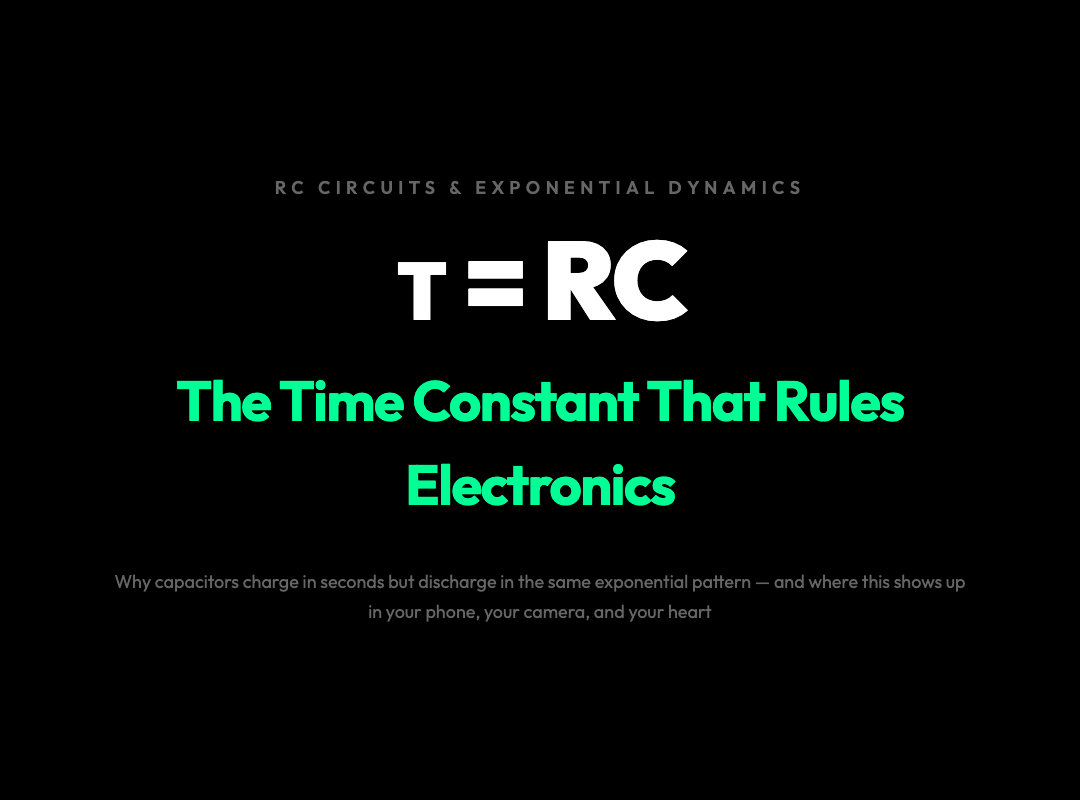
Why Your Phone Charges Slowly When It’s Cold — and What Physics Has to Do With It
Every lithium-ion battery has a dirty secret: it charges faster in summer than in winter. Leave your phone in a cold car overnight, and that “fast charge” label on your charger suddenly doesn’t deliver. Plug it back in at the beach, and it fills up noticeably quicker. Nobody puts this on the box, but it’s pure circuit physics — the same exponential dynamics that govern every RC circuit on the planet.
The capacitor is one of the most fundamental components in electronics. It’s essentially two metal plates separated by an insulator, and when you apply voltage across those plates, charge accumulates and energy gets stored in the electric field between them. The charging process isn’t linear — it follows a precise exponential curve that shows up everywhere: in how long your phone takes to charge, in the timing circuits inside CPUs, in the flash of a camera, and in the defibrillator that might save your life one day.
The One Number That Predicts Everything: τ = RC
The time constant τ = RC is the heartbeat of every RC circuit. R is resistance in ohms, C is capacitance in farads, and their product gives you a time in seconds. At t = τ, a charging capacitor reaches 63.2% of its final voltage. At t = 5τ, it reaches 99.3% — close enough to fully charged that engineers treat it as complete.

This isn’t an approximation. It’s baked into the math. The charging voltage follows V(t) = V₀(1 − e^(−t/RC)). The discharging voltage follows V(t) = V₀·e^(−t/RC). These two equations — one rising, one falling — describe the transient behavior of every circuit that has a resistor and a capacitor together.
What makes τ = RC so powerful is that it works in both directions. You can use it to predict how quickly a circuit will respond, or you can measure the response and back-calculate the component values. This is exactly what engineers do when they’re debugging a circuit — they look at the exponential waveform on an oscilloscope, measure how long it takes to reach 63.2%, and immediately know the RC product.
Why the Current Flows Backwards at the End
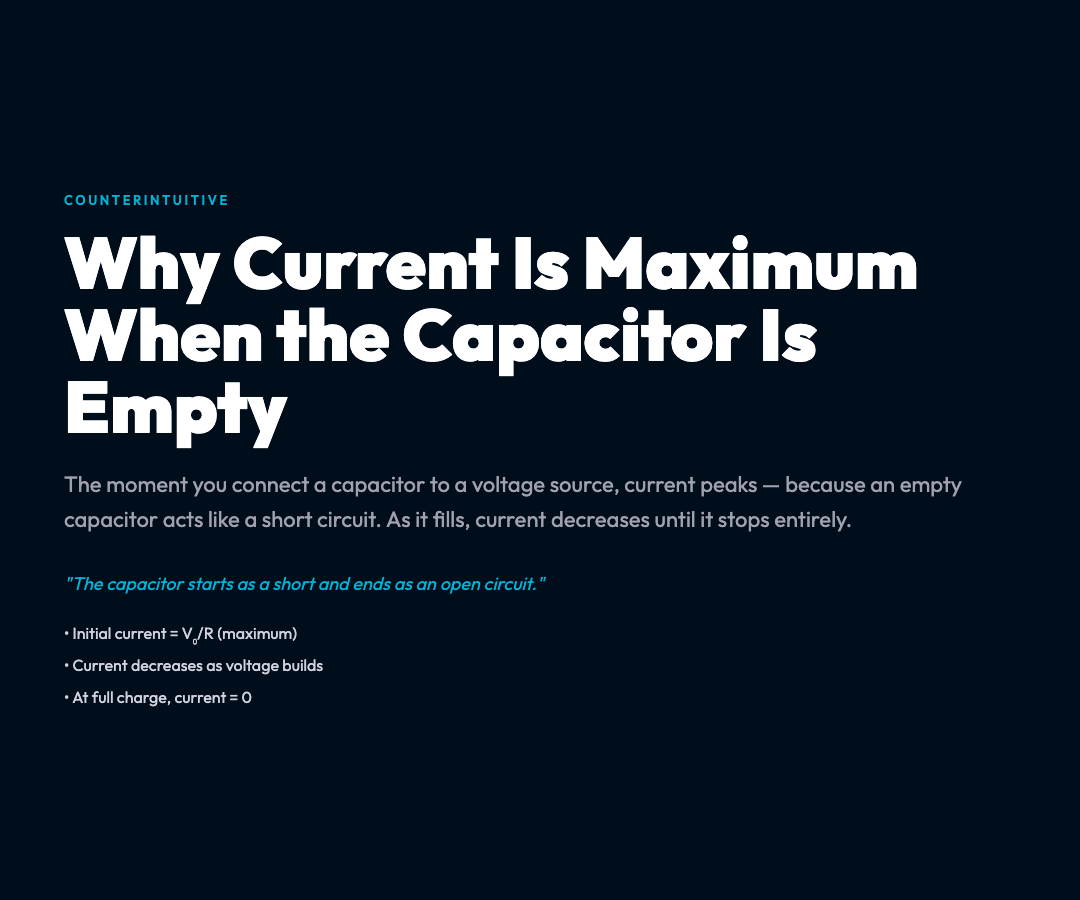
Here’s something counterintuitive about charging a capacitor. The moment you connect it to a voltage source through a resistor, the current is at its maximum — equal to V₀/R. The capacitor is empty, so it behaves like a short circuit. As charge accumulates, the voltage across the capacitor rises, opposing the source voltage, and the current decreases. By the time the capacitor is fully charged, current has stopped flowing entirely.
During discharge, the capacitor reverses roles. It becomes the voltage source, and current flows out of it — in the opposite direction of charging current. The voltage across the capacitor decays exponentially as the stored charge flows through the resistor, eventually dropping to zero.
This reversal is what makes capacitors so useful as energy reservoirs. A charged capacitor can deliver its stored energy almost instantaneously — that’s why a camera flash fires the instant you press the button, rather than building up gradually like a battery would.
Where RC Circuits Show Up in the Real World
Every smartphone uses RC dynamics to manage battery charging. The charging circuit monitors voltage across the battery (which acts as a capacitor) and adjusts current based on how close it is to full. When the voltage reaches 63.2% of the charging voltage, the circuit knows it’s at one time constant — and can estimate how much longer until full charge.
In audio equipment, RC circuits act as filters. A high-pass filter blocks low frequencies by using a capacitor in series with the signal path — bass gets attenuated because the capacitor’s reactance is higher at low frequencies. A low-pass filter does the opposite, placing the capacitor in parallel to shunt high frequencies to ground. These simple circuits are the building blocks of every equalizer, crossover network, and tone control ever made.
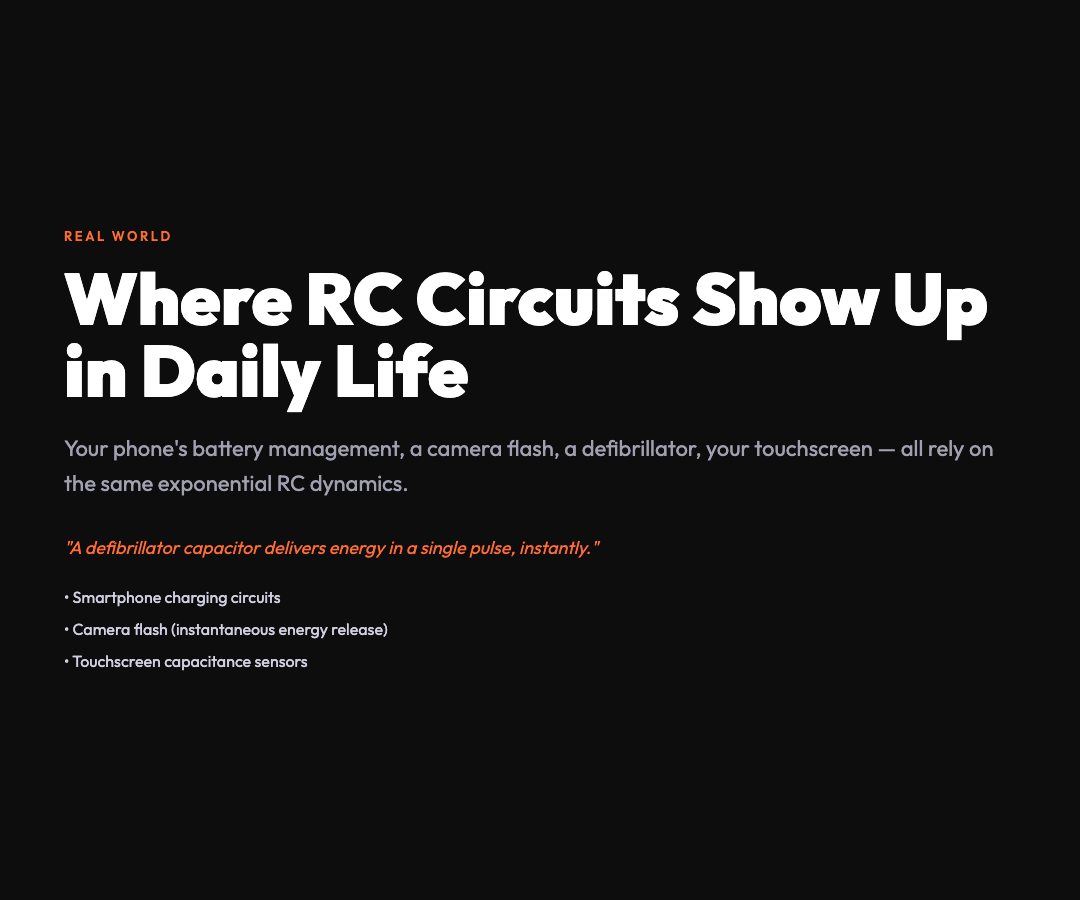
Medical devices depend on RC timing in ways that are literally life-critical. A defibrillator charges a capacitor to a high voltage, then delivers that energy in a single pulse when the pads are placed on a patient’s chest. The charge time is determined by τ = RC — too slow and you delay treatment, too fast and you risk damaging the circuitry. Pacemakers use similar RC timing to deliver precisely metered electrical pulses to keep a failing heart in rhythm.
Touchscreens work because your finger changes the capacitance of a grid of sensors. The circuit measures the RC constant at each intersection — when your finger gets close, it adds its own capacitance to the local field, changing the time constant in a detectable way. The phone’s processor reads thousands of these changed RC values per second and triangulates the exact position of your fingertip.
Energy: Half Stored, Half Wasted
When a capacitor charges, the energy story is strange. The voltage source delivers energy, but only half of it ends up stored in the capacitor’s electric field. The other half is dissipated as heat in the resistor during the charging process. This is unavoidable — it’s a consequence of how the current decreases as the capacitor fills up.
The energy stored in a capacitor is E = ½CV² = q²/(2C). Double the voltage, quadruple the stored energy. This is why high-voltage capacitors are dangerous even when they’re disconnected from a circuit — they can hold enough energy to cause serious injury or death. A defibrillator capacitor charged to 5,000 volts stores enough energy to stop a heart if discharged improperly.
Why This Matters Beyond the Textbook
The exponential charging and discharging of RC circuits isn’t just academic. It’s the operating principle behind digital memory, power supply smoothing, camera flashes, heart monitors, and the timing circuits inside every microchip made. When you understand τ = RC, you understand why some circuits respond in microseconds and others take minutes.
What’s remarkable is that the same 63.2% figure shows up everywhere in nature — not just electronics. The decay of radioactive isotopes, the cooling of a hot object, the diffusion of ink in water — all follow the same exponential mathematics with their own characteristic time constants. The RC circuit just happens to be the version that’s easiest to see, measure, and interact with.
Explore the interactive RC Circuit visualization at ElysiaTools to see how resistance, capacitance, and time constant determine the shape of the charging and discharging curves in real time.