Why Totality Is the Rarest Kind of Darkness
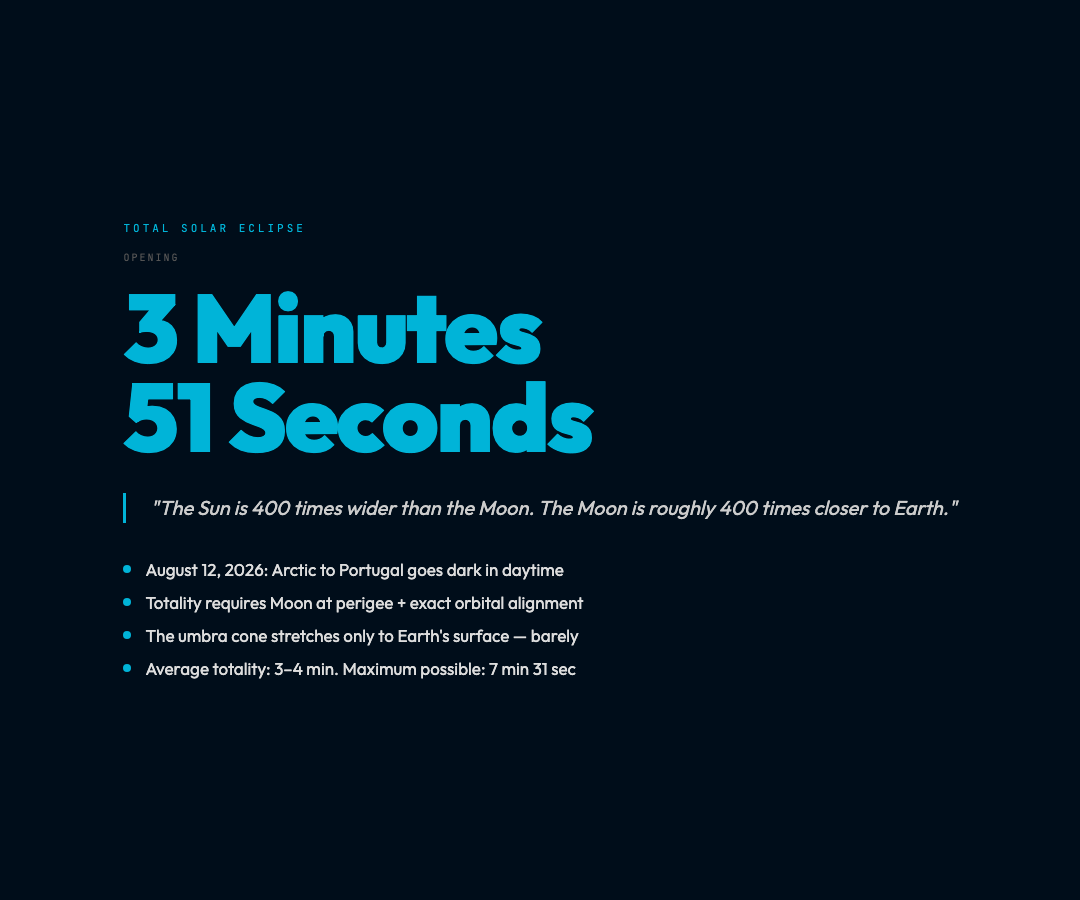
On August 12, 2026, a strip of Earth from the Arctic to Portugal will go dark in the middle of the day. Not twilight — totality. The kind of darkness where streetlights flip on and planets become visible overhead. For up to 3 minutes and 51 seconds, the Moon will swallow the Sun completely, and anyone standing in the right thin ribbon of land will experience one of the most precise coincidences in our solar system.
That’s the strange thing about total solar eclipses: they shouldn’t exist.
A Coincidence That Shouldn’t Happen
The Sun is 400 times wider than the Moon. The Moon is roughly 400 times closer to Earth than the Sun. This near-perfect ratio means that from your backyard, the Moon’s disk almost exactly covers the Sun’s disk during a total eclipse. Almost is doing a lot of work here — it’s what makes totality possible, but also vanishingly rare.
The Moon’s orbit isn’t a perfect circle. It’s an ellipse. At its farthest point (apogee), the Moon looks small enough that even at perfect alignment, it can’t fully cover the Sun — you get an annular eclipse, the “ring of fire.” At its closest point (perigee), it covers the Sun completely and leaves the solar corona blazing outward in wispy white streamers.
So total solar eclipses require three conditions to align simultaneously: a new Moon, the Moon at or near perigee, and the Moon crossing Earth’s orbital plane at exactly the right moment. Miss by degrees and you get a partial eclipse. Miss by much more and you see nothing at all.
The Shadow Geometry
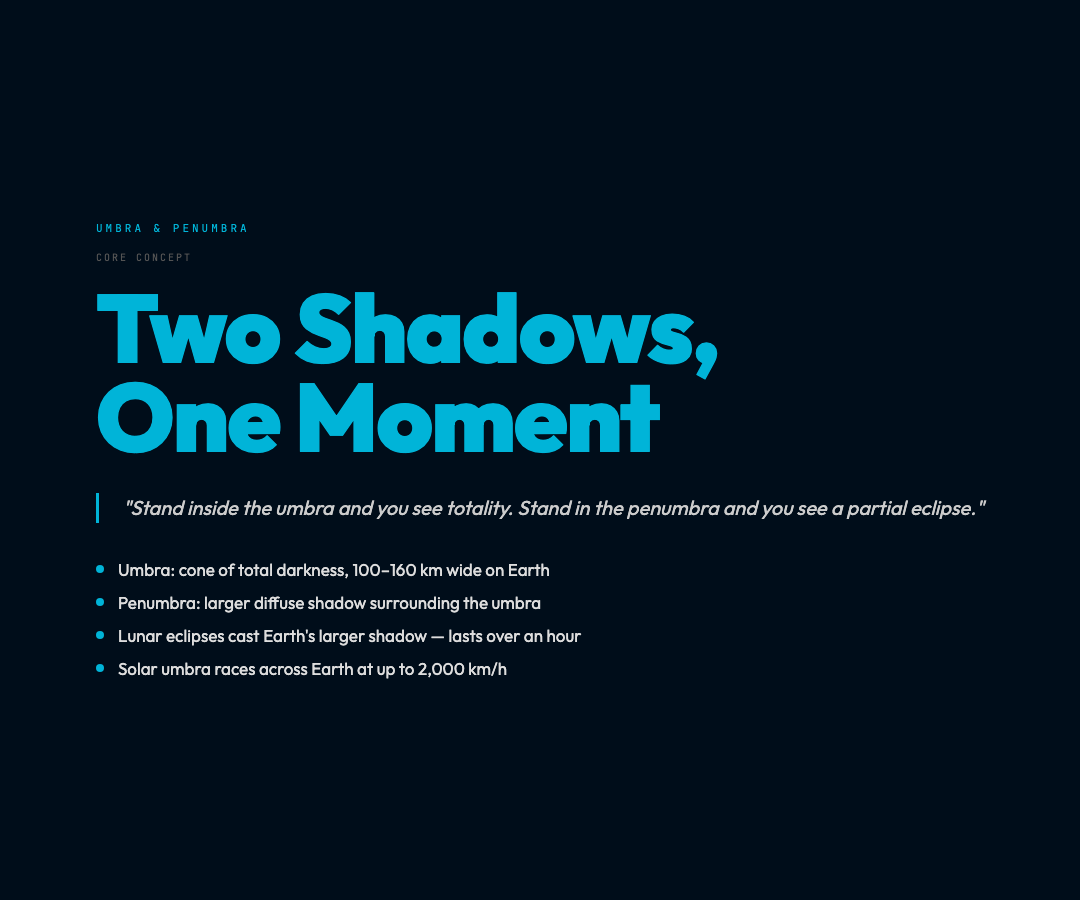
There are two shadows at play during any eclipse. The umbra is the cone of total darkness — the region where the Sun is completely blocked. If you stand inside the umbra, you see totality. The penumbra is the larger, diffuse shadow where the Sun is only partially covered. Standing in the penumbra gives you a partial eclipse, which is interesting but nowhere near as dramatic.
The umbra cone is surprisingly short. It stretches only about 370,000 kilometers from the Moon — roughly the distance from Earth to the Moon itself. That means the Moon’s shadow barely reaches Earth at all. During a total solar eclipse, you’re not standing in the Moon’s permanent shadow; you’re catching the tip of a shadow cone that just barely scrapes our planet’s surface.
This is why totality never lasts long. The tip of the cone sweeps across Earth at up to 2,000 kilometers per hour near the equator. Even at its most generous, a total solar eclipse lasts less than 8 minutes. The average is around 3 to 4 minutes.
By contrast, a total lunar eclipse — when Earth casts its shadow on the Moon — can last over an hour. Earth’s shadow is roughly three times larger than the Moon’s, so the Moon dawdles through it.
The 5-Degree Tilt That Blocks Most Eclipses
Here’s what makes eclipses infrequent rather than monthly: the Moon’s orbit is tilted about 5 degrees relative to Earth’s orbit around the Sun. Two times a year, the Moon crosses Earth’s orbital plane at points called nodes. Only when a new Moon coincides with the Moon crossing a node can an eclipse occur. These are the eclipse seasons — windows of about 34 days when eclipses become possible.
Most months, the new Moon passes above or below the Sun as seen from Earth. The alignment is close but not exact. During an eclipse season, the alignment snaps into place.
This 5-degree tilt also explains why total solar eclipses are rarer at any given location than lunar eclipses. The Moon’s shadow hits Earth in a narrow track, typically 100 to 160 kilometers wide. You need to be standing inside that track. A lunar eclipse, by contrast, is visible from the entire night hemisphere simultaneously.
What Totality Actually Looks Like
The few people who have witnessed a total solar eclipse describe a shift in perception that no photograph captures well. The temperature drops. The horizon glows in all directions — a 360-degree sunset because you’re standing in the Moon’s shadow and can see sunlight from every direction around you. Stars appear. The corona blazes into view, and if you’re lucky, you might see solar prominences — massive loops of plasma arcing off the Sun’s surface in deep red.
Then it’s over. The edge of the Moon catches a bit of sunlight — the “diamond ring” — and the umbra races away at impossible speed.
Professional astronomers plan years in advance for a single totality. Amateur eclipse chasers — called “umbralophiles” — cross continents and oceans for 3 minutes of darkness.
How to Watch Safely
Never look directly at the Sun except during the brief window of totality itself. Every other phase of a solar eclipse — partial, annular, or the moments before and after totality — requires certified solar filter glasses. Regular sunglasses, exposed film, smoked glass, and polarized filters are not safe.
During totality, when the Sun is fully covered, it is safe to look with naked eyes. The moment even a sliver of sunlight reappears, put your glasses back on.
Lunar eclipses are different. Earth’s shadow falling on the Moon is beautiful and completely safe to observe with naked eyes, binoculars, or telescopes. No filters needed.
The Science Inside the Shadow
Eclipses have been scientific opportunities for over a century. During the 1919 total solar eclipse, Arthur Eddington confirmed Einstein’s theory of general relativity by measuring how starlight bent around the Sun’s mass. The corona — normally invisible against the Sun’s glare — becomes measurable during totality. Modern eclipse expeditions still study the corona’s magnetic field structure and how it drives the solar wind.
The next total solar eclipse after August 2026 crosses North America in August 2044, then Australia and New Zealand in 2045. The path of totality is narrow. Most humans alive today will see at most one total solar eclipse in their lifetime — if they’re lucky enough to be in the right place at the right time.
That’s worth knowing. The geometry is precise, the window is short, and the darkness is unlike anything else our sky offers.