Why Heavy Ships Float: The One Principle Behind Everything That Floats
Drop a steel nail into water and it sinks instantly. But a 200,000-ton steel tanker glides across the ocean like it’s made of cork. The difference isn’t weight — it’s the water the object pushes out of the way.
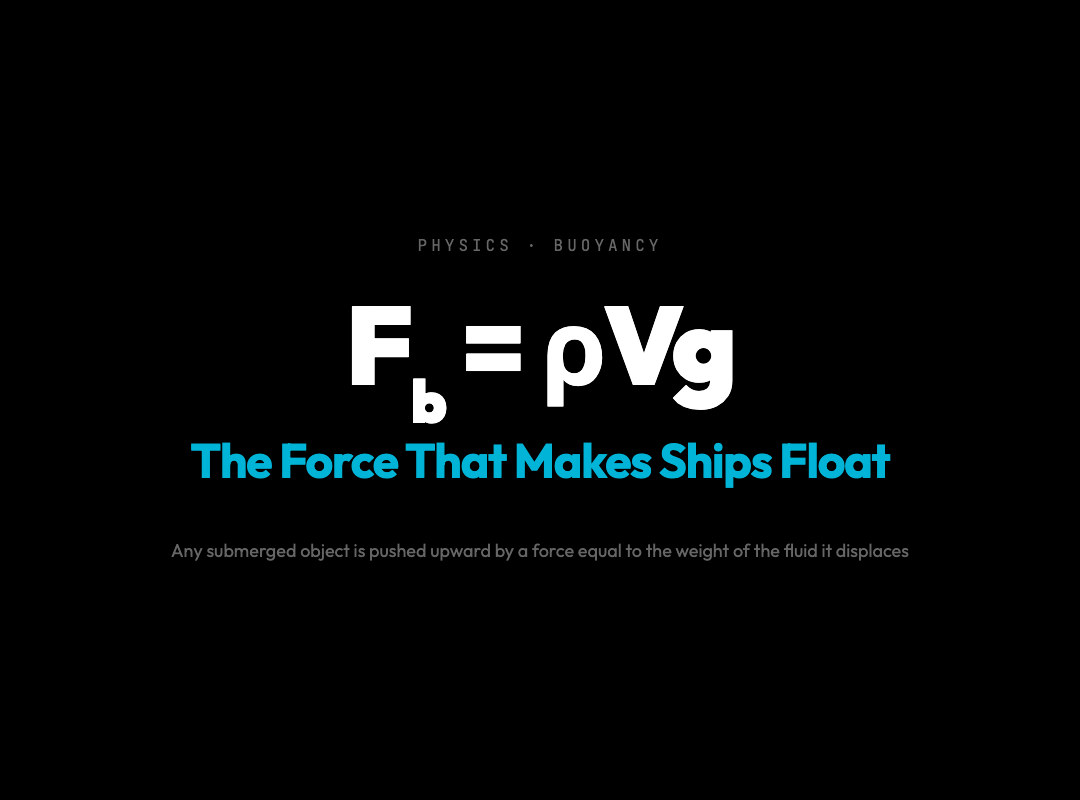
Archimedes’ principle, formulated around 250 BCE, states that any object submerged in a fluid experiences an upward force equal to the weight of the fluid it displaces. That single rule governs everything from why ice floats in your drink to how massive cargo ships stay afloat across oceans.
The Two Forces at War
When an object sits in water, two forces are constantly competing. Gravity pulls the object down — this is simply the object’s weight (mass × gravitational acceleration, or mg). Buoyancy pushes the object up — this is the weight of the water displaced (fluid density × displaced volume × g, or ρVg).

Whether an object sinks or floats comes down to a single comparison:
If mg > ρfluid × V × g  →  the object SINKs
If mg < ρfluid × V × g  →  the object FLOATs
Cancel out g and this becomes a density contest. An object sinks when its average density exceeds the fluid’s density. Steel is far denser than water (about 7,800 kg/m³ vs 1,000 kg/m³), which is why a steel nail sinks. But a steel ship isn’t solid steel — it’s a hollow shell filled with air. The overall density of the ship (steel + air + cargo + crew) ends up much lower than water, so it floats.
This is the counterintuitive core of buoyancy: you can’t ask “is this material dense?” — you have to ask “is this whole object less dense than the fluid?”
Density: The Hidden Variable
The critical parameter isn’t weight — it’s density (mass per unit volume). An ice cube (917 kg/m³) floats in water (1,000 kg/m³) because it’s less dense. A gold bar sinks because gold is 19,300 kg/m³.
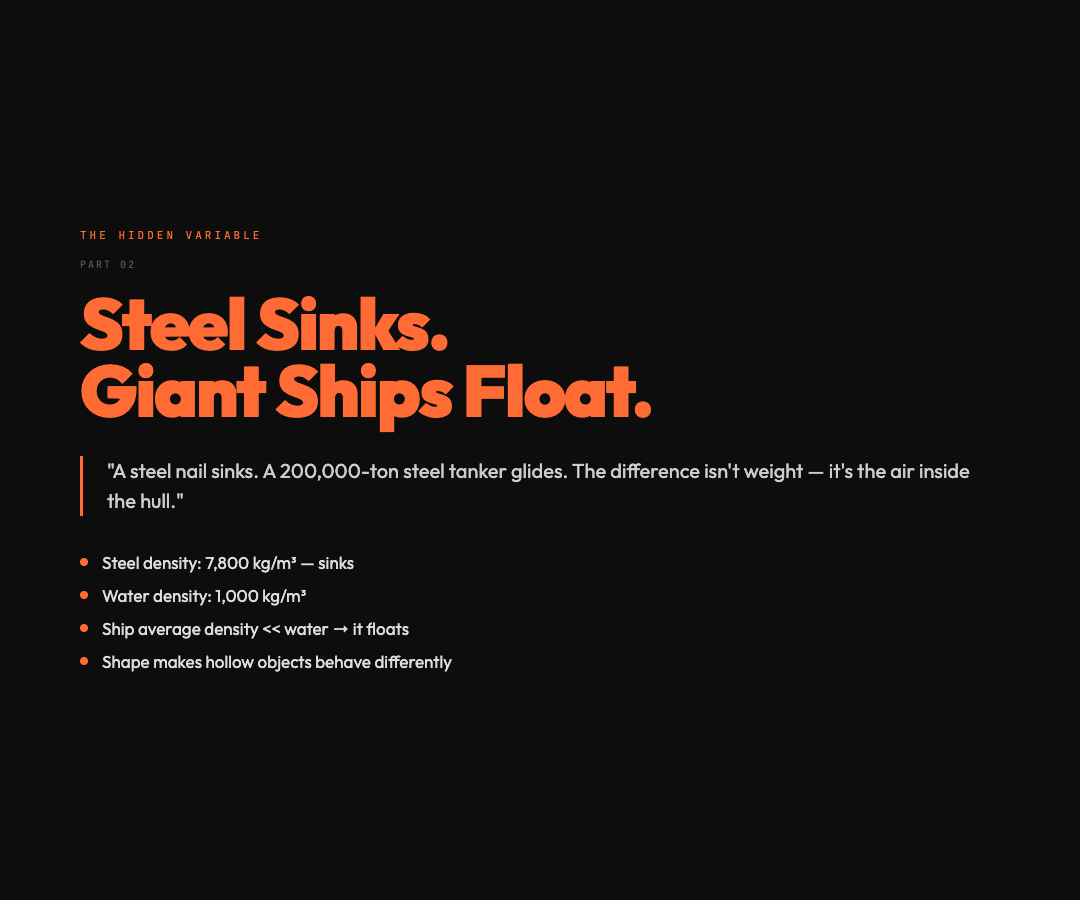
Most materials are either denser or less dense than water by nature. But engineered objects like ships exploit a loophole: shape changes everything. By making a dense material hollow and filling it with air, you lower its overall average density below that of water.
The Archimedes simulation lets you test this directly. Adjust the object’s mass and volume independently, then watch what happens when you drop it into the fluid. You’ll see the buoyancy arrow (Fb) and gravity arrow (mg) drawn to scale — when they’re equal, the object reaches equilibrium and stops accelerating.
Real-World Examples
The principle shows up everywhere once you know to look:
– Submarines control their buoyancy by flooding or emptying ballast tanks. When the submarine’s average density matches seawater, it hovers at neutral buoyancy — neither rising nor sinking. That’s how divers hover motionless underwater.
– Hot air balloons float in air the same way boats float on water. Heated air is less dense than surrounding cool air, so the balloon experiences an upward buoyant force. The envelope’s volume and the temperature difference determine lift.
– Icebergs float with about 90% of their volume submerged. This is why they’re so dangerous to ships — you only see the tip. Seawater is slightly denser than fresh ice (which is why ice melts faster in saltwater), but the principle remains the same.
– Swimming works because your lungs hold air. A person with full lungs is slightly less dense than water and can float easily. Exhale completely and your density increases enough that you sink. This is why experienced swimmers time their breathing — maintaining lung volume keeps you higher in the water.
Equilibrium and Neutral Buoyancy
When the buoyant force exactly equals gravity (Fb = mg), the object reaches mechanical equilibrium in the fluid. It won’t accelerate up or down — any vertical push will result in oscillation around that equilibrium point.

In the simulation, when you set the object’s density equal to the fluid’s density, the object stays where you drop it. This is neutral buoyancy, used by scuba divers and the International Space Station’s robotic arms when they grapple satellites.
The equilibrium position depends on the object’s shape. A tall narrow object will stick out of the water further than a flat disc of the same volume. The displaced volume is the same — but shape determines where that displaced water sits relative to the object’s geometry.
What You Can Control
The simulation exposes the three levers you have in any buoyancy problem:
1. Object density — set by material choice and internal composition. Lower density means more tendency to float.
2. Fluid density — seawater (1,025 kg/m³) is slightly denser than fresh water (1,000 kg/m³), so objects float slightly higher in the ocean. This is why ships have different load lines for ocean vs river water.
3. Displaced volume — shaped by the object’s geometry. A bowl-shaped hull displaces far more water than a solid sphere of the same mass.
The physics is old, but the counterintuitive insight still surprises people: a giant cruise ship floats because it’s full of air. Strip away the air and the steel hull would sink immediately. Every ship is an engineering compromise between density and shape.
The next time you see a cargo ship loaded with containers sitting impossibly high in the water, you’ll know what’s really going on — it’s still winning the density contest, just barely.
Try the simulation: Archimedes’ Principle Interactive Simulation