Why Figure Skaters Spin Faster When They Pull In Their Arms
The first time you watch a figure skater pull their arms inward during a spin, something strange happens — they accelerate. Their rotation speeds up without any apparent push. It’s not a trick, not a special skill reserved for Olympians. It’s one of the most elegant laws in physics, playing out in real time.
The principle is called conservation of angular momentum, and once you see it, you’ll find it everywhere: in the wobble of a bicycle rider balancing at speed, in the death spiral of a neutron star, in the precise orientation of a spacecraft using reaction wheels to stay pointed at distant targets.
The One Equation That Explains It All
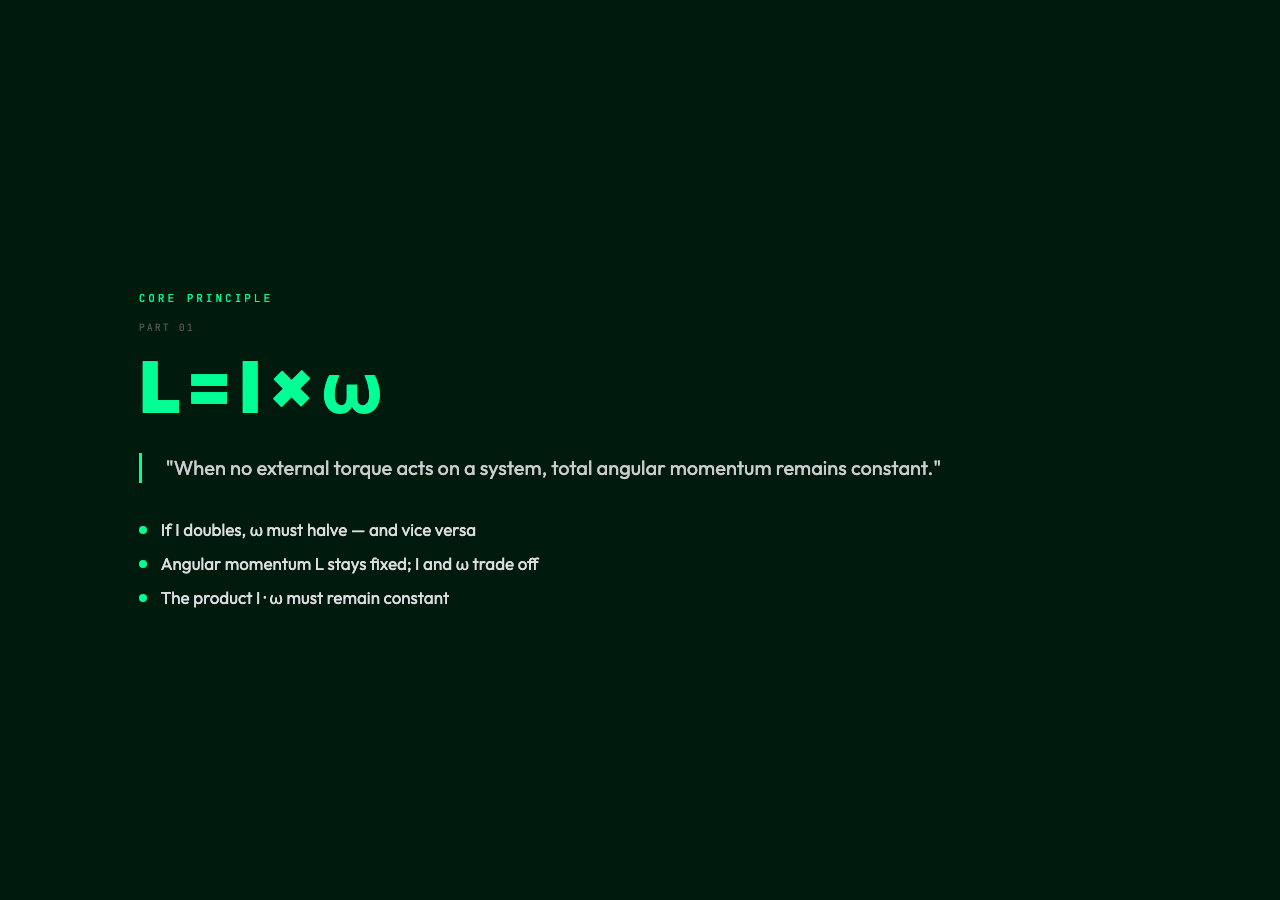
The entire phenomenon rests on a single relationship:
L = I × ω
Where L is angular momentum, I is the moment of inertia, and ω (omega) is the angular velocity — how fast something spins.
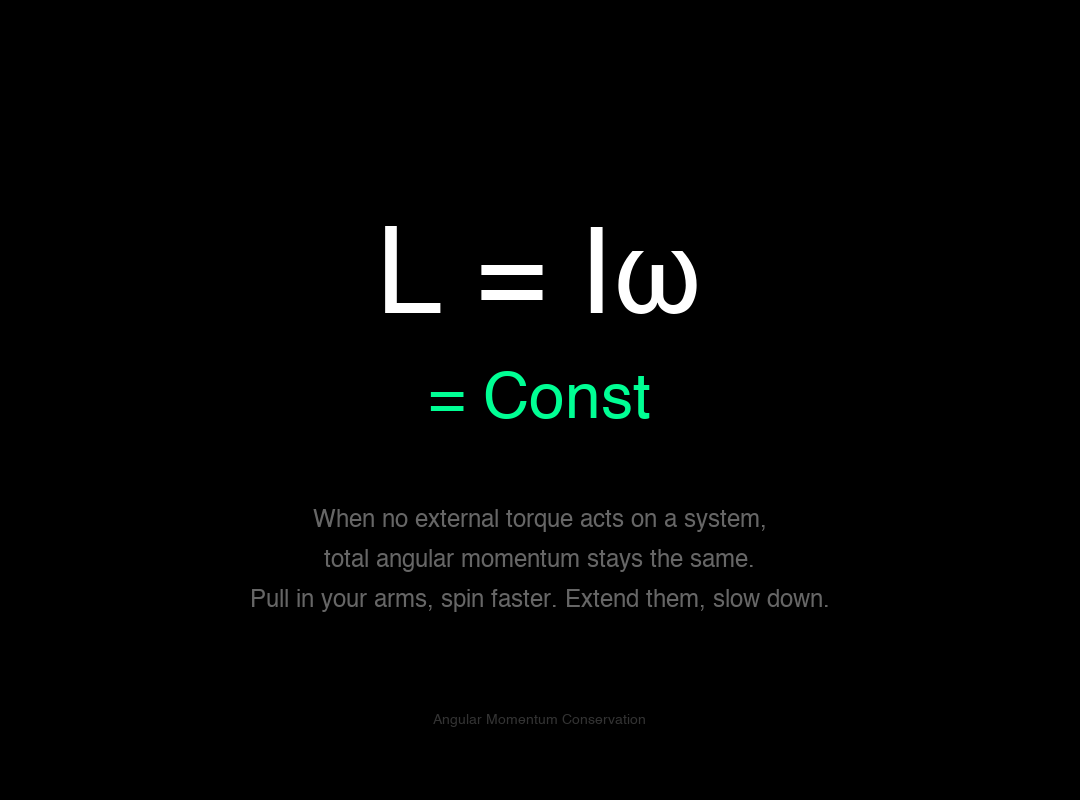
When no external force acts to change how a system rotates, L stays constant. That means if I changes, ω must change in the opposite direction to compensate. Pull your arms in and I decreases, so ω must increase. Extend your arms and I increases, so ω must decrease.
This isn’t magic. It’s arithmetic. The product has to stay the same.
The Figure Skater’s Secret
Watch a skater prepare for a jump. Arms extended, body relatively loose. Then the spin begins — modest at first. As the skater pulls their arms tight against their chest, their moment of inertia drops dramatically. The angular momentum, conserved from the initial push, now manifests as a much faster rotation.

The math is stark: if a skater halves their moment of inertia by pulling in their arms, their spin rate doubles. Pull in even tighter, and they spin even faster. Professional skaters routinely achieve rotation rates of 300-400 degrees per second in competition. The fastest recorded spins exceed 600 degrees per second — more than six full rotations every second.
What makes this counterintuitive is that we’re used to thinking about linear motion. Push something and it speeds up. Here, the skater isn’t pushing against anything — they’re just changing their shape. Yet the spin accelerates as if they had.
The Platform Experiment You Can Do at Home
You don’t need Olympic training to feel this principle. Find a rotating stool or office chair with no armrests. Sit with your arms extended, feet off the ground, and give yourself a push to spin slowly. Then pull your arms tight to your chest.
You’ll speed up. Let your arms extend again and you’ll slow down. The angular momentum you started with doesn’t change — but its distribution between inertia and rotation rate does.
This is exactly what the Angular Momentum Conservation visualization recreates in interactive form. You can adjust parameters like initial angular velocity, arm position, body radius, and platform radius, then watch how the system responds in real time. The charts show angular momentum staying flat as moment of inertia and angular velocity trade off in opposite directions.
Why Bicycles Stay Upright
Angular momentum doesn’t just apply to spinning on ice. It explains why bicycles are self-stable at speed.
A moving bicycle wheel has angular momentum pointing sideways (along the axle). This creates a kind of “resistance” to being tipped over — to tip the bike, you have to change the direction of that spin. At higher speeds, the wheel’s angular momentum is larger, making the bike more stable. This is why beginners wobble more at low speeds and experienced riders feel confident at high speeds.
The same principle applies to motorcycles, spinning tops, and even the front wheels of shopping carts when you’re pushing one down a slope.
The Extremes: From Diving Boards to Neutron Stars
Athletes exploit this everywhere. Divers off a high platform start with their body extended and slow rotation. As they tuck into a tight ball, their moment of inertia shrinks and they spin faster for the somersault. Just before hitting the water, they extend again to slow down for a clean entry.

At the cosmic scale, conservation of angular momentum produces some of the most extreme objects in the universe. When a massive star collapses into a neutron star — crushing half a million Earth-masses into a sphere the size of a city — its rotation rate skyrockets. Some neutron stars, called pulsars, spin hundreds of times per second. The fastest known pulsar, PSR J1748-2446ad, rotates 716 times per second. Nothing that massive should spin that fast. It does because angular momentum is conserved from the original star’s rotation.
The Spacecraft in the Void
Thousands of miles above Earth, conservation of angular momentum keeps satellites oriented in deep space. When a spacecraft needs to point its antenna at Earth or its camera at a target, it uses reaction wheels — essentially heavy disks that spin faster or slower. Spin a reaction wheel in one direction, and the spacecraft body slowly rotates in the other, conserving total angular momentum. No fuel, no thrusters, no exhaust.
The Hubble Space Telescope used reaction wheels to maintain its pointing accuracy. The James Webb Space Telescope uses them to stay locked on distant galaxies while shielding its instruments from solar heat.
What Energy Has to Do With It
There’s one subtlety worth noting: angular momentum is always conserved, but rotational kinetic energy is not. When a figure skater pulls in their arms and speeds up, they’re actually adding energy to their spin — the work they do pulling their arms inward against the centrifugal force gets converted into faster rotation.
This is why skaters don’t just start with their arms tucked — they have to extend first, then pull in. The extension gets them rotating. The pull tightens the rotation. The energy comes from their muscles, not from violating any physical law.
Try It Yourself
The Angular Momentum Conservation visualization lets you experiment with this law without buying a rotating stool. Adjust the moment of inertia by changing arm position or body radius. Set the initial rotation rate and watch what happens when the system reconfigures itself. The real-time charts make the tradeoff visible — angular momentum as a flat line, while inertia and angular velocity move in opposite directions.
It’s a rare case where a fundamental physics principle is both deeply counterintuitive and immediately, viscerally accessible. Once you’ve felt it — on a chair, watching a skater, or in the visualization — you’ll never see rotation the same way again.
Explore the interactive visualization:
Angular Momentum Conservation – Interactive Visualization
Free browser-based tool — no download required.