Why the Moon Can Perfectly Block the Sun: The Geometry of Eclipses
Every so often, the sky performs one of its most dramatic illusions. The Sun — a fireball 400 times larger than our Moon — goes dark in the middle of the day. Not gradually, not faintly, but completely, as if someone reached up and flipped a switch. For a few precious minutes, the Moon’s shadow sweeps across the landscape and turns noon into something closer to twilight.
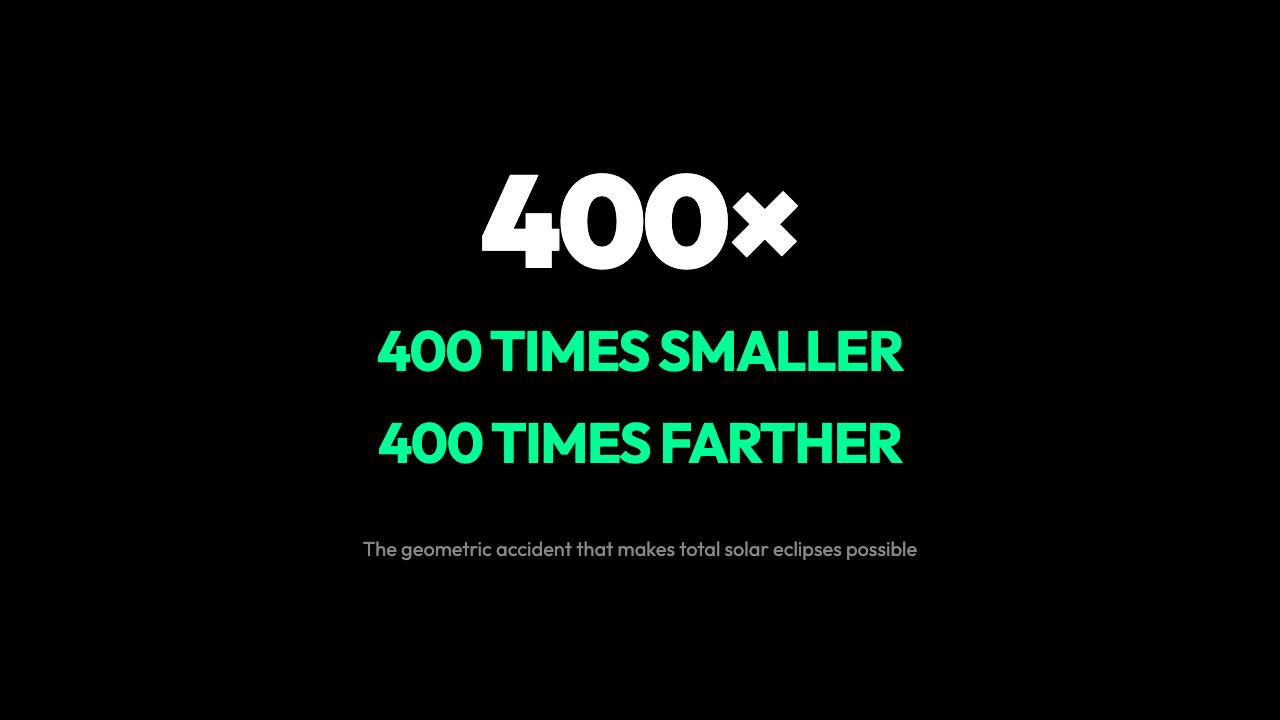
This is a solar eclipse. And the fact that it happens at all is a geometric accident so precise that it stops many people cold when they first hear it: the Sun is roughly 400 times wider than the Moon, and the Sun is also about 400 times farther away. These two ratios cancel almost perfectly, meaning the Moon and Sun appear almost exactly the same size in our sky. When they align, the Moon can cover the Sun to within a few hundredths of a degree of accuracy.
That coincidence is what makes total solar eclipses possible. And it is only the beginning of the geometry that governs every eclipse, solar and lunar, that has ever occurred.
Shadows in Three Dimensions
An eclipse is, at its core, a shadow event. Understanding it requires thinking in three dimensions — specifically, about the shapes cast by bodies illuminated by the Sun.

The Sun is not a point source. It is a large, distant sphere, which means it produces two distinct shadow regions behind any opaque object:
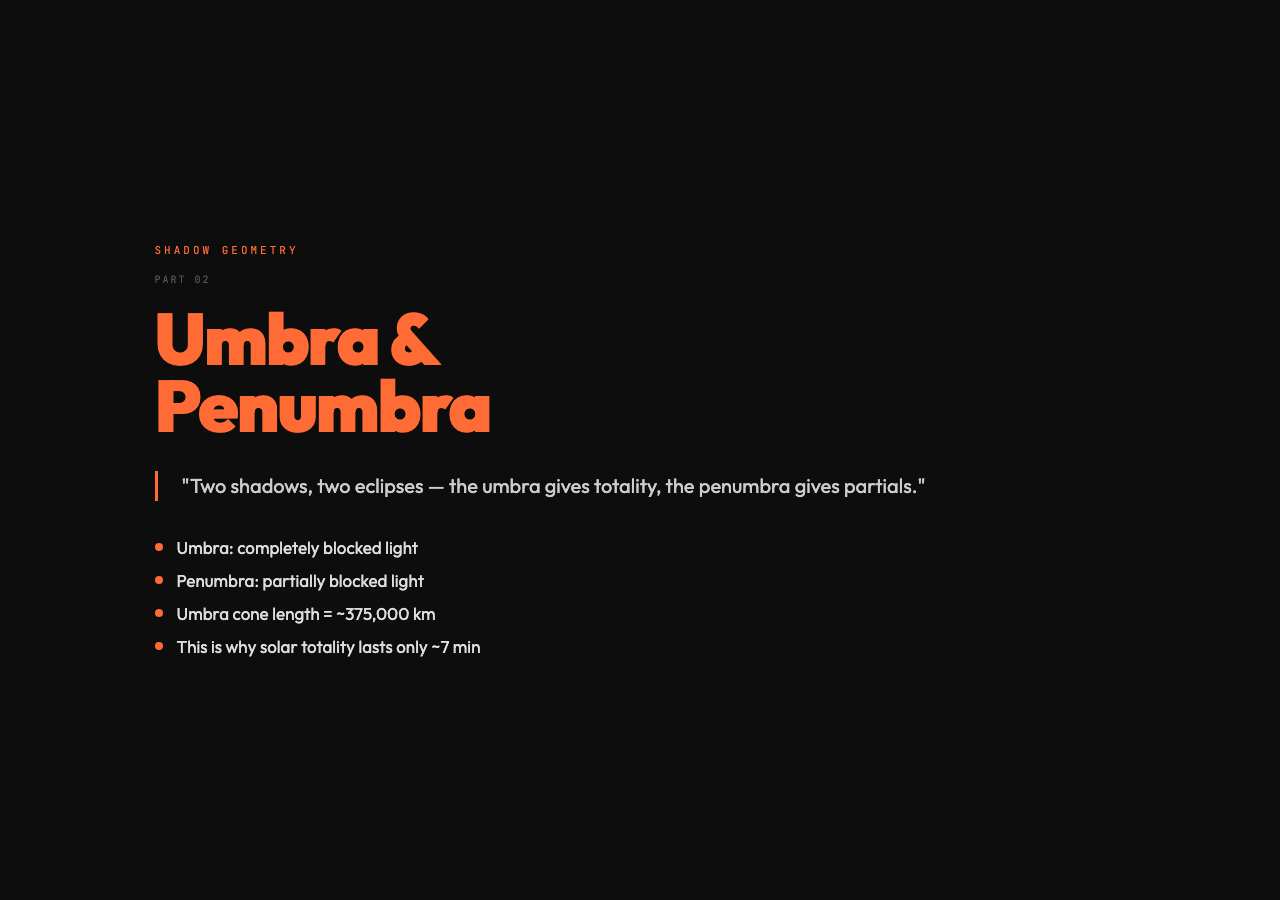
The umbra is the dark inner cone where light is completely blocked. If you stand in the umbra, you see nothing of the Sun’s surface — it is fully covered. This is the region that produces totality during a solar eclipse, or the reddened Moon during a total lunar eclipse.
The penumbra is the lighter outer region, where the Sun is only partially blocked. If you stand in the penumbra, you see a crescent Sun — some of its surface still visible around the blocking body. Partial eclipses, both solar and lunar, are penumbra events.
These two shadow cones extend in opposite directions from any illuminated sphere. For the Earth-Moon system, the geometry is governed by their relative sizes and distances, and the numbers are striking: the Earth’s umbra cone extends about 1.4 million kilometers — roughly 3.7 times the Earth-Moon distance. This is why lunar eclipses, where the Moon passes through Earth’s umbra, last for hours. The solar umbra cone, by contrast, extends only about 375,000 kilometers — just past the Moon’s average orbital distance. This is why total solar eclipses are so brief: you are inside the Moon’s umbra for at most about 7.5 minutes at any point on Earth.
Why Eclipses Don’t Happen Every Month
If the Moon orbits Earth once every 29.5 days, you might expect an eclipse every time the Moon passes between the Sun and Earth — and every time Earth passes between the Sun and Moon. But eclipses are rare. The reason is the Moon’s orbital plane.
The Moon does not orbit in the same plane as Earth’s orbit around the Sun. It is tilted by about 5 degrees. This means that most new moons and full moons pass above or below the line of Sun-Earth alignment, missing the shadow entirely.
Twice per orbit, however, the Moon crosses what astronomers call the nodes — the two points where its orbital plane intersects Earth’s orbital plane. If a new moon occurs when the Moon is at or near one of these nodes, the alignment is close enough that the Moon’s shadow crosses Earth, and we get a solar eclipse. If a full moon occurs at the same condition, the Moon passes through Earth’s umbra, and we get a lunar eclipse.
These roughly 34-day windows are called eclipse seasons, and they occur about every 173 days. During each season, the Sun is close enough to one of the nodes that an eclipse of some kind becomes possible. Whether it is total, partial, or annular depends on how precisely the alignment occurs.
The Three Types of Solar Eclipses
Not all solar eclipses are created equal. There are three types, each determined by the precise geometry of the Sun-Moon-Earth alignment.

Total solar eclipses occur when the Moon completely covers the Sun. This requires that the Moon be at or near perigee — its closest point to Earth — so its apparent size is large enough to cover the Sun. When totality occurs, the Sun’s corona blazes into view, a ring of plasma extending millions of kilometers into space. The temperature drops. Birds return to roost. Streetlights flicker on. It is one of the most physically dramatic events observable from Earth’s surface.
Annular eclipses occur when the Moon is near apogee — its farthest point from Earth. At this distance, the Moon’s apparent size is slightly smaller than the Sun’s. The Sun appears as a bright ring, or annulus, surrounding the dark Moon. The word comes from the Latin annulus, meaning ring. During an annular eclipse, there is no totality and no corona — the Sun’s surface remains fully visible, just obscured at its center.
Partial eclipses occur when the alignment is off-center. Either the umbra misses Earth entirely (for observers in the penumbra during an annular or total eclipse), or the alignment is too shallow to produce a full coverage. From space, the Moon’s shadow traces an elliptical path across Earth’s surface, but its darkest point may pass north or south of most landmasses.
The Red Moon: Why Lunar Eclipses Turn the Moon Red
Lunar eclipses are less dramatic than solar eclipses, but they have a beauty all their own. When the Moon passes into Earth’s umbra, it does not go dark. It turns red.
This happens for the same reason that sunsets are red: atmospheric scattering. Earth’s atmosphere bends and scatters shorter-wavelength light (blue and violet) away from the shadow, while allowing longer-wavelength red light to pass through. The same atmosphere that gives us a blue sky in the daytime and red sunsets at evening filters the sunlight that passes through Earth’s rim and falls on the Moon.
The exact shade of red varies from one lunar eclipse to the next, depending on how much dust and cloud cover exists in Earth’s atmosphere at the time. After major volcanic eruptions, lunar eclipses have been known to turn almost black. After the 1991 Mount Pinatubo eruption in the Philippines, some observers reported lunar eclipses so dark the Moon nearly disappeared.
Scientists use lunar eclipses as informal measurements of atmospheric clarity — a kind of planetary checkup delivered by shadow.
Why Totality Is So Short
The Moon’s umbra cone at the Moon’s distance is only about 100 kilometers wide where it intersects Earth. This shadow path — the region from which a total eclipse is visible — moves at roughly 1,700 kilometers per hour as Earth rotates and the Moon orbits.
At that speed, any given point on Earth’s surface spends only a few minutes inside the umbra. The maximum possible duration of totality is about 7 minutes and 30 seconds, and total eclipses that long are exceptionally rare. The last time Earth experienced a totality longer than 7 minutes was in 1973, and it won’t happen again until 2186.
Most total eclipses last between 2 and 4 minutes. The shortness of the event is what makes it feel so rare and valuable — totality arrives, overwhelms, and is gone before you have time to fully absorb what is happening.
What You Can Learn from an Eclipse
Eclipses were among the first astronomical events that humans learned to predict with precision. Babylonian astronomers tracked eclipse cycles as early as the 8th century BCE, noting that eclipses repeat on a 18-year, 11-day cycle now called the Saros cycle. Ancient Greek astronomers used eclipses to estimate the distance to the Moon. Modern astrophysicists use them to study the Sun’s corona — which is only visible to the naked eye during the few minutes of totality.
The geometry that makes eclipses possible is also the geometry that makes the simulations at Elysia Tools valuable. When you adjust the Moon’s position in the eclipse simulator and watch the shadow geometry change in real time — when you see how a slight misalignment produces an annular eclipse instead of a total one, or how the observer’s latitude determines whether they witness a partial or a total event — you are watching the same three-dimensional shadow geometry that astronomers calculate to predict eclipses decades into the future.
Every eclipse is a geometry problem, written on the sky, visible to anyone who looks up at the right moment.
Try the Solar & Lunar Eclipse Simulator to see how the Moon’s position, the observer’s latitude, and the eclipse type interact in real time.