Why Waves Bend at Boundaries: The Geometry of Light, Sound, and Ocean Swells
Watch ocean waves approach a sandy shore. Long before they reach the beach, something strange happens: the wave fronts gradually rotate until they run parallel to the coastline. This is not the water slowing down randomly. It is geometry — pure and predictable.
The same principle makes a straw look bent when you dip it in a glass of water. It is why a prism splits white light into a rainbow. It is why fish look closer to the surface than they actually are. It is wave refraction: the bending of a wave as it passes from one medium into another.
And it follows a single, elegant law.
Snell’s Law: The One Equation That Rules All Wave Bending
In 1621, the Dutch mathematician Willebrord Snell derived an equation that works identically for light, sound, water, and any other wave:
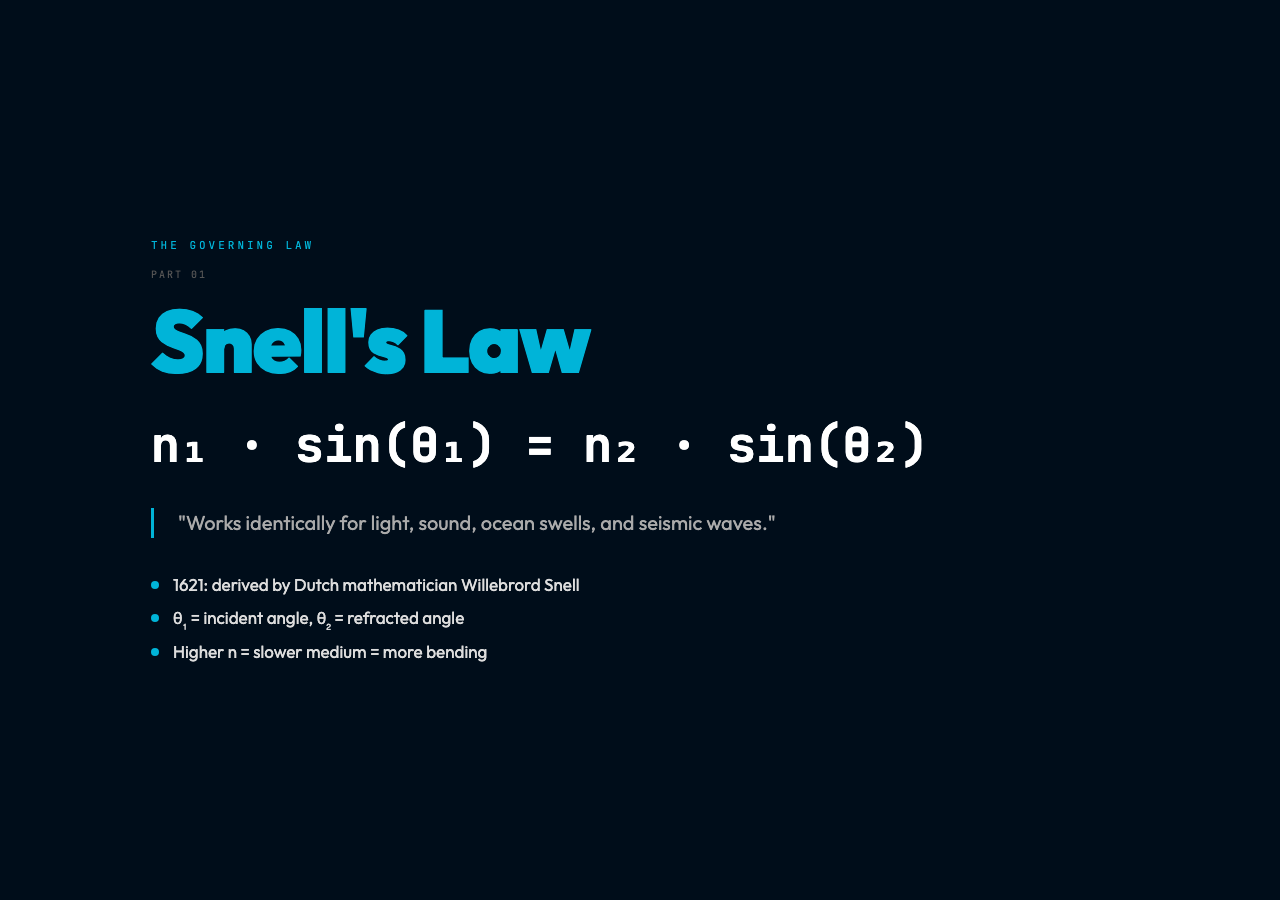
n₁ × sin(θ₁) = n₂ × sin(θ₂)
Where:
– n₁ and n₂ are the refractive indices of the two media (how “optically dense” each material is) – θ₁ is the angle of incidence (the angle at which the wave first strikes the boundary) – θ₂ is the angle of refraction (the angle at which the wave continues into the second medium)
A higher refractive index means the wave travels more slowly in that medium. Light moves at roughly 299,792 km/s in vacuum (n = 1.0) but slows to about 200,000 km/s in water (n ≈ 1.33) and to 124,000 km/s in glass (n ≈ 2.42).
When a wave crosses a boundary at an angle, one side of the wave front hits the new medium first and slows down immediately. The other side is still moving at the original speed for a brief moment. This difference in speed across the wave front is what causes the bending — the wave pivots around the point that hit first.
Why Bending Happens: Speed Change at the Boundary
The mechanism is mechanical. Consider a wave front as a line of marching soldiers. When the line reaches muddy ground on its right side while the left side is still on solid ground, the right file slows down while the left file marches on at full speed. The whole line rotates. That rotation is the bending.
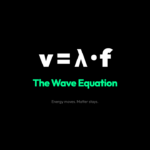
Wavelength shrinks in the slower medium. Frequency — the rate at which the source emits wave cycles — stays the same, because the source controls it. Since wave speed = frequency × wavelength, a lower speed with the same frequency means a shorter wavelength.
In the wave refraction simulation, you can adjust the incident angle (0° to 90°), the refractive index of medium 1 (typically air, n ≈ 1.0), and the refractive index of medium 2 (water, glass, etc.). Watch how the refracted angle changes in real time as you drag the sliders.
Total Internal Reflection: When No Bending Is Possible
There is a critical angle beyond which refraction is impossible. When light travels from a denser medium (like water or glass) toward a less dense medium (like air), and the incident angle is steep enough, the refracted angle would need to exceed 90°. Since an angle greater than 90° has no physical meaning at a boundary, the wave reflects entirely back into the original medium.
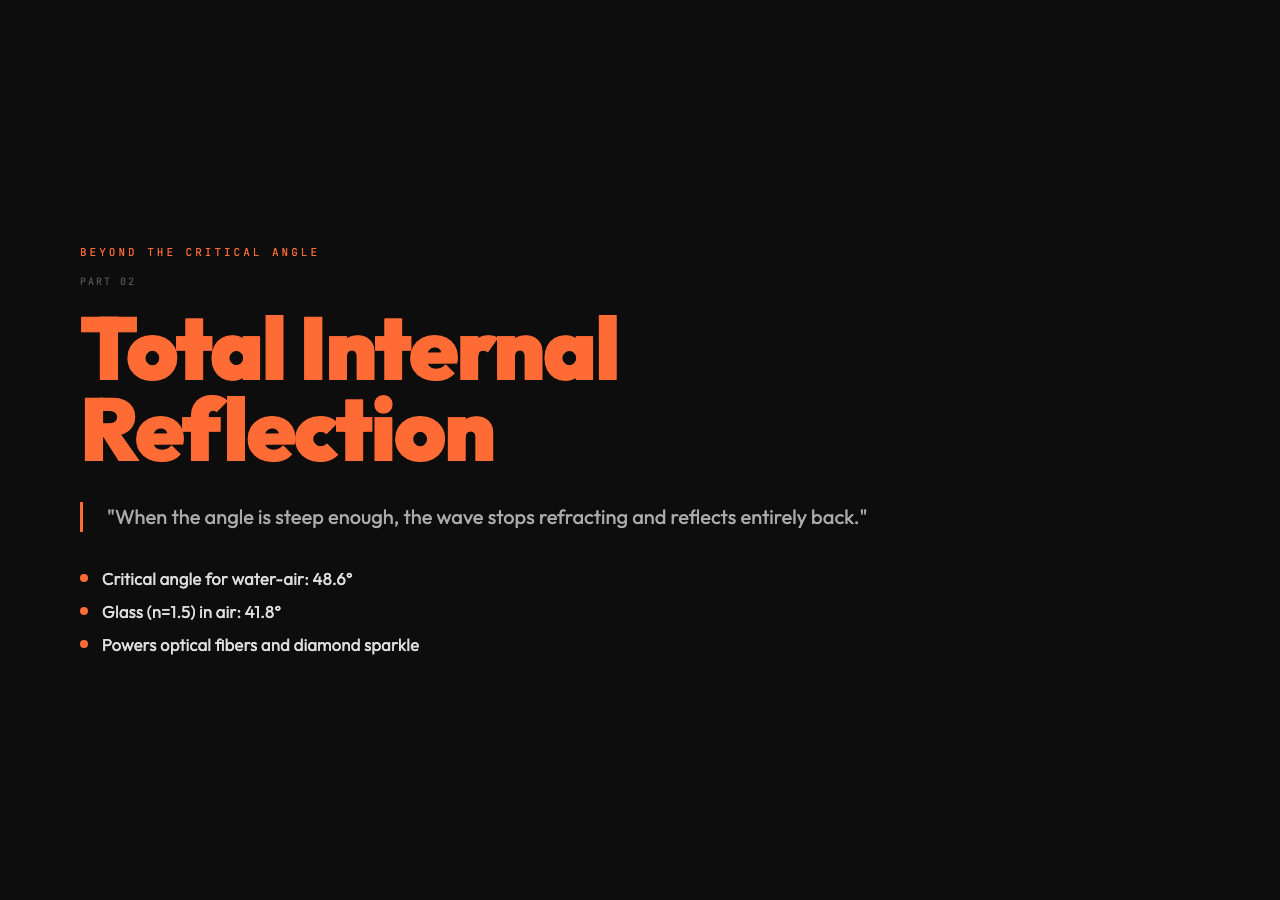
This is total internal reflection.
It is the operating principle behind optical fibers — light pulses bounce off the inner walls of a glass fiber at angles steeper than the critical angle, traveling kilometers with almost no loss. Diamond gemstones are cut to exploit total internal reflection, trapping light inside and releasing it only at specific angles to produce sparkle.
The critical angle for a water-air boundary is about 48.6°. For glass (n = 1.5) in air, it is about 41.8°.
Real-World Examples Across All Wave Types
Optics — lenses and prisms. Eyeglasses, camera lenses, microscopes, and binoculars all rely on carefully calculated refraction at curved glass surfaces. Each lens shape bends light by a precise amount to focus it at a specific point (or spread it out, in the case of corrective lenses).
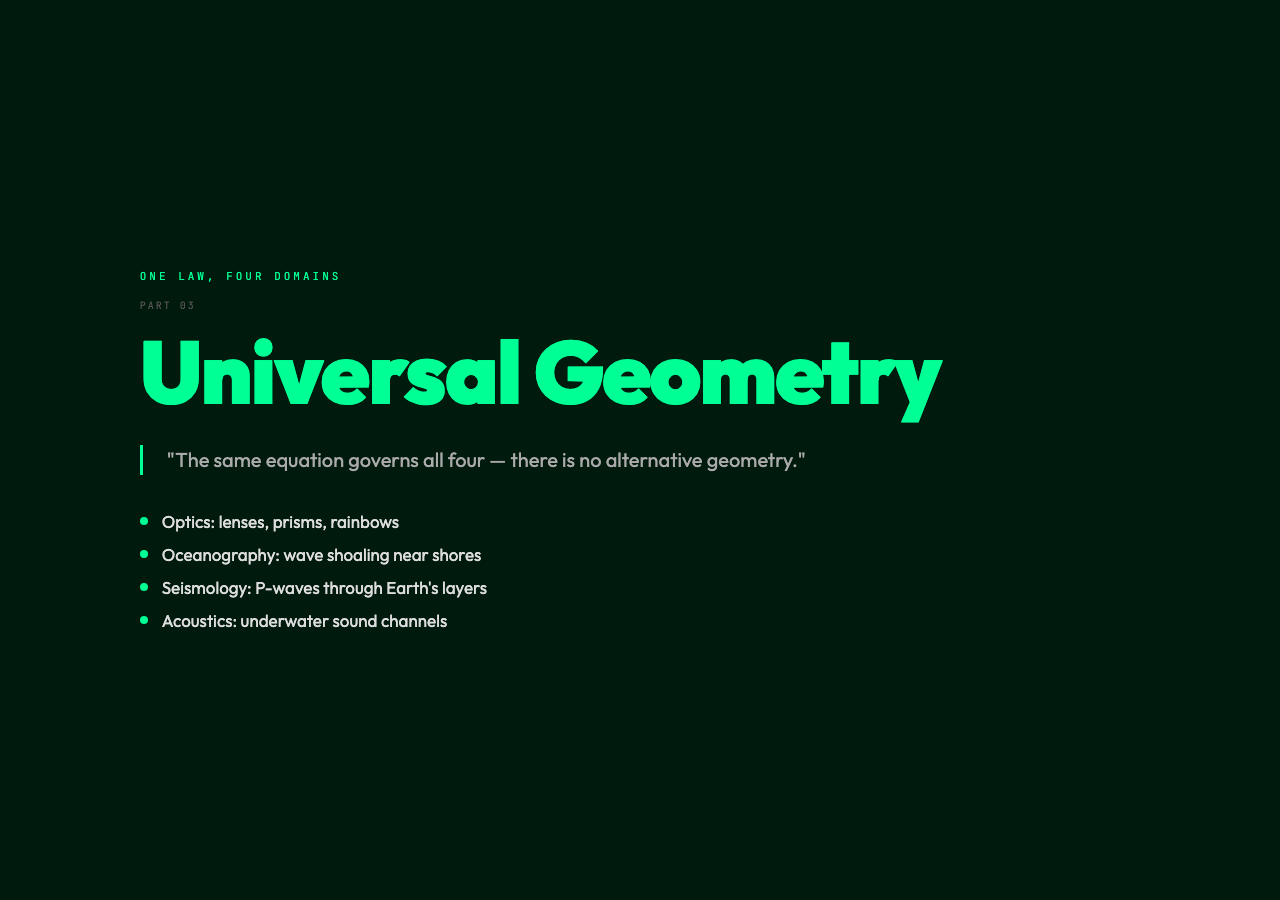
Oceanography — wave shoaling. As ocean swells move from deep water toward the shore, they enter progressively shallower water. Wave speed decreases, wavelength shortens, and wave height increases. The wave front rotates to become parallel with the shoreline — the same geometric bending, happening at a scale of kilometers.
Seismology — P-waves and S-waves. Earthquake waves traveling through Earth’s layers bend as they pass from rock with one density/composition into rock with another. The behavior of these refracted seismic waves is how geologists “see” Earth’s internal structure without ever drilling past the crust.
Acoustics — underwater sound channels. Sound travels about four times faster in water than in air. In the ocean, sound waves can be “trapped” in a deep sound channel where refraction caused by temperature and pressure gradients bends them back up toward the surface, allowing them to travel thousands of kilometers.
What You Can Control in the Simulation
The Wave Refraction simulation gives you five interactive parameters:
| Parameter | Range | Physical Meaning |
|---|---|---|
| Incident Angle | 0° – 80° | Direction of incoming wave relative to the boundary normal |
| n₁ (Medium 1 Index) | 0.5 – 3.0 | Optical density of the first medium |
| n₂ (Medium 2 Index) | 0.5 – 3.0 | Optical density of the second medium |
| Wave Frequency | 0.5 – 5.0 Hz | How many wave cycles pass per second |
| Wave Speed | 50 – 500 px/s | Speed of wave propagation |
Toggle wavefronts to see the actual oscillating crests and troughs. Toggle rays to see the simplified directional arrows. Toggle the normal line to see the reference axis from which angles are measured.
The Geometry Is the Story
What makes wave refraction remarkable is not just that it happens — it is how completely predictable it is. The same equation that describes light bending through a raindrop to create a rainbow also describes sound bending in the ocean and earthquake waves bending through Earth’s mantle.
That universality is not a coincidence. It is a consequence of the mathematics of waves: if something oscillates and propagates through space, and if it slows down when entering a different medium, then it bends according to Snell’s Law. There is no alternative geometry.
The straw in the water glass is not an illusion. It is the world showing you a true fact about how waves behave — one that takes a moment of thought to reconcile with what your eyes report.
Try adjusting the incident angle in the simulation and watching how small changes near the critical angle produce large changes in the refracted beam. That disproportionate sensitivity is not a bug in the physics. It is the geometry.