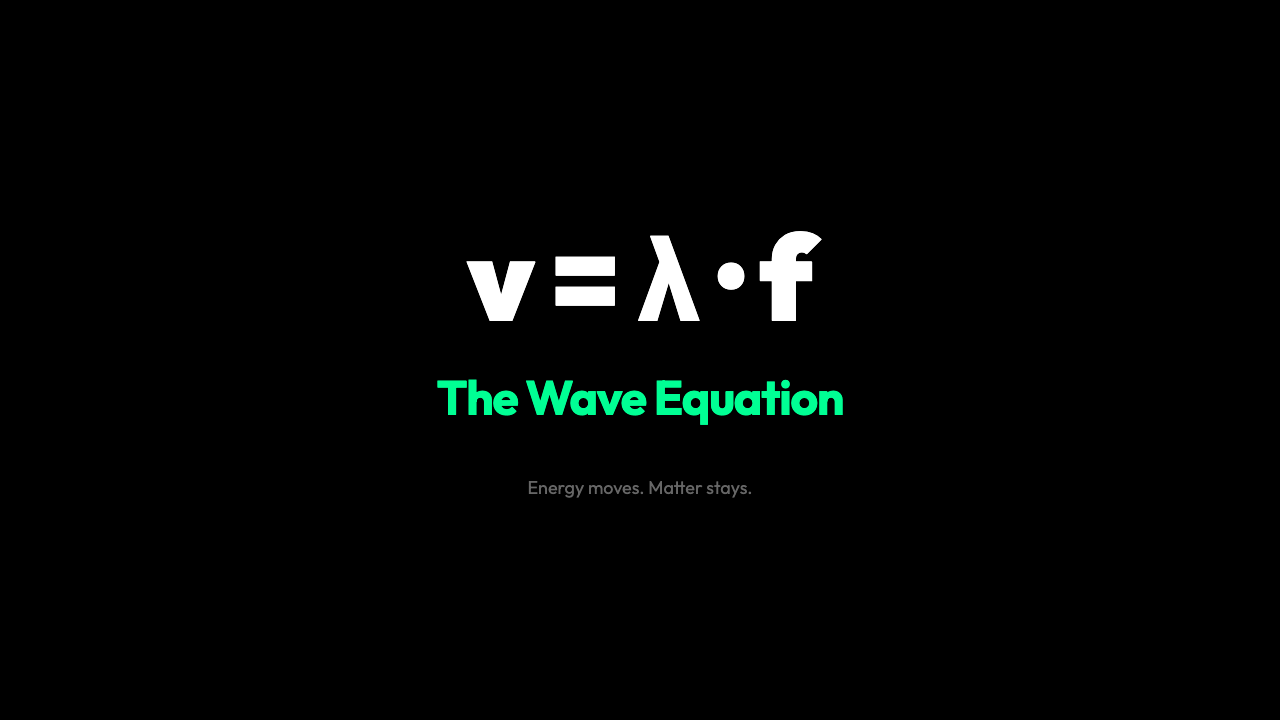
What Happens When You Shake a Rope: The Hidden Physics of Mechanical Wave Generation
Stand at one end of a long rope, give it a sharp flick, and watch a wave pulse travel to the other end. The wave moves. But did the rope move with it?
No. And that single fact is the key to understanding all mechanical wave phenomena.
The wave pattern propagates across the medium while each individual particle of the rope merely vibrates back and forth around its own equilibrium position. This is the central paradox of mechanical wave physics — something travels, but nothing material travels with it. Only energy moves.
The Two Ways a Medium Can Vibrate
Mechanical waves split into two fundamental categories based on how the medium moves relative to the wave’s travel direction.

Transverse waves occur when particle vibration is perpendicular to the direction the wave propagates. Think of a rope shaken up and down: the wave travels horizontally while each segment of rope moves vertically. Water waves are also transverse — you can see the surface bob up and down while the wave shape travels across the pond.
Longitudinal waves occur when particle vibration is parallel to the direction of propagation. Picture a spring stretched between two points: if you push and pull one end, compressions and rarefactions travel down the spring while each coil oscillates back and forth along the spring’s axis. Sound waves are longitudinal — they work by compressing and decompressing the air.
Both wave types share the same fundamental requirement: a source of vibration and a medium capable of storing and transmitting that energy.
The Source and the Medium
Mechanical waves need two things to exist. First, a source of vibration — a hand shaking a rope, a speaker cone vibrating air, an earthquake rupturing rock. Second, a medium to propagate through — the rope itself, the surrounding air, the Earth’s crust.
The source creates a periodic disturbance. That disturbance passes from one particle of the medium to the next, carrying energy forward without carrying any matter. Each particle briefly receives energy, jiggles, and passes it along.
This distinction matters enormously. A sound wave from a concert travels thousands of meters to your ears — but the air molecules at your ears are not the same molecules that left the speaker. The energy arrived; the air stayed local.
The Four Numbers That Describe Any Wave
Every mechanical wave is fully characterized by four interrelated parameters.
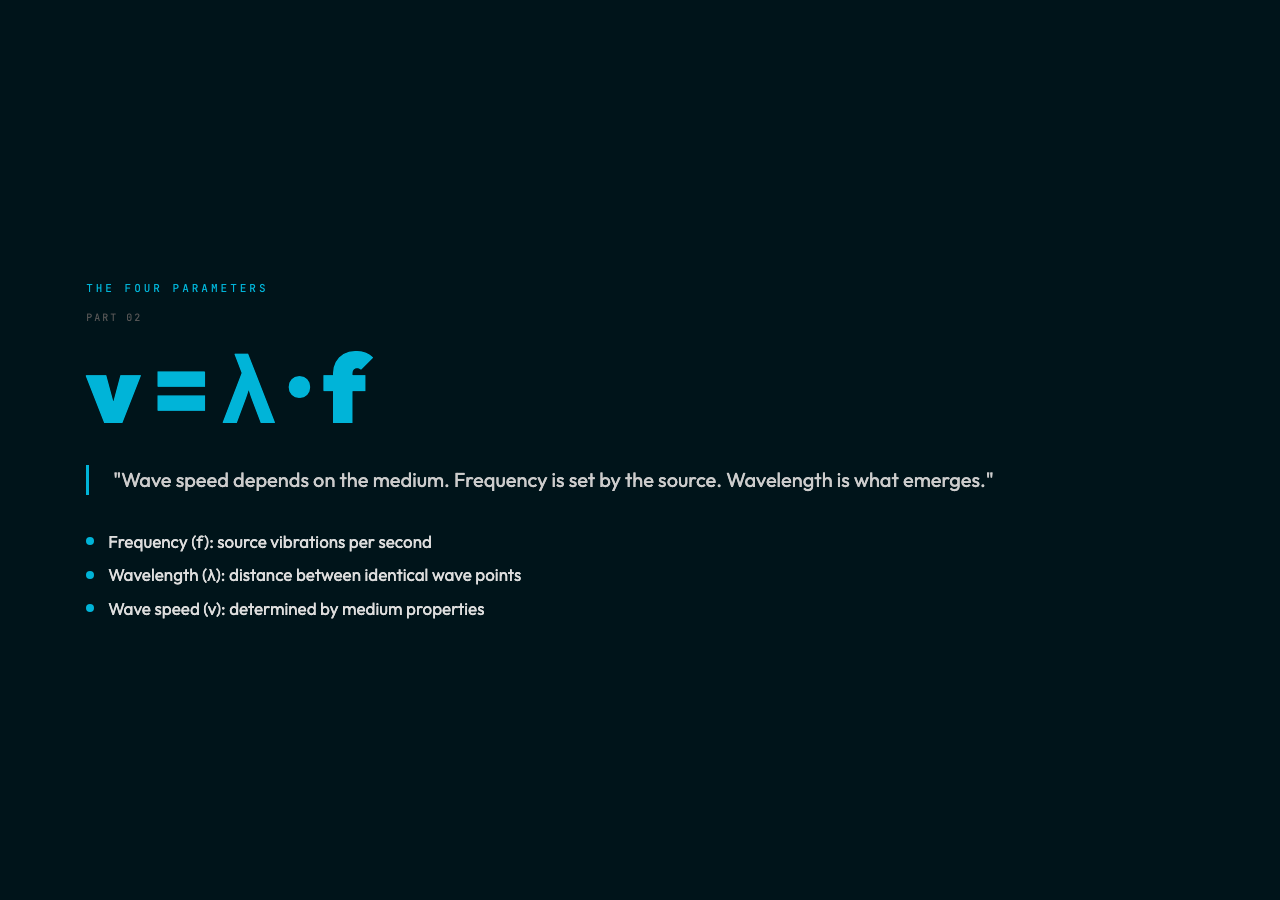
Frequency (f) — measured in hertz (Hz) — is the number of vibrations per second at the source. It is set by whatever is generating the wave. A tuning fork vibrating at 440 Hz produces sound waves with frequency 440 Hz regardless of what medium surrounds it.
Amplitude (A) — measured in meters for a rope, pascals for sound — is the maximum displacement of particles from their rest position. Amplitude controls the intensity of the wave: a bigger flick of the rope sends a larger-amplitude pulse carrying more energy.
Wavelength (λ) — measured in meters — is the distance between two identical points on the wave pattern, such as crest to crest. Wavelength is not set by the source alone; it depends on both the source frequency and the wave speed in the medium.
Wave speed (v) — measured in meters per second — is how fast the pattern travels through the medium. Crucially, wave speed is determined by the medium’s properties, not by the source. Sound travels at roughly 343 m/s in air regardless of whether it came from a whisper or a shout. A rope under higher tension propagates waves faster than a slack rope.
These four quantities are linked by the fundamental wave equation:
v = λ · fThis equation reveals an immediate consequence: if frequency increases (shorter time between source vibrations), wavelength must decrease, assuming the medium stays the same.
Energy Transfer Without Matter Movement
The most important practical consequence of mechanical wave behavior is how they transfer energy.
A ocean wave crashing against a seawall delivers energy from a storm hundreds of kilometers away. But the water in that wave doesn’t travel from the storm to the wall — it mostly stays in place, bobbing up and down. The energy propagated; the water was local.
This same principle applies across scales. Seismic waves from an earthquake transfer destructive energy through the Earth’s crust. Ultrasound machines send energy into the body to image organs without transporting any material. A guitarist’s pluck drives energy down a string to the soundboard of a guitar, which then pushes air into your ears.
The mechanism is identical in every case: a source disturbs a nearby particle, that particle disturbs its neighbor, the neighbor disturbing the next, and so on. Energy cascades outward; matter oscillates locally.
Real-World Applications
Understanding mechanical wave generation is not purely academic. It directly shapes several technologies people depend on daily.
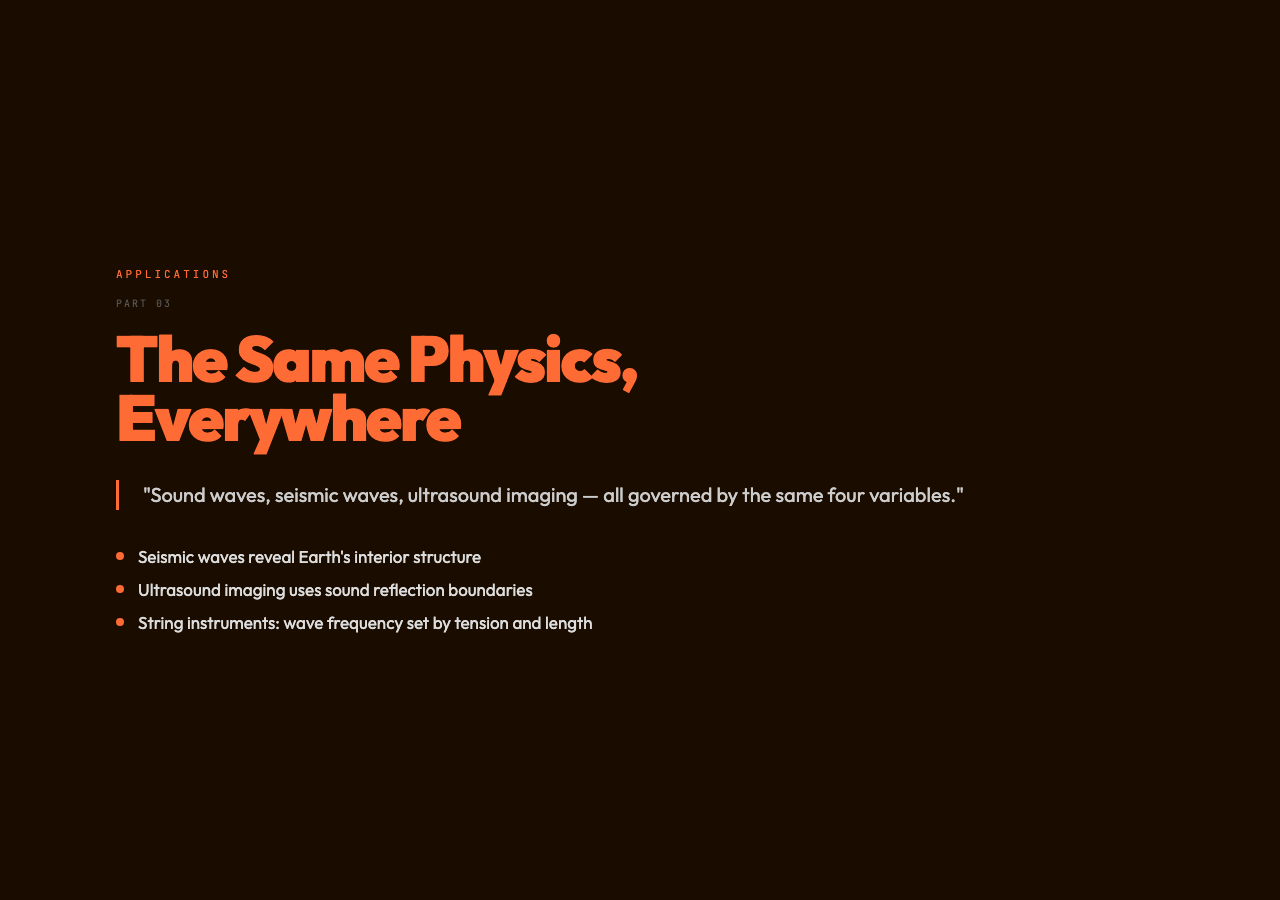
Sound waves — longitudinal pressure waves — are the medium of human speech, music, and most audio technology. The frequency of a sound wave determines its pitch; the amplitude determines its loudness. Musical instruments are precision mechanical wave generators: a violin string vibrates at a fundamental frequency determined by its length, mass, and tension, producing a note.
Seismic waves generated by earthquakes propagate through Earth’s interior. Geologists analyze the arrival times and amplitudes of different seismic wave types to infer the structure of the Earth’s core, mantle, and crust. The speed of seismic waves depends on the density and elasticity of the rock they travel through — exactly the physics described by the wave equation.
Ultrasound imaging uses high-frequency sound waves (typically 1–20 MHz) sent into the body. The waves reflect at tissue boundaries, and analyzing the returning echoes constructs an image. The same principles govern naval sonar, which uses sound propagation in water to detect submarines and map the ocean floor.
String instruments — guitars, violins, pianos — all generate waves on stretched strings. The fundamental frequency is set by string length, mass per unit length, and tension. When you tighten a guitar string, you increase wave speed, which increases frequency, which raises the pitch.
Four Key Insights Worth Remembering
The physics of mechanical wave generation can be distilled into a small number of durable insights.
Waves transfer energy, not matter. The wave pattern moves; particles stay in place. This is not an approximation — it is a precise description of what happens, and it has profound implications for how waves interact with objects in their path.
Wave speed is a property of the medium, not the source. You cannot make sound travel faster in air by speaking louder or at a higher pitch. You can only change amplitude (loudness) or frequency (pitch). To change speed, you must change the medium — sound travels faster in water than in air, faster in steel than in water.
Frequency is determined at the source; wavelength emerges from the medium. The vibrating object dictates how many oscillations per second occur. But wavelength depends on how fast those oscillations propagate, which depends on what the wave is traveling through.
When frequency increases, wavelength decreases proportionally. This follows directly from v = λ · f. A higher pitch sound does not travel faster — it simply has a shorter wavelength. Both the high and low-pitched sounds from the same source arrive at the same time.
Why This Matters Beyond the Textbook
Mechanical wave physics explains why a guitar sounds different from a piano, why earthquakes can topple buildings hundreds of kilometers from the epicenter, and why doctors can see an unborn child using sound rather than radiation.
The same four variables — frequency, amplitude, wavelength, wave speed — and the same fundamental equation v = λ · f govern all of them. The mathematics is clean and compact. The applications are everywhere.
The next time you watch a wave travel across a pond, try to spot the marked leaf floating on the surface. The wave passes under it, but the leaf barely moves from its starting position. The pattern traveled; the water stayed. That single observation is the entire physics of mechanical wave propagation in a nutshell.