Why Mars Sometimes Moves Backward: The Illusion That Changed Astronomy
For two thousand years, astronomers recorded something that made no sense: planets would occasionally stop their steady march across the night sky, drift backward for weeks or months, then reverse course again. Mars was the most dramatic offender, sometimes brightening to rival Jupiter before performing these strange reversals.
Ancient astronomers called it retrograde motion — backward movement. And for centuries, it was one of the most stubborn problems in all of science.
The Geocentric Fix: Circles on Circles
The dominant model placed Earth at the center of the universe. Planets, the Sun, and the Moon all traced perfect circular paths around us. But retrograde motion broke this picture. A planet moving at constant speed in a simple circle should never drift backward relative to the fixed stars.
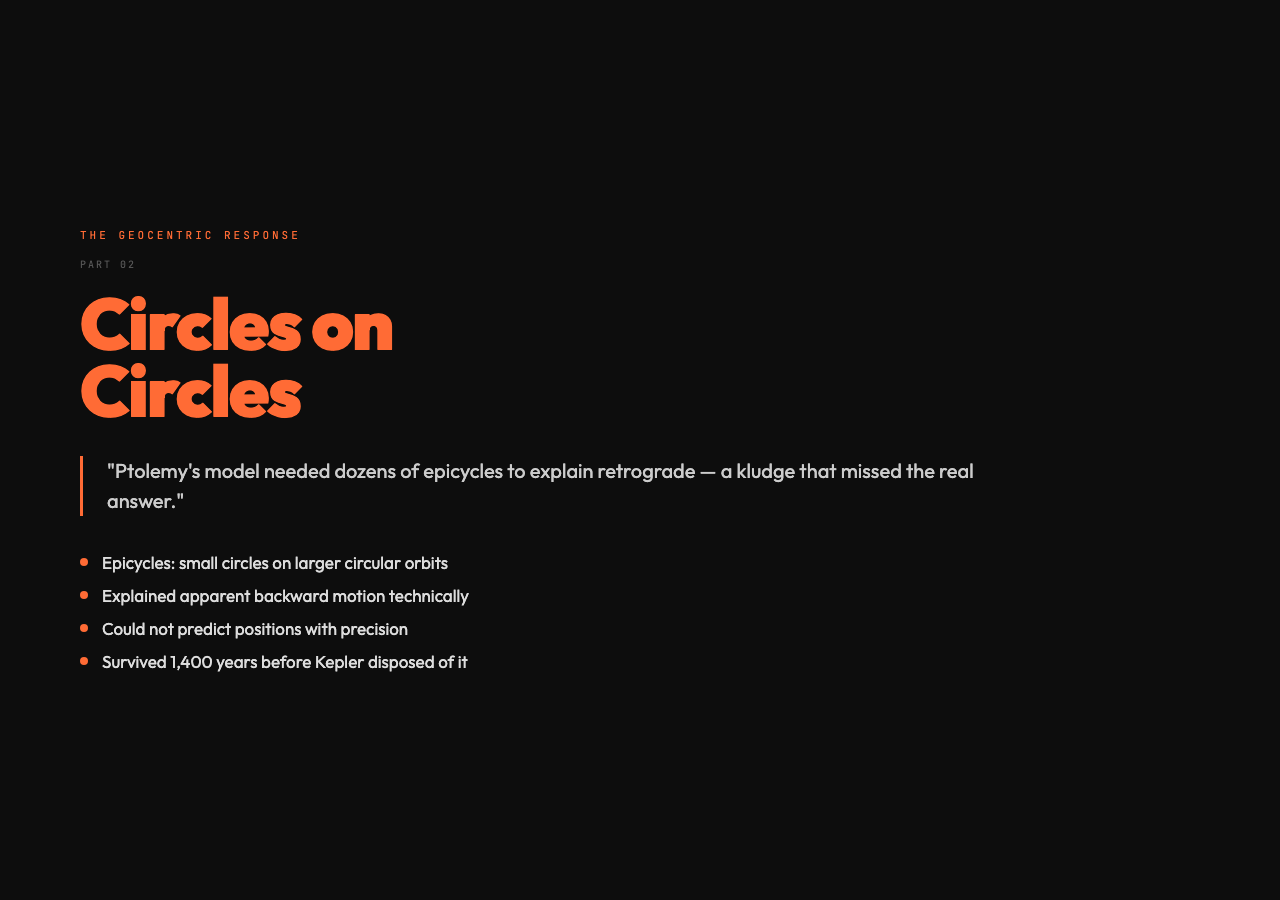
To save the geocentric model, astronomers added epicycles — small circles whose centers moved along the larger circular orbits. Think of it as a planet tracing a looping path: the forward motion along the main circle, plus the sideways loop, produced an apparent reversal when seen from Earth. Ptolemy’s system required dozens of these epicycles. It worked, technically. But it was ugly, and it couldn’t predict planetary positions with real precision.
The epicycles were a kludge — an explanation that accounted for the data but missed something fundamental about what planets actually do.
The Heliocentric Answer: It’s All About the Race
The real explanation arrived with Copernicus in the 16th century, and it is beautifully simple.
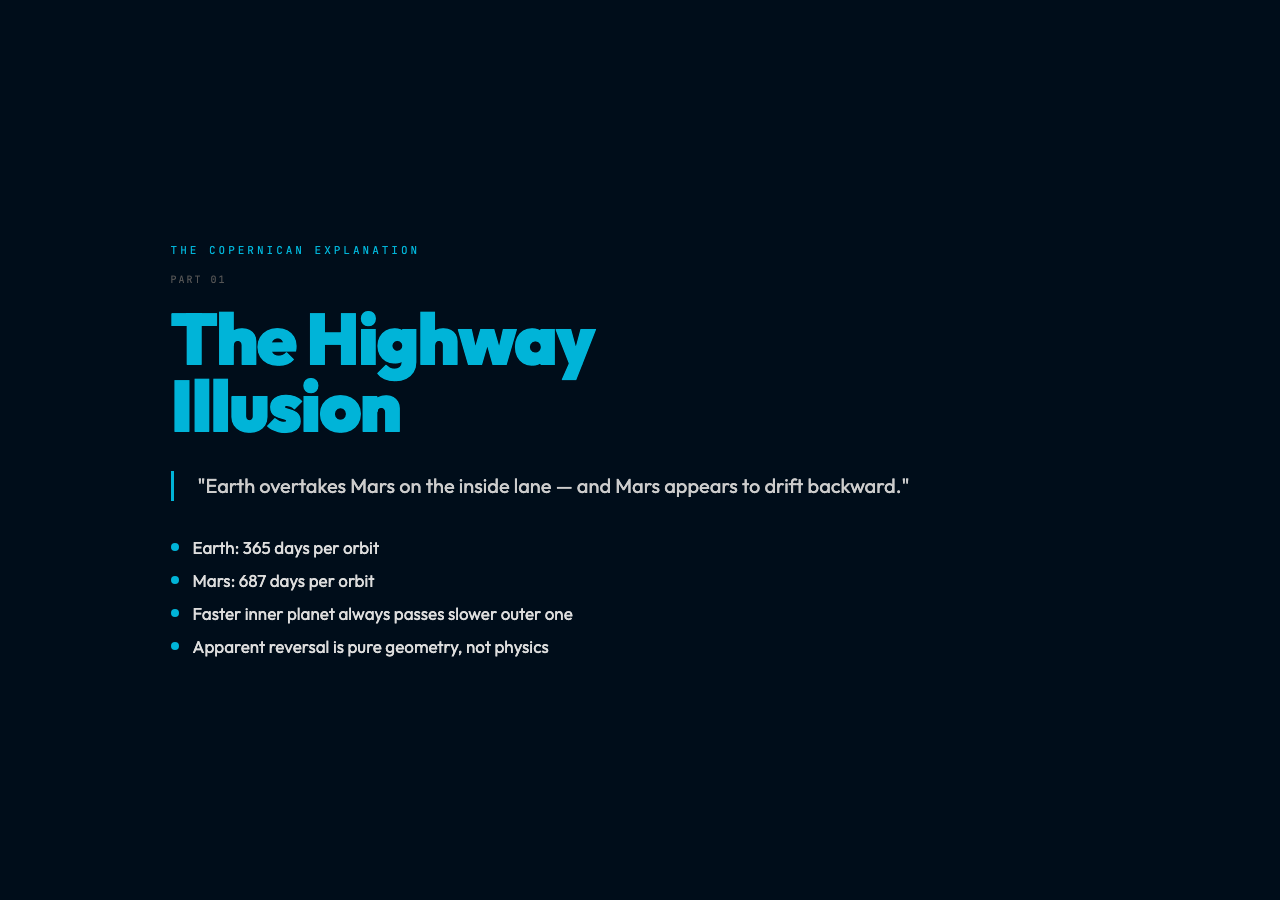
Earth orbits the Sun faster than Mars does. Earth takes 365 days to complete one orbit; Mars takes 687. This means Earth is the inner, faster runner in the same race around the Sun.
When Earth overtakes Mars on the inside lane, Mars appears to slow down in our sky, pause, and then drift backward — even though Mars never stops its own forward motion. It’s the same effect you see on the highway: when you pass a slower car, the car you’re passing appears to slide backward relative to the distant horizon, even though it’s still moving forward at its own pace.
The geometry makes this precise. When Earth and Mars are on the same side of the Sun — a configuration astronomers call opposition, because Mars rises when the Sun sets — Earth is directly between the Sun and Mars. This is also when Mars is closest to Earth and brightest in our sky. It’s also when retrograde motion begins.
As Earth continues its faster orbit and moves around the Sun, the apparent positions of Mars relative to the distant stars shift. From our perspective, Mars appears to reverse direction, trace a backward arc, slow to a stop again, then resume its normal east-to-west motion against the star background.
Why Mars More Than Others?
Mars shows the most dramatic retrograde motion for two reasons. First, it is the next planet outward from Earth, so the geometry of the overtake is sharpest — Earth’s orbital motion produces the largest angular shift as seen from Mars. Second, Mars has a relatively long orbital period compared to Earth, which means the window of apparent backward motion is extended.
The other outer planets show retrograde motion too: Jupiter, Saturn, Uranus, and Neptune all occasionally drift backward in our sky. But their slower orbits and greater distances make the effect subtler. Mars retrograde, by contrast, can last up to 72 days and produces a visible brightening that ancient observers certainly noticed.
The Epicycles That Remained
Even after Copernicus proposed the heliocentric model, he retained epicycles. He was right about the Sun at the center but wrong about circular orbits. Johannes Kepler later showed that planets move in ellipses, not circles — a discovery that finally disposed of the epicycle entirely. With elliptical orbits, the varying orbital speed of each planet explained retrograde motion completely and quantitatively.
Kepler’s laws let astronomers predict planetary positions with unprecedented accuracy. They also confirmed that retrograde motion is purely a matter of perspective: planets don’t actually stop or reverse. They just appear to, because we are watching from a moving platform that is itself orbiting the Sun.
Seeing It for Yourself
You can observe retrograde motion with patience and a clear sky. Mars is visible to the naked eye and brightens noticeably at opposition, roughly every 26 months. During those months, if you sketch Mars’s position against the background stars each week, you’ll see it trace a backward arc — a direct demonstration of Earth’s faster orbit in action.
The ancient Babylonians tracked these motions with remarkable precision, recording Mars’s retrograde periods on clay tablets thousands of years ago. They had no model of orbital mechanics — just meticulous observation. What they recorded as anomalous behavior was, in fact, the fingerprint of heliocentric motion, written in the night sky for anyone patient enough to look.
The simulation below lets you watch both the heliocentric view — Earth overtaking Mars from the Sun’s perspective — and the geocentric view, where Mars’s backward drift against the star background becomes visible. Toggle the retrograde highlight to see exactly when the illusion occurs.
What looks like cosmic weirdness is, in the end, just geometry: a faster planet on the inside track, passing a slower one on the outside.