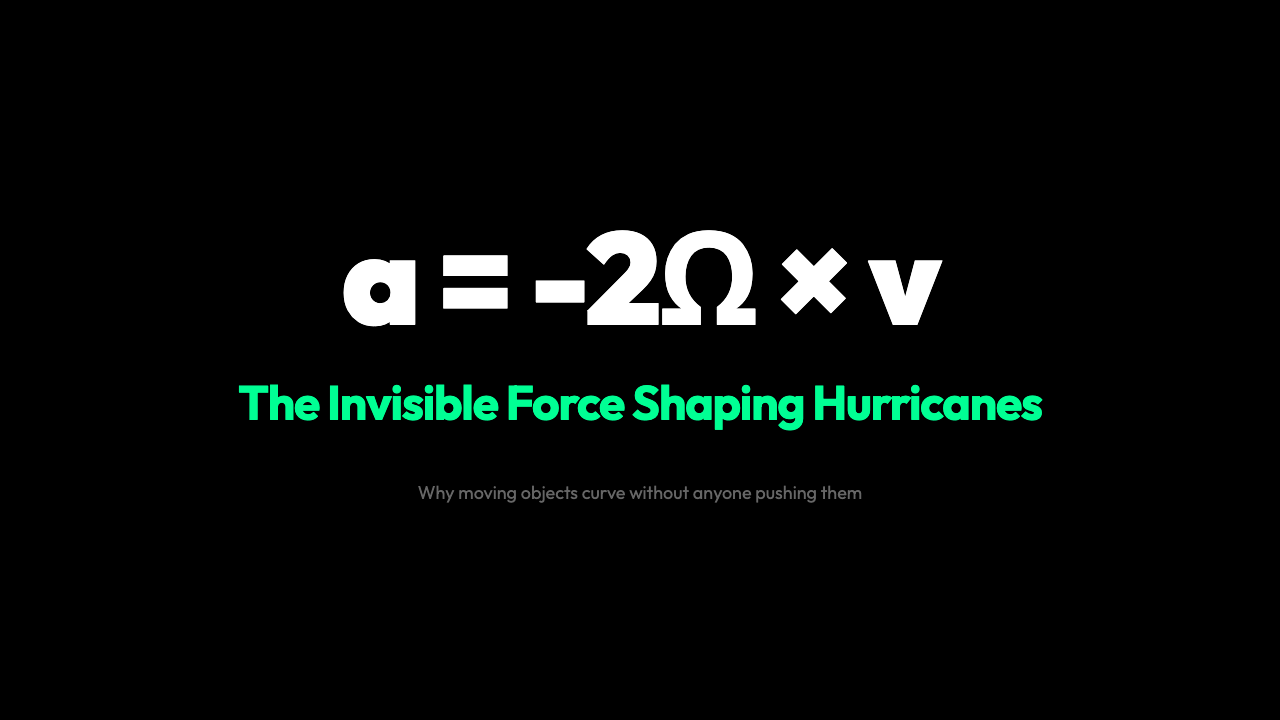
Why Moving Objects Curve Without Anyone Pushing Them: The Coriolis Force
Walk outside and throw a ball straight north. According to everything you know about physics, it should land directly ahead of you. It won’t. In the Northern Hemisphere, the ball will drift slightly to the right — not because of wind, spin, or any visible force, but because the Earth is rotating beneath it while the ball travels in a straight line through space.
This invisible deflection is called the Coriolis force, and it is one of the most pervasive — and least intuitive — forces in everyday life.
The Core Idea: You’re on a Rotating Platform
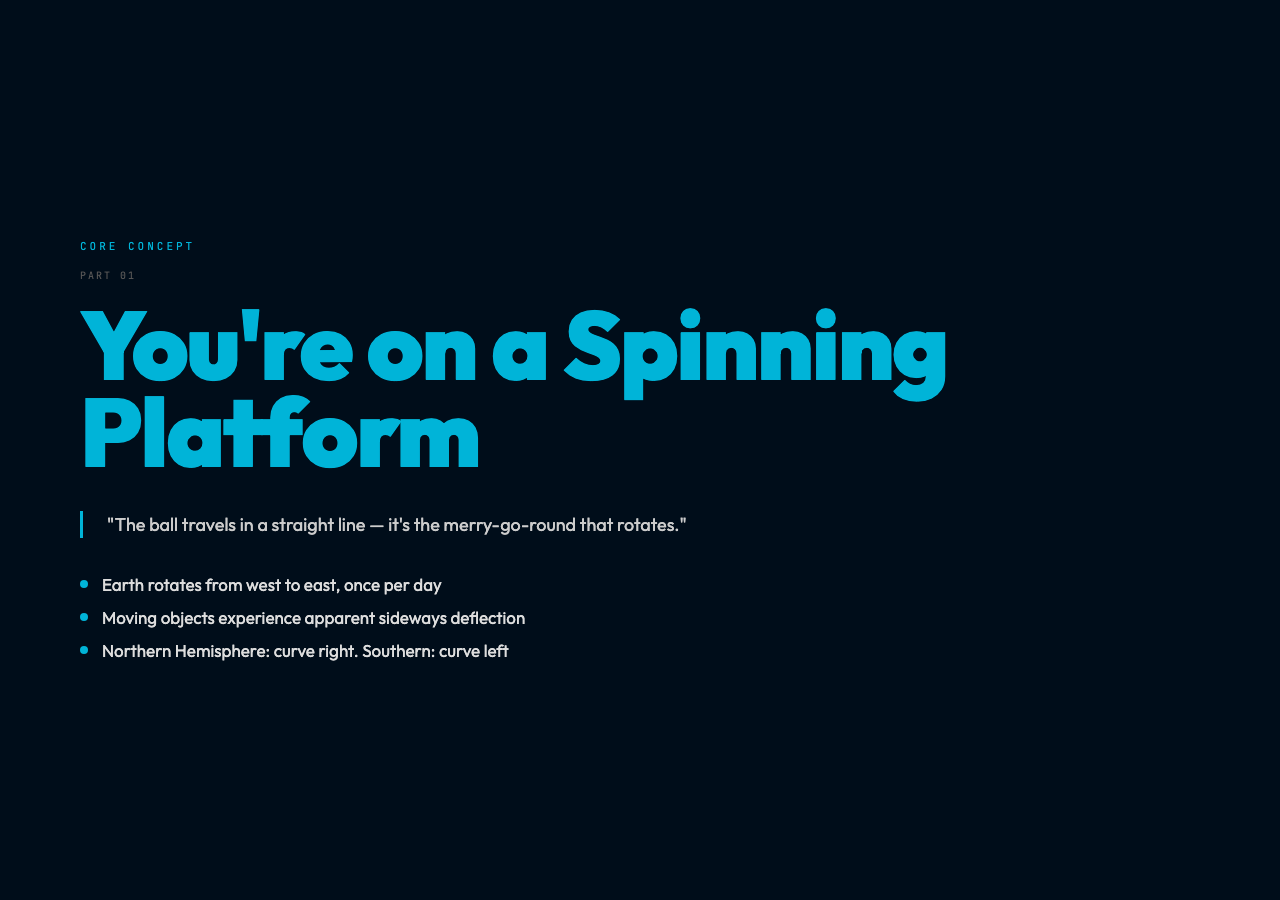
Imagine standing at the center of a spinning merry-go-round, facing outward. You throw a ball toward the edge. From your perspective on the merry-go-round, the ball curves sideways. From an observer watching from above, the ball travels in a perfectly straight line — it’s the merry-go-round that is rotating, not the ball.
Earth works the same way, just much larger and less obvious.
Because Earth rotates from west to east, any object moving horizontally experiences an apparent deflection: – In the Northern Hemisphere, objects curve to the right – In the Southern Hemisphere, objects curve to the left
This is not a true force in the traditional sense — there’s no engine pushing the ball sideways. It’s an apparent force that emerges because we are measuring motion from a rotating reference frame (Earth’s surface) rather than a fixed one.
The Math: A Simple Derivation
The Coriolis acceleration formula is surprisingly clean:
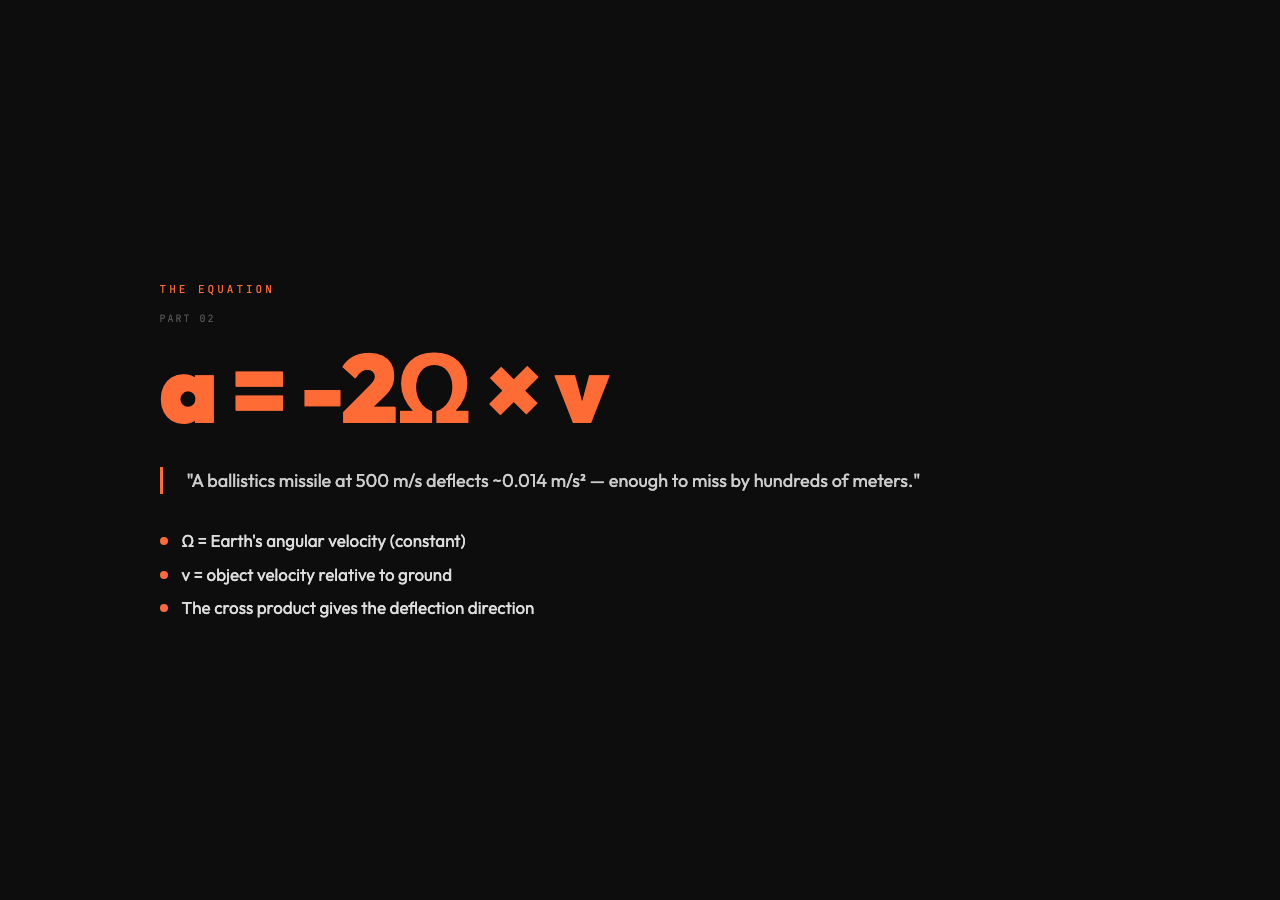
a = -2Ω × v
Where: – a is the Coriolis acceleration – Ω is Earth’s angular velocity vector (rotating once per day) – v is the object’s velocity relative to Earth’s surface
The magnitude of deflection depends on two things: how fast Earth rotates (constant) and how fast the object is moving (variable). A cruise missile traveling at 500 m/s at mid-latitudes experiences a Coriolis deflection of roughly 0.014 m/s² — small, but enough to miss a target by hundreds of meters over its flight path if uncorrected.
This is why artillery tables — long before GPS — included Coriolis corrections. Without them, long-range cannon fire would systematically veer off target.
Three Places the Coriolis Force Dominates
1. Weather Systems
Hurricanes and cyclones are direct products of the Coriolis effect. In the Northern Hemisphere, winds spiraling toward a low-pressure center are deflected rightward, creating the characteristic counterclockwise rotation. In the Southern Hemisphere, the spiral runs clockwise.

Without the Coriolis force, warm and cool air masses would meet and mix without organized rotation — no hurricanes, no cyclones, no organized mid-latitude weather patterns.
The minimum latitude for hurricane formation is about 5° N/S — closer to the equator, the Coriolis effect is too weak to initiate the spin.
2. The Foucault Pendulum
In 1851, French physicist Léon Foucault hung a 28-kilogram pendulum from the dome of the Paris Panthéon. Over the course of an hour, the pendulum’s swing plane slowly rotated — proof that the Earth was turning beneath it.
The pendulum doesn’t actually change its swing direction. The Earth rotates underneath it. At the poles, the plane rotates once per day. At Paris’s latitude (49° N), it rotates once per 31 hours.
3. Ballistics and Satellites
Long-range artillery, ballistic missiles, and satellite orbital corrections all require Coriolis calculations. The effect is more pronounced at higher latitudes (where Ω has a larger horizontal component) and for longer flight times.
Why You Can’t See It in Your Sink
A persistent myth claims that water always drains clockwise in the Northern Hemisphere and counterclockwise in the South — proof of the Coriolis force. This is false for two reasons:
1. The Coriolis acceleration at sink-scale is roughly 0.00001 m/s² — far weaker than the geometry of the drain, the shape of the basin, or the initial water motion. 2. The effect only manifests over large distances and long time periods.
The Coriolis force shapes hurricanes and ocean currents, but it does not determine which way your bathtub drains.
The Deeper Point: Reference Frames Are Not Created Equal
The Coriolis force exists because Newton’s laws — the foundation of classical mechanics — only apply in inertial (non-accelerating) reference frames. Earth’s surface is not inertial; it rotates. To use Newton’s laws on Earth, we must introduce fictitious forces: Centrifugal force, Coriolis force, and others.
This isn’t cheating — it’s a coordinate system transformation. But it means that what looks like a force to us on the ground is actually geometry: the curvature of spacetime introduced by Earth’s rotation.
That is why the Coriolis force doesn’t push objects sideways — it reveals that “straight line” means something different depending on where you’re standing.
The Invisible Hand Shaping Your Weather
Next time you check the weather forecast, remember: the spiral on the map isn’t happening because of some mysterious wind pushing storms in circles. It’s the geometry of a rotating planet expressed through a formula you can write on an index card.
a = -2Ω × v
Everything from the trajectory of a NFL punt to the path of a hurricane across the Atlantic traces back to that single line — and the fact that the planet beneath your feet is a spinning platform, not a fixed stage.