
Why Two Frequencies Close Together Create a Pulsing Sound You Can Feel in Your Chest
You press play. Two tones fill the room — one at 440 Hz, one at 444 Hz. They sound almost identical. But then something strange happens. A throbbing pulse emerges from nowhere, waxing and waning like a heartbeat. You didn’t add a third sound source. You just added four hertz.
This is the beat frequency — and it shows up everywhere: in tuning a guitar, in police sirens passing on the highway, in the way your ear extracts meaning from overlapping sounds.
The Math: What Actually Happens
When two sound waves occupy the same space, they don’t collide like billiard balls. They superpose — their pressure variations add together algebraically. If wave 1 has amplitude A₁ and wave 2 has amplitude A₂, the combined signal at any moment is simply A₁ + A₂.
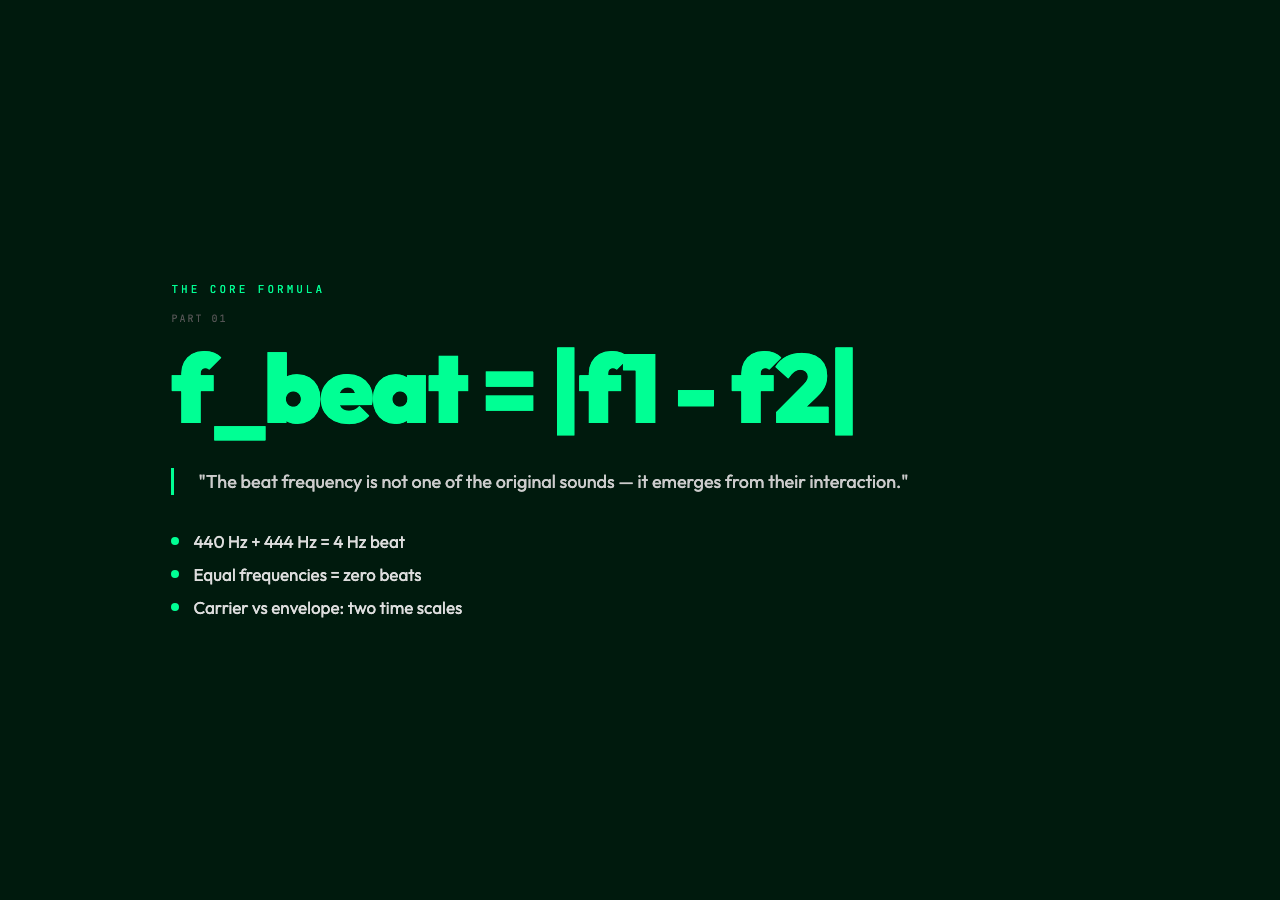
At 440 Hz and 444 Hz, each wave completes roughly 440 or 444 cycles per second. For most of those cycles, the two waves are nearly in phase or nearly out of phase — the sum stays relatively large or relatively small. But at a rate of 4 times per second, the waves line up constructively (reinforcing each other) and then, a quarter-second later, line up destructively (partially canceling).
That 4 Hz difference is the beat frequency — the rate at which the combined amplitude pulses.
More precisely:
f_beat = |f₁ - f₂|So 440 Hz and 444 Hz produce a 4 Hz beat. If you tune two oscillators to 440 Hz and 441 Hz instead, the pulse slows to once per second. Get them exactly equal and the beat vanishes — you’re left with a single, steady tone.
The Envelope Tells the Story
Visualize it. Open the simulation and watch the two individual waveforms (blue and red) riding on top of each other. They’re oscillating fast — too fast for your ear to track individually. But the combined waveform reveals a slow undulation: an amplitude envelope that rises and falls at exactly the beat frequency.
The mathematical form of this envelope is:
A_combined(t) = 2A · cos(π · f_beat · t)The cos function oscillates between +1 and −1, which means the combined amplitude swings from full reinforcement (twice the individual amplitude) to near-cancellation. When the two waves are perfectly out of phase, they nearly wipe each other out — even though each wave individually is just as loud as before.
This is not acoustic interference in the sense of two sound beams competing for the same physical space. It’s temporal interference: the overlapping waves alternate between adding and subtracting at a rate your brain can perceive as rhythm.
Real Ears, Real Instruments
Professional musicians use this phenomenon every time they tune. When tuning an instrument to a reference tone, you adjust until the beat frequency drops to zero — meaning the two pitches are identical to within a fraction of a hertz.
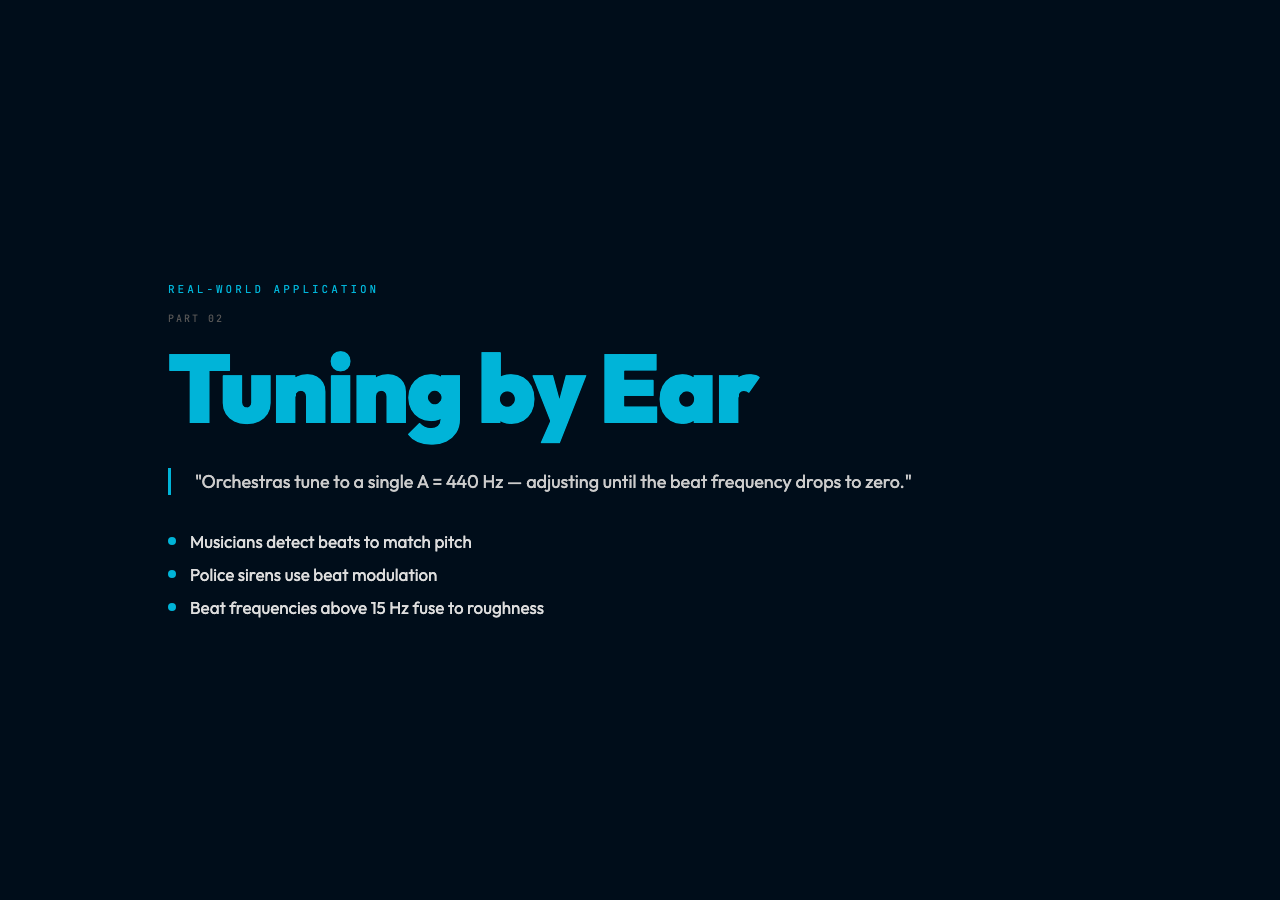
Orchestra tuning before a concert is a practical demonstration: the oboe plays an A = 440 Hz, and every string player adjusts until their instrument’s A matches with no audible beating.
The same principle appears in police sirens. The classic wail slides the frequency up and down continuously. When the siren moves toward you, the waves compress (Doppler effect), raising the pitch. As it passes and moves away, the pitch drops. But the beat between the approaching and receding frequencies creates a distinctive pulsing tremolo — which is why emergency vehicle sirens are so attention-grabbing.
In acoustic engineering, beat frequencies can be problematic. If two amplifiers reproduce the same signal with a tiny frequency offset (say, 59.9 Hz and 60.0 Hz due to power line interference), a 0.1 Hz beat emerges — slow enough that it can modulate the output in unwanted ways.
The Limit of Perception
Your auditory system can’t track individual cycles at 440 Hz. The period of one cycle is about 2.3 milliseconds — far faster than conscious time resolution. But a 4 Hz beat has a period of 250 milliseconds, which is slow enough for your auditory system to track as a distinct rhythmic modulation.
There’s a perceptual crossover point. Below roughly 15–20 Hz, amplitude modulation is perceived as distinct pulses. Above that range, it fuses into a single sensation of roughness or tremolo. This is why the beat frequency is such an effective tuning cue: 4 Hz is well within the range of conscious rhythmic perception, while 440 Hz is not.
Why the Envelope Formula Works
The envelope 2A · cos(π · f_beat · t) comes directly from the trigonometric identity for the sum of two cosines:
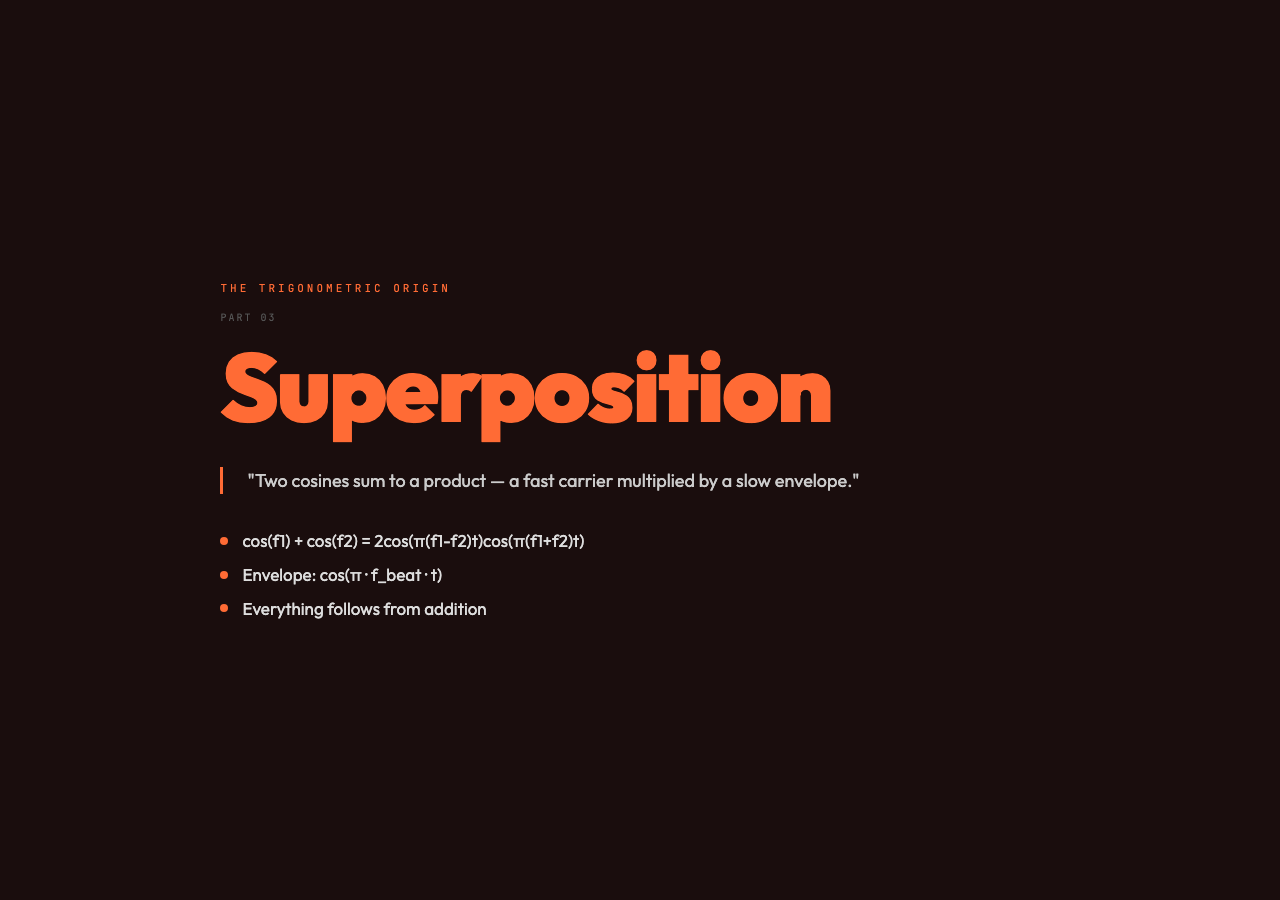
cos(2πf₁t) + cos(2πf₂t) = 2 · cos(π(f₁ − f₂)t) · cos(π(f₁ + f₂)t)The fast oscillation is at the average frequency (f₁ + f₂)/2 — that’s the tone you hear. The slow oscillation is at half the beat frequency π(f₁ − f₂) — that’s the envelope. The factor of π appears because we’re using angular frequency in the identity; converting back to ordinary frequency gives f_beat = |f₁ − f₂|.
Interactive Exploration
Open the simulation and try the presets:
- Slow (4 Hz beat): 440 Hz and 444 Hz — you can count the pulses by hand
- Moderate (6 Hz beat): 440 Hz and 446 Hz — noticeably faster pulsing
- Fast (10 Hz beat): 440 Hz and 450 Hz — approaching the boundary of rhythmic perception
- No beat: 440 Hz and 440 Hz — perfectly silent between pulses; the waveform is a single steady oscillation
Watch how the combined waveform’s envelope changes speed while the individual waveforms keep their own rhythm. The two scales of oscillation — the carrier wave and its modulating envelope — coexist without interfering with each other.
The Takeaway
Two nearly-identical frequencies don’t produce a boring, slightly-out-of-tune sound. They produce something genuinely new: a rhythmic pulse that your auditory system detects as a distinct perceptual object. The beat frequency is not one of the original sounds — it’s an emergent property of their interaction.
And it emerges from nothing more than addition.


Nice overview and splitting of phenomena. I looked in vain for the simulation (showing wave and envelope) – where is it? I’m very visually oriented; helps me understand mathematical descriptions of physics better than formulae.