Why Push a Swing at the Right Moment: The Physics of Resonance
In 1940, the Tacoma Narrows Bridge twisted itself apart in a steady wind. It wasn’t a storm. It wasn’t faulty material. The wind pushed at a frequency that matched the bridge’s natural oscillation frequency, and the bridge越来越大 — until the metal gave way. Engineers call this resonance: when you apply a periodic force at the right frequency, a system that should dampen instead amplifies.
This article explores why resonance happens, when it’s catastrophic, and how it shows up in everything from your kitchen microwave to the MRI machine at the hospital.
The Setup: A Mass on a Spring
Imagine a mass hanging from a spring. Pull it down and let go, and it bobs up and down at its natural frequency — determined by how heavy the mass is and how stiff the spring is. This is the frequency the system “wants” to vibrate at.
Now imagine you reach down and push the mass — not randomly, but rhythmically. If you push in time with its natural bob, each push adds energy to the system. The amplitude grows. Push at the wrong rhythm, and you’re fighting the motion half the time, draining energy instead.
The driven harmonic oscillator follows this equation:
x(t) = A(ω) cos(ωt – δ)
Where A(ω) — the amplitude as a function of driving frequency ω — determines how large the oscillations get.
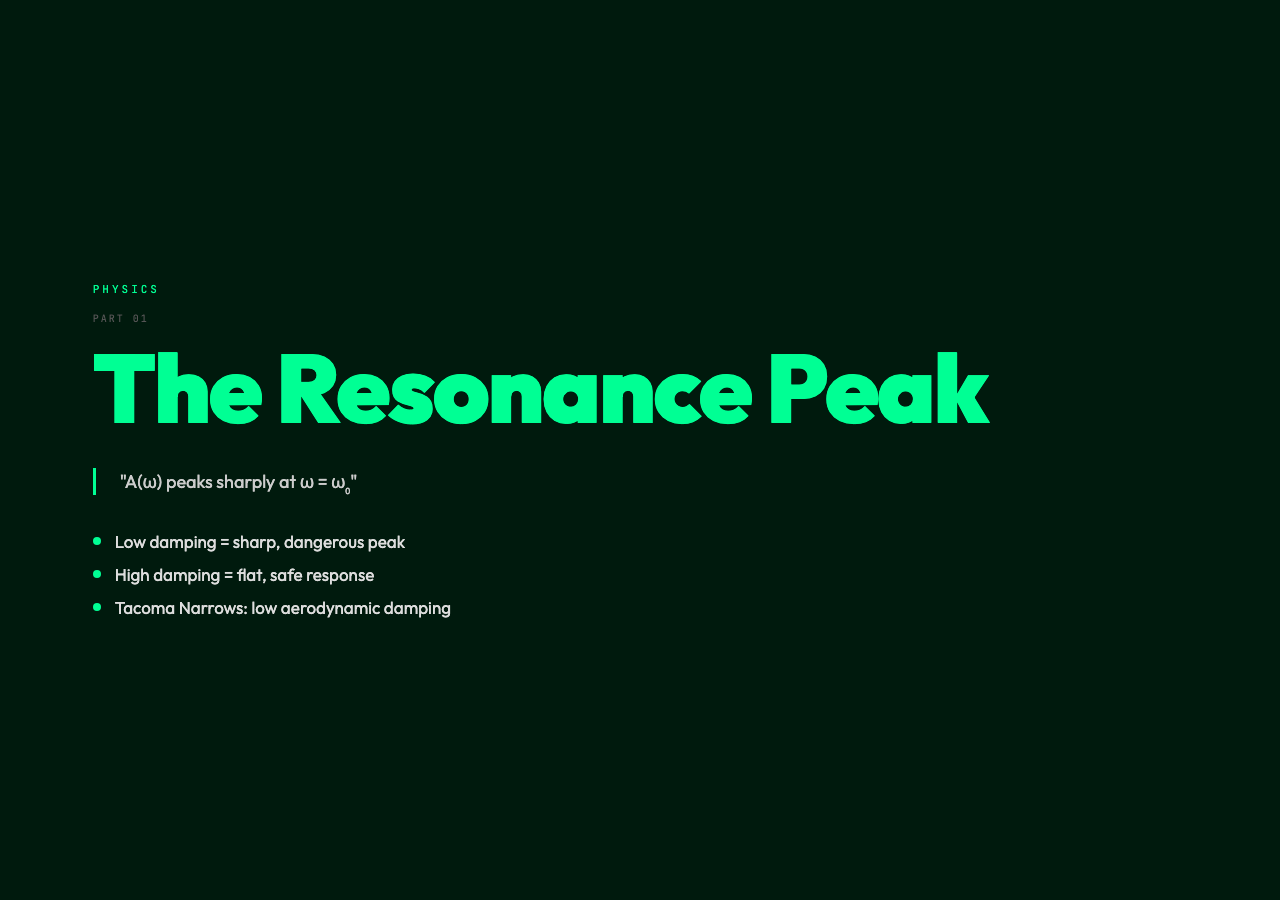
The critical insight: A(ω) peaks sharply when ω approaches the natural frequency ω₀, especially when damping is low.
The Resonance Curve: Why Low Damping Is Dangerous
Run the simulation and watch what happens as you sweep the driving frequency upward, starting low:
– At very low frequency (ω << ω₀): the mass moves slowly, almost tracking the driving force. Amplitude is modest. – As ω → ω₀: amplitude climbs steeply. This is the resonance peak. – At very high frequency (ω >> ω₀): the mass can’t keep up with the rapid pushes. It barely moves.
Now increase the damping coefficient. The peak flattens. The system dissipates energy faster, so it can’t build up enormous oscillations even when you hit the right frequency.
This is the central engineering tradeoff: low damping gives you sensitive, selective systems (radio receivers, musical instruments) but makes them vulnerable to unwanted resonance.
The Tacoma Narrows Bridge had low aerodynamic damping — it channeled wind energy into a narrow frequency band and let it accumulate.
Phase: Why You Have to Push at the Right Moment
The phase difference δ between the driving force and the system response depends on how far the driving frequency is from natural frequency:
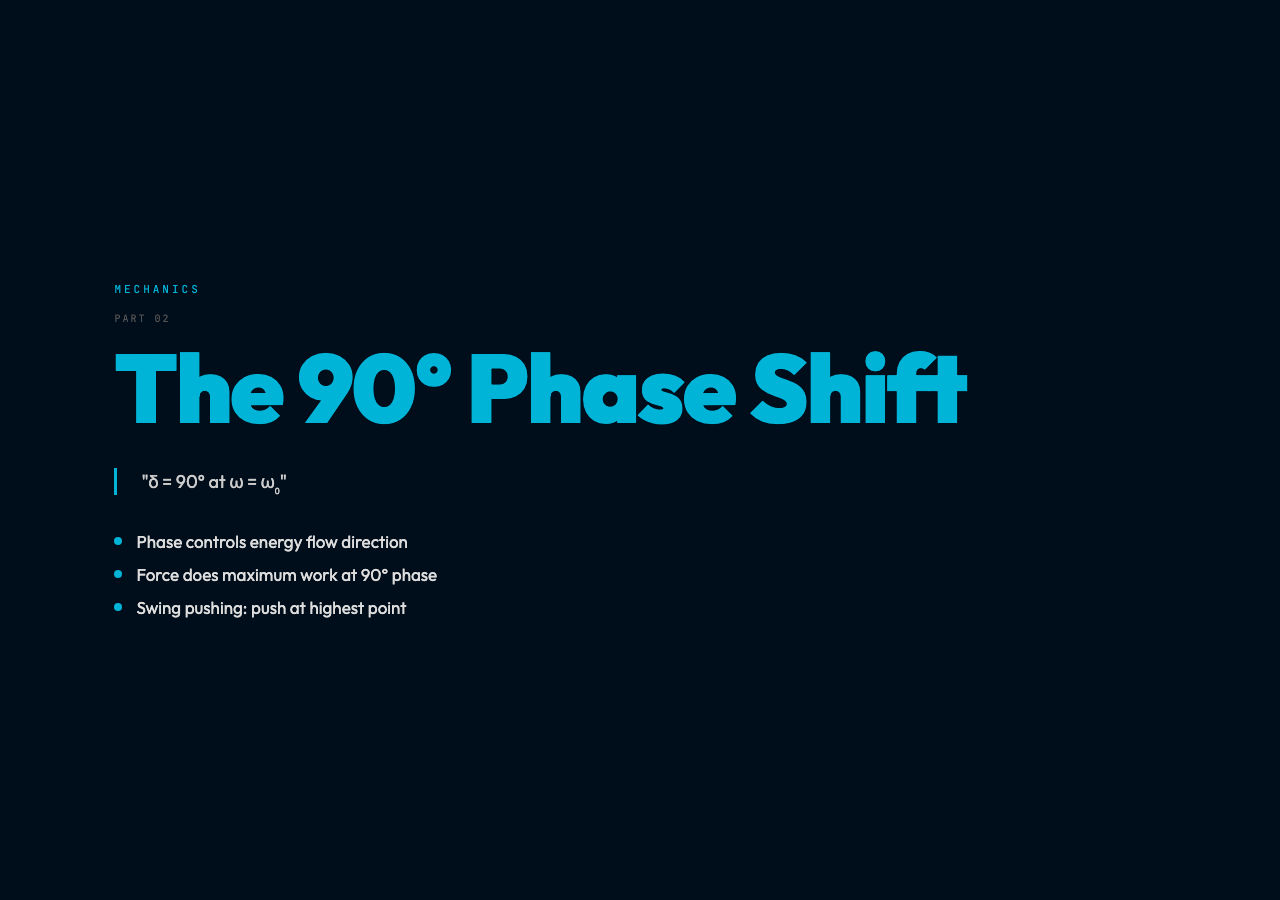
– At ω = ω₀: phase = 90°. The force is always perpendicular to the motion — pure energy transfer. – Below resonance: phase → 0°. Force and motion are nearly in sync, but the system doesn’t need much energy input to track a slow drive. – Above resonance: phase → 180°. Force and motion are nearly opposite. You’re fighting the system.
Resonance is not just about frequency matching — it’s about phase alignment. When phase is 90°, the force does maximum work on the system at every cycle.
This is exactly why pushing a swing works: you push when the swing is at its highest point (zero velocity) and the direction of your push aligns with the swing’s upcoming motion. Time it right and you add energy. Time it wrong and you fight momentum.
Where Resonance Shows Up
Bridges and Buildings: The Tacoma Narrows is the textbook case, but modern skyscrapers and long-span bridges include tuned mass dampers — massive weights that oscillate at the structure’s natural frequency to cancel out resonance.
Musical Instruments: Every instrument has resonant cavities or strings tuned to amplify specific frequencies. A guitar’s body resonates at frequencies that match the strings’ vibrations, projecting sound efficiently.
Radio and MRI: Your FM radio receives one station at a time because the receiver’s resonant circuit is tuned to the carrier frequency. An MRI machine applies radio pulses at exactly the resonant frequency of hydrogen nuclei in your body’s water — letting it flip their spin states with precision.
Microwave Ovens: The cavity is designed to sustain a standing wave pattern at 2.45 GHz. Food absorbs energy most efficiently at that frequency, because water molecules have a resonant frequency close to it.
The Tacoma Narrows Bridge Collapse: The wind created a periodic vortex shedding frequency that matched the bridge’s torsional natural frequency. Once locked in, the amplitude grew until structural limits were exceeded.
Why Damping Is the Unsung Hero
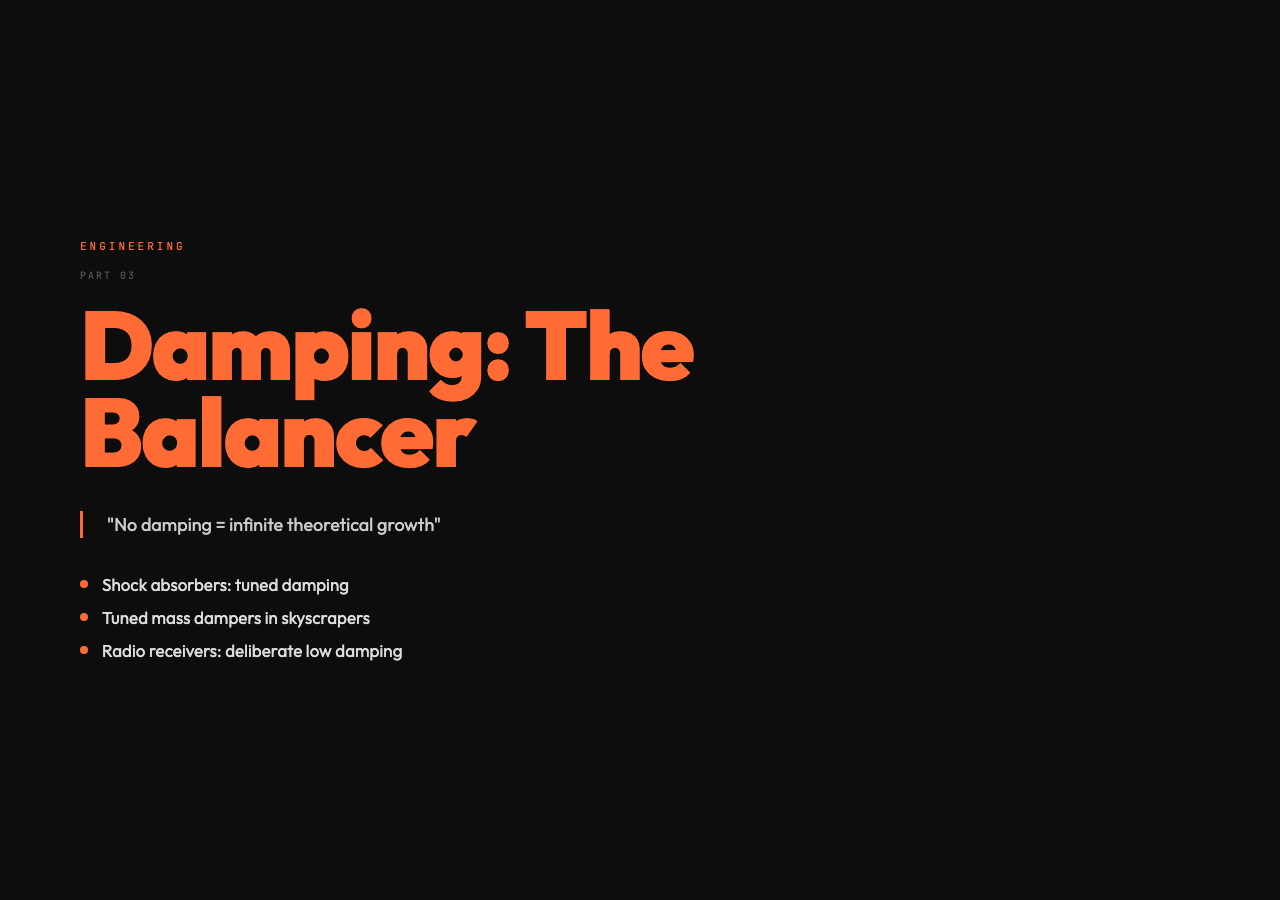
Resonance without damping is theoretically infinite growth — each driving cycle adds energy and nothing removes it. In practice, every real system has some damping: air resistance, internal friction, heat loss.
Engineers deliberately add damping to systems near sensitive resonance conditions. Shock absorbers in cars, for instance, are tuned to prevent suspension resonance on bumpy roads.
But too much damping makes a system sluggish. The art is in the balance: enough damping to survive random perturbations, but not so much that the system can’t respond to intended inputs.
The Takeaway
Resonance is not a curiosity — it’s a fundamental feature of any system that stores and exchanges energy between two modes (spring potential and kinetic energy, in the simplest case). It emerges whenever a driving force acts near a system’s natural frequency, and phase conditions allow continuous energy transfer.
The danger comes from surprise: a system resonant at one frequency encountering a driving force at exactly that frequency. The cure is understanding the resonance curve, controlling damping, and testing for frequency lock-in before deployment.
Next time you tune a radio, push a child on a swing, or watch a bridge sway — you’re working with resonance.