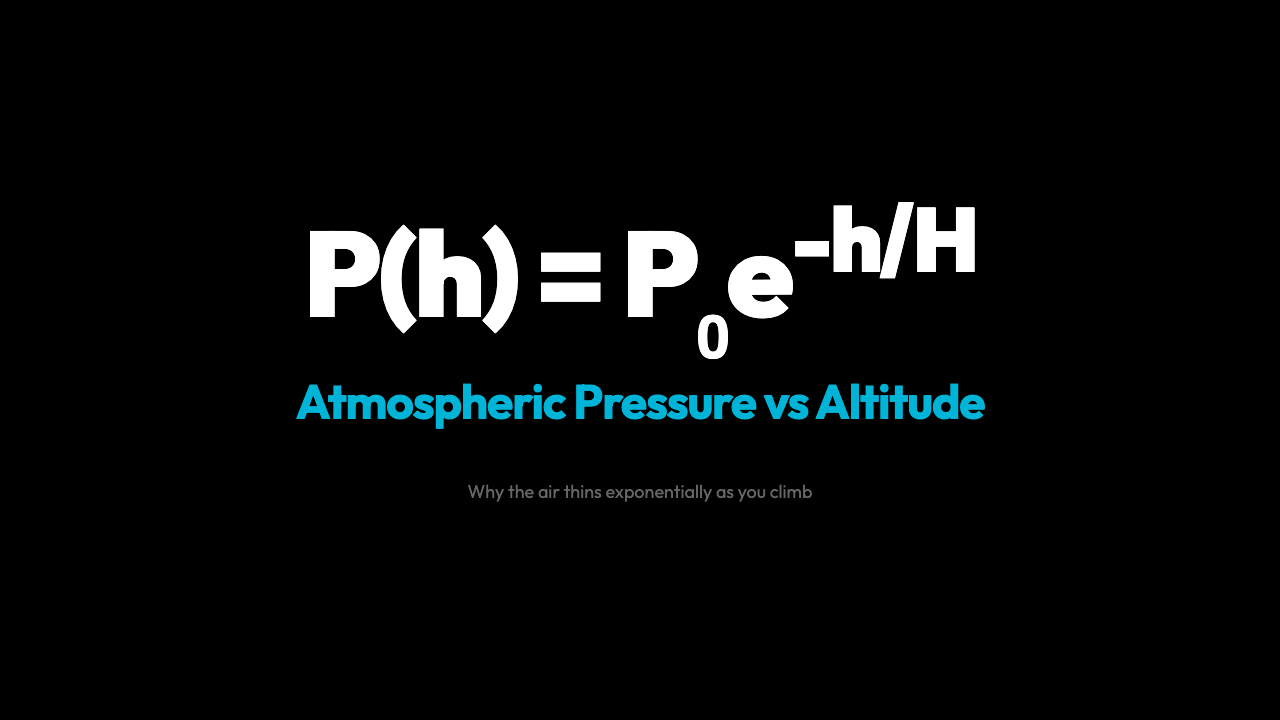
Why Mountains Make It Harder to Breathe: The Exponential Physics of Atmospheric Pressure
The air at the top of Mount Everest is so thin that climbers describe it as breathing through a straw. At 8,850 meters, the atmospheric pressure is roughly one-third what it is at sea level. The human body, adapted to life at sea level, struggles not because there’s no oxygen — the percentage is the same, 21% — but because the partial pressure of oxygen has dropped below what your blood can efficiently absorb.
This is the barometric formula in action: pressure doesn’t fall linearly with altitude. It falls exponentially.
The Core Mechanism: Why Air Has Weight
At sea level, the atmosphere exerts a pressure of 101.325 kPa on every square centimeter of your body. You don’t feel it because the pressure inside your body pushes outward with equal force. But that pressure is the weight of the entire column of air above you — from the surface to the edge of space.
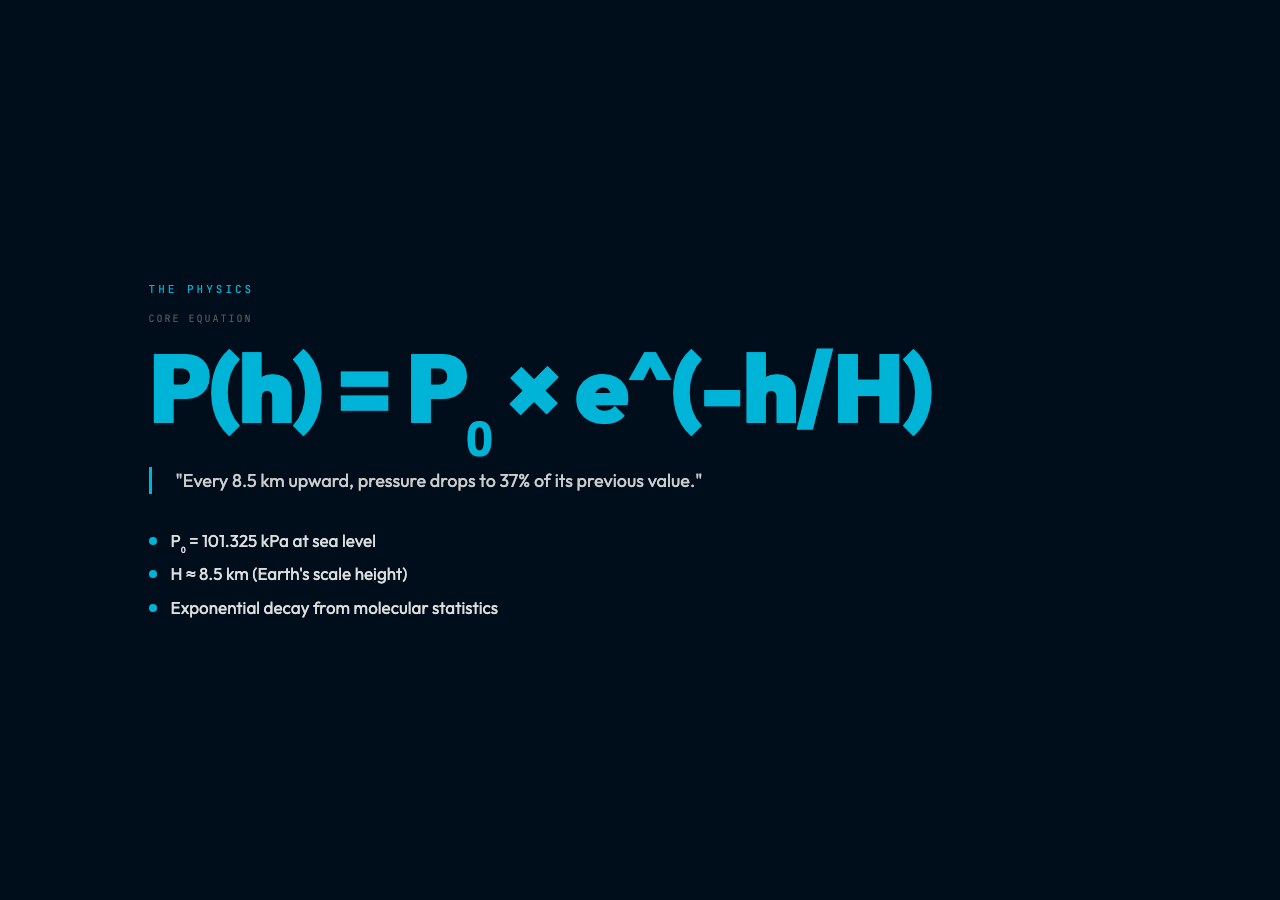
The barometric formula describes this:
P(h) = P₀ × e^(-h/H)
Where: – P(h) is pressure at altitude h – P₀ is sea level pressure (101.325 kPa) – H is the scale height (~8.5 km for Earth’s atmosphere) – e is the base of the natural logarithm
The scale height H is the altitude at which pressure drops by a factor of 1/e (about 37%). Climb 8.5 km, and pressure is already down to 37% of its sea level value. Climb 17 km — roughly twice the scale height — and it’s 1/e², or about 13.5%.
This exponential decay isn’t a coincidence. It emerges from the same statistics that govern how molecules distribute themselves under gravity. At any temperature, gas molecules are in constant thermal motion. Gravity pulls them downward, but thermal agitation pushes them upward. The equilibrium is a density that decreases exponentially with altitude — a distribution first derived by Laplace in 1783.
The Scale Height: Earth’s 8.5-Kilometer Signature
The 8.5-kilometer scale height applies to Earth’s atmosphere under standard conditions (sea level temperature around 15°C). But it changes with temperature.
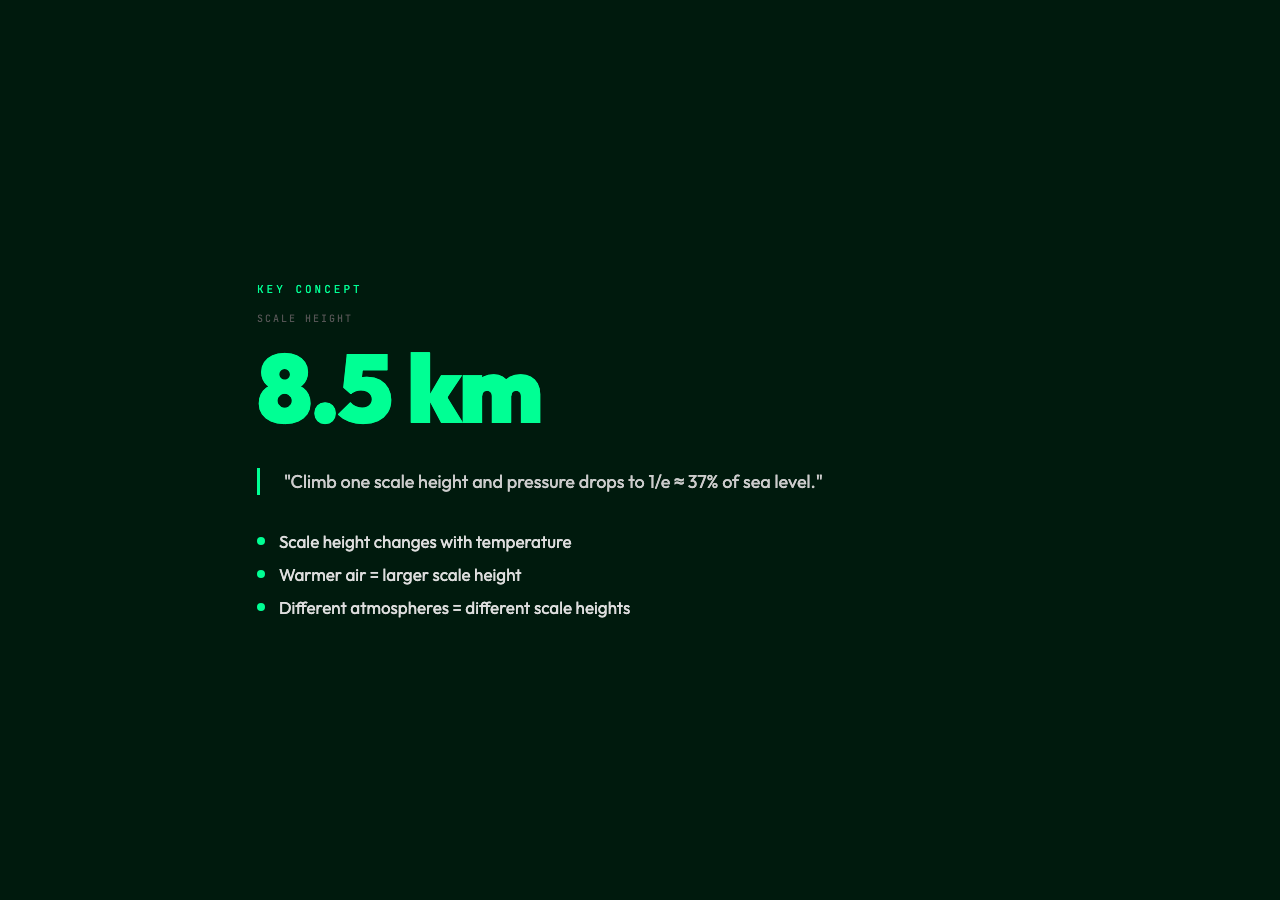
Warmer air has a larger scale height — the exponential decay is slower, because molecules have more kinetic energy to resist gravity. Colder air compresses more tightly, giving a smaller scale height. This is why atmospheric pressure varies seasonally: winter air over cold continents is denser at low altitudes than summer air over warm plains.
The scale height also depends on molecular composition. Earth’s atmosphere is mostly nitrogen (78%) and oxygen (21%). A hypothetical atmosphere of heavier molecules like argon would have a smaller scale height — pressure would drop off faster with altitude. This matters for aerospace: Mars’s atmosphere, mostly CO₂ with a smaller scale height, has a pressure profile that decays even more sharply than Earth’s.
Real-World Consequences: From Aviation to Medicine
The exponential pressure profile shapes several domains:
Aviation: Commercial airplanes cruise at 10–12 km, where cabin pressure must be artificially maintained at the equivalent of 1,500–2,400 meters (roughly 84 kPa). At true cruising altitude (8–10 kPa outside), pilots and passengers would lose consciousness within seconds without pressurization. Aircraft pressurization systems simulate a lower-altitude environment to keep occupants functional.
Respiratory physiology: At 3,000 meters (about the elevation of Denver, Colorado), arterial oxygen saturation drops from 98% to roughly 88–90%. Most people adapt within days, but unacclimatized visitors often experience altitude sickness — headaches, nausea, fatigue. The body compensates by breathing faster and producing more red blood cells over weeks. Elite athletes deliberately train at altitude to exploit this adaptation.
Ecuador’s mystery: The planet’s rotational bulge means sea level is farther from Earth’s center at the equator than at the poles. This makes equatorial sea level pressure slightly lower than polar sea level pressure — even before temperature effects. Quito, Ecuador at 2,850 meters feels like it should be lower-pressure than Denver at 1,609 meters, but the equatorial bulge partially offsets the altitude difference.
Why Percentage Oxygen Doesn’t Save You
A common misconception: since oxygen is 21% of the atmosphere at all altitudes, breathing should work the same everywhere. This ignores partial pressure.
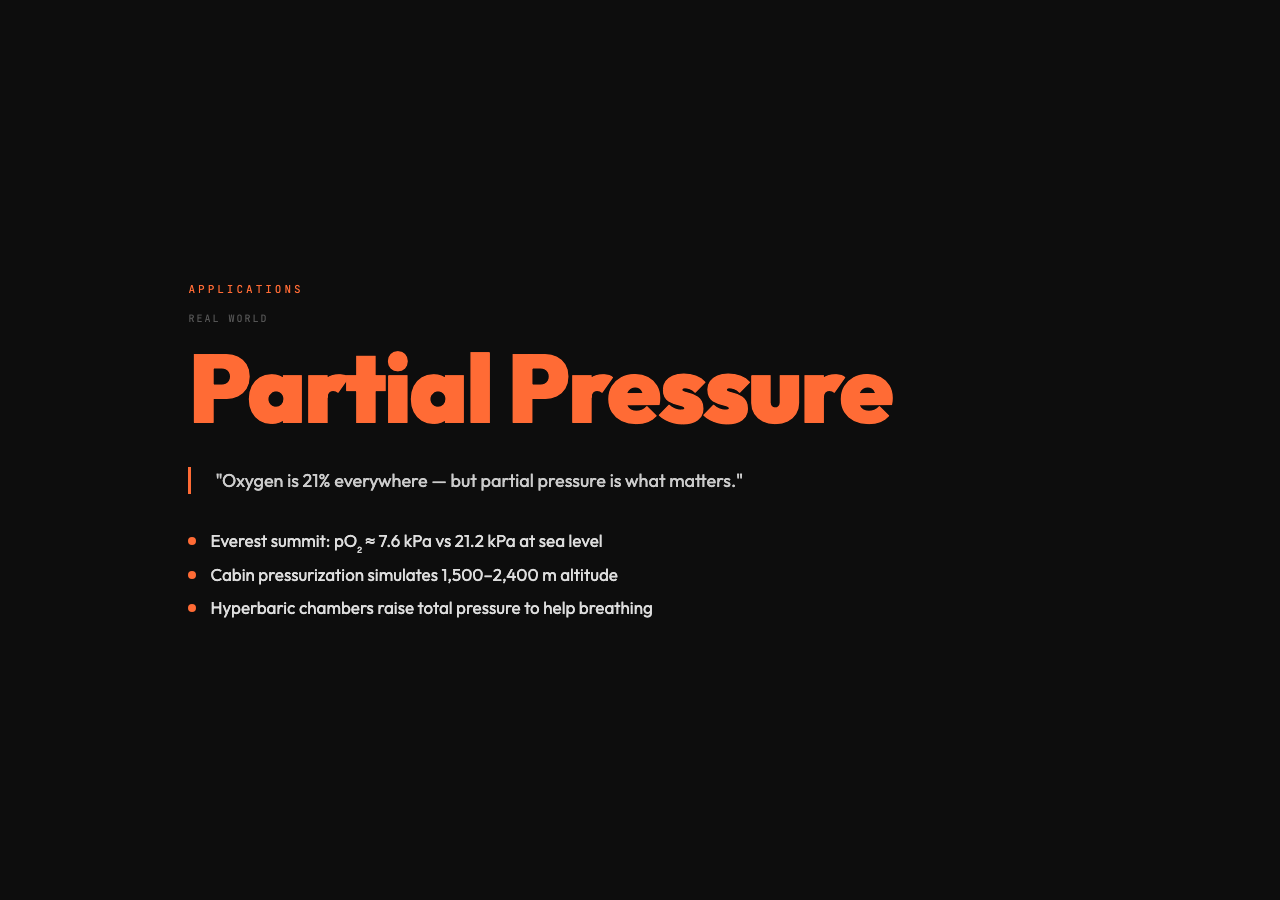
Dry air at sea level has a partial pressure of oxygen (pO₂) of about 21.2 kPa. At Everest’s summit, even with 21% oxygen, the pO₂ drops to roughly 7.6 kPa — below the threshold for sustained consciousness without supplemental oxygen. The percentage hasn’t changed; the total pressure has.
This is also why hyperbaric chambers help: they increase total pressure, raising the partial pressure of oxygen even at sea level. Conversely, pure oxygen at altitude is still limiting — you need both the right percentage and sufficient total pressure.
The Takeaway
Atmospheric pressure decreases exponentially with altitude because of a fundamental balance between gravitational attraction and the thermal motion of gas molecules. The scale height — approximately 8.5 km for Earth — tells you how quickly: every 8.5 km upward, pressure drops to about 37% of its previous value.
This exponential profile shapes everything from how we design aircraft to how athletes train to how your body feels on a mountain hike. Understanding it transforms an abstract altitude number into a concrete physical prediction.
The next time you’re short of breath at elevation, you’re not just high — you’re experiencing the barometric formula in real time.