Why the Center of Mass Moves the Way It Does: The Invisible Point That Governs All Motion
Throw a bowling ball and a baseball simultaneously from the same height. Despite their vastly different masses, both hit the ground at the same instant. But link them together with a spring, or throw a hammer with a loose head, and something stranger happens — the system moves in a way that seems to follow its own rules, independent of what the individual parts are doing.
That rule comes down to a single invisible point: the center of mass.
The center of mass is the weighted average position of every piece of mass in a system. It is not a physical object — nothing holds it up, no material traces its boundaries. Yet it is the one point whose motion fully describes how the entire system translates through space. Every external force acting on the system accelerates its center of mass according to Newton’s second law, no matter how chaotic the internal forces between parts.
This is why a spinning firefighter can throw a twirling baton and still have it land in her hands. The internal torques and rotations cancel out in the center-of-mass frame. What matters externally is simply where that one balancing point is and where it is going.
The Four Scenarios That Reveal Everything
Projectile Motion: When the Whole System Falls Together
Launch a two-body system — say, two balls of unequal mass connected by a rigid rod — at an angle. The lighter ball does not lag behind or get left behind. The entire system follows a single parabolic arc, because the center of mass accelerates downward under gravity at exactly g, regardless of the mass distribution.
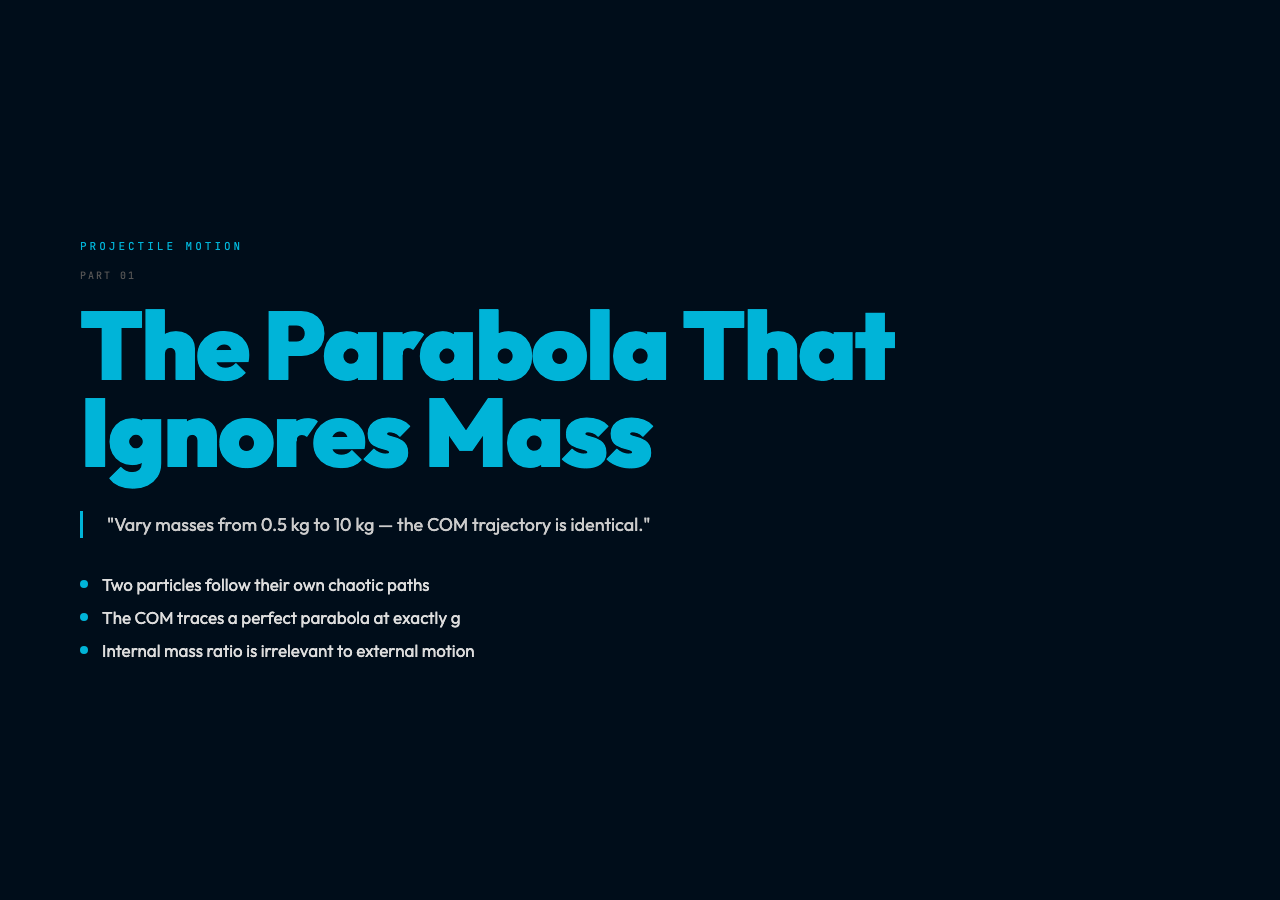
You can vary the masses from 0.5 kg to 10 kg, adjust the launch angle, change the initial velocity. The center of mass trajectory is identical. The internal mass ratio is irrelevant to the external motion. This is not an approximation — it is a direct consequence of Newton’s laws.
The visualization shows this clearly: two particles following their own curved paths through space, while a third point — the center of mass — traces a perfect parabola that matches what you would get from a single point particle with the system’s total mass.
The Explosion Paradox: Recoil Without External Force
Place two blocks on a frictionless surface. Give them an internal push — a spring releases, a small explosion occurs — and they fly apart. No external force was applied to the system. Yet the center of mass, which was at rest before the explosion, remains exactly at rest after.
This is conservation of momentum. With zero net external force, the total momentum of the system cannot change. Since the center-of-mass velocity is total momentum divided by total mass, it stays put. The heavier block crawls slowly backward; the lighter one rockets away — and their weighted average position never moves.
This is the principle behind recoil. A cannon fires a shell; both the cannon and the shell fly apart, but the system’s center of mass stays fixed relative to the Earth. The heavier cannon gains a small velocity; the lighter shell gains a large one. Multiply each by its mass, and the sums are equal and opposite.
Decomposition: Separating Internal Motion from External Motion
One of the most powerful techniques in mechanics is decomposing a particle system’s motion into two parts: the motion of the center of mass itself, and the motion of particles relative to the center of mass.
The center of mass follows the external-force dynamics — gravity, friction, drag. The relative motions are governed only by internal forces — springs, constraints, collisions. These two layers can be analyzed independently and then recomposed. The separation is not an approximation; it is exact.
This decomposition is why a diver can tuck into a somersault and then extend before entry. Her center of mass follows the same parabolic trajectory whether she is spinning or not. Her rotation rate changes because she is redistributing mass relative to that center — but the center itself is immune to her gymnastics.
No External Force, No Center-of-Mass Acceleration
With zero external force, the center of mass moves at constant velocity — or stays at rest. This is Newton’s first law applied to the system as a whole. Internal explosions, vibrations, chemical reactions, or nuclear decays cannot change the system’s total momentum, and therefore cannot change the center-of-mass motion.
This is why a spacecraft that expels reaction mass slows down the expelled mass and itself in opposite directions — but the center of mass of the whole spacecraft-plus-exhaust system follows exactly the same trajectory it would have without the expulsion.
What Makes This Visualization Different
Most demonstrations show the center of mass as a static point — a dot drawn on a diagram. This simulation shows it as a living, moving consequence of real forces. You can switch between four scenarios and watch the center of mass respond in real time:

– Projectile mode: Launch a multi-particle system and watch the COM trace a perfect parabola independent of mass distribution. – Explosion mode: Trigger an internal separation with a controlled force and observe the COM remain stationary. – Decomposition mode: Toggle separate views showing COM motion and relative particle motion independently. – Free decomposition mode: Separate a connected system into independent fragments and watch the COM track the fragment with the most mass.
Every scenario makes the same underlying point, but from a different angle: the center of mass is not a convenient fiction. It is the physical consequence of how mass and force relate to each other across an entire system.
Why This Matters Beyond Physics Class
The center-of-mass concept extends well beyond textbooks. In aerospace engineering, trajectory calculations for multi-stage rockets are performed in the center-of-mass frame. In biomechanics, researchers model the human body as a segmented system to understand how mass distribution affects athletic performance. In astrophysics, binary star systems orbit their mutual center of mass — both stars move, but neither stays still.

The abstract mathematics — weighted sums of position, velocity, acceleration — maps directly onto observable physical reality. That is what the simulation lets you see: the math breathing, the invisible point drawing its line through space, and the individual particles dancing around it.
Interact with the simulation to see for yourself: adjust masses, trigger explosions, vary initial conditions, and watch how the center of mass responds — or refuses to respond.