Why Red and Green Make Yellow: The Physics Behind Additive Color Mixing
Every screen you stare at—phone, laptop, television—is built on a lie your brain tells you. Red pixels and green pixels sit side by side on that LCD panel, emitting completely different wavelengths of light. But your eyes don’t see red light and green light. They see yellow. Or orange. Or pink. The physics of light didn’t change. Your visual system did the math without asking you.
This is additive color mixing, and it’s one of the most counterintuitive things in optics.
The Old Way vs. The New Way
For painters and printmakers, color worked subtractively. You mixed pigments—blue plus yellow got you green because each pigment absorbed some wavelengths and reflected others. Add enough pigments together and you got black, because everything was absorbed.
Light doesn’t work that way. Light adds. When two beams of colored light overlap on a white screen, your eye receives both sets of wavelengths simultaneously. The result is a new color—computed by your brain, not by physics.
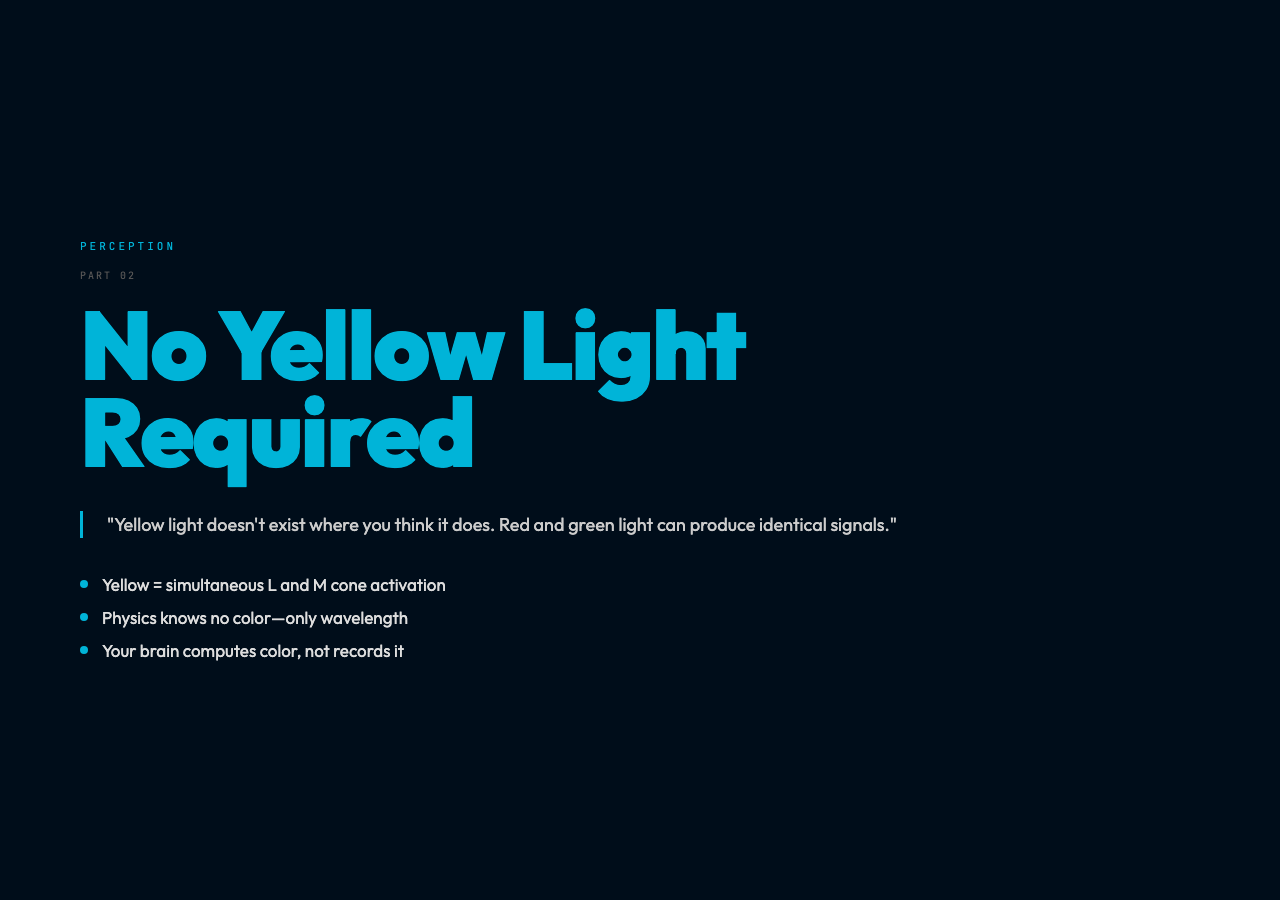
The physics doesn’t care about color. It only cares about wavelength. A beam at 650 nanometers is red. A beam at 530 nanometers is green. Neither is “yellow.” But when both strike the same cone cells in your retina at the same time, your visual cortex interprets the combined signal as yellow.
This is not an illusion. It is how human vision evolved to work.
RGB: The Trillion-Dollar Accident
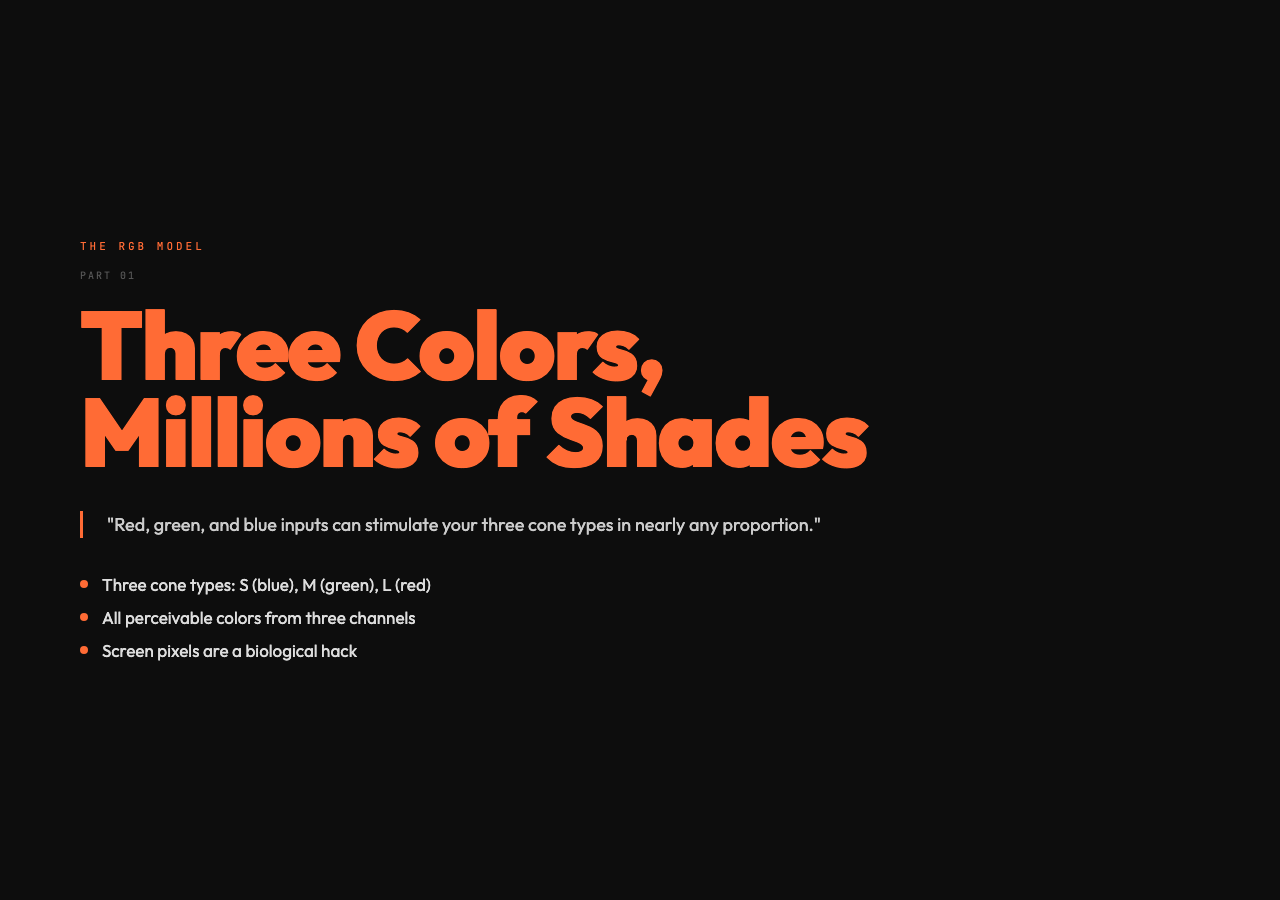
The screens surrounding us use three colors: red, green, and blue. Not because these are scientifically special, but because of biology. Your retina contains three types of cone cells, sensitive to roughly short (blue, S), medium (green, M), and long (red, L) wavelengths. These three channels give you all the color perception you have.
By mixing intensities of just three wavelengths, you can stimulate these three cone types in nearly any proportion. The result: millions of perceivable colors from just three inputs.
The math is elegant. Equal parts red and green light (with no blue) produces yellow. Equal parts red and blue produces magenta. Green and blue produces cyan. All three at full intensity produces white. This is the RGB color model—not a description of how light physically combines, but a clever engineering trick that exploits how human color perception works.
Why This Matters Beyond Screens
Additive mixing appears everywhere nature didn’t intend it. A sunset turns the sky orange because Rayleigh scattering shifts blue toward red—your visual system receives an unusual ratio of wavelengths and interprets it as warmth. A green laser pointer looks green not because the light is “green” in some absolute sense, but because it emits at a wavelength that your M-cones respond to strongly and your other cones barely register.
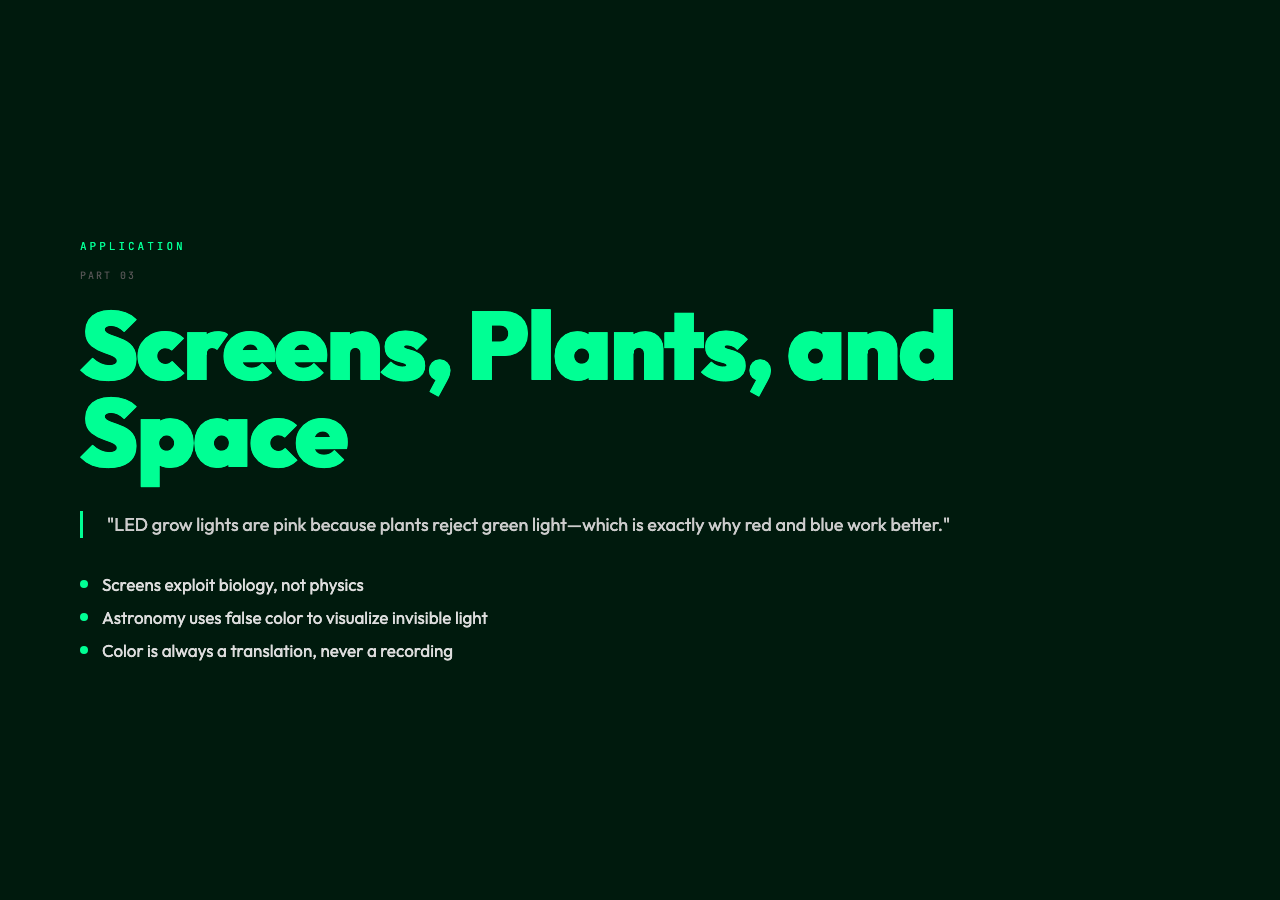
The same principle explains why LED grow lights for plants often look pink or purple—combining red and blue LEDs is more efficient for photosynthesis than using “green” light, which plants reflect. The color you see is the color the plants reject.
Even in astronomy, additive thinking trips people up. The Hubble Space Telescope doesn’t take “color” photos in the traditional sense. It exposes sensors to specific wavelengths—often beyond visible range—and assigns those channels to red, green, and blue in the final image. The colors in nebula photos are often “false color,” mapping invisible radiation into visible wavelengths your eyes can process. The science is real. The color is a translation.
What Additive Mixing Teaches Us
The takeaway isn’t about screens or pigments. It’s about perception being a computational process, not a passive recording. Every color you see is your brain’s best guess about what’s out there in the world, based on incomplete wavelength data.
When you see yellow, there may be no yellow light hitting your eye at all. There might only be red and green. Your brain did the rest—silently, instantly, and mostly correctly for the millions of years it evolved to operate in.
That’s both the wonder and the limitation. You never see the world as it is. You see the world as your wiring allows.
Understanding additive color mixing doesn’t fix this. But it makes the gap between reality and perception impossible to ignore.