Why Two Charges Decide Whether to Meet or Flee: The Invisible Hand Behind Every Spark
Every lightning strike begins with a decision made in microseconds: will two charged particles attract or repel? The answer is so fundamental that it shapes chemistry, electronics, and the structure of matter itself. And it all comes down to one equation written over two centuries ago.
The Law That Governs Every Charged Particle in the Universe
In 1785, Charles-Augustin de Coulomb measured something remarkable with a torsion balance: the force between two charged objects is proportional to the product of their charges and inversely proportional to the square of the distance between them. The modern form of what we now call Coulomb’s law reads:
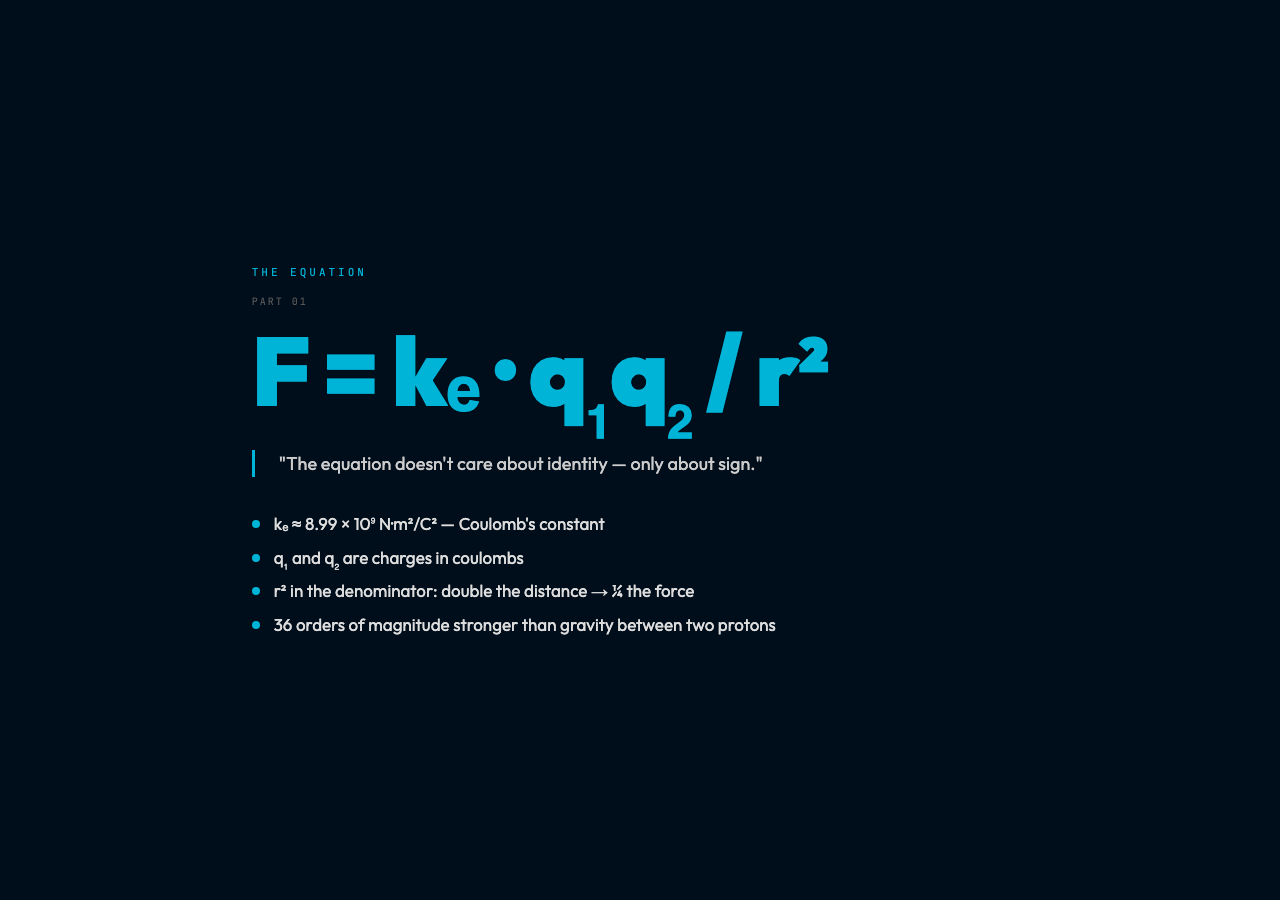
F = k_e × q₁ × q₂ / r²
Where F is the electrostatic force in newtons, q₁ and q₂ are the charges in coulombs, r is the distance between them in meters, and k_e is Coulomb’s constant — approximately 8.99 × 10⁹ N·m²/C².
What makes this equation unforgettable is the sign embedded in the product q₁ × q₂. When both charges have the same sign — both positive or both negative — their product is positive, and the force is repulsive: they push apart. When the charges have opposite signs, the product is negative, and the force is attractive: they pull together.
This single variable — whether the charges agree or disagree — determines the entire behavior of the system.
The Three Configurations
The visualization at the core of this exploration lets you place two charges in three characteristic configurations and watch what happens.

Positive–Positive (Like Repels Like): Two positively charged particles placed near each other feel a repulsive force that grows explosively as they get closer. At short distances, the repulsion dominates everything else. This is why identical ions in a crystal lattice don’t collapse into each other — electrostatic repulsion holds them apart.
Negative–Negative: The same dynamics apply, mirrored. Two electrons repel each other with the same mathematical fury as two protons. The equation doesn’t care about the identity of the charge carrier; it only cares about the sign.
Positive–Negative (Opposites Attract): When one charge is positive and the other is negative, the product q₁ × q₂ is negative, and the force reverses direction. The particles accelerate toward each other. This is the configuration behind chemical bonds, static cling, and the initial moments of a lightning strike.
What the Exponent Actually Means
The r² in the denominator deserves special attention. The force does not simply decrease with distance — it decreases with the square of the distance. Double the separation, and the force drops to one-quarter. Triple it, and you get one-ninth.
This inverse-square behavior is not unique to electrostatics. Gravity, light intensity, and sound pressure all follow the same mathematical structure. But for charged particles at human scales, the electrostatic force is so enormously stronger than gravity that it overwhelms everything — which is why you can feel static electricity lift your hair, even though gravity is pulling the entire Earth downward.
The strength differential is staggering. Between two protons placed one meter apart, electrostatic repulsion exceeds gravitational attraction by roughly 36 orders of magnitude.
The Electric Field: Seeing the Invisible Influence
Charges don’t just reach across empty space — they fill their surroundings with an electric field, a vector field that tells every other charged particle which way to accelerate. The field points away from positive charges and toward negative ones.

Field lines make this invisible structure visible. Each line traces the direction a positive test charge would follow if placed in the field. The density of lines encodes the field’s strength: dense near the charges, sparse far away.
Where field lines converge most tightly — at the sharp points of a charged object — the field strength can become extreme enough to ionize the surrounding air. This is why lightning rods are pointed: the concentrated field at the tip safely channels charge before it builds into a destructive bolt.
Coulomb’s Law in the Real World
Every piece of modern technology runs on Coulomb’s law. The resistance of a wire, the behavior of a transistor, the operation of a capacitor — all are applications of charge interaction at different scales and configurations.
At the atomic scale, the competition between electrostatic attraction (opposite charges pulling together) and electrostatic repulsion (identical charges pushing apart) determines crystal structures, bond angles, and molecular geometry. Chemistry, at its core, is applied electrostatics.
Even biology uses it: the firing of a neuron involves a carefully orchestrated flow of sodium and potassium ions across a membrane, each ion responding to the electrostatic forces created by the others. Your thoughts, in a very real sense, are made of charge interactions following Coulomb’s law.
The Symmetry That Makes Physics Possible
Perhaps the most elegant feature of Coulomb’s law is its mathematical symmetry with Newton’s law of universal gravitation. Both follow the same inverse-square form; both are central forces acting along the line joining two objects. The difference is that gravity only attracts, while electrostatics attracts and repels.
This symmetry made it possible for physicists to develop powerful mathematical tools — Gauss’s law, potential theory, field equations — that work in both contexts. The same mathematics that describes the orbit of Mars describes the path of an electron in a semiconductor.
That two such different phenomena share such deep structural unity is one of the quiet miracles of physics. And it all starts with two charges, a distance, and a simple question: attract or repel?