Why a Particle Trapped in a Box Can Only Spin in Fixed Steps: The Quantum Infinite Square Well
The electron doesn’t slide smoothly between energy levels. It jumps. And the infinite square well — the simplest model of a particle trapped in a box — shows exactly why.
In classical physics, a ball in a box can roll to any speed you give it. Slow roll, fast roll, anything in between — all allowed. Lock that same ball in a box at the quantum scale, and something bizarre happens: only specific speeds survive. Not two, not ten — an infinite ladder of exact, discrete steps.
This isn’t a quirk of mathematics. It’s the direct consequence of a particle’s wave nature, and the infinite square well is the cleanest place to watch it unfold.
The Setup: A Particle with Nowhere to Go
Imagine a particle trapped between two walls, infinitely hard — a wall that nothing can penetrate, not even by a fraction of a nanometer. The particle is free to move inside the well, but the moment it reaches either edge, it encounters an impassable barrier.
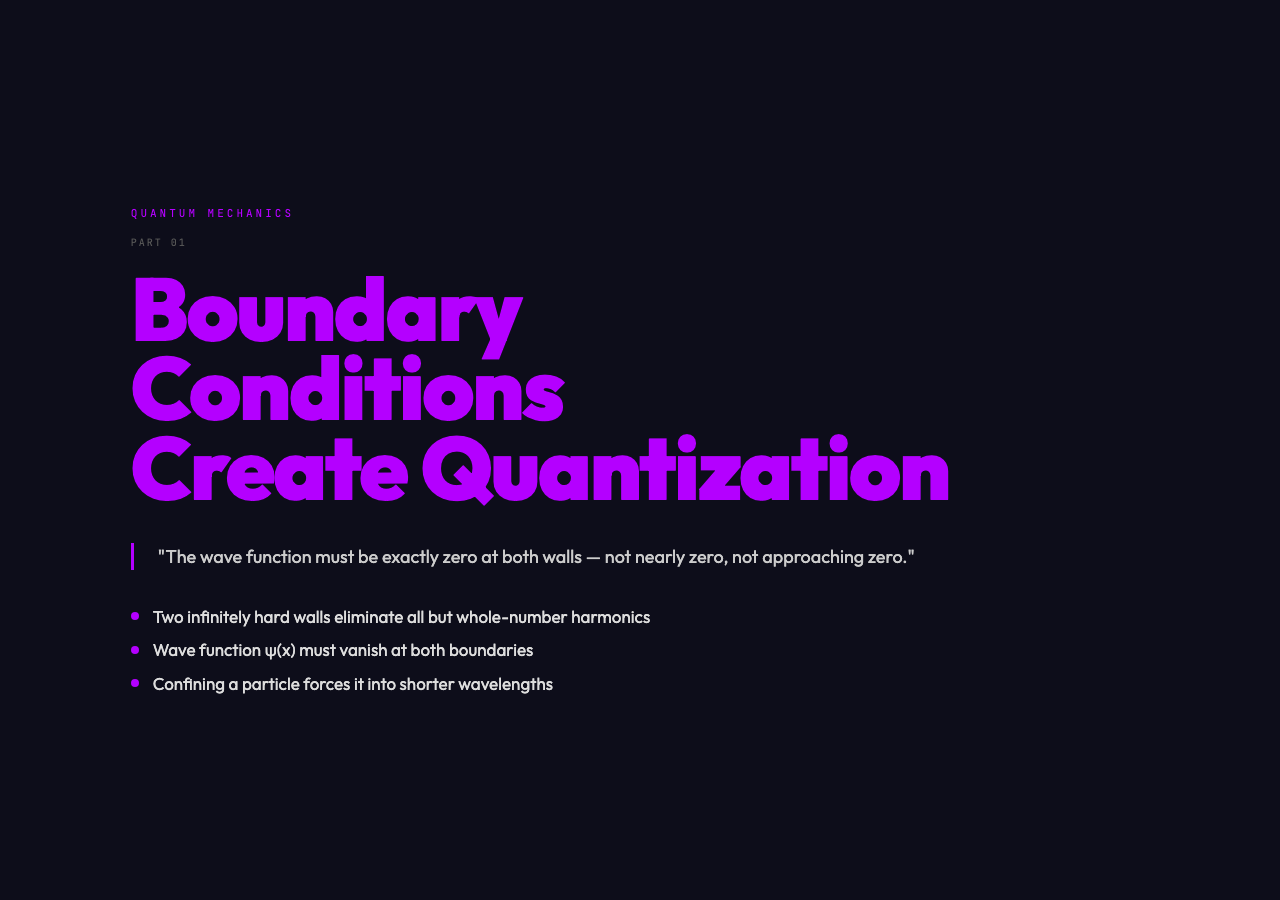
In quantum mechanics, the particle is described by a wave function ψ(x, t), and that wave function must be exactly zero at both walls. Not nearly zero, not approaching zero — mathematically forced to vanish at the boundaries. This single constraint is what creates the quantization.
The well itself is characterized by its width L. Everything about the system — the allowed energies, the shapes of the wave functions, the probability distributions — flows from L and one fundamental constant: Planck’s constant divided by 2π, ħ.
The Wave Functions: Fixed Shapes, Notarbitrary Oscillations
The solution to the Schrödinger equation for this system gives wave functions with a precise, non-negotiable form:
ψₙ(x) = √(2/L) · sin(nπx/L) for n = 1, 2, 3, …
Each integer n defines a quantum state. The n = 1 state is the ground state — the lowest possible energy. The n = 2 state is the first excited state, and so on, without bound.
Here is what makes this visually striking: the sine wave must fit perfectly inside the well. The wavelength of each state is λₙ = 2L/n — each higher quantum number crams half an additional oscillation into the same width. You cannot squeeze in a partial wavelength. The boundary conditions eliminate everything except whole-number harmonics.
This is identical to the constraint that determines which notes a plucked string can produce. A guitar string fixed at both ends supports only certain resonant frequencies. The quantum particle in a box follows the same mathematics, but with a crucial difference: the string’s vibrations are classical waves, while the particle’s wave function is a probability amplitude. What the particle can “vibrate as” is fundamentally restricted.
The Energy Levels: Why Only Specific Speeds Survive
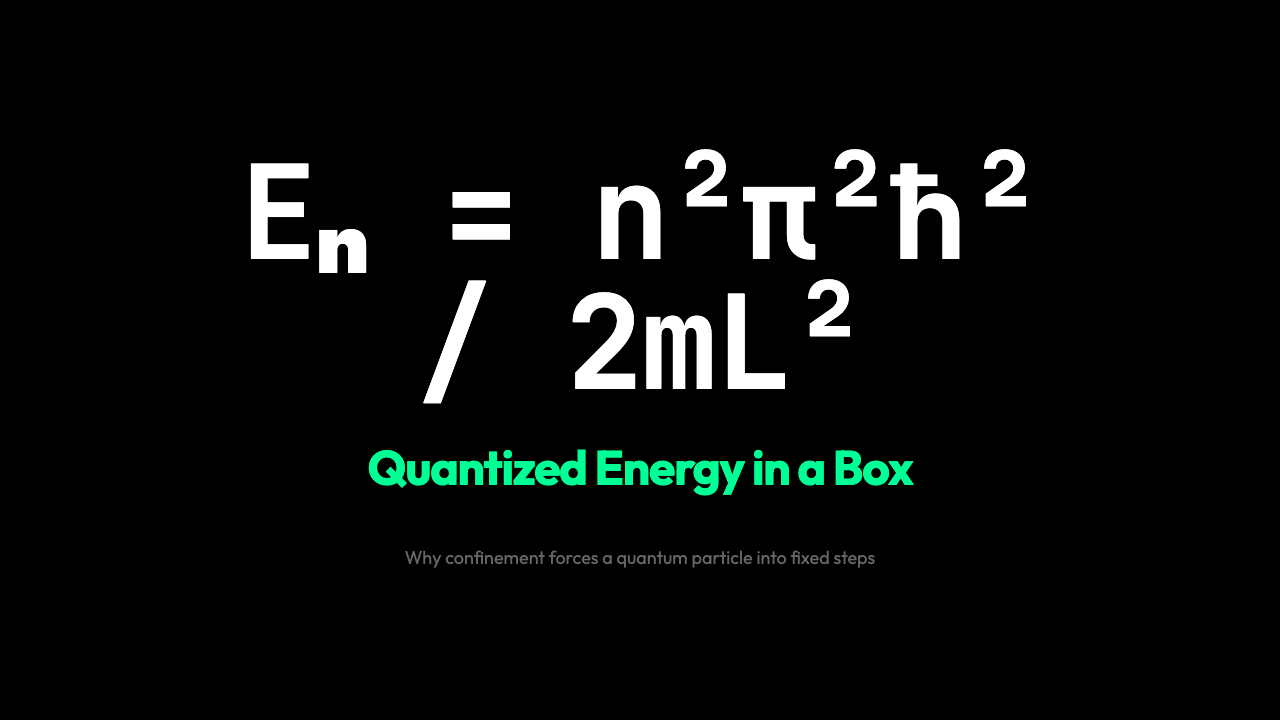
Each quantum state carries a specific energy:
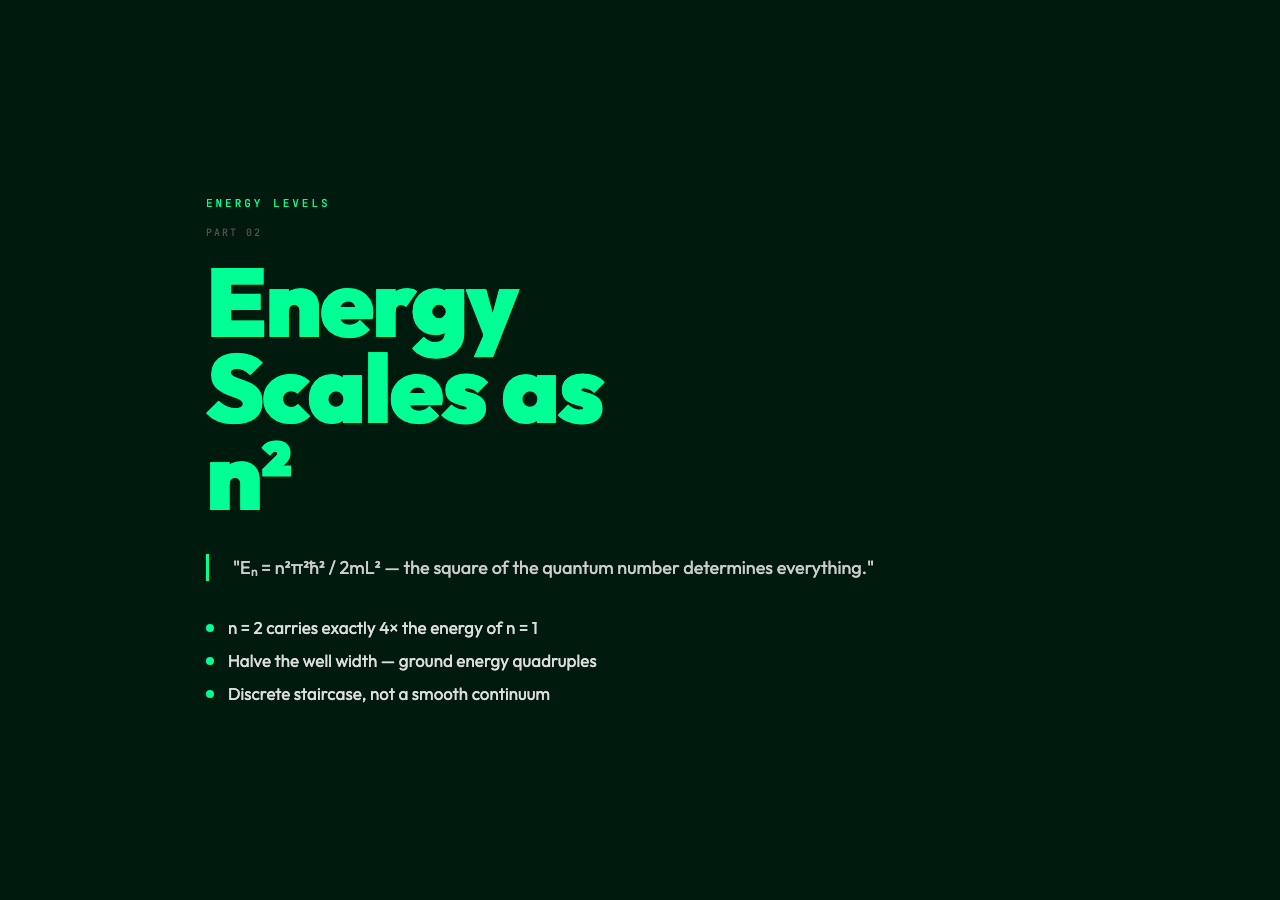
Eₙ = n²π²ħ² / (2mL²)
Energy scales with the square of the quantum number. The n = 2 state carries exactly four times the energy of the n = 1 state. The n = 3 state carries nine times. Not a smooth continuum — a discrete staircase.
The dependence on 1/L² deserves special attention. Halve the width of the well, and the ground state energy quadruples. This is why confining a particle to a smaller space raises its energy so dramatically — it’s not linear but quadratic. This is the theoretical foundation behind quantum dot physics: when you shrink a semiconductor structure small enough that electrons are trapped in all three dimensions, the energy levels jump up visibly, and the material begins to emit or absorb light at specific colors that depend on the dot’s size.
Stationary vs Non-Stationary States: A Crucial Distinction
Not all quantum states behave the same way over time, and this is where the infinite square well reveals one of its most important conceptual lessons.
Stationary states (single quantum number n) have wave functions that look like standing waves. The probability density |ψ|² does not change with time — the particle is not going anywhere, in a precise mathematical sense. The energy is sharp, defined to infinite precision.
Non-stationary states are superpositions of two or more stationary states. For example, an equal superposition of n = 1 and n = 2:
ψ(x) = (1/√2)[ψ₁(x) + ψ₂(x)]
When you display this superposition, something visually dramatic happens: the probability density |ψ|² begins to oscillate in time. The particle doesn’t stay in one place — it sloshes back and forth between the two halves of the well at a frequency set by the energy difference ΔE = E₂ – E₁ = 3π²ħ²/(2mL²), divided by ħ.
This oscillation is not a classical particle bouncing between walls. It’s a probability current flowing through space, driven by the interference between the two stationary components. The visualization of this effect — watching the probability cloud pulse and shift — is one of the most direct windows into how quantum mechanics differs from classical probability.
Why This Matters Beyond the Textbook
The infinite square well appears in introductory courses as a pedagogical tool, but its reach extends into real technology.
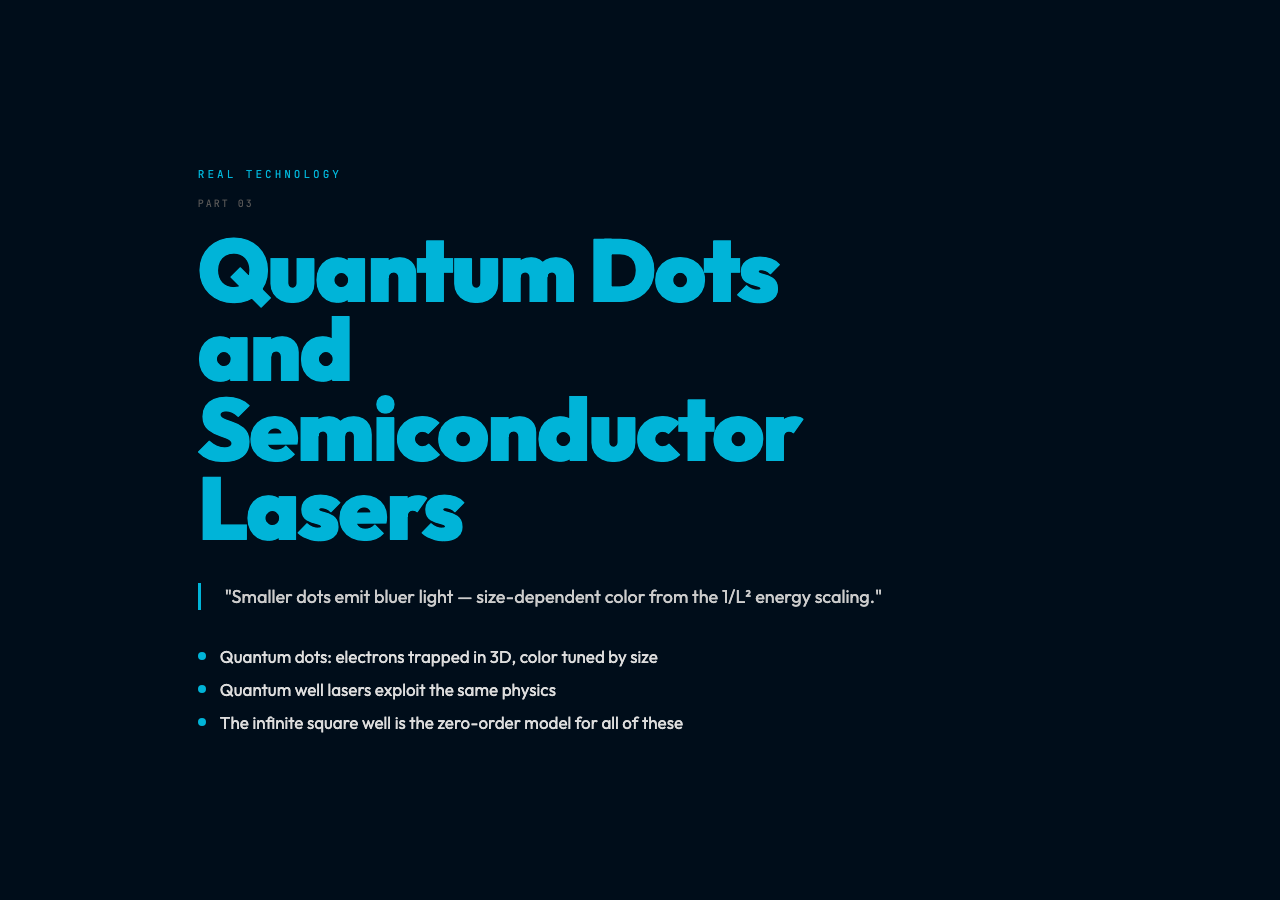
Quantum dots: Nanoscale semiconductor structures that trap electrons in all three dimensions. Their emission wavelengths are directly tunable by controlling the dot’s size — smaller dots emit bluer light, larger dots emit redder. This size-dependent color is a direct consequence of the 1/L² energy scaling of a confined particle.
Quantum wells in semiconductors: Devices like some laser diodes engineer thin layered structures where electrons are confined in one dimension but free in the other two. These quantum wells exploit exactly the same physics — quantized energy levels that depend on the well width — to produce light at specific wavelengths.
Particle-in-a-box as an approximation: More complex systems — molecules, defects in crystals, atoms trapped near surfaces — are often modeled as particles in boxes, with corrections. The infinite square well is the zero-order approximation from which these refinements depart.
The Core Intuition
What the infinite square well teaches is not the specific math. It’s the relationship between confinement and quantization: the more tightly you confine a quantum particle, the higher its minimum energy climbs, and the more widely spaced its excited states become.
This is the opposite of classical intuition, where stronger confinement means lower kinetic energy (as in a ball rolling slower in a smaller box). In quantum mechanics, confinement forces the wave function into shorter wavelengths, and shorter wavelengths mean higher momentum uncertainty, which means — through the energy-momentum relation — higher minimum energy.
The particle cannot be still. The walls force the wave function to wiggle. And that forced wiggling is what we call quantum energy.
The next time you see a quantum dot glow blue, or read about a semiconductor laser, you are watching the infinite square well at work — a theoretical model born from asking what happens when you trap a wave and give it nowhere to go.