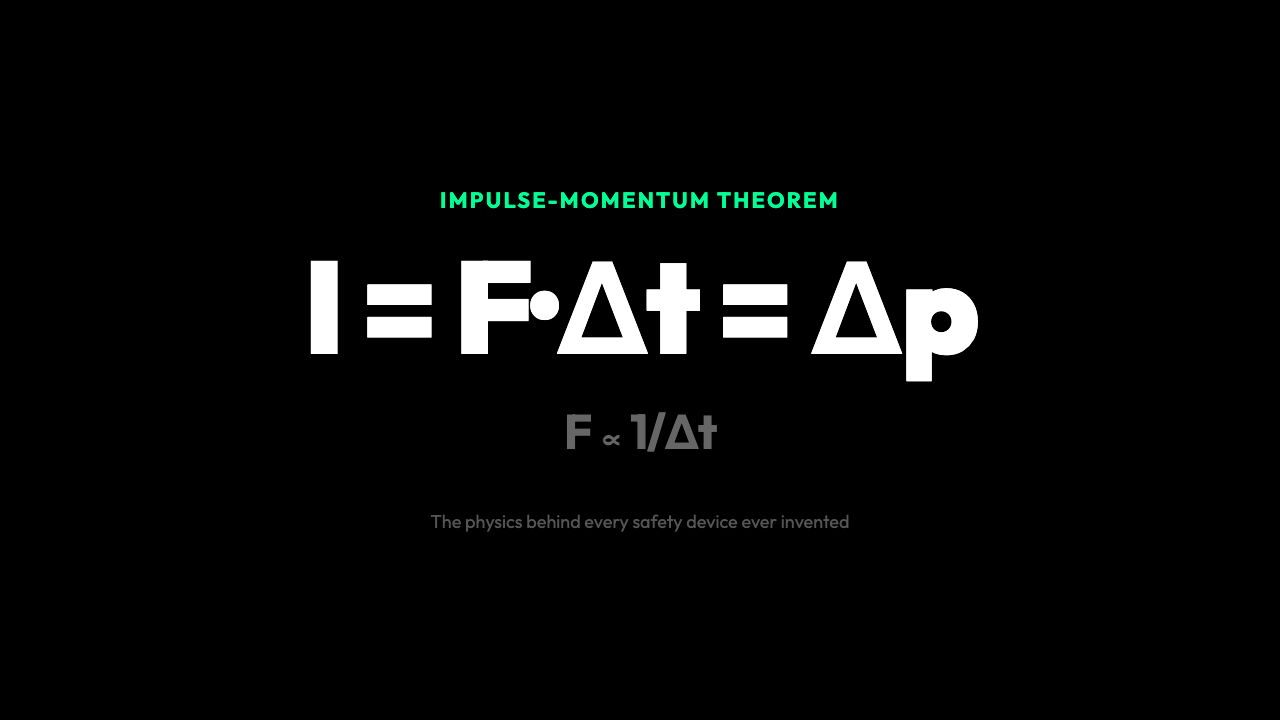
Why the Same Hit Can Feel Gentle or Deadly: The Physics of Impulse and Momentum
A baseball bat slams into a ball. Contact lasts less than a thousandth of a second. The ball flies off at 160 km/h. The batter feels nothing but satisfaction. Now imagine the same momentum change happening to your torso in a car crash — you wouldn’t be reading this. The difference isn’t the momentum transferred. It’s the time window it happens in.
This is the heart of the impulse-momentum theorem — one of the cleanest relationships in classical mechanics, and one of the most consequential for human survival.
The Core Equation
The theorem states:
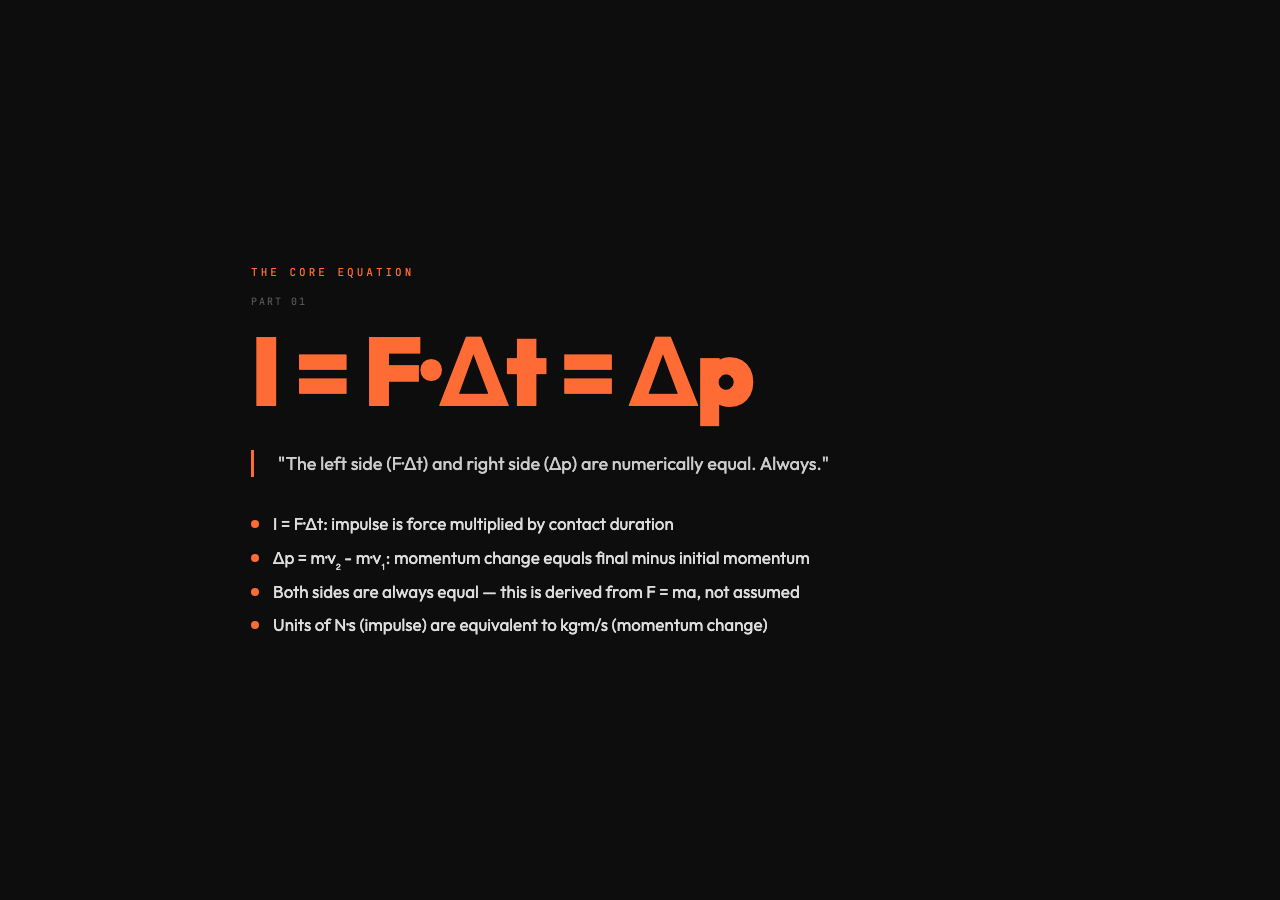
I = F·Δt = Δp = m·v₂ – m·v₁
Where: – I is impulse (measured in N·s) – F is the average force applied – Δt is the duration of contact – Δp is the change in momentum – m is mass, v₁ is initial velocity, v₂ is final velocity
The left side (F·Δt) and right side (Δp) are numerically equal. This is not an approximation — it is a direct consequence of Newton’s second law, derived without simplification.
What Momentum Actually Means
Momentum (p = m·v) is the quantity of motion an object carries. It is a vector — it has direction. A 1 kg ball moving east at 5 m/s has different momentum than the same ball moving west at 5 m/s. Their magnitudes are identical but their directions are opposite.
Momentum matters because it is conserved in closed systems. In a collision between two objects, the total momentum before impact equals the total momentum after impact — regardless of what happens to the individual objects during the collision.
The Force-Time Graph: Where the Math Becomes Visual
The impulse-momentum theorem becomes intuitive when you look at a force-time graph. The area under the F-t curve equals the impulse. For a constant force, this area is a simple rectangle: F × Δt.
For variable forces — which is most real-world forces — the area under the curve still equals impulse. The shape of the force profile determines how much force is experienced for a given momentum change. A sharp spike in force for a brief moment produces a small area under normal force scale but still transfers significant impulse because the integral across that brief interval adds up.
When you multiply any force profile by its duration and get the same impulse as a different force profile multiplied by a different duration, you have achieved the same momentum change through completely different means. This is the central insight of the theorem.
Three Scenarios, Three Lessons
Hitting: Short Time, Large Force
When a bat strikes a ball, contact time is typically 0.001 to 0.01 seconds. The forces involved reach 1,000 to 10,000 newtons. The bat imparts enormous momentum to the ball in a nearly instantaneous event.
This is a high-force, short-duration scenario. It works precisely because the time window is so brief. The batter applies a large force, but only for a moment — enough to reverse the ball’s direction and accelerate it to flight speed. You cannot achieve the same result with a gentle, prolonged push. Try it: place your hand against a ball and push it slowly. It barely moves. The same momentum change requires either a large force over a short time, or a small force over a long time.
Braking: Long Time, Moderate Force
A car traveling at 60 km/h comes to a stop. The driver feels a gentle deceleration — not a wall of force. The stopping time is 2 to 10 seconds. The braking force is moderate, spread over a long interval. The momentum change is identical to what a concrete barrier would produce in 0.01 seconds — but the force experienced is hundreds of times smaller.
This is why highway guardrails are not solid concrete walls. They are designed to extend the collision time, reducing the peak force on the vehicle’s occupants.
Collision: Momentum Transfer Between Two Objects
In an elastic collision between two balls on a pool table, momentum transfers from one ball to another. Ball 1 (mass m₁, velocity v₁) strikes Ball 2 (initially at rest). After collision, Ball 1 slows down and Ball 2 rolls away.
The total momentum is conserved: m₁·v₁ = m₁·v₁’ + m₂·v₂’
The force each ball experiences depends on the stiffness of the collision and the deformation of the material. A hard pool ball collision involves very short contact times and high forces. A soft collision (two rubber balls) involves longer contact times and lower forces for the same momentum transfer.
The Design Principle: F ∝ 1/Δt
When the required momentum change (Δp) is fixed, force and time are inversely proportional:
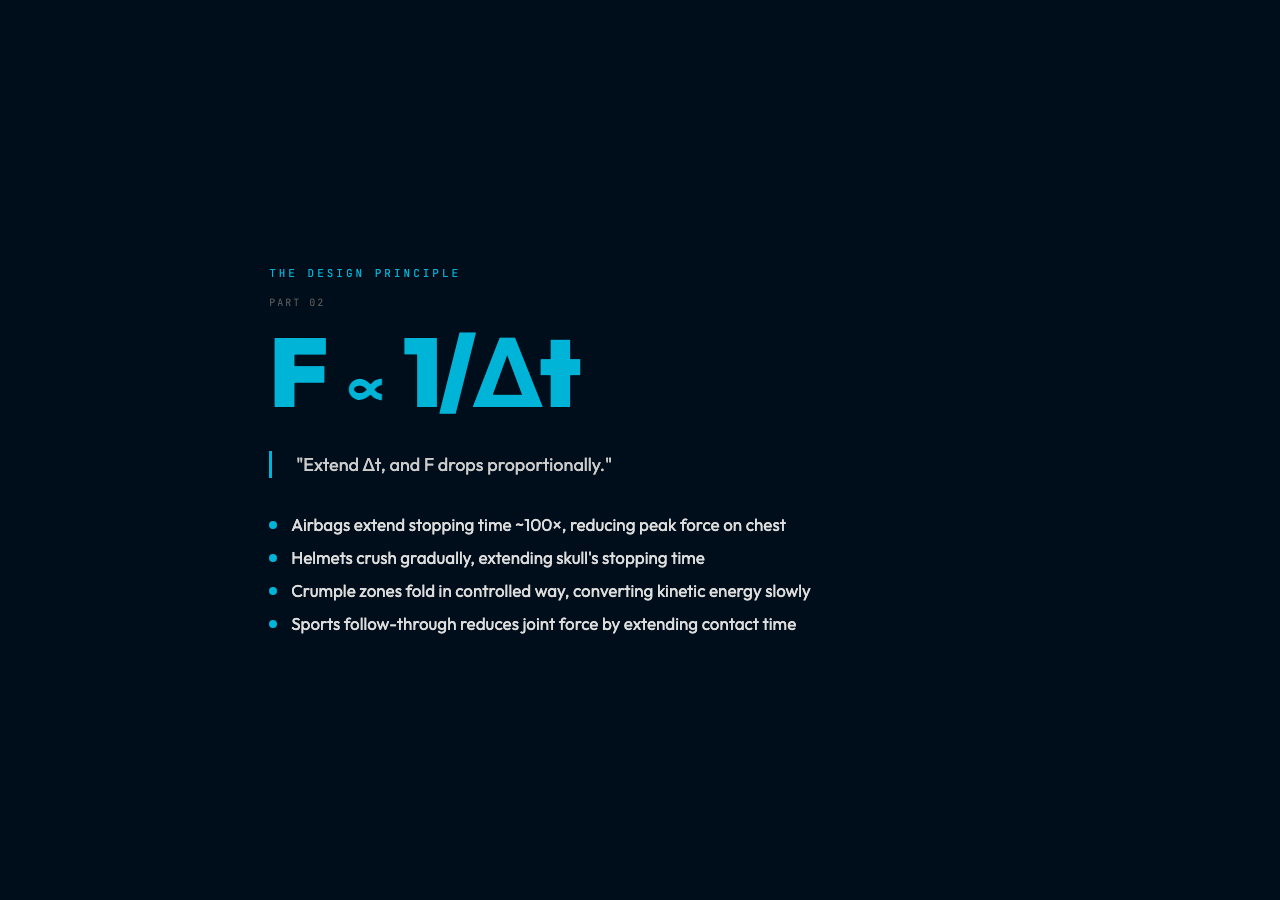
F = Δp / Δt
This single relationship explains the design of every safety device ever invented. You need to reduce a person’s momentum to zero during an accident. You cannot change Δp — it is determined by the incoming speed and mass. What you can control is Δt.
Extend Δt, and F drops proportionally. This is why:
- Airbags inflate to increase stopping time from ~0.001 s (direct steering wheel impact) to ~0.1 s — reducing peak force on the chest by ~100×
- Helmets use cushioning materials that crush gradually, extending the skull’s stopping time during an impact
- Crumple zones in cars fold in a controlled way, converting kinetic energy gradually and extending the collision duration
- Sports coaches teach “follow-through” — not for accuracy, but because a longer contact time with the ball or bat reduces the force on the athlete’s joints
Impulse vs. Work-Energy: Two Theorems, Two Languages
The impulse-momentum theorem and the work-energy theorem address the same physical reality from different angles:

| | Impulse-Momentum | Work-Energy | |–|–|–| | Physical quantity | I = F·Δt | W = F·s | | What changes | Momentum (Δp) | Kinetic energy (ΔEₖ) | | Scalar/Vector | Vector | Scalar | | Focus | Time interval (Δt) | Displacement (s) |
The work-energy theorem is useful when you care about energy conversion — how much work is done, how much fuel is consumed, how much heat is generated. The impulse-momentum theorem is useful when you care about forces over time — collisions, impacts, safety design, and anything involving contact duration.
Both theorems are always valid simultaneously. They are not competing explanations — they are two different integrals of Newton’s second law applied to different physical quantities.
Why This Matters Beyond the Classroom
The impulse-momentum theorem is not a textbook abstraction. It is the reason you survive car accidents.
Every safety standard for vehicles, sports equipment, building materials, and public infrastructure is built on this relationship. Engineers calculate the momentum change that a human body will experience in a given collision scenario, then design the structure to extend Δt until the resulting force falls below the threshold of serious injury.
A 2016 study by the Insurance Institute for Highway Safety found that cars with longer crumple zones and earlier-activated airbag systems reduced fatality rates by more than 30% compared to vehicles with identical mass but shorter deformation paths. The physics was simple: same mass, same speed, same Δp — longer Δt, lower F, more survivors.
The next time you see a guardrail, a helmet, an airbag warning label, or a martial artist breaking a brick with a bare hand, you are looking at the impulse-momentum theorem in material form. The math is a few lines. The applications are everywhere.