Why Some Waves Shake Perpendicular and Others Compress Forward
Every wave in physics moves energy from one place to another. But not all waves move that energy the same way. Crack a whip and the wave travels forward — but the cord snaps side to side. That’s a transverse wave. Squeeze a slinky spring at one end and the compression races to the other end, with each coil pushing into the next. That’s a longitudinal wave. The difference between these two wave types is one of the most fundamental divides in all of physics, and once you see it, you start finding it everywhere.
The Two Directions Every Wave Has
To understand the difference, you need just one concept: direction of oscillation versus direction of propagation. A wave propagates — it travels from A to B. But the medium it travels through also oscillates — the particles in the medium move back and forth, up and down, or in some other pattern that isn’t the same as the direction the wave is going.
In a transverse wave, the oscillation is perpendicular to the direction of propagation. Imagine a rope held at one end and flicked up and down. The wave travels horizontally along the rope. But the rope itself moves vertically — perpendicular to that direction. Light, electromagnetic radiation, ocean surface waves, and seismic S-waves all behave this way.
In a longitudinal wave, the oscillation is parallel to the direction of propagation. The medium compresses and expands along the same line the wave is traveling. Sound traveling through air is the most familiar example. A speaker cone pushes air molecules together, creating a compression that travels outward. The air molecules themselves only move back and forth along that same line — not sideways.
The distinction matters enormously. Transverse waves can polarize — you can filter out certain oscillation directions and leave others. Light from the sun is unpolarized; a polarizing filter blocks all orientations except one. Longitudinal waves cannot polarize in this way. This single fact about wave geometry underlies vast areas of optics and communications technology.
What the Interactive Graph Reveals
The visualization at ElysiaTools shows both wave types simultaneously, updating in real time. Two parallel panels display a transverse wave on top and a longitudinal wave below, each driven by the same frequency and amplitude sliders. A third panel tracks the relationship between particle velocity and displacement for each wave type — the phase relationship that distinguishes them.
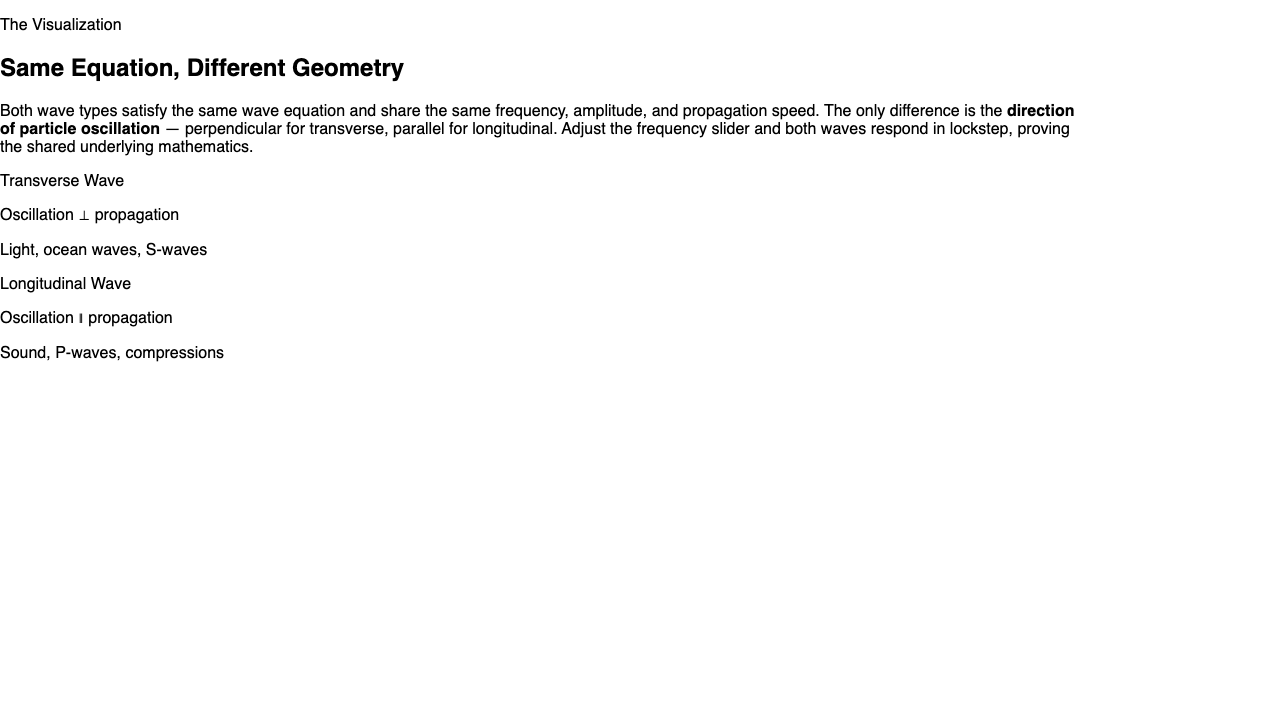
Watch the particle marked in the center of each wave. In the transverse panel, that particle moves straight up and down while the wave pulse passes through it left to right. In the longitudinal panel, the same marked particle compresses and expands horizontally as the compression pulse passes through. The velocity-displacement chart for the transverse wave shows the particle 90 degrees out of phase with its displacement — maximum velocity at the equilibrium position, zero velocity at maximum displacement. The longitudinal wave shows the same phase relationship, but the graph plots compression versus particle velocity instead of vertical position.
Being able to adjust frequency, wave speed, and particle count and watch both waves respond in lockstep makes the underlying physics tangible. The two wave types obey the same wave equation — they both satisfy the same mathematics of sinusoidal oscillation — but the geometry of their oscillation is fundamentally different.
Where Each Type Appears in Nature
Light is exclusively a transverse wave. Radio waves, microwaves, X-rays, and all other forms of electromagnetic radiation propagate through vacuum via transverse oscillations in electric and magnetic fields. This is why polarizing sunglasses work — they contain a grid of molecules that absorbs light oscillating in one direction while passing through the perpendicular component.
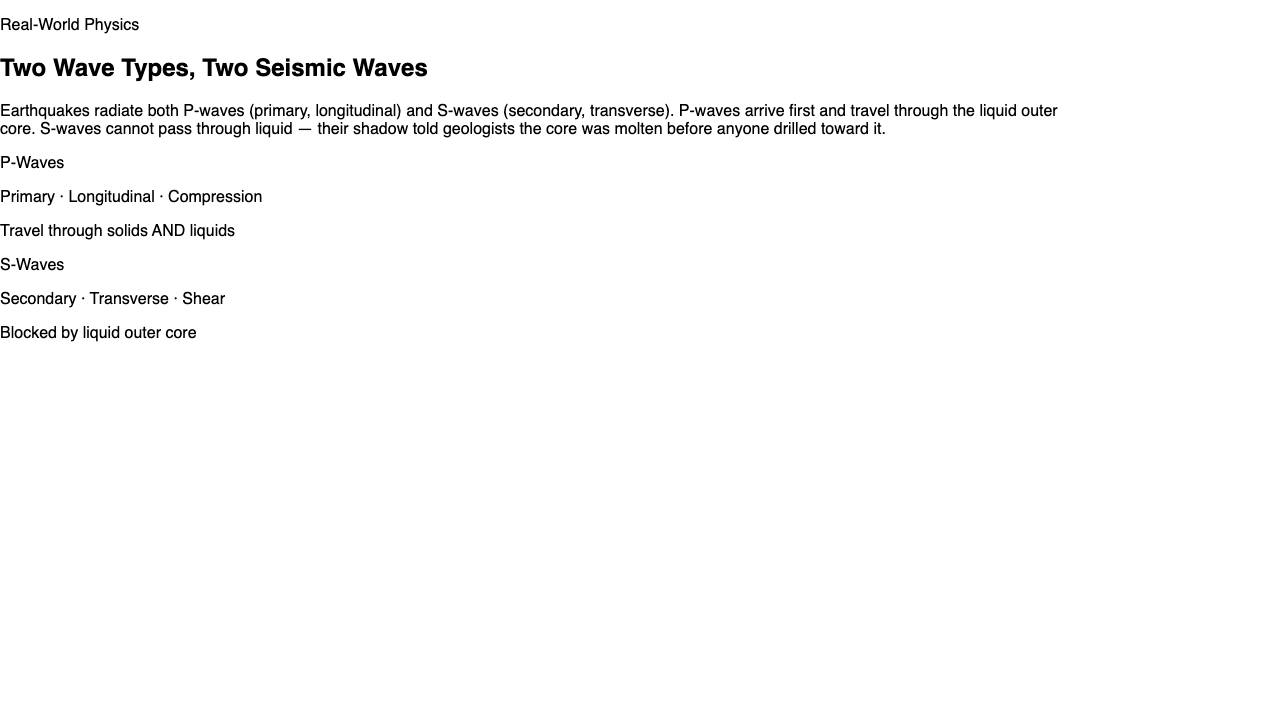
Sound, by contrast, is exclusively longitudinal in gases and liquids. Air molecules cannot sustain transverse shear forces, so sound cannot propagate as a transverse wave in the atmosphere or underwater. In solids, sound can be both transverse and longitudinal — the solid’s rigidity allows shear waves (S-waves, the destructive waves in earthquakes) to propagate perpendicular to their oscillation, while pressure waves (P-waves) propagate compressionally, the same way sound does in air.
Seismic waves demonstrate this beautifully. When an earthquake strikes, it radiates both P-waves (primary, longitudinal, compression-based) and S-waves (secondary, transverse, shear-based). P-waves arrive at seismometers first — they travel faster through rock — and S-waves follow. The gap between their arrival times tells geologists how far away the quake was. The fact that S-waves cannot travel through the liquid outer core is what told us the core was molten long before we drilled into it.
The Same Mathematics, Different Geometry
One of the most striking things about transverse and longitudinal waves is how much they share mathematically. Both satisfy the one-dimensional wave equation. Both carry energy at a speed determined by the medium’s properties. Both exhibit reflection, refraction, and interference. Two coherent sources of either wave type produce interference fringes.
The difference in geometry does affect some physical consequences. In a transverse wave, the amplitude is a distance — the maximum displacement perpendicular to propagation. In a longitudinal wave, the amplitude is a pressure or density variation — how much the medium compresses at the peak compression. When a longitudinal wave reflects off a fixed boundary, the compression inverts: peak compression becomes peak rarefaction. When a transverse wave reflects off a fixed boundary, the displacement inverts — a crest becomes a trough.
Both types of wave can superposition and interfere. The famous double-slit interference pattern for light works because light is a transverse wave. Sound waves in a tube interfere to produce standing waves — the same principle that lets a flute produce a specific note. The mathematical framework of Fourier analysis applies to both equally: any periodic wave, transverse or longitudinal, can be decomposed into a sum of pure sinusoidal components.
Why This Division Runs So Deep
The transverse-longitudinal distinction isn’t just a curiosity about wave motion — it reflects something fundamental about the forces that hold matter together. Transverse waves require a restoring force that can act perpendicular to the direction of propagation. In a rope, that’s the tension in the rope. In a light wave, that’s the coupling between electric and magnetic fields in vacuum. In a solid, that’s the shear modulus of the material — its resistance to being deformed sideways.
Longitudinal waves require a restoring force that acts along the direction of propagation. In a gas or liquid, that’s the bulk modulus — the pressure of the medium. Compress air and it pushes back. In a solid, both bulk modulus (resistance to volume change) and shear modulus contribute, which is why solids can support both wave types while fluids support only longitudinal ones.
This distinction ripples outward through all of physics. The polarization of light is a consequence of its transverse nature. The speed of sound in a gas follows from the bulk modulus and density — longitudinal wave speed. The S-wave shadow of Earth’s core told us about the liquid outer core. The list goes on.
Next time you hear a sound and see light, you’re experiencing two entirely different wave geometries traveling through the same room at the same time — one pushing the air molecules it passes through, the other shaking the electromagnetic field that requires no medium at all.