Why Light Can’t Escape an Optical Fiber: The Physics of Total Internal Reflection
When you send a laser pulse through an optical fiber stretching across an ocean floor, that pulse travels 10,000 kilometers without turning a corner. It bounces off the inner walls of the fiber millions of times — and yet it never escapes. That is not an accident of manufacturing. It is physics doing exactly what it was designed to do.
The mechanism is called total internal reflection (TIR), and it is the reason modern telecommunications exist. To understand why TIR works, we need to start with something simpler: a spoon in a glass of water.
Refraction: Why the Spoon Looks Broken
When light travels from air into water, it bends. This is refraction, and it happens because light moves at different speeds in different materials. In vacuum it travels at roughly 299,792 km/s. In water it slows to about 225,000 km/s. In glass it slows further to around 200,000 km/s.
The ratio of light’s speed in vacuum to its speed in a material is called the refractive index (n). Water has n ≈ 1.33. Glass has n ≈ 1.5. Air has n ≈ 1.0003 — nearly 1.
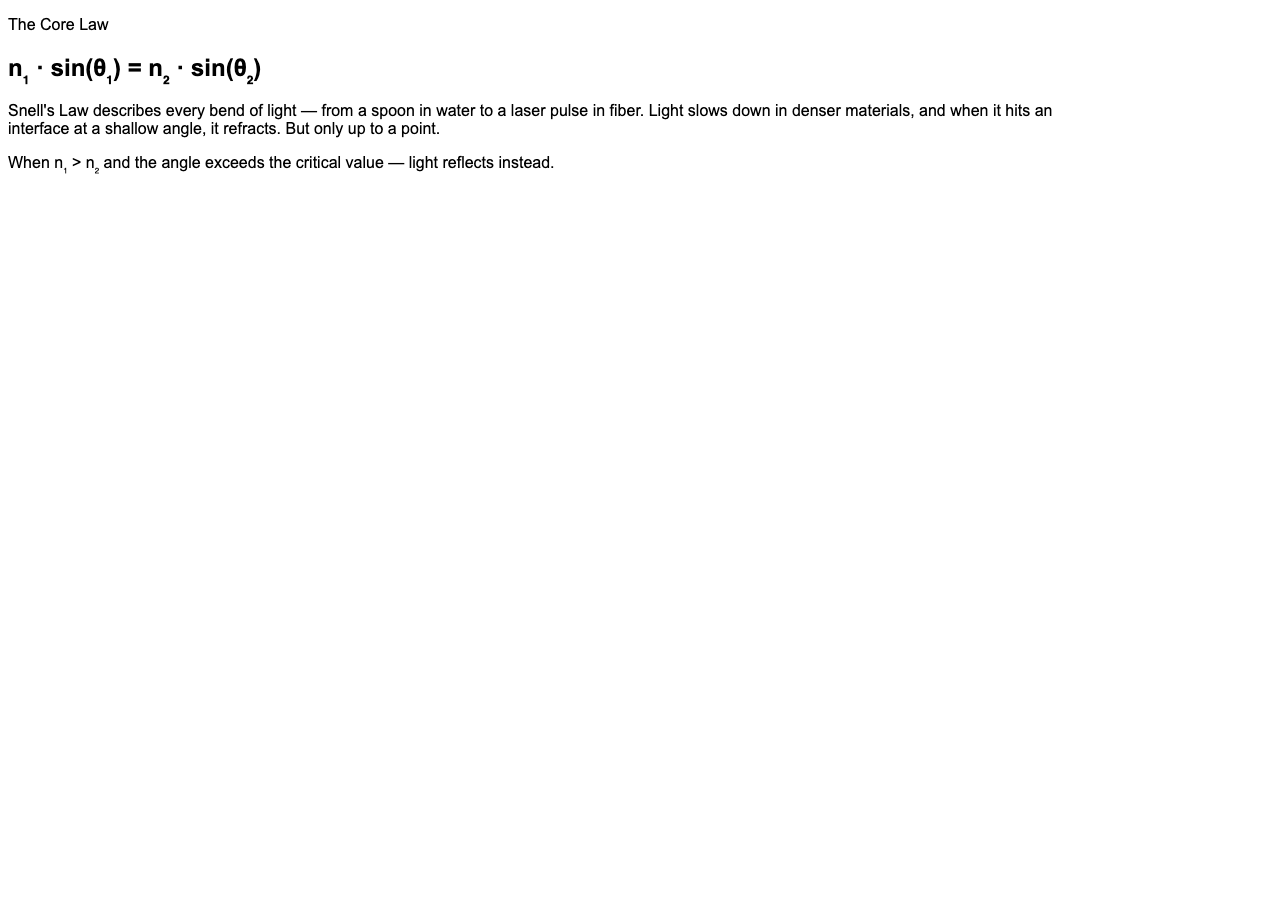
When a light ray hits the boundary between two materials, it bends according to Snell’s Law:
n₁ · sin(θ₁) = n₂ · sin(θ₂)
Where θ₁ is the angle of the incoming ray measured from the normal (the line perpendicular to the surface), and θ₂ is the angle of the refracted ray on the other side.
This explains why a spoon immersed in water looks bent at the surface. The light rays coming from the submerged part change direction at the water-air boundary, and our eyes extrapolate the rays straight backward — producing a distorted image.
When Bending Becomes Reflection
Now consider what happens when light travels from a higher-index material to a lower-index material — for example, from water (n₂ ≈ 1.33) to air (n₁ ≈ 1.0). The formula says:
sin(θ₂) = (n₁/n₂) · sin(θ₁)
Since n₁/n₂ < 1, the refracted ray is always bent away from the normal — it tilts toward the surface.
As we increase θ₁ (incoming angle), sin(θ₁) grows, so sin(θ₂) must also grow. But sin(θ₂) cannot exceed 1 — it is a mathematical limit. When:
(n₁/n₂) · sin(θ₁) = 1
the refracted ray runs along the surface — θ₂ = 90°. This is called the critical angle. For water-to-air, the critical angle works out to about 48.6°.
Beyond that threshold — if the incoming angle is steeper than the critical angle — sin(θ₂) would need to be greater than 1, which is physically impossible. Instead of bending through the surface, the light reflects back into the original material. This is total internal reflection.
Inside an Optical Fiber
An optical fiber applies this principle with extraordinary precision. A standard fiber has two layers:
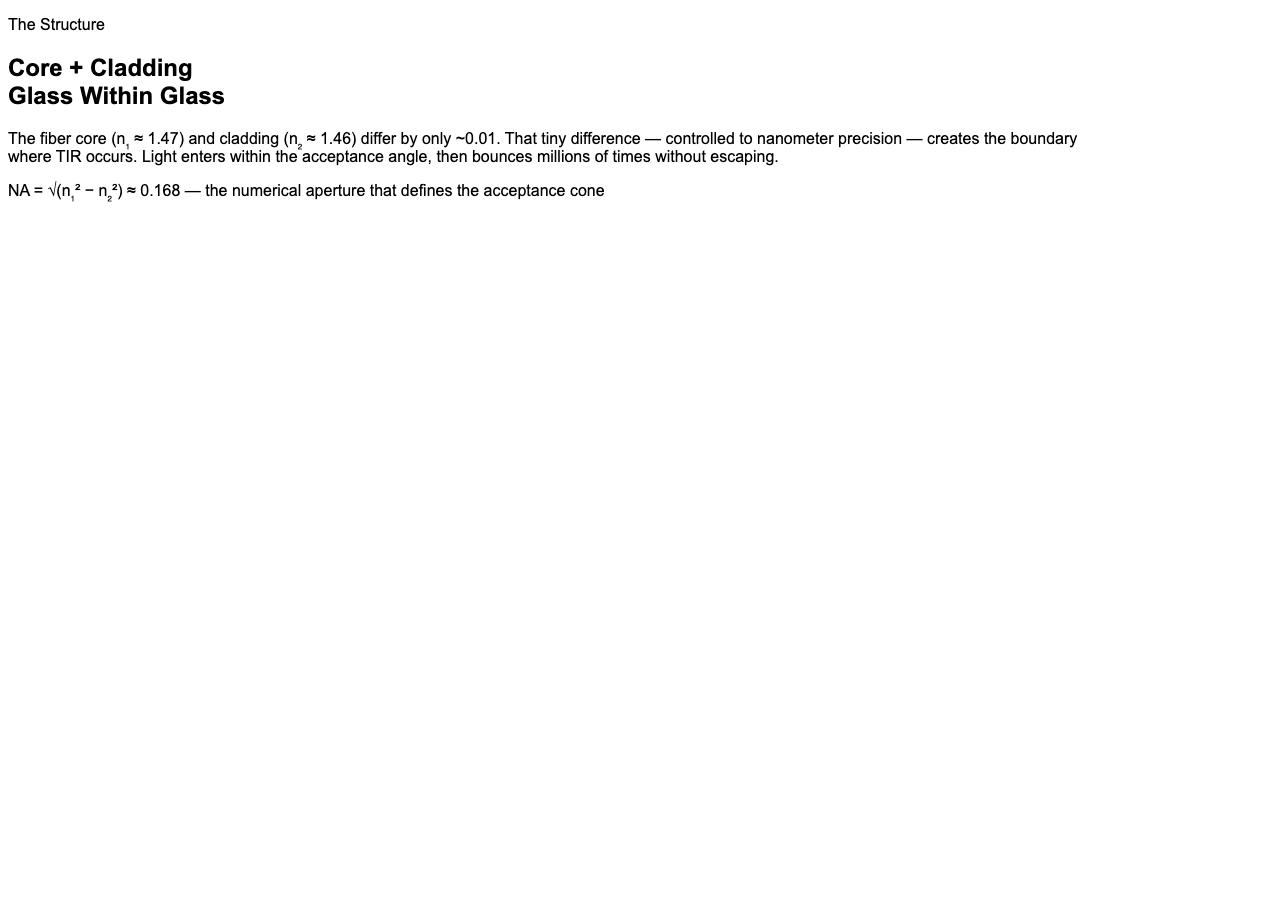
- Core: The inner cylinder, usually made of silica glass with refractive index n₁ ≈ 1.46–1.48
- Cladding: The outer jacket, also silica, with a slightly lower refractive index n₂ ≈ 1.45–1.46
The difference is small — only about 0.01 to 0.02 — but it is enough. Light traveling inside the core and hitting the core-cladding boundary at a shallow angle will undergo total internal reflection and stay trapped in the core.
The geometry defines exactly which angles work. Light can only enter the fiber within a specific cone called the acceptance angle. The sine of this angle is determined by the numerical aperture (NA):
NA = √(n_core² − n_cladding²)
For a typical fiber with n_core = 1.47 and n_cladding = 1.46:
NA = √(1.47² − 1.46²) = √(0.0281) ≈ 0.168
The acceptance angle θ_a satisfies sin(θ_a) = NA. For this fiber, sin(θ_a) ≈ 0.168, giving θ_a ≈ 9.7°. That is a narrow cone — a fiber only accepts light entering within about 10° of its axis. But once inside, the light can travel for thousands of kilometers.
Why This Matters in the Real World
The reason optical fiber is so valuable for telecommunications is precisely this: light can be guided with almost no loss, over enormous distances, without any amplification.
At each reflection inside the fiber, the light experiences essentially zero loss — the glass is so pure that absorption is minimal. Early transatlantic fiber optic cables in the 1980s lost about 0.2 dB per kilometer. Modern fibers lose less than 0.18 dB/km, meaning a signal can travel about 100 km before it needs amplification. For a 10,000 km undersea cable, that is only about 100 amplifiers — compared to the electronic repeaters that would be needed for copper wire.
Beyond telecommunications, TIR enables other technologies:
- Medical endoscopes: A bundle of optical fibers lets doctors see inside the body with minimal invasiveness
- Industrial inspection: Fiberscope probes inspect machinery internals without disassembly
- Laser energy delivery: High-power lasers are guided through fibers to cut or weld materials
The Core Insight
What makes optical fiber remarkable is not just the physics — it is the precision of the engineering that makes the physics work. The core and cladding are manufactured to tolerances of nanometers. The slight refractive index difference — n_core minus n_cladding ≈ 0.01 — is carefully controlled to ensure the critical angle works exactly as designed.
Light does not care about our intentions. It follows Snell’s Law blindly, bouncing at the boundary between glass and glass, never knowing it is carrying a phone call across an ocean or a surgeon’s view inside a chest cavity. The physics is simple. The engineering to make it reliable across 10,000 kilometers of ocean floor is extraordinary.