Why Evaporation and Boiling Are Not the Same Thing
Walk into any kitchen and you’ll hear someone say “the water is boiling” when bubbles start rising. But in physics, boiling and evaporation are fundamentally different processes — and confusing them misses something important about how matter transitions from liquid to gas.
The Core Difference
Evaporation is a surface phenomenon. Individual molecules at the liquid’s surface happen to have enough kinetic energy to escape into the air. It happens at any temperature — a puddle slowly disappears on a cool morning, long before the water reaches 100°C. The hotter the water, the more molecules have enough energy to escape, but the process never requires the entire liquid to reach boiling.

Boiling is a volume phenomenon. When the liquid’s vapor pressure rises to equal the external atmospheric pressure, bubbles can form and expand throughout the liquid — not just at the surface. That’s when you see bubbles rising everywhere. The water is at a precise temperature: 100°C at standard atmospheric pressure (1 atm).
What 2260 kJ/kg Actually Means
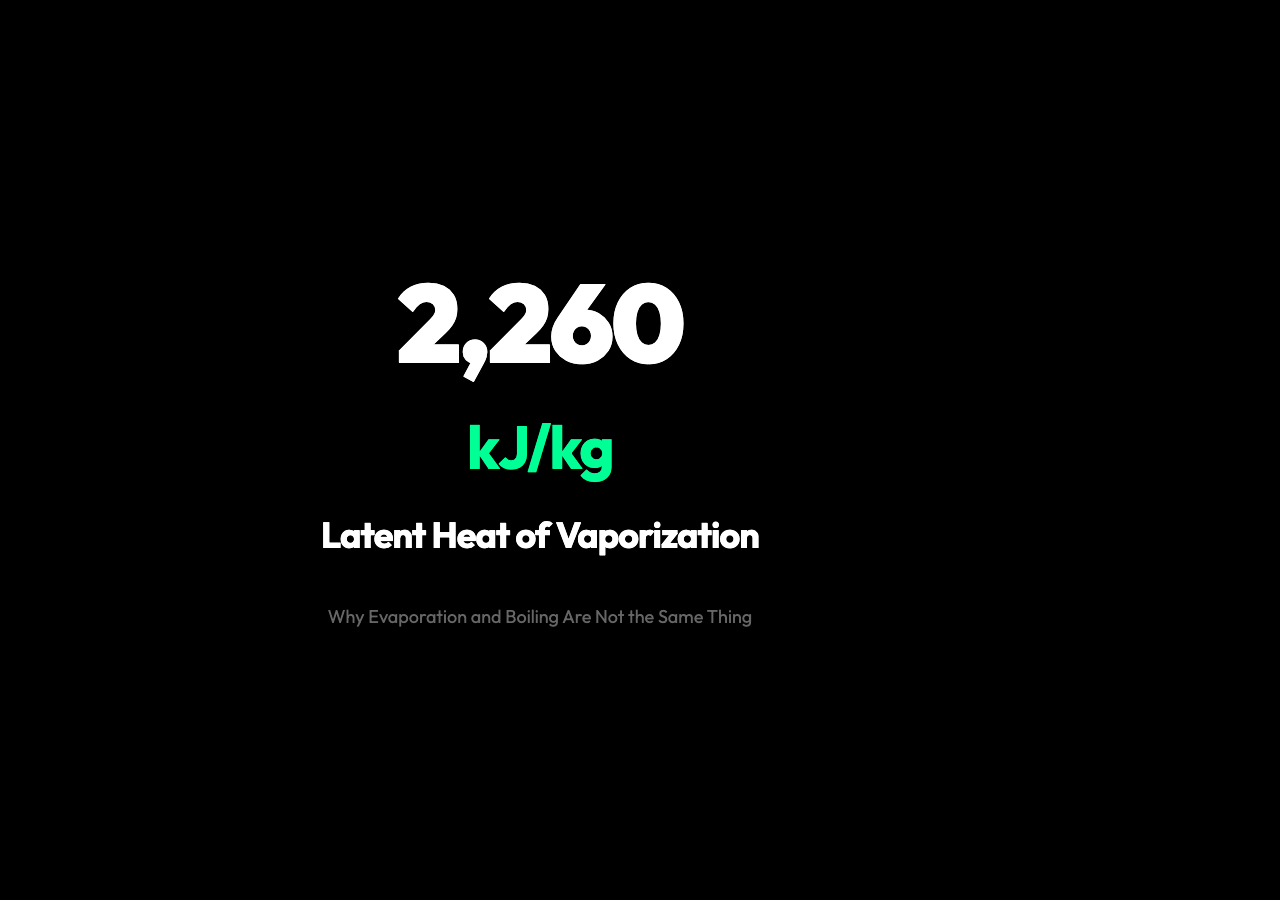
Water’s heat of vaporization is 2,260 kJ/kg — the energy required to convert 1 kg of liquid water at 100°C into steam at 100°C. This is enormous compared to the specific heat capacity of water (4.18 kJ/kg·°C). To boil away 1 kg of water starting from 25°C requires roughly 4.18 × 75 = 313.5 kJ to heat it, plus 2,260 kJ to vaporize it. The phase change dominates.

That high latent heat is why sweating cools you down — each gram of perspiration that evaporates takes 2.26 kJ with it. It’s also why steam burns are far more severe than boiling water burns: the steam releases that 2,260 kJ/kg when it condenses on your skin.
Pressure Changes Everything
The boiling point isn’t fixed. At 1 atm (standard sea-level pressure), water boils at 100°C. Climb to 8,848 m (Mount Everest) and the pressure drops to about 0.33 atm — water boils at roughly 70°C. Pressure cookers work the opposite way: at 2 atm, water boils near 120°C, cooking food faster.

The rule is straightforward: higher pressure raises the boiling point; lower pressure lowers it. This is why a pressure cooker is useful — food that needs 150°C to break down soft tissue can cook in minutes instead of hours.
The simulation lets you dial the pressure and watch how the boiling point shifts. At 0.5 atm, the water wants to boil at 78°C. At 2.0 atm, it pushes toward 120°C. Evaporation happens at all pressure settings, but boiling only kicks in once the temperature reaches the new boiling point.
Why Two Molecules Watching the Same Pot See Different Things
Molecules in a liquid follow a distribution of kinetic energies — some have more, some have less. At any temperature below the boiling point, the fastest molecules at the surface can escape. This is evaporation.
Boiling requires the average temperature to reach the point where vapor pressure equals atmospheric pressure. Below that point, even energetic molecules at the surface escape one at a time. Above it, the whole liquid is at the threshold — bubbles form everywhere, not just at the surface.
The Takeaway
Evaporation and boiling aren’t just “slow” versus “fast” ways to make steam. They are distinct physical mechanisms with different energy requirements and temperature dependencies. One is a surface-level statistical escape; the other is a volume-level phase equilibrium. Understanding the difference matters whether you’re engineering a pressure vessel, treating a burn, or just watching your kettle.