
Why One Equation Explains Why Water Flows Into Your Cells
There is a force operating silently at the boundaries of every cell in your body, pulling water inward against what your intuition might expect. You cannot see it. You do not feel it. But without it, you would not exist.
It is called osmotic pressure, and it is governed by one of the cleanest equations in physical chemistry:
π = iMRT
where π is the osmotic pressure, i is the van’t Hoff factor, M is the molar concentration, R is the ideal gas constant (0.082057 L·atm/(mol·K)), and T is the absolute temperature. At standard conditions — 0.1 mol/L and 298 K — this gives an osmotic pressure of roughly 2.4 atmospheres. That is the pressure difference water will naturally cross to reach equilibrium. A membrane that blocks solute but lets solvent through is all it takes to exploit this force.
The Membrane Is the Gatekeeper
The concept starts with a semipermeable membrane: a barrier with pores large enough for solvent molecules to pass through, but too small for solute particles. The solute stays on one side. The water does not.
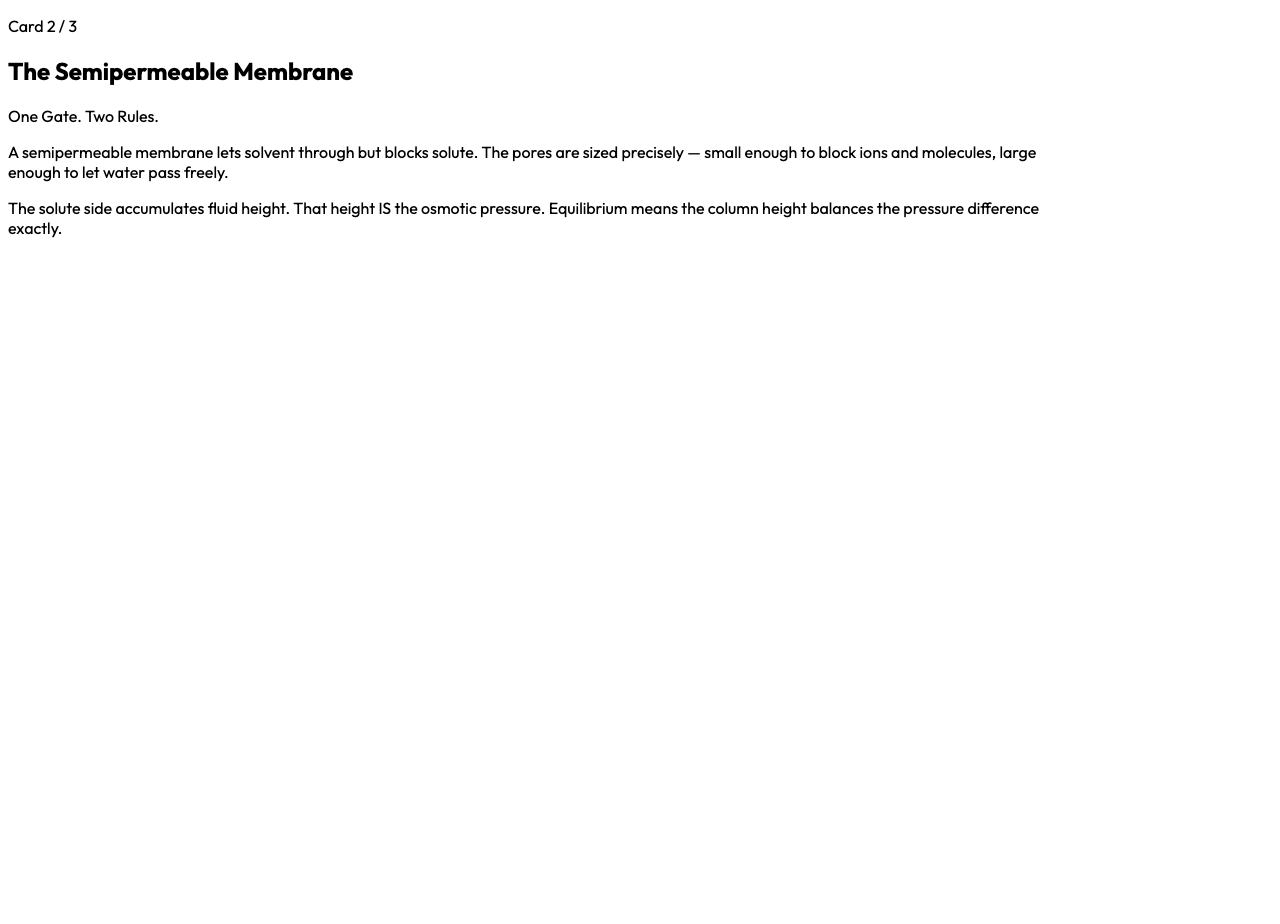
Imagine a container divided by such a membrane. Pure water fills the left chamber. On the right, the same solvent dissolves a solute — say, sodium chloride. Sodium chloride dissociates into two ions, so for NaCl the van’t Hoff factor i = 2. The right side now has more particles per liter than the left.
Here is the key point: each particle, whether solvent or solute, contributes equally to the pressure on its side of the membrane. The solute ions do not push harder — they simply occupy volume that would otherwise be filled by solvent. When the system reaches equilibrium, the extra height of fluid on the solute side reflects exactly the osmotic pressure that developed during the process.
This is not gravity pulling water down. It is entropy — the natural tendency of particles to spread throughout whatever space is available to them. More particles on one side means more of the available space is already accounted for, leaving less room for solvent molecules to move freely. They cross the membrane to restore the balance.
The van’t Hoff Equation in Practice
The van’t Hoff equation is π = iMRT. It looks strikingly similar to the ideal gas law (PV = nRT) because dilute solutions behave like gases in many respects. Just as gas molecules generate pressure by colliding with container walls, solute particles in solution generate osmotic pressure by colliding with — and partially occupying — the space available to solvent molecules.

At 0.1 mol/L and 298 K with i = 1, the calculation is straightforward:
π = 1 × 0.082057 × 0.1 × 298 ≈ 2.4 atm
That 2.4 atmospheres translates to roughly 2.4 bar — about the pressure in a fully inflated car tire. Applied to biological systems, this is a substantial force. It is the reason plant roots can pull water from soil upward through capillary action, and why red blood cells can regulate their volume with such precision.
The van’t Hoff factor i accounts for dissociation. Non-electrolytes like glucose have i = 1 — they do not split apart. Electrolytes like NaCl have i = 2 in dilute solutions. More concentrated solutions deviate from ideal behavior, and i drops below the theoretical maximum as ions begin to interact with each other rather than moving independently.
Reverse Osmosis: When You Fight the Pressure
Osmosis is passive. Solvent flows across the membrane to equalize concentration on its own. But what if you apply pressure greater than the osmotic pressure in the opposite direction?
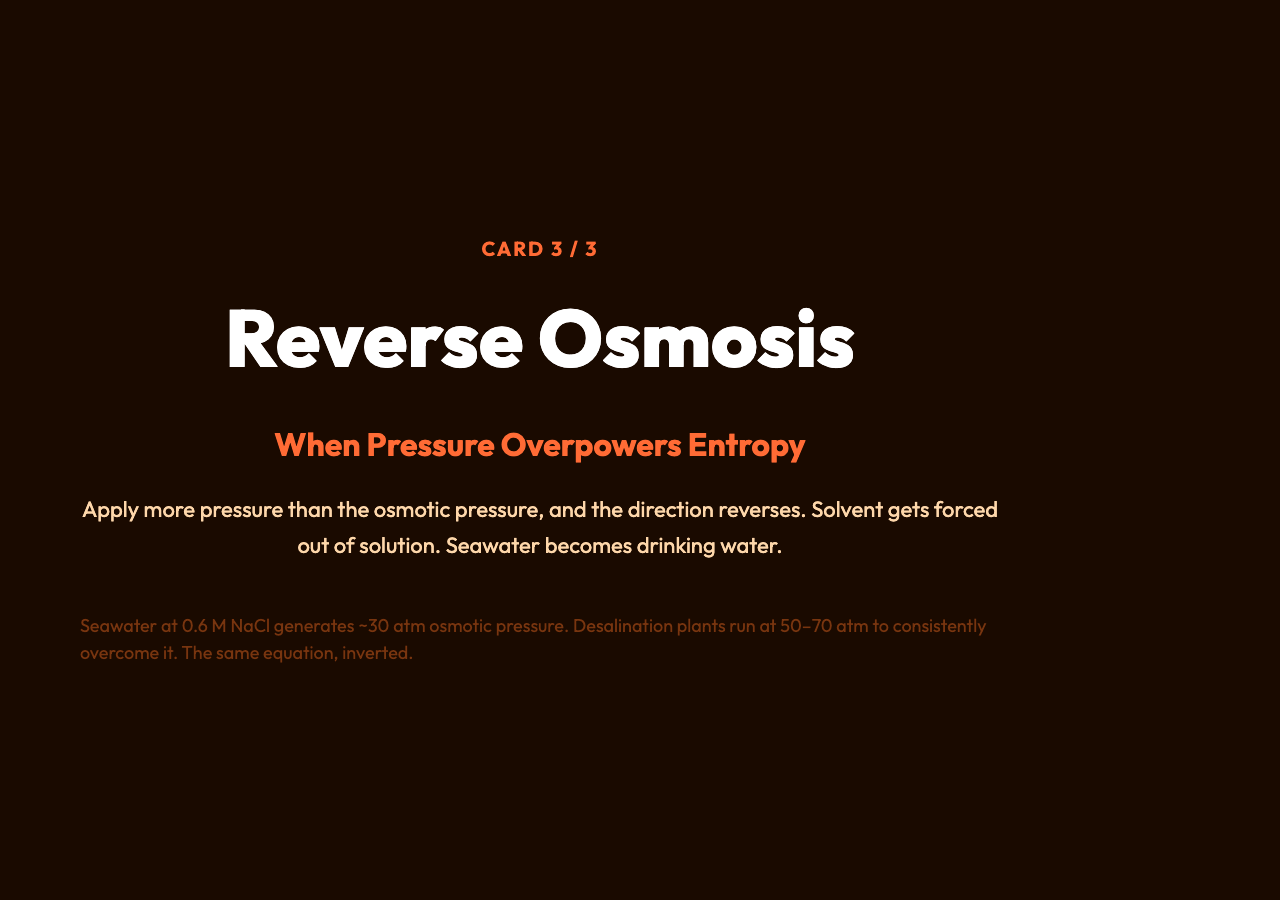
You get reverse osmosis. Instead of water flowing in to balance concentration, you force water out, leaving concentrated solute behind. This is the principle behind most modern water desalination systems.
In a reverse osmosis plant, seawater at roughly 0.6 M NaCl develops an osmotic pressure near 30 atmospheres at 298 K. To push water back through the membrane against this gradient requires applied pressures well above 30 atm — typically 50–70 atm in practice. The membrane must be strong enough not to rupture, and the energy cost is significant. But the output is water clean enough to drink.
The same physics applies in kidney dialysis. Blood contains waste solutes at concentrations that, if left to equilibrate with a clean dialysate solution, would generate osmotic pressure differences across the semipermeable membrane in the dialysis machine. By controlling the dialysate concentration and applying carefully chosen pressures, the machine selectively removes waste while retaining blood cells and proteins — a process directly governed by van’t Hoff’s law.
Why This Matters Beyond the Textbook
Osmotic pressure is not a niche concept. It is one of the foundational forces shaping living systems.
In human biology, every cell in your body exists in an aqueous environment where solute concentrations differ between the inside and outside of the cell membrane. The osmotic pressure gradient across that membrane determines whether water flows in, out, or stays balanced. This is why dehydration causes cells to shrivel and why excessive fluid intake can cause cells to swell and burst — the underlying equation is always π = iMRT.
In environmental engineering, osmotic power plants convert the mixing of freshwater and saltwater into electricity, using the osmotic pressure gradient as a natural head of pressure. It is an emerging technology, but it runs on the same van’t Hoff calculation that predicts how much pressure will develop when two solutions of different concentrations meet across a membrane.
In material science, osmotic pressure drives the synthesis of polymer gels that expand or contract in response to solute concentration changes — smart materials that sense their chemical environment and deform accordingly.
The Interactive Dimension
The simulation lets you adjust three parameters that directly govern osmotic pressure. Concentration, temperature, and van’t Hoff factor are the three levers available in the van’t Hoff equation, and changing any of them reshapes the pressure curve in real time. You can also switch between osmosis and reverse osmosis modes to see how the same equation behaves under opposite boundary conditions.
This interactive relationship is worth sitting with. The same formula predicts both the passive flow of water inward and the forced expulsion of water outward — depending entirely on whether the applied pressure stays below or exceeds π. There is no ambiguity in the physics. There is only a threshold, and the equation tells you exactly where it sits.
What makes osmotic pressure remarkable is not just the equation itself — it is the quiet inevitability behind it. Left unchecked, solvent molecules will always drift toward the side with more solute, not because they are drawn to it, but because the statistical reality of more particles demands more space. This same principle that fills our cells, powers our kidneys, and makes desalination possible is, at its heart, a single sentence: more particles demand more space. The membrane does not push. The water decide. The math simply counts.