The thought experiment is simple. Picture Earth from above, orbiting the Sun. One hemisphere tilts toward the star — longer days, more direct light, summer. The other tilts away — shorter days, slanted rays, winter. Both happen simultaneously, on the same ball of rock, 93 million miles from the Sun.
Most people assume Earth’s distance from the Sun explains the seasons. It does not. Earth’s orbit is nearly circular — the difference between perihelion and aphelion is about 3 million miles, less than 2% of the average distance. That small variation produces a radiative change of less than 7%. The seasons, meanwhile, produce a radiative change of 50–70% at mid-latitudes. Something else is in play, and that something is geometry.
The Axial Tilt That Changes Everything
Earth’s rotation axis is tilted 23.5° relative to the perpendicular of its orbital plane. This is not a rounding error — it is the fundamental cause of every season you have ever experienced.
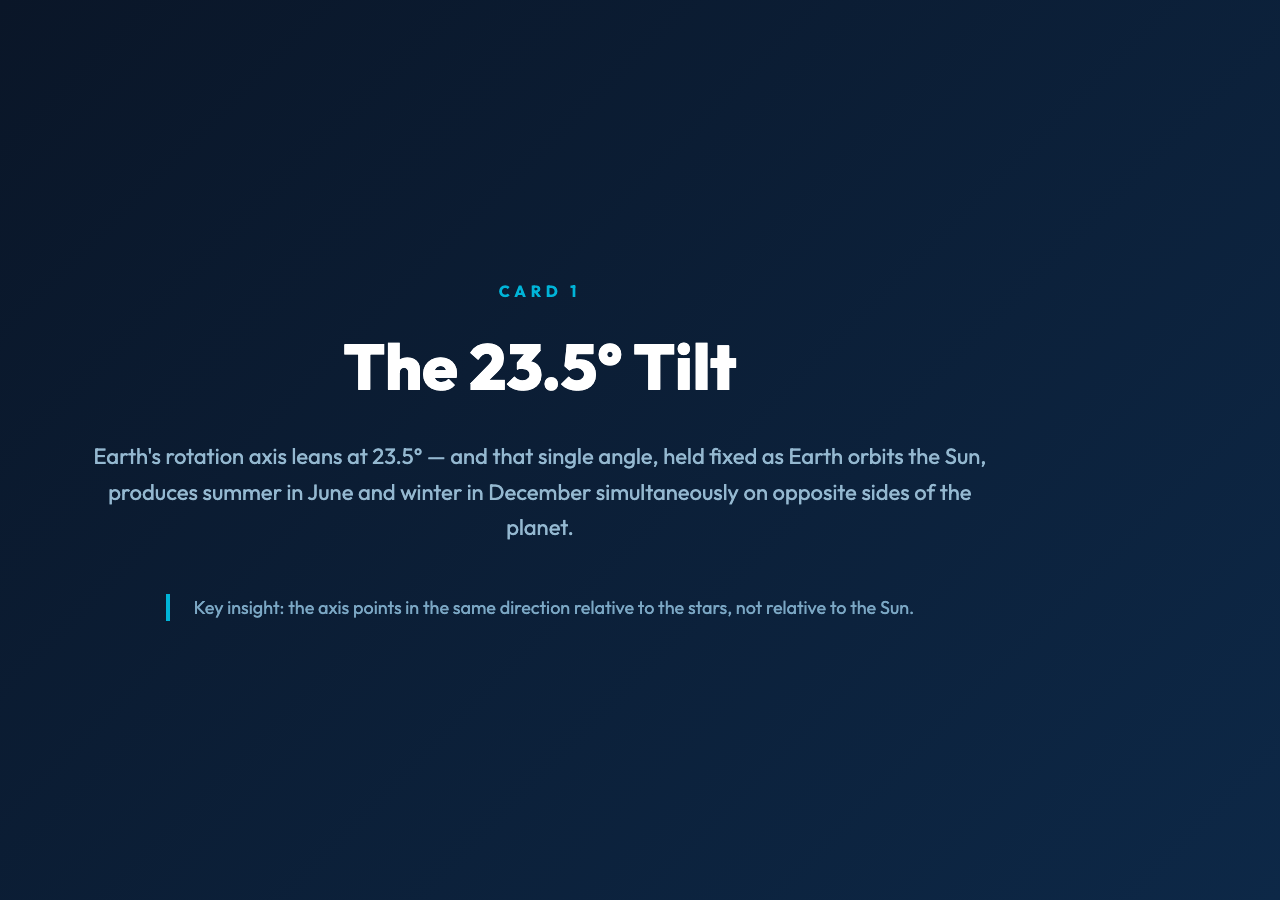
When the Northern Hemisphere tilts toward the Sun at 23.5°, the Sun’s rays arrive more perpendicular to the surface. The same amount of energy is concentrated over a smaller area. During summer solstice (around June 21), the Sun is overhead at the Tropic of Cancer (23.5° N) — 90° angle of incidence, maximum energy per square meter. Six months later, on the winter solstice, the Sun is overhead at the Tropic of Capricorn (23.5° S). The geometry has flipped.
The effect is amplified by day length. During summer in the Northern Hemisphere, the Arctic Circle experiences 24 hours of daylight. During winter, it experiences 24 hours of darkness. This is not a subtle effect — it is a 100% variation in daily radiant energy input between summer and winter, driven entirely by axial tilt.
Why Distance Is a Distraction
The perihelion (closest approach to the Sun) occurs in early January. The aphelion occurs in early July. This means the Northern Hemisphere actually experiences winter when Earth is slightly closer to the Sun. If distance were the primary driver, the Northern Hemisphere would have slightly warmer winters — it does not. The Southern Hemisphere, receiving slightly more solar energy at perihelion, actually has more extreme seasons than the Northern Hemisphere. This is the opposite of what the distance model predicts.

The orbital eccentricity does modulate the intensity of the seasons — southern summers are about 0.5°C warmer than northern summers due to the ~3% increase in solar flux at perihelion — but this is a secondary effect built on top of the primary mechanism: axial geometry.
The Interactive Visualization
The SeasonsFormation simulation models Earth’s orbit with the following parameters:
– Axial tilt: 23.5° – Orbit: elliptical with visible eccentricity – Day counter: 0–365 with season labeling
As you advance through the year, the simulation shows the Sun’s rays striking different latitudes with different intensities. The visual that emerges is the Earth’s axis pointing in the same direction in space throughout the orbit — it does not “follow” the Sun. This is the critical insight: the axis orientation is fixed relative to the stars, not relative to the Sun. As Earth moves along its orbit, the relationship between the axis and the Sun changes, creating the seasons.
The simulation also reveals why the solstices and equinoxes occur at specific orbital positions. At the March and September equinoxes, Earth’s axis is perpendicular to the Sun’s rays, and day and night are equal everywhere. At the June solstice, the Northern Hemisphere is maximally tilted toward the Sun; at the December solstice, maximally away.
What the Numbers Tell You
At 45° latitude (a representative mid-latitude location):
– Summer solstice solar elevation: 90° − 23.5° + 45° = 71.5° above horizon – Winter solstice solar elevation: 90° + 23.5° − 45° = 48.5° above horizon
The solar elevation difference of 23° between summer and winter translates to a cosine-of-angle effect on incident radiation:
– cos(71.5°) = 0.316 → relative intensity 0.316 – cos(48.5°) = 0.662 → relative intensity 0.662
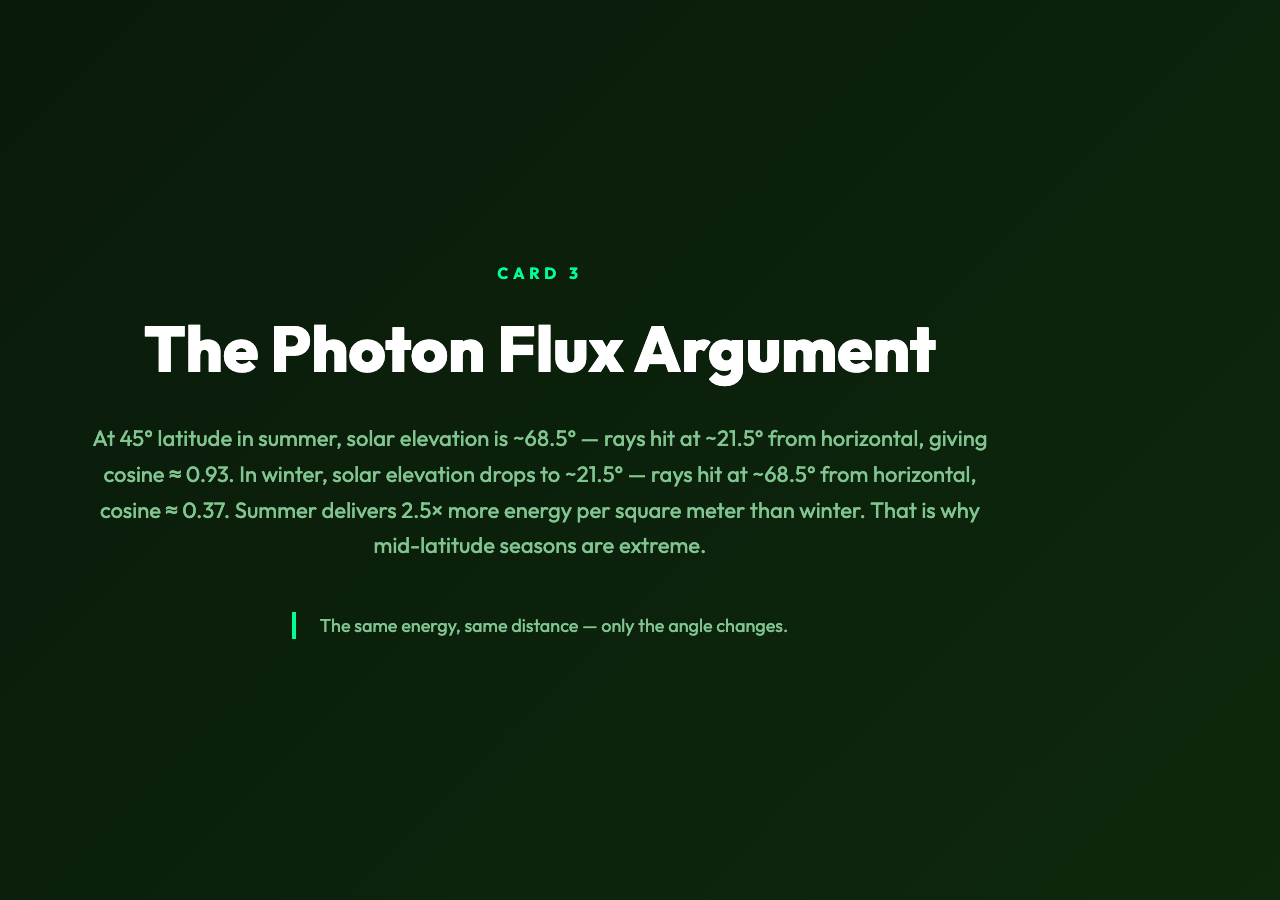
Wait — that would suggest winter is more intense than summer, which contradicts what we know. Let me recalculate. The solar elevation above the horizon is 90° minus the latitude plus the tilt (for summer). At 45° N on the summer solstice: 90 − 45 + 23.5 = 68.5°. The angle of incidence relative to the surface normal is what matters — the Sun at 68.5° elevation means the rays hit at 68.5° from vertical, or 21.5° from horizontal. The cosine of 21.5° = 0.93 — very efficient. In winter at 45° N: 90 − 45 − 23.5 = 21.5° elevation. The cosine of 21.5° from horizontal = sin(21.5°) ≈ 0.37 — less than half the summer intensity. This is why mid-latitude winters are cold and summers are warm despite the distance argument being wrong.
The Deeper Pattern
The same 23.5° tilt governs more than just temperature. It drives:
– The latitudinal temperature gradient that creates atmospheric circulation and weather patterns – The precession of equinoxes (a 26,000-year cycle where the solstice alignment shifts relative to the stars) – The obliquity variations that, over geological timescales, influence ice age cycles
Earth’s seasons are not a quirky exception — they are a direct mathematical consequence of a 23.5° angle between rotation and orbit. Every summer is an experiment in what happens when one hemisphere faces the star. Every winter is the control. The same physics, the same planet, two opposite outcomes.
What the animation reveals, and what no static diagram can convey, is that Earth’s seasons are not about distance — they are about geometry. The same planet, the same orbit, the same sun. Only the angle changes. In June, the Northern Hemisphere tilts toward Sol. In December, it tilts away. The photon flux per square meter shifts by a factor of two at mid-latitudes. Every summer is winter’s mirror, and every winter is summer’s shadow, recorded in the same 23.5° tilt that has organized life on this planet for hundreds of millions of years.