Why a Piano Recital Costs More Every Year (and What That Actually Means)
A Steinway concert grand piano costs roughly what it did in 1990, adjusted for inflation. A live performance of Chopin by a world-class pianist does not. This gap — between a product that gets cheaper in real terms and a service that keeps getting more expensive — has a name. William Baumol called it “cost disease” in 1966, and it remains one of the most unsettling observations in economics.
The intuition is simple. Manufacturing productivity rises because machines can do more per hour than they could a generation ago. A factory that employed 500 workers in 1970 might employ 50 today and produce far more. The human brain cannot be similarly upgraded. A violin soloist practices for decades to reach the stage, and that practice time doesn’t compress. An hour of surgery is still an hour of a surgeon’s undivided attention. These services are “stagnant” in productivity terms — they don’t benefit from the same automation dividends as making microchips or weaving fabric.
And yet their wages must rise to stay competitive with the progressive sector. If factory wages climb 3% per year and concert musician wages don’t, talented people stop becoming musicians and start working in factories. Markets equalize. So wages in the stagnant sector track the progressive sector even when productivity there stands still.
The Two-Sector Model
Baumol’s framework contrasts two kinds of activities:
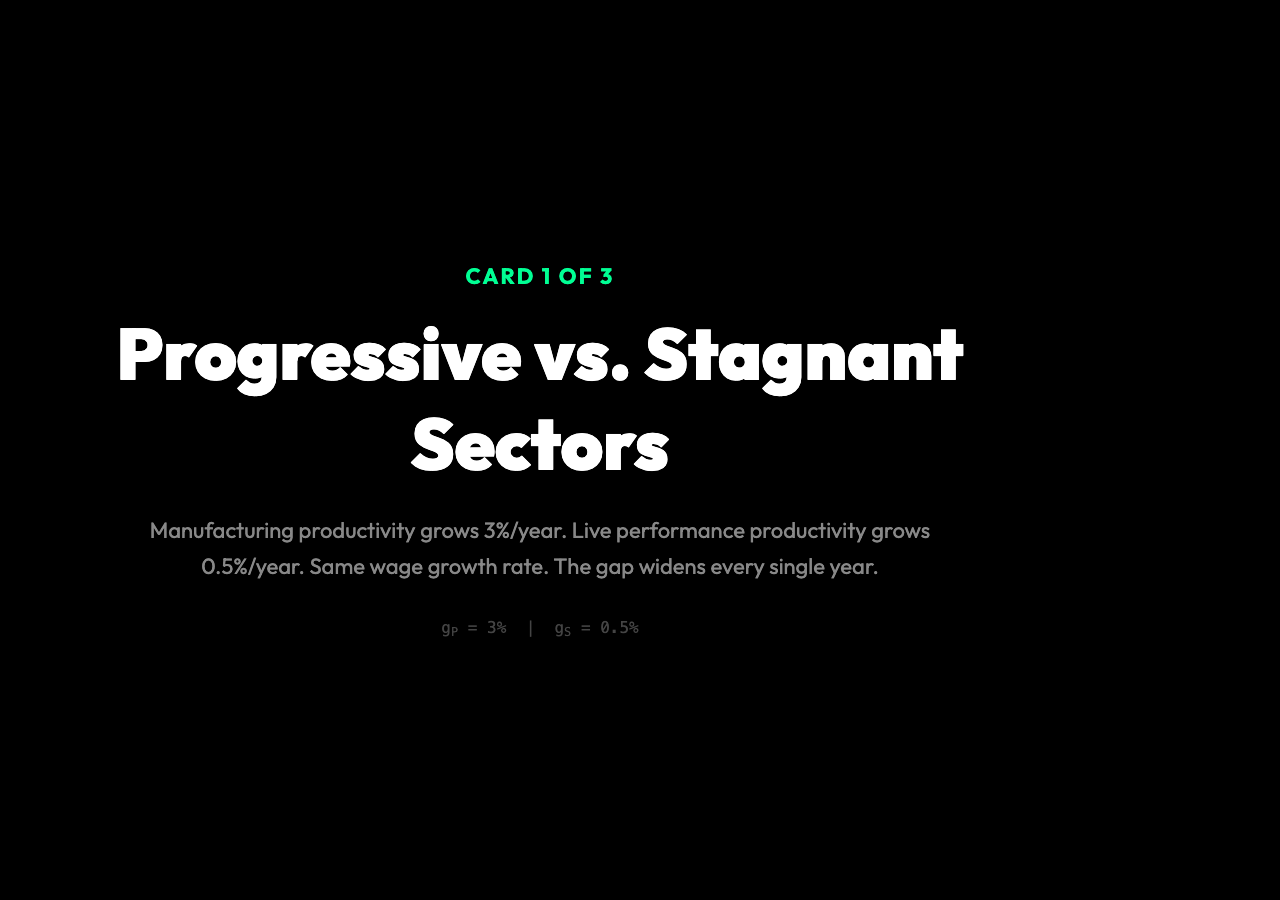
- Progressive sectors — where productivity grows steadily. Manufacturing, agriculture, information technology. Every year, the same labor produces more output.
- Stagnant sectors — where productivity barely moves. Live performance, healthcare, education, personal care. An hour of accounting in 2025 requires roughly the same human effort as an hour of accounting in 1985.
In the stagnant sector, rising wages are not matched by rising output per worker. Businesses and governments absorb the higher labor cost or pass it on as higher prices. Over decades, this produces the familiar pattern: a smartphone that cost $1,000 in 2010 costs $400 in 2025, while a dental crown that cost $800 in 2010 costs $2,200 today.
The interactive model embedded in this article lets you explore this with two key parameters. Set the productivity growth rate for the progressive sector (say, 3% per year) and for the stagnant sector (close to 0%). Watch how the relative price gap — measured as the cost index of the stagnant sector relative to the progressive sector — widens exponentially over 50 years. There is no fix that doesn’t involve accepting lower real wages in the stagnant sector, which in turn drives talent out of those fields.
Why Services Get More Expensive While Goods Get Cheaper
The math behind this is worth spelling out, because it confuses many people who encounter the idea casually.
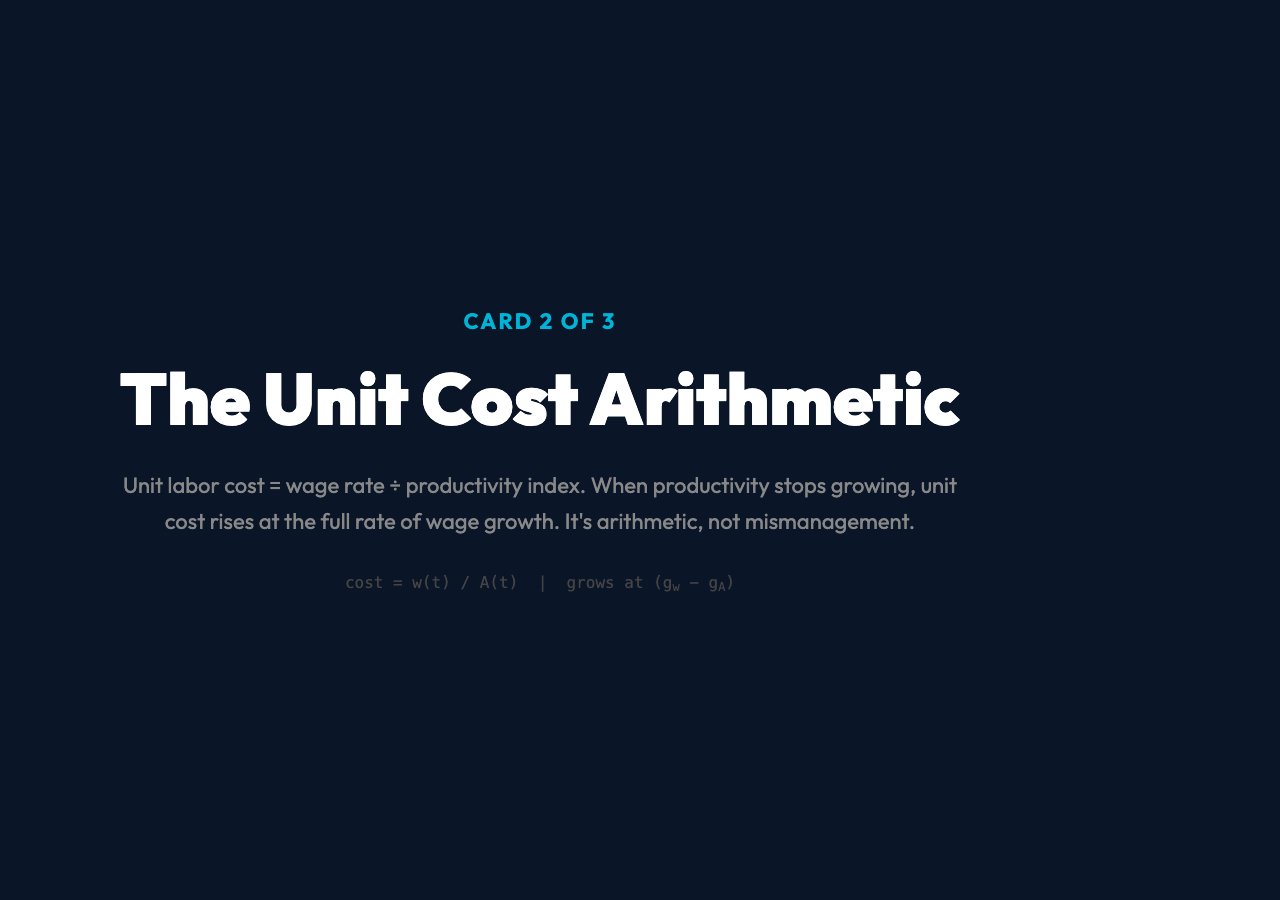
Let w(t) be the wage at time t. Let A(t) be the productivity index at time t. The unit labor cost — the cost per unit of output — is w(t) divided by A(t). If wages grow at rate g_w and productivity grows at rate g_A, then unit labor cost grows at rate g_w minus g_A. In the progressive sector, g_A is large enough that g_w minus g_A is near zero or negative — costs per unit of output actually fall. In the stagnant sector, g_A is near zero, so unit labor cost grows at nearly the full rate of wage growth.
This isn’t a failure of management. It isn’t waste or bloat. It is arithmetic.
The same mechanism shows up in your city’s police department budget. Police officers can’t be replaced by robots — their judgment, presence, and authority are irreducibly human. But police salaries must keep pace with private-sector wages to attract competent officers. The result: a department that has roughly the same number of officers per capita today as it did in 1990, yet spends three times as much in real dollars.
The Measurement Problem
The original Baumol paper described this for live performances specifically — hence the piano recital example. But the logic scales. In 2026, the United States spends roughly 18% of GDP on healthcare, compared with about 9% in 1970. The population is healthier, but not eight times healthier. The cost of the underlying human activity — the surgeon’s time, the nurse’s attention, the physical therapist’s hands — has simply risen at the rate of general wage growth while productivity gains bypassed the sector almost entirely.
This creates serious policy confusion. Proposals to “fix” rising healthcare costs frequently focus on increasing productivity, as if efficiency savings in hospital administration will materially change the unit cost of a surgical procedure. They rarely do, because the dominant cost driver is physician time and attention, which are not amenable to standard productivity improvements.
What Can Actually Be Done
Baumol’s insight does not imply that stagnant-sector cost growth is inevitable or harmless. Several interventions can slow the rate of increase:
Supplement human time with technology. Diagnostic imaging, laboratory automation, and AI-assisted clinical decision support don’t replace the physician’s judgment at the bedside, but they multiply the effective output of each hour of physician time. The unit cost per diagnosis can fall even while the physician’s hourly rate rises.
Export the service internationally. Some service work can be delivered remotely. Radiological readings, accounting, legal research, and software testing can be performed in lower-wage jurisdictions, increasing effective global supply. This moderates the wage pressure — though it generates its own political economy complications.
Redesign the service for lower human-time intensity. Much of what physicians do in a typical office visit could be handled by a nurse practitioner or a well-designed self-service tool. Triage — routing the right patient to the right level of human expertise — reduces average human-time cost per patient served. This is a form of labor arbitrage within the sector rather than across sectors.
Accept trade-offs rather than hide them. Cost disease in public education is real. If teacher salaries must keep pace with engineers’ salaries to maintain teacher quality, and if teaching productivity cannot rise at engineering productivity rates, then either class sizes rise, per-pupil spending falls in real terms, or taxes rise. There is no elegant engineering solution. Honest public budgeting acknowledges which trade-off is being made.
The Philosophical Sting
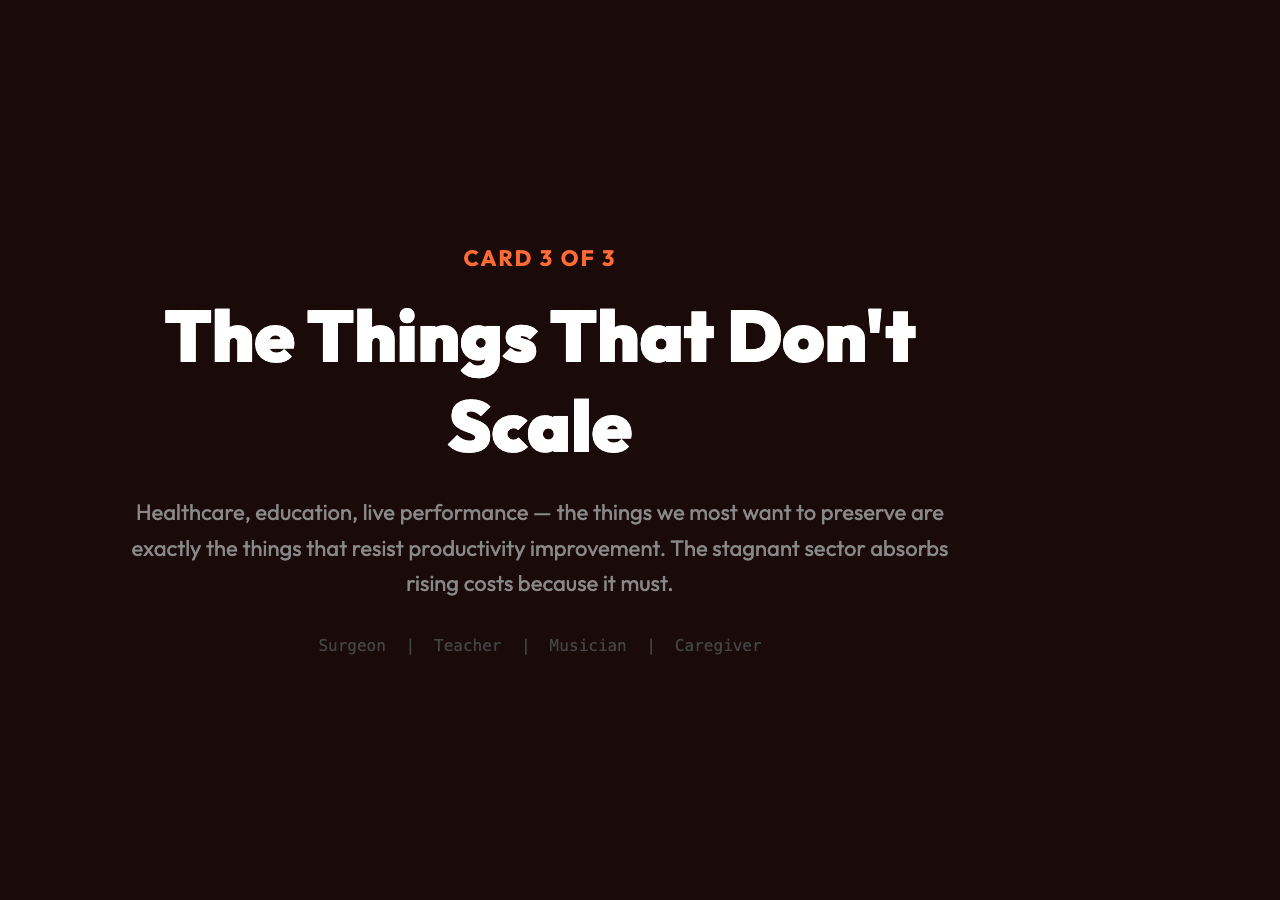
What makes Baumol’s cost disease philosophically uncomfortable is its implication for humanistic work. The things that resist productivity improvement — a pianist’s interpretation, a surgeon’s judgment, a teacher’s encouragement — are precisely the things we most want to preserve and reward. If Baumol is right, these activities will consume an ever-larger share of the economic surplus simply because they involve humans doing human things in human time.
This is not a failure of the system. It is a feature of what it means to be human. Productivity growth in manufacturing creates the material abundance that allows society to afford more live music, more surgery, more teaching, more care. The stagnant sector doesn’t drag the economy down — it is what the productivity gains are for.
Two Sector Interactive Model
Adjust the parameters in the model to see how unbalanced growth plays out over decades.