
A construction worker on a building site pulls down on a rope. A steel beam, twelve times heavier than she is, rises steadily. No crane. No motor. Just a system of wheels and rope, and the work she’s doing with her arms.
She is not generating more energy than her body can produce. She is distributing the same energy differently — pulling more rope over more distance, to move the same weight less far. The pulley made the job possible. But it didn’t make it free.
This is the trade-off every pulley system carries, whether it’s in a gym, a sailing ship, or a construction crane. Understanding it changes how you see every machine that uses wheels and ropes.
What a Pulley Actually Does
A pulley is a wheel with a groove, fixed to a structure or free to move, with a rope threaded through it. The basic physics is straightforward: when you pull down on one side of the rope, the other side pulls up.

In a fixed pulley — the simplest kind, like the one above a gym’s weight stack — the wheel only changes the direction of force. You pull down, and the load rises. The mechanical advantage is 1. No force is saved, only direction is changed. You still need to apply the full weight of the load as force.
The advantage appears with a movable pulley, where the wheel itself moves. Half the force now lifts the full load — but you need to pull twice as much rope. The math: F = mg / 2.
Real systems rarely use just one or the other. They combine fixed and movable pulleys into compound systems, stacking mechanical advantage. A 3:1 system (three parts of rope supporting the load) requires only one-third of the weight in force — but requires pulling three times as much rope.
The Force-Distance Trade-Off
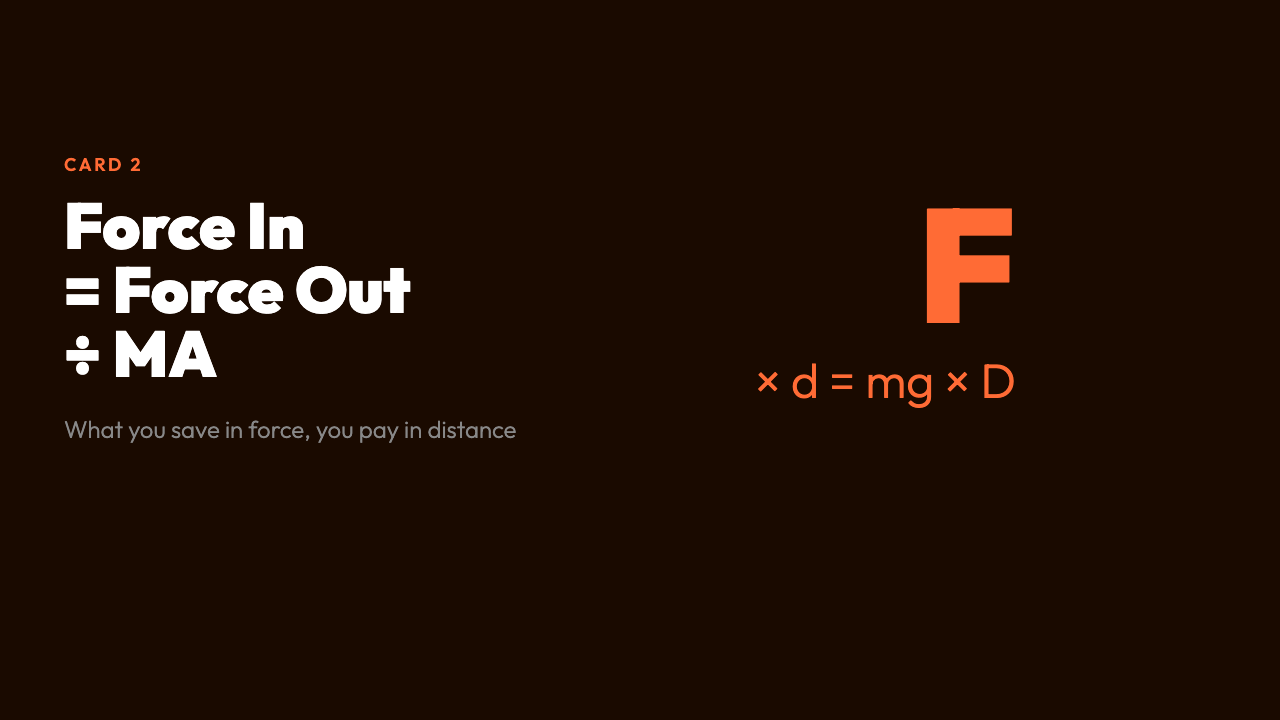
Mechanical advantage has a cost. It is not free energy — it is energy redistributed.
The ideal mechanical advantage (IMA) of a pulley system is the number of rope segments supporting the load:
IMA = number of rope segments supporting the load
For a compound system with 3 supporting segments, the IMA = 3. This means the input force needed is F = mg / 3. But to lift the load by 1 meter, you must pull 3 meters of rope through the system.
Work in = work out (in the ideal, frictionless case):
F_in × d_in = F_out × d_out
(mg/3) × (3m) = mg × 1m
This is conservation of energy, not an exception to it. The pulley does not create energy — it trades force for distance, or vice versa, with no free lunch.
Friction: The Reality Tax
No real rope runs over a real wheel without friction. In pulley systems, friction is the reason the mechanical advantage printed on the package is never the one you actually get.
The actual mechanical advantage (AMA) accounts for friction:
AMA = (load weight × distance lifted) / (input force × input distance)
AMA < IMA always, in real systems
Friction increases with: – More pulley wheels (more axles, more contact surfaces) – Rough rope material (hemp vs. steel cable) – Tight bends around small pulley radii

A well-lubricated, large-radius pulley system might achieve 90% efficiency. A small, fiber-rope, multi-pulley system might lose 30–40% to friction, meaning you get significantly less mechanical advantage than the rope count suggests.
Mechanical Advantage vs. Efficiency: Not the Same Thing
It is tempting to conflate a high mechanical advantage with an efficient machine. They are related, but distinct.
Mechanical advantage tells you how much easier the force is — how many times the rope divides the load.
Efficiency tells you how much of your input work actually goes into lifting the load, versus being lost to friction and deformation.
A simple 2:1 pulley (one fixed, one movable) with smooth axles and good lubrication might achieve 95% efficiency. A complex 6:1 block-and-tackle with worn rope might only achieve 60% — it gives you more force leverage, but wastes more of your energy as heat.
The trade-off between MA and efficiency is practical: more pulleys mean more mechanical advantage, but also more friction. The optimal system is the one that balances the force you can apply against the losses you’ll incur.
Real Systems: From Gym Weights to Cranes
Gym weight stacks typically use a 4:1 or 6:1 cable system. A 60 kg weight on the stack might feel like 10 kg on the handle — but you pull the handle 4–6 meters for every meter the weight rises. The system is simple, efficient, and designed for repeated human use.
Sailing blocks use 6:1 or 8:1 purchase systems. A sail weighing 200 kg requires only 25–33 kg of pull on the line — but the crew might need to haul 8 meters of rope to raise the sail 1 meter. Sailors learn this balance intuitively: more mechanical advantage means more rope to manage.
Construction cranes use steel cable systems with motorized winches. A tower crane lifting a 10-tonne concrete panel uses a cable system with mechanical advantage of perhaps 12:1 — the motor applies 833 kg of force on the cable, but the cable must travel 12 meters to lift the panel 1 meter. Large, lubricated steel sheaves keep efficiency above 95%.
The same physics applies in all three cases. The difference is only in the materials, the scale, and how much friction the designers chose to accept.
The Grammar Beneath Every Pulley
All pulley systems — from the simplest gym machine to the most complex marine rigging — follow the same physical grammar:
- Force in = Force out / Mechanical Advantage (ideal case)
- Work in = Work out + Work lost to friction
- Distance pulled = Distance lifted × Mechanical Advantage
This grammar is not approximate. It does not depend on the material of the rope, the size of the wheel, or whether the system is 500 years old or built yesterday. It is the consequence of energy conservation and the geometry of circular motion.
The pulley is one of the oldest machines in human history. The Egyptians used rope and wooden rollers to raise stones. Greek sailors used block and tackle to hoist sails. Modern engineers use steel cables and precision-machined sheaves in cranes and elevators.
All of them are doing the same thing: trading force for distance, under the constraint of energy conservation.
The Trade-Off You Can’t Escape
The pulley system makes heavy lifting feel effortless — but the effort never disappears. What you save in force, you pay for in distance. A mechanical advantage of 3 means pulling three times as much rope to lift the same weight. Add friction, and the gap between ideal and real narrows further.
This is the trade-off embedded in every machine: leverage force, lose convenience. The physics doesn’t care whether you’re raising a flag or lifting a construction beam. The math is the same. The tension in the rope, the torque on the pulley, the work in versus work out — they all follow the same grammar.
Next time you see a crane lifting a steel beam, watch the cable. The motor is doing exactly what your arm would do, just over a longer distance. The pulley isn’t magic. It’s patience, traded for force.