
The quiet arithmetic behind VINs
That string of seventeen characters stamped on your dashboard isn’t only an identifier — it’s a checksum in disguise. Position nine is computed from the other sixteen using a 1981 standard called ISO 3779. Change any other character, and position nine changes with it. Miss one digit, and the algorithm catches it before any database ever sees the typo.
The 17 characters stamped on cars since 1981
A Vehicle Identification Number is exactly seventeen characters, made up of digits 0–9 and capital letters from a restricted alphabet. Three letters are forbidden: I, O, and Q. The reason is purely visual — on a stamped metal plate, the difference between I and 1, O and 0, or Q and O is impossible to read in bad lighting. So the VIN alphabet skips those three entirely, leaving 31 letters and 10 digits, or 41,416,577,250,242,895,872 possible seventeen-character combinations. Each car manufactured since the 1981 model year carries one.

The seventeen characters split into three sections, each with its own job:
- Characters 1–3: WMI (World Manufacturer Identifier) — which company built the vehicle, and which country. The first character alone reveals the region:
1through5is North America,JthroughMis Asia,SthroughWis Europe. - Characters 4–9: VDS (Vehicle Descriptor Section) — model, body style, engine type. Manufacturers design this section themselves.
- Characters 10–17: VIS (Vehicle Identifier Section) — model year, assembly plant, and a sequential serial number unique to that model-year run.
That’s why your mechanic can tell at a glance that JHM is a Honda built in Japan, while 1G1 is a Chevrolet built in the United States — the first three characters essentially form a country code with a manufacturer suffix.
Position 9: the check digit nobody reads
Here’s the part that surprises most people. The ninth character of a VIN is not assigned by the factory. It’s computed from the other sixteen.

The algorithm is ISO 3779, and it works in three steps:
1. Transliterate each letter to its numerical value. A=1, B=2, C=3, all the way to Z=9 (with skipped values for the forbidden letters). 2. Multiply each character by a position-specific weight. The weights are [8, 7, 6, 5, 4, 3, 2, 10, 0, 9, 8, 7, 6, 5, 4, 3, 2] — note the 10 in position 9 and the 0 in position 9’s own slot. That’s how a check digit verifies itself. 3. Sum, take mod 11, and convert back to a character. If the result is 10, use X. Otherwise use the digit.
The reason it’s mod 11 and not mod 10 is that mod 11 can produce 11 distinct check values (0–9 plus X), giving the check digit a full alphanumeric range. This catches more single-character typos than a mod-10 sum would.
The result is a self-validating string. Type any random sixteen characters, compute position nine, and you have a valid-looking VIN. Type a real VIN and mistype one character, and the check digit will almost certainly fail. According to a 1984 NHTSA rule (49 CFR Part 565), passenger cars, multipurpose passenger vehicles, trucks, and buses built on or after April 30, 1984 had to carry a 17-character VIN with this check digit. Insurance fraud investigations, salvage-title disputes, and recall campaigns have all relied on it since.
A worked example: 1HGCM82633A004352
Take a real 2003 Honda Civic VIN: 1HGCM82633A004352. Position nine is 3. Let’s see if the algorithm confirms it.
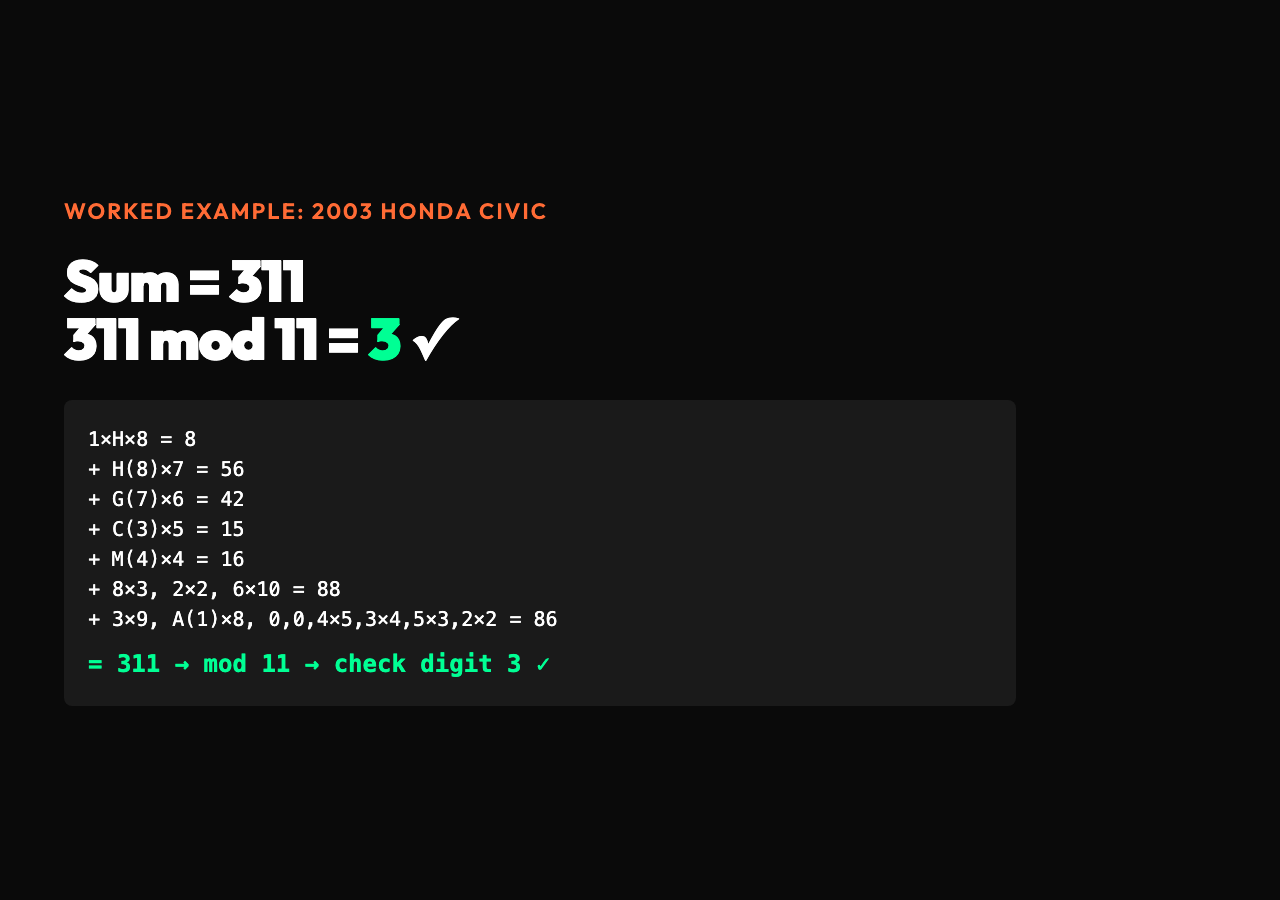
Walking through position by position, multiplying each character by its weight and summing (skipping position 9, which contributes zero):
– Position 1: 1 × 8 = 8 – Position 2: H × 7 = 56 – Position 3: G × 6 = 42 – Position 4: C × 5 = 15 – Position 5: M × 4 = 16 – Position 6: 8 × 3 = 24 – Position 7: 2 × 2 = 4 – Position 8: 6 × 10 = 60 – Position 10: 3 × 9 = 27 – Position 11: A × 8 = 8 – Position 12: 0 × 7 = 0 – Position 13: 0 × 6 = 0 – Position 14: 4 × 5 = 20 – Position 15: 3 × 4 = 12 – Position 16: 5 × 3 = 15 – Position 17: 2 × 2 = 4
Sum of contributions: 8 + 56 + 42 + 15 + 16 + 24 + 4 + 60 + 27 + 8 + 0 + 0 + 20 + 12 + 15 + 4 = 311. Divide by 11: 311 ÷ 11 = 28 remainder 3. The expected check digit is 3, which matches position nine. The VIN validates.
That single arithmetic step — multiply, sum, mod 11 — is the entire algorithm. A VIN Validator tool runs this calculation under the hood, then cross-references positions 1–3 against a manufacturer table and position 10 against the year-code cycle. If any of those three layers disagrees, the tool flags the VIN before it ever reaches a database.
The year code resets on a 30-year cycle
Position ten encodes the model year, and here’s where the encoding gets clever. There are only 31 year-code characters available (10 digits plus 21 letters, with I, O, Q, and U excluded for visual reasons), and the codes repeat on a thirty-year cycle:
– A = 1980 or 2010 – B = 1981 or 2011 – C = 1982 or 2012 – … continuing through … – Y = 2000 or 2030 – 1 through 9 = 2001–2009 or 2031–2039
A VIN with R in position ten comes from either 1994 or 2024. The cycle exists because the original 1980 standard exhausted the available characters by 2009, and reusing codes for the next generation of vehicles was the cleanest fix. To distinguish between, say, a 1994 Civic and a 2024 Civic, you read the WMI prefix — the manufacturer identifier — to figure out which model-year run this serial number belongs to.
In practice, this means a VIN lookup tool that returns “1994 or 2024” is doing exactly the right thing. It cannot tell you which one without more context. The model-year ambiguity is a feature of the standard, not a bug.
Why this matters beyond the dashboard
ISO 3779 isn’t unique. The same trick shows up in ISBN-10 (the check digit at the end of each book), in credit card numbers (the Luhn algorithm), in the IBANs that identify European bank accounts, and in U.S. Social Security Numbers (the area number’s first three digits encode the state of issuance). All of them use a weighted sum, a transliteration table for letters, and a modulus that’s almost always 11 or 10.
The pattern works because the cost of catching one typo at the input stage is dramatically lower than fixing it later. A single mistyped VIN in an insurance database cascades into claim mismatches, recall exclusions, and parts-ordering errors. A book with a bad ISBN cannot be ordered from a distributor. A credit card number that’s off by one digit gets declined at the gas pump. The check digit isn’t a security feature — it’s a data-quality feature. It exists to catch the kind of mistakes humans make when they copy seventeen characters from a metal plate by hand.
The next time a VIN Validator tool tells you a VIN is invalid, it’s not because the format is exotic. It’s because one of sixteen characters was mistyped, and position nine caught it before the data ever reached a database. You can paste any 17-character string into the VIN Validator at Elysia Tools, and the tool walks through the check-digit calculation, the WMI lookup, and the model-year decode in a single output. If the string is real, you’ll get the manufacturer and country. If it isn’t, the tool will show you exactly which character broke the checksum.
So the next time a car dealership hands you a key fob with seventeen characters printed on the tag, look at position nine. That single character is the result of a calculation your phone could perform in microseconds — and it has been quietly catching typos since the Reagan administration. What other seventeen-character strings in your life are running arithmetic you never noticed?