You can take the battery out, wipe the storage, and put the device in a drawer for a year. The next time it touches a cell tower, the network still knows what it is. That is not an accident, and it is not magic. It is a 15-digit number etched into the radio hardware at the factory, guarded by a checksum algorithm that was first published in a 1960 patent, and it has been quietly identifying your phone since before you owned it.
The number is called the IMEI — the International Mobile Equipment Identity — and almost no one outside carrier fraud teams and device-recycling shops thinks about it until something goes wrong. A phone is stolen. A used device is reported as blacklisted. A support ticket crosses your desk asking why a perfectly good handset cannot connect to a network. In every one of those cases, the first question any operator asks is: what is the IMEI, and is it valid?
Most IMEI validators do the obvious thing: count the digits, and call it a day. The good ones, like the free IMEI Validator from Elysia Tools, do something more interesting. They verify the Luhn checksum, decode the manufacturer and model ranges, and tolerate both the original 15-digit format and the newer 16-digit variant that the GSMA rolled out in 2017. That extra care turns a string of digits into a story, and that story is what this article is about.
What the 15 digits actually mean
An IMEI is not a random serial. It is a structured identifier, and the structure has been stable for decades.
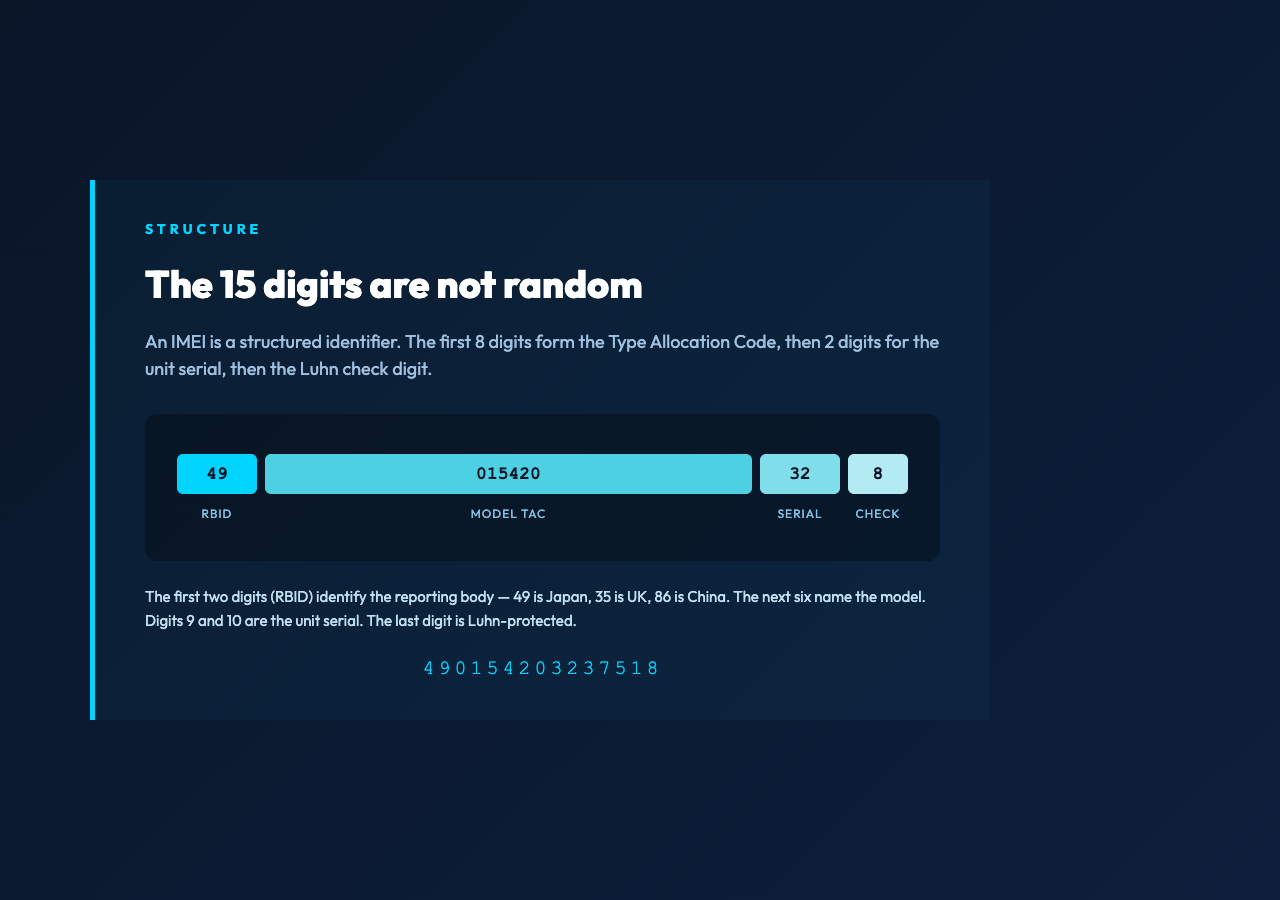
The first eight digits are the Type Allocation Code (TAC). The first two of those identify the Reporting Body Identifier (RBID) — the organization that registered the device model. 35, for example, belongs to BABT in the UK; 49 belongs to the Japanese authority; 86 is for China. The next six digits identify the specific model, and they are assigned by the manufacturer. Together, the eight-digit TAC uniquely identifies a phone model on the planet.
Digits nine and ten are the Serial Number of the individual device. These are the part that changes from unit to unit within a model line. The 15th digit, at the end, is the check digit, computed using the Luhn algorithm. The 14th digit has historically been a spare zero, but starting with newer devices, it carries a software version nibble when an IMEISV is in use.
That structure is why a validator that just counts digits is missing the point. The check digit exists to catch typos, transcription errors, and sloppy data entry, but it also doubles as a fingerprint for the manufacturer and the model. A valid IMEI carries the entire lineage of the device inside it, and a good validator surfaces that lineage instead of just saying yes or no.
Why Luhn is the wrong algorithm for everything except catching typos
The Luhn algorithm, sometimes called the mod-10 algorithm, was patented by Hans Peter Luhn at IBM in 1960. It is a deliberately simple checksum. You take the digits, double every second one from the right (subtracting nine from anything that ends up over nine), sum them all, and check that the total is a multiple of ten. It catches every single-digit error and most transpositions of adjacent digits. It is exactly the algorithm the IMEI specification adopted in 2003, and it is exactly the algorithm the IMEI Validator uses today.
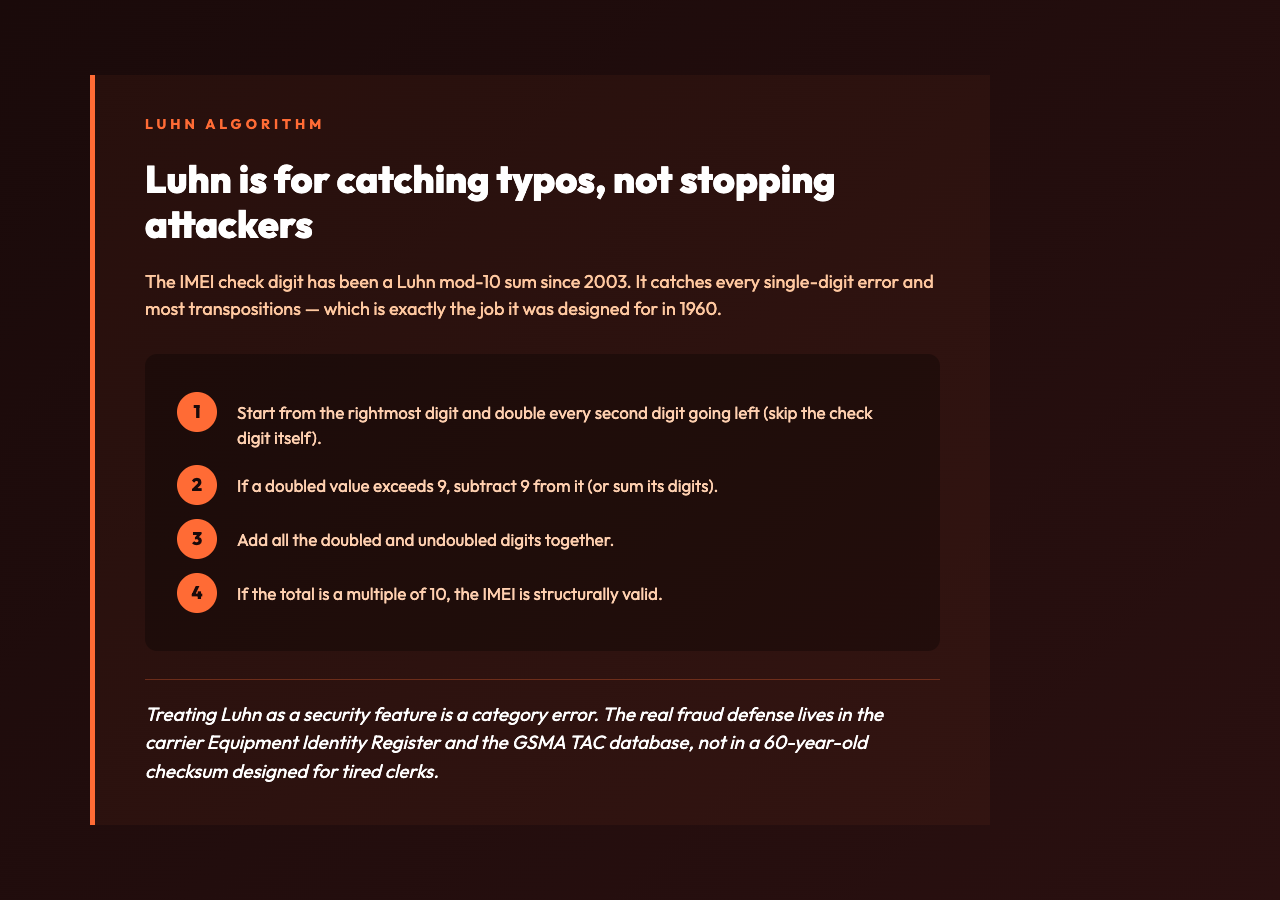
The reason it is perfect for this job is also the reason it is useless for security. Luhn was never designed to defeat an attacker. It was designed to defeat a tired clerk typing a 15-digit number from a sticker. If someone wants to forge an IMEI, they can compute a valid check digit for any prefix they want in a single line of code. The whole point of the checksum is to catch honest mistakes, not dishonest ones. Real device fraud is caught at a different layer entirely — the Equipment Identity Register, the blacklist databases that carriers share, and the TAC database that ties a prefix to a real manufacturer.
This distinction matters when you read industry write-ups. Some blog posts talk about Luhn as if it were a security feature. It is not. It is a data-quality feature. The security is in the registration system that assigns TAC ranges and the network equipment that consults the blacklist. Luhn is the bouncer who checks that your ID is well-formed before the actual security team takes a look. Treating it as a cryptographic primitive is a category error that surfaces most often in product pitches from people who have not thought about the problem carefully.
The 16-digit version nobody warned you about
Here is the part that catches even experienced engineers. Since 2017, the GSMA has been moving toward a 16-digit identifier called the IMEISV — the International Mobile Equipment Identity, Software Version. The format looks like this: 35-209900-176148-2. Sixteen digits, four groups, with a software version at the end instead of a Luhn check digit. The last two digits are a hex pair representing the software version of the device’s radio firmware.
This is where most validators fail. They count 16 digits, run a Luhn check, get a wrong answer, and report the number as invalid. The number is not invalid — it just is not in the original IMEI format. A well-built validator strips the separator, recognizes the 16-digit pattern, and reports on the TAC and serial portions without demanding a Luhn match. This is the difference between a validator that works for real device flows and one that only works for 2003-vintage hardware.
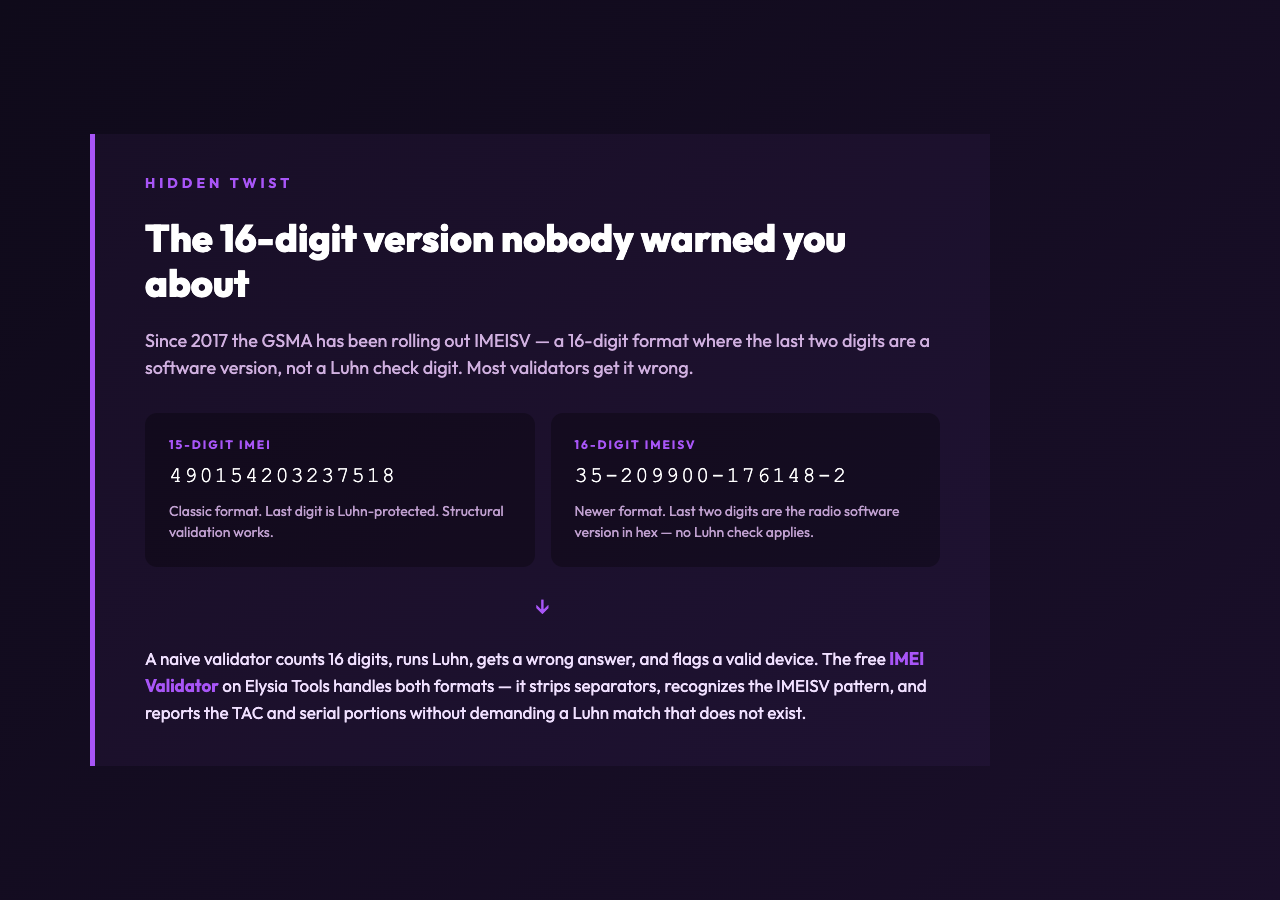
Try this for yourself. The number 35-209900-176148-2 is a valid 16-digit IMEISV with a TAC of 352099 (a registered model in the BABT range) and a software version of 02. A naive Luhn check will reject it. A proper validator will tell you the structure is sound, the manufacturer range is recognized, and the number is well-formed. The free IMEI Validator handles both formats, which is why it is worth bookmarking if you work with device intake or refurbished-phone inventory.
A small example, walked through
Take the IMEI 490154203237518. The first two digits are 49, the Japanese RBID. Digits three through eight are 015420, which is a TAC assigned to a specific Japanese OEM. Digits nine and ten, the serial, are 32. The 14th digit is 1, and the 15th is the check digit 8.
To verify the Luhn checksum by hand: starting from the right, double the 14th, 12th, 10th, and so on. The check digit itself is not doubled. In this number, doubling the alternating positions and summing, then adding the non-doubled positions, gives a total of 80. Eighty is a multiple of ten, so the number is valid. A validator that does this in a few lines of code is what you want — hand-checking gets old around the third device.
You can repeat the same exercise with the IMEI 352099001761480, which uses the same BABT TAC range as the 16-digit example. Same checksum, same logic, slightly different output. Two valid numbers, one format, one rule. The validator just has to know the rule.
Where IMEI checks actually matter in 2026
If you are not a carrier engineer, why should you care? Three reasons that have all gotten more important in the last few years.
Refurbished device trade. The market for used phones is now measured in tens of billions of dollars annually, and every device that changes hands needs an IMEI verification. A small share of those devices are blacklisted for loss, theft, or fraud, and a single bad IMEI in a batch of fifty turns a profitable transaction into a loss. Validators that check the structure are a first line of defense; they are not a substitute for a real blacklist lookup, but they cut the obvious garbage before the expensive API call.
RMA and warranty flows. A support engineer pasting an IMEI into a CRM field is a typo away from approving a return on a device that was never sold by the company. A Luhn check at the form layer catches the typo before the workflow starts. This is the kind of small thing that, multiplied across a busy support team, prevents real money from being lost to mistakes.
Customs and import compliance. Several jurisdictions now require IMEI registration before a device can be activated on a local network. Validating the structure at intake, before the device is shipped or sold, prevents a backlog of unregisterable inventory from showing up in a warehouse three weeks later. The TAC lookup, in particular, tells you whether a device is even a model the GSMA recognizes — which is a different question from whether the device is blacklisted.
The end of the story is also the beginning
The IMEI is one of the oldest identifier schemes still in active use on consumer hardware. It has survived the transition from 2G to 5G, the rise of eSIMs, and the slow migration toward software-defined radios. It is a 60-year-old checksum algorithm, a 20-year-old allocation system, and a five-year-old software-version extension, all living inside a 15- or 16-digit string. It works because it does almost nothing — it identifies a device model, it identifies the unit, it lets a network ask is this thing on the list, and it lets a tired human ask did I type that right.
If you work with mobile devices at all, take fifteen seconds and run your last five IMEIs through the IMEI Validator. Look at the TAC ranges. Notice the model assignments. Notice which numbers are flagged and why. The pattern is small, the format is stable, and the next time a device flow breaks — and it will — you will know whether the number itself is the problem, or whether the problem is somewhere else entirely.
The 15 digits were not designed to be elegant. They were designed to be useful, and on that count, they have been quietly succeeding for longer than most of the software we run today. Try it on a real number and see for yourself.
Explore more tools at elysiatools.com.