
If you have ever asked “how long until my money doubles,” you have probably been handed the same one-sentence answer for forty years: divide 72 by the annual rate and you get the years. The shortcut shows up in finance textbooks, MBA case studies, and the slide deck of every retirement-planning webinar. Most people walk away believing they have learned a piece of mathematics. They have actually learned a piece of forgiveness — and the difference matters at every rate the calculator quietly lets you get wrong.
The Rule of 72 Calculator on Elysia Tools takes a rate, an optional principal, and a single calculation mode, then returns three numbers side by side: the shortcut answer, the exact-math answer, and the actual end-balance. It is a paste-the-rate interface — no spreadsheet to wire up, no formula bar, and the three numbers appear in the order a human reads them. It is the only calculator worth opening once you understand what those three numbers actually mean.
The shortcut is right for one reason, and the reason is not “72”
The Rule of 72 is an approximation of the exact doubling formula. The exact formula is:
Years to double = ln(2) / ln(1 + r)
where r is the annual rate as a decimal. ln(2) is a constant: approximately 0.693147. If you divide 0.693147 by r, you get the precise doubling time. For r = 0.08 (eight percent), that is 0.693147 / 0.08 = 8.6643 years — not 9.0, not 9.006, and not whatever the slide deck on your screen claims.
So why does 72 work? Because 72 / r in percent — that is, 72 / 8 = 9 — happens to land within 4 percent of the exact answer for every rate a real saver is likely to encounter. The number 72 is not sacred. What is sacred is that 72 is divisible by 2, 3, 4, 6, 8, 9, and 12, so the shortcut divides cleanly in your head for the rates the bank teller, the index fund prospectus, and the high-yield savings account all advertise.
The shortcut is, in other words, a gift of arithmetic to oral arithmetic. The exact answer is what the calculator produces. The shortcut is what the calculator lets you skip computing.
Where the shortcut lies to you, gently
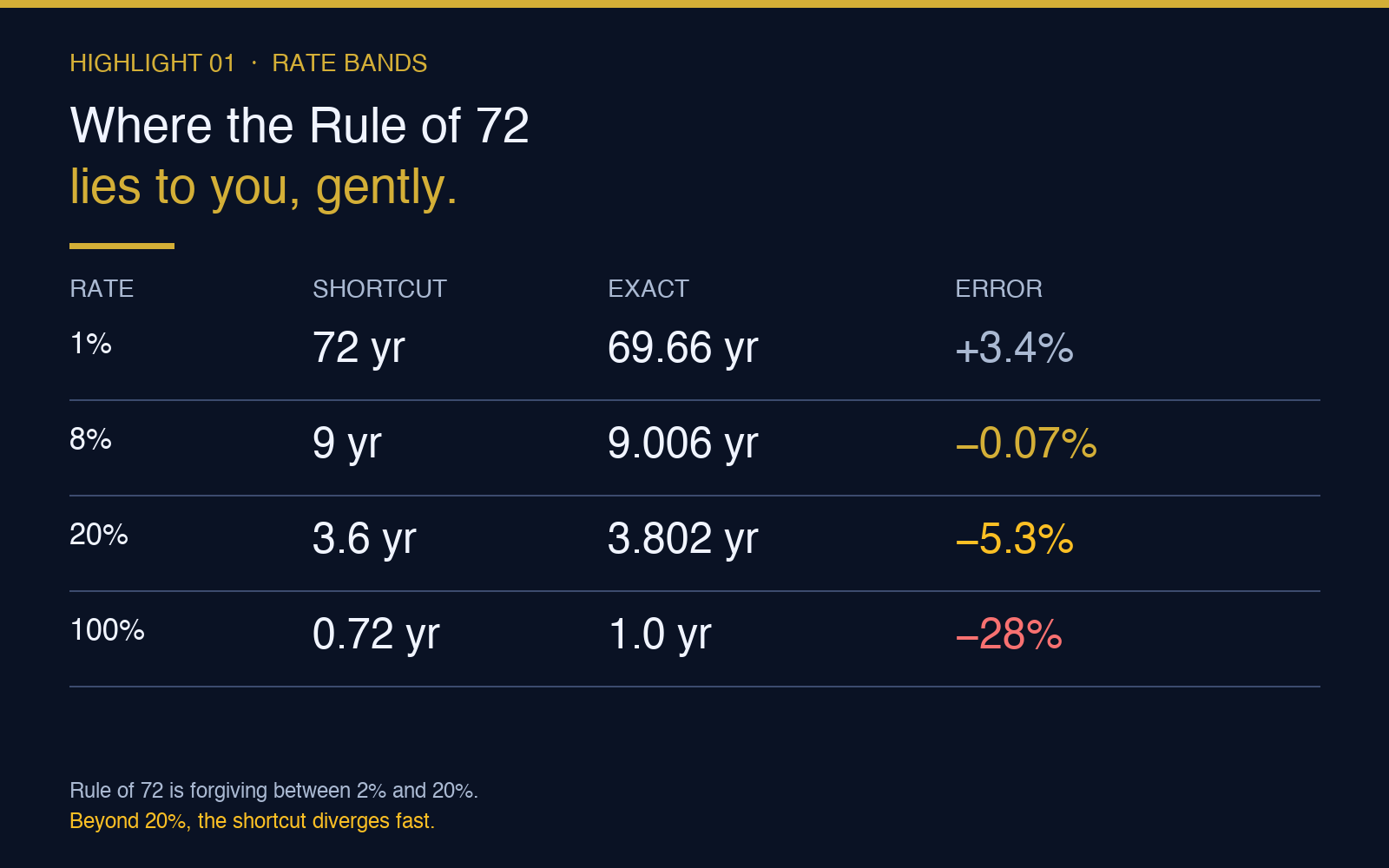
Every approximation has a rate band where it lies. The Rule of 72 lies gently — under five percent error between roughly two percent and twenty percent annual return — and then it stops being gentle fast.
At 1 percent, the shortcut says 72 years. The exact answer is 69.66 years. The shortcut overshoots by 3.4 percent. In a context where you are choosing between two savings accounts, that overshoot is harmless.
At 8 percent, the shortcut says 9 years. The exact answer is 9.006 years. The shortcut undershoots by 0.07 percent — practically zero. This is the rate band where the rule deserves its reputation.
At 20 percent, the shortcut says 3.6 years. The exact answer is 3.802 years. The shortcut undershoots by 5.3 percent. Now you are starting to misrepresent the timeline.
At 100 percent — yes, the doubling time of a fund that returns its entire value every year — the shortcut says 0.72 years, or about 8.6 months. The exact answer is 1.0 year. The shortcut is off by 28 percent, and you would have known better if you had run the numbers.
The shape of the error curve is not an accident. It comes from the fact that ln(1 + r) is well approximated by r when r is small, and diverges from r as r grows. The shortcut inherits that divergence. The Rule of 72 Calculator exposes it by showing both numbers next to each other, which is more honesty than most retirement calculators will give you.
The rate-adjusted divisors that the slide decks never teach
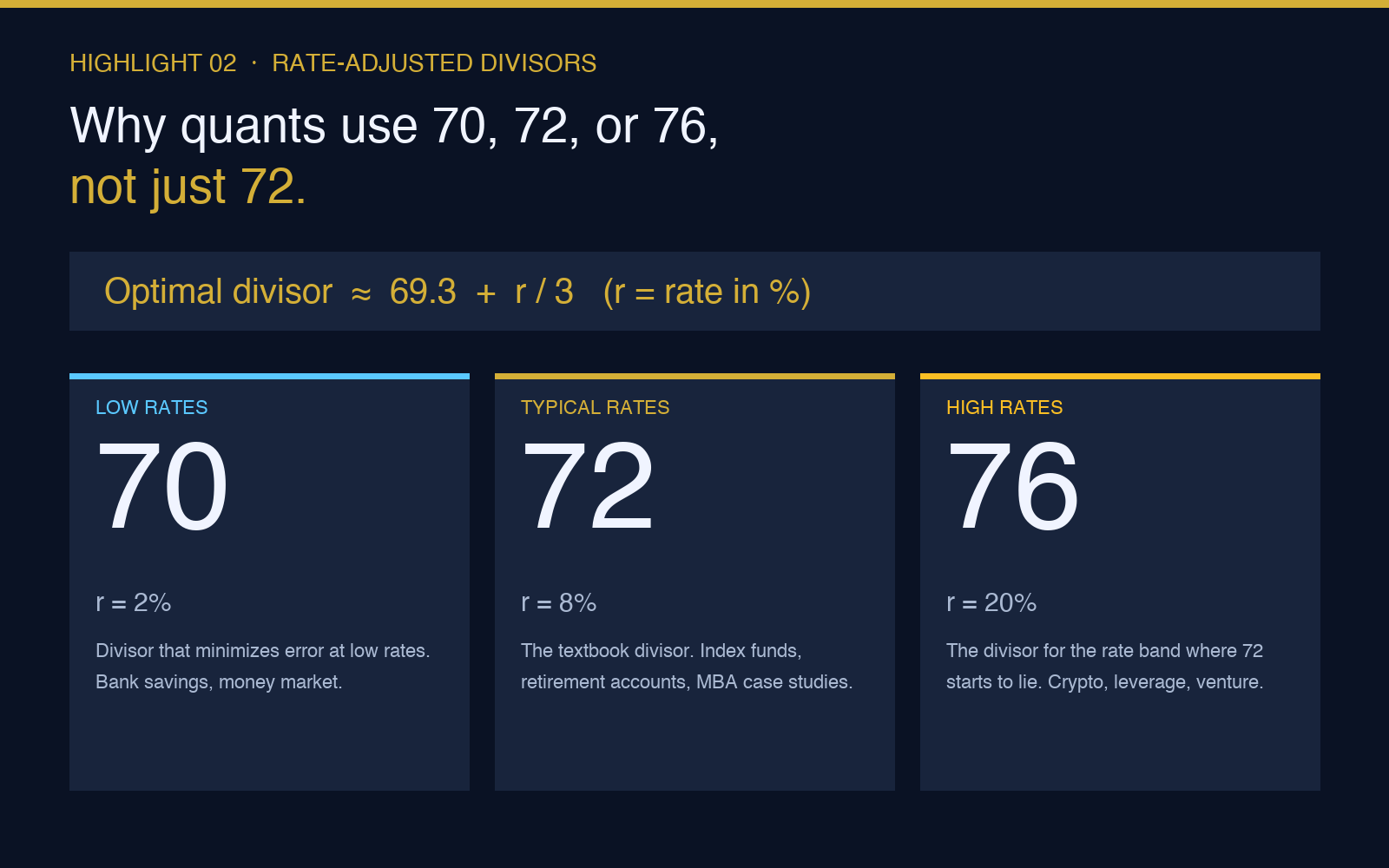
The 72 is not the only divisor that gets used in industry. Quants and finance textbooks quietly switch to 70 for low rates and 73 or 74 for high rates, because the divisor that minimizes error shifts with the rate band. The formula that picks the right divisor for any rate is approximately:
Optimal divisor ≈ 69.3 + r/3 (where r is the rate as a percent)
So at 2 percent, the optimal divisor is 70.0. At 8 percent, it is 72.0. At 20 percent, it is 76.0 — which is why the bare 72-rule starts to lie at exactly the rate the rule was not designed for.
The single most useful number to memorize is not 72. It is 69.3, the natural-log constant. Once you know 69.3 / r% is the exact answer, you can mentally invert any divisor the slide deck hands you. A claim of “9 years at 8 percent” stops being a fact and becomes a check: 69.3 / 8 = 8.66, so the claim rounds to 9 — fine. A claim of “6 years at 12 percent” is 69.3 / 12 = 5.78, so the claim is honest. A claim of “5 years at 14 percent” is 4.95 — also honest. A claim of “4 years at 20 percent” is 3.46 — and now you can spot the rounding.
The number nobody asks about: principal
The Rule of 72, despite its name, does not actually need a principal. Doubling time depends only on the rate. The principal tells you what the doubled amount is, not how long it takes to get there. A thousand dollars at 8 percent doubles in 9.006 years whether the principal is $1,000 or $1,000,000.
This is the part most personal-finance calculators elide. The Rule of 72 Calculator has a principal field for a reason, and the reason is not the doubling time. The reason is the doubled amount — and the compounded amount, which is what the calculator returns when you give it a horizon longer than one doubling period. $1,000 at 8 percent for 18 years is not two doublings; it is four doublings, less the compounding friction of a non-integer number of periods. The exact end balance is $3,996, and the shortcut estimate is $4,000. The shortcut wins because at four doublings the rounding errors cancel.
The principle generalizes. The Rule of 72 is most accurate when the number of doubling periods is an integer or close to one. For non-integer counts, the calculator’s exact-math mode is the only honest answer.
What the calculator shows that spreadsheets do not
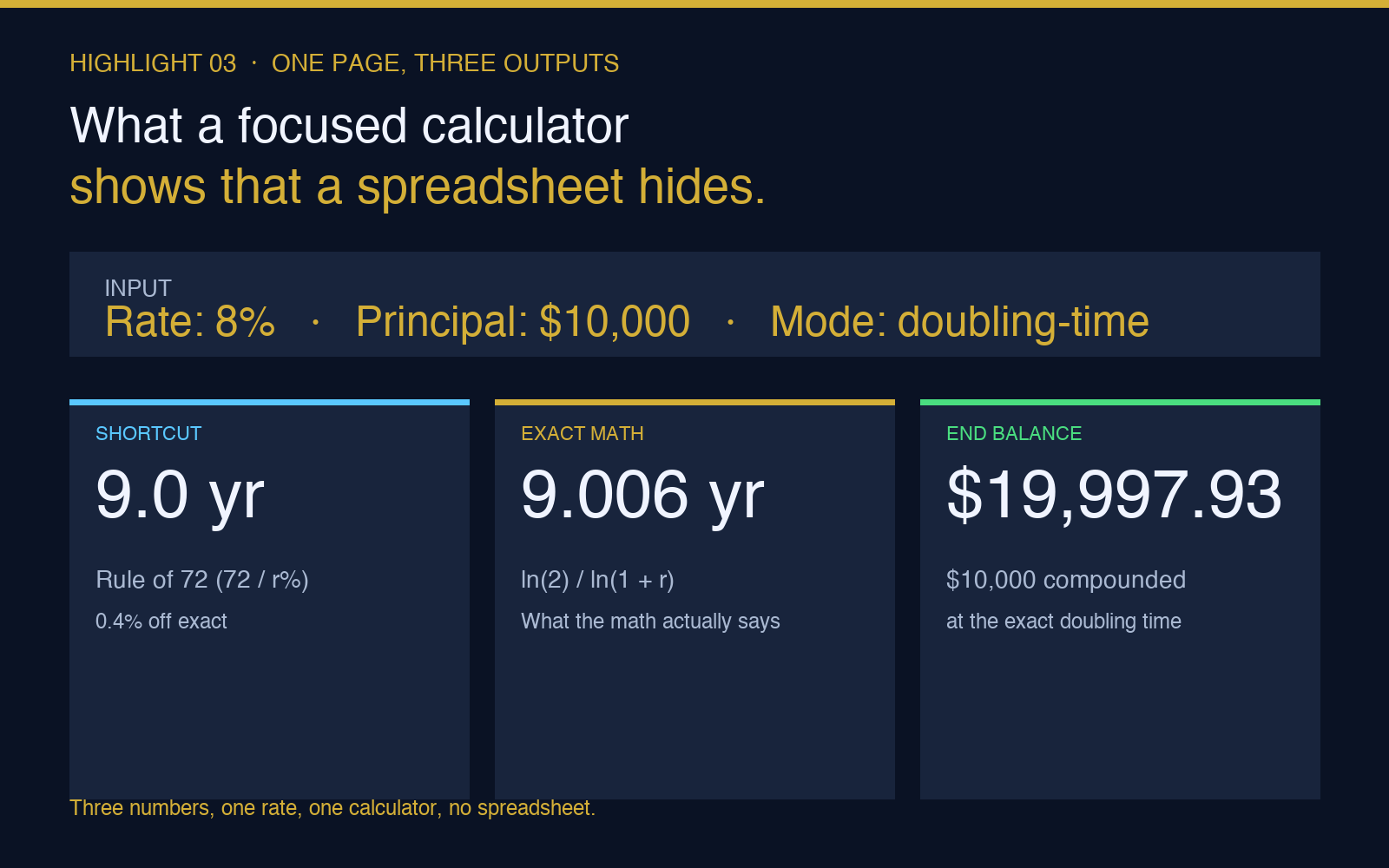
A spreadsheet with =LN(2)/LN(1+0.08) in cell B2 gives you 8.66 years and nothing else. The Rule of 72 Calculator gives you 8.66 years, 9.0 years (the shortcut), and $19,997.93 (the end balance on $10,000 compounded once at that rate) — at the same time, on the same page, from a single input. That is the entire value of a focused calculator: it shows you the relationship between the three numbers, instead of forcing you to build the relationship in three separate cells.
The next time you see a doubling-time claim — in a pitch deck, a financial-planning brochure, or a robo-advisor landing page — pull up the Rule of 72 Calculator, enter the rate, and read all three outputs. The shortcut, the exact answer, and the actual end balance should agree to within the rounding of the rate band you are in. If they do not agree, the claim was either optimistic or you are in a rate band where the shortcut was not designed to be used.
The doubling that never quite arrives
The Rule of 72 assumes the rate is constant. Real investments are not constant. Index funds have good years and bad years. Savings accounts compound monthly, not annually. Real estate has a leverage multiplier the rule does not model. Inflation eats the doubled amount in nominal terms while the rule counts it in real terms. None of this is a flaw in the rule — it is a flaw in the assumption. The shortcut tells you how long a hypothetical fixed-rate instrument takes to double. It tells you nothing about the actual instrument you are holding, which is the one that matters.
That is the practical use of the rule, and the practical use of the calculator. Not to predict the future, but to bound it. If the instrument you hold doubles faster than the rule says it should, something is going right. If it doubles slower, something is going wrong, and you want to know that before the spreadsheet tells you.
The Rule of 72 is a contract between you and your future self. Three numbers — 72, the rate, and the number of years you actually have — determine whether the doubling that shows up on your spreadsheet arrives in your retirement account or only on paper. The shortcut works because the math is forgiving in the range most people save at. Run your real rate and your real horizon through the Rule of 72 Calculator before you trust the round number on a slide deck. The compounding does not care which formula you used. It will be just as exact either way — and that is the one thing on a retirement slide deck that has ever been true.