Your client is paging you at 11:47 PM. Production is fine, but staging broke the moment the API team shipped the response payload rewrite. The new field is there. The new type is there. And yet a downstream service has been quietly receiving 200 OK with a body it cannot parse for the last three hours. Nothing threw. Nothing returned an error. The contract says success, the data says noise. This is the moment an API response contract validator earns its place on your desk.
The job of an API contract validator is to compare what the server says it returns against what the server actually returns. Schema validators do half the job. Static type checkers do the other half. But neither asks the question that catches production surprises: does the live response match the declared schema, end to end, including the optional fields that drift when someone adds a feature flag?
What a response contract validator actually checks
OpenAPI 3.x gives you a way to describe the shape of a response body in components.schemas and then declare under paths.<endpoint>.<method>.responses.<status> which schema applies. The contract is the binding. A response contract validator takes three things and produces one answer:
- The OpenAPI spec — a
openapi: 3.xdocument, in either YAML or JSON form. - The response body — a real JSON payload captured from production, staging, or a recorded test fixture.
- The location — the
pathandstatusCodepair that names which response schema applies.
It then walks the JSON tree, applies the schema rule set, and reports each mismatch as either a missing required field, a wrong type, a value that fails the declared enum, an extra property that the contract said to disallow, or a pattern that does not match. Every finding is paired with a JSON pointer back to the offending node, so a fix is a line edit, not a hunt.
The API Response Contract Validator at elysia tools reads your spec, your response, and your path/status pair, and prints each violation on its own line. The whole loop is fast enough to run on every CI build, and small enough to drop into a curl one-liner for ad-hoc checks against a staging environment.
Five situations where a response check earns its keep
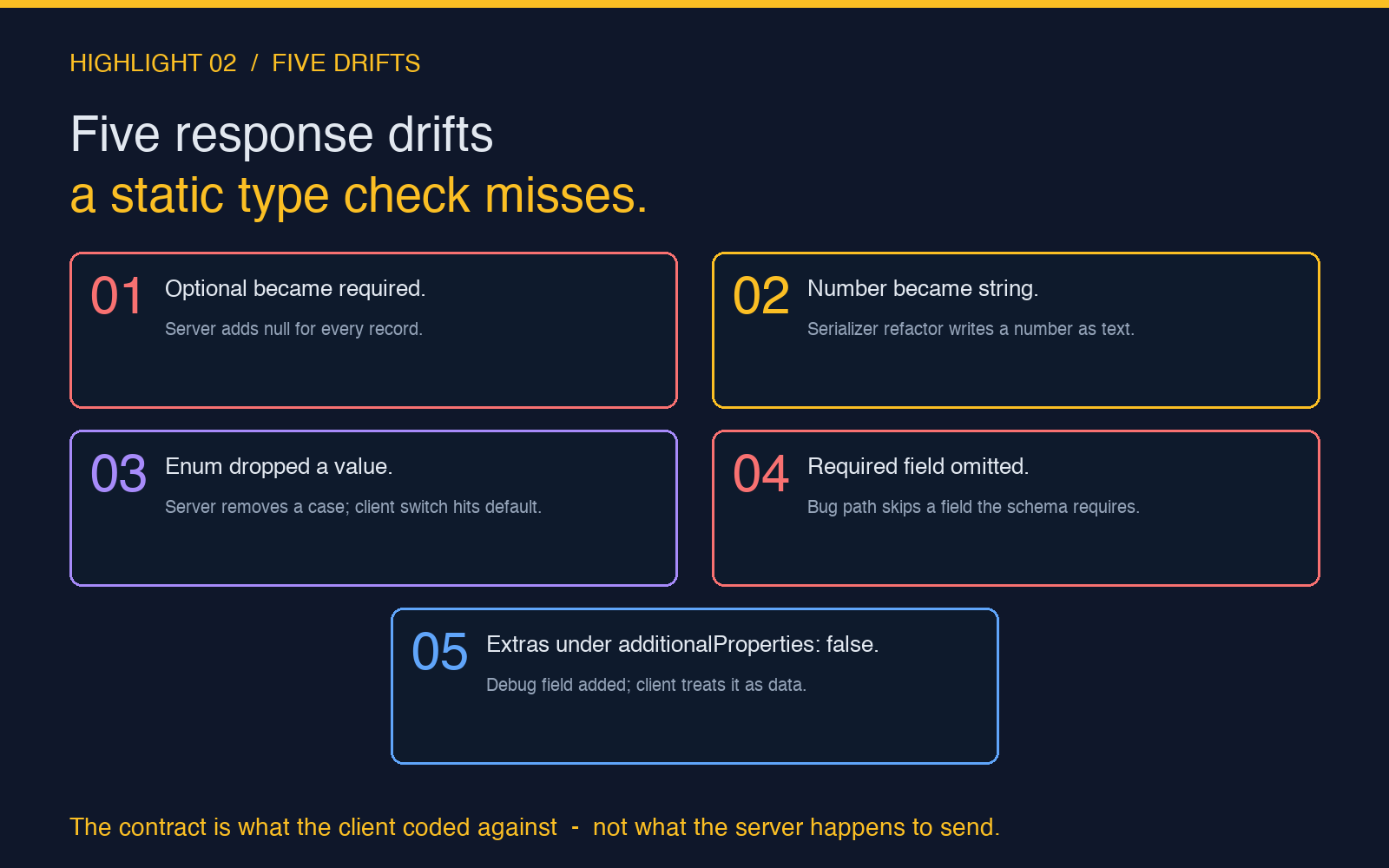
The contract is the thing your client wrote code against. When the contract drifts, the client does not get an error — it gets a quiet ambiguity that shows up three weeks later as a misrouted shipment. The five most common causes are not the obvious ones.
- The optional field became required. A server team ships a new release that returns
"address": nullfor every record. The schema still saysaddressis optional, so the static type check is happy. A client written against a non-nulladdressnow NPEs in production. - The number became a string. A serializer changes from a typed numeric write to a default string write, often during a refactor. The schema still says
type: integer, so the contract claims a number. The response delivers"42". The static type check passes because the field is not in the schema at all. The client crashes onparseInt. - The enum dropped a value. A new release removes a deprecated enum case the schema still lists. The contract says
enum: [A, B, C]. The response delivers"D". Any client branch thatswitches on the enum now hits a default arm that was never tested. - The required field was silently omitted. A fix-path release forgot to populate a field under a specific code path. The schema says
required: [id, name]. The response is missingnamefor a particular input shape. The static test, which only exercises the happy path, is green. The client throws on the first production request that hits the buggy path. - The contract said additionalProperties is false, and the response is full of extras. A monitoring or observability field gets added to the payload for debugging. The schema forbids extras. The static type check never sees the extras. A client that iterates the response object and reads every key now treats the debug field as user data and pushes it into a database column.
None of these are caught by a static schema check on the client side, because the client only checks what it is coded to read. They are caught by a response check on the server side, because the server has the full payload and the full schema in one place.
The four fields that decide whether the check is honest
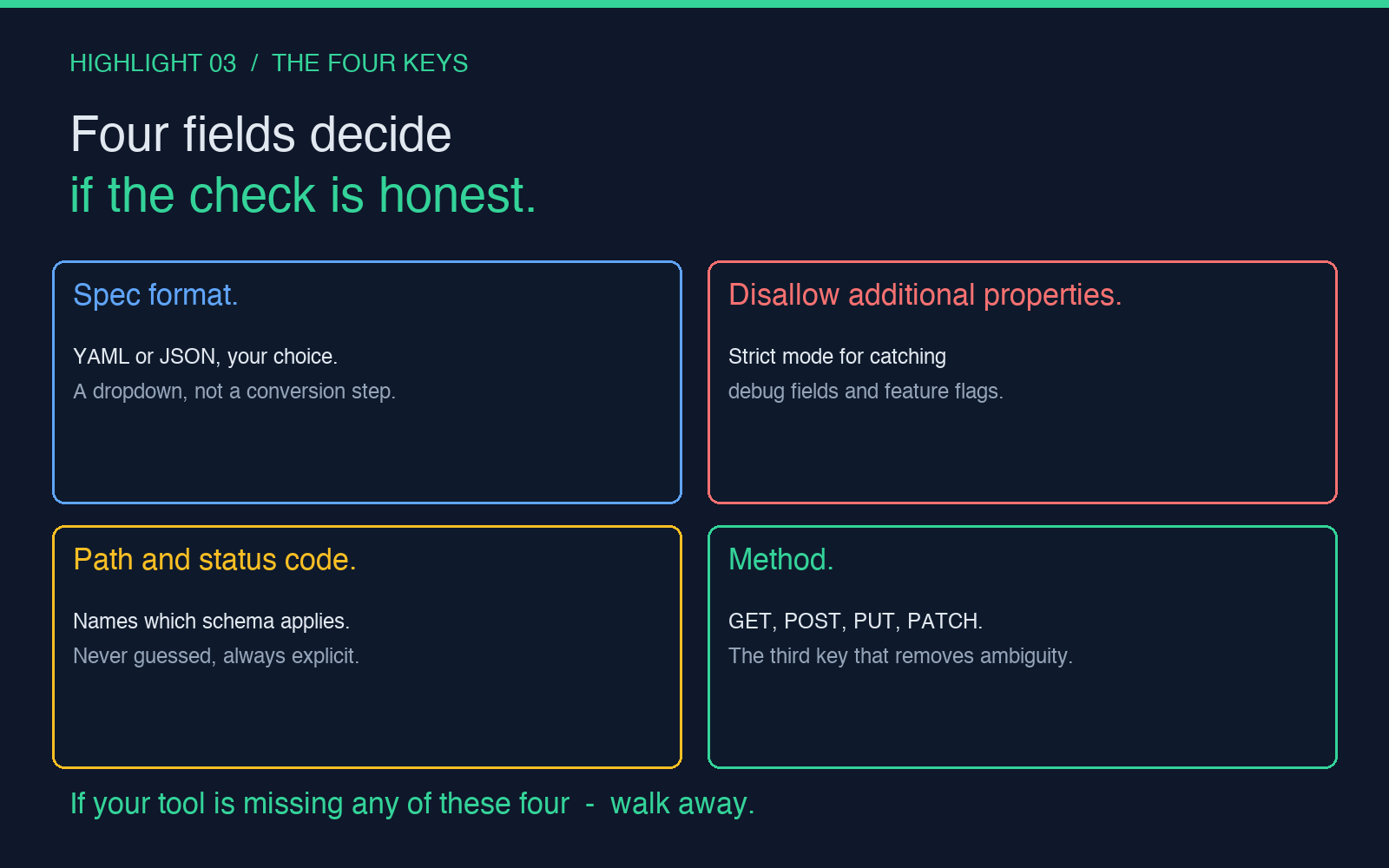
A response contract validator is only as strict as the inputs you give it. The four fields below decide whether the comparison produces a real signal or a polite shrug. Skim any tool’s options panel and look for these.
- Spec format. YAML and JSON are equivalent in OpenAPI 3.x, but a tool that only accepts one forces a conversion step that loses comments and reflows long descriptions. The contract validator accepts both, with a single dropdown to declare which one you sent.
- Disallow additional properties. Most real APIs return at least one field that the schema does not list (debug metadata, an internal trace id, a deprecation banner). The
additionalProperties: falseswitch in the schema is the strict mode. A tool that ignores this setting will report false positives on every response. A tool that honors it, and exposes the switch as a checkbox, lets you opt in to strict mode per check. - Path + status code pair. The schema for a
200 OKis different from the schema for a404 Not Found, which is different from the schema for a422 Unprocessable Entity. The path (/users/{id}) and the status code (200) together name the response. A tool that asks for both, and refuses to guess, prevents the common bug of validating a422body against the200schema. - Method. OpenAPI 3.x lets you declare the same path twice with different methods, and each method can have its own response schema. The method dropdown (
GET/POST/PUT/DELETE/PATCH) is the third key. Three fields together name a single, unambiguous schema. A tool that accepts all three is the only kind worth trusting.
If your tool does not have all four, walk away. You will spend the next debugging session arguing about whether the spec or the response is the source of truth, which is the exact ambiguity the tool was meant to resolve.
How to run a response check in under sixty seconds
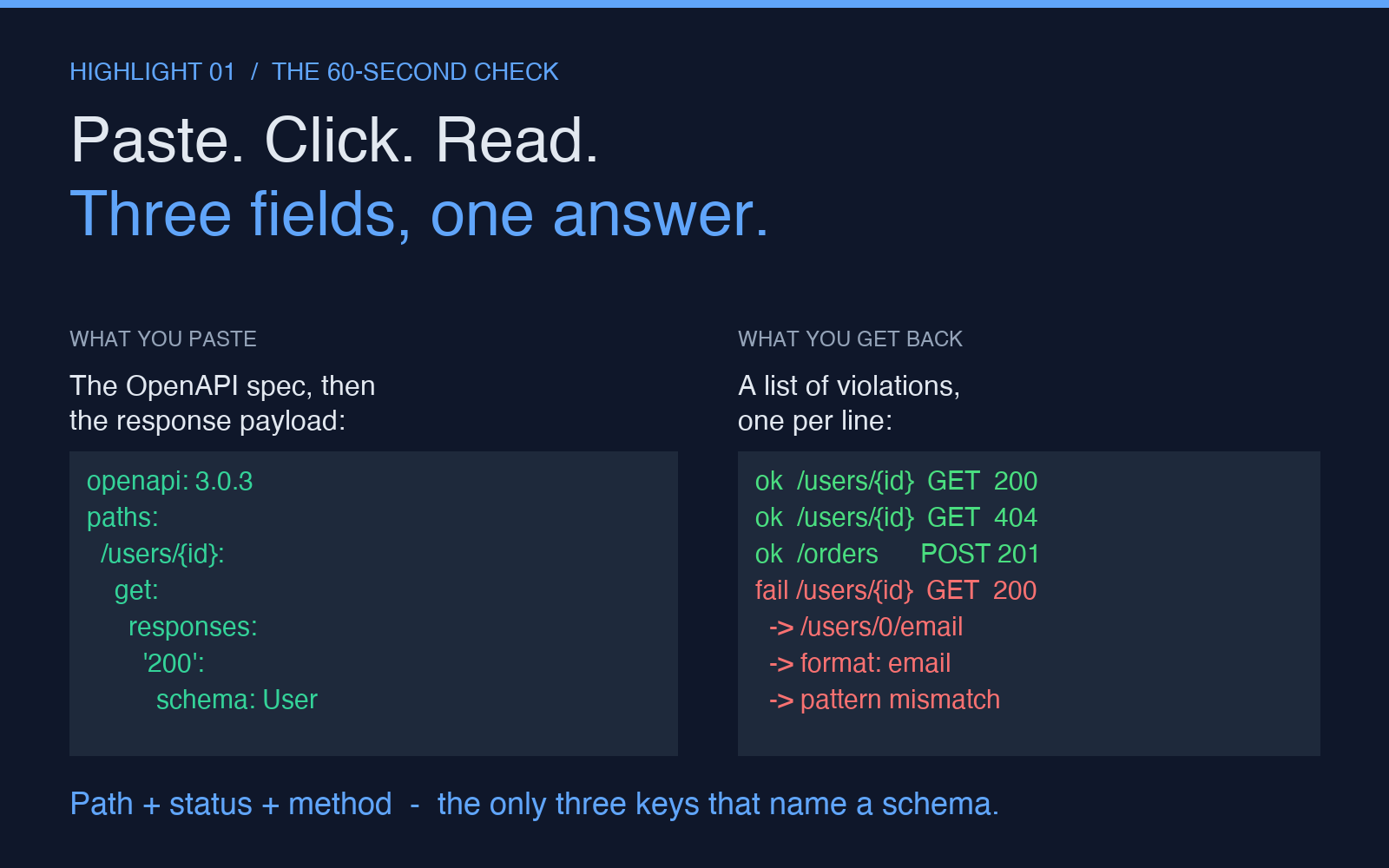
The fastest workflow needs no setup. Paste the spec, paste the response, name the path and the status, click validate. The output is a list of violations. Most of the time the list is empty, which is the answer you wanted. The rest of the time the list is a punch list you can hand to the server team in a single message.
The second-fastest workflow runs the same check on every CI build. The spec is committed to the repo, the response is captured from a contract test fixture, and the validator is a step in the pipeline. The team gets a build break the moment a payload drifts, with a one-line diff that names the field, the rule, and the JSON pointer. That feedback loop is what turns contract testing from a one-off to a habit.
The third workflow runs against staging, on a schedule, against the actual live response. This is the one that catches the optional field that becomes required under a feature flag, the enum case that gets dropped, the silent omission. Schedule it for once an hour, alert on any new violation, and you have a canary that lives between the static type check and the page-at-11:47-PM page.
What the validator is not
A response contract validator is not a test runner. It does not exercise endpoints, does not manage fixtures, and does not compare two response snapshots against each other. The API response diff and semantic analyzer at elysia tools is the tool for the latter job — it takes two payloads and tells you what changed, with a semantic understanding of which changes are breaking and which are additive.
A contract validator is also not a schema generator. If you have a spec and need to draft a new one from a sample payload, the JSON schema generator writes the schema for you, and the OpenAPI to TypeScript generator writes the client types after the spec is signed off. A spec is the upstream artifact; the contract check is the verification that the server is still holding up its end of the deal.
It is also not a breaking change detector. That is the API breaking changes detector and migration planner, which diffs two OpenAPI specs and tells you which endpoints need a versioned release. Use it before a deployment; use the response check after.
The case for running it on every build
The cheapest contract check is the one that runs every commit. The most expensive contract violation is the one you find in production. The ratio between the two is the entire pitch for a response contract validator. The API Response Contract Validator runs in a browser, in a curl, and in a CI step. Pick the surface that fits your team, and run it on every change that touches the spec or the handler.
The contract is the agreement between the team that writes the server and the team that writes the client. The agreement is meaningless without a check that both sides still hold up their end. A response contract validator is that check, expressed as a one-line command and a list of violations. The 11:47 PM page is what you avoid.
Explore more tools at elysiatools.com.