Most people type their height into a body fat calculator, fill in a couple of measurements, and trust the number that comes out. The number they trust is determined by exactly three things — and almost everyone gets at least one of them wrong. The US Navy method, the same one built into Elysia Tools’ Body Fat Calculator, is deceptively simple: waist, neck, and (for women) hip. That is the entire input surface. But each of those three measurements has a measurement-tape rule that changes the result by 4 to 6 percentage points, and most calculators never warn you which one you just violated.
This is a walk-through of the three measurements and the three rules that decide whether your reported body fat percentage is accurate to within a point or quietly off by half a body category.
The three numbers the US Navy formula actually uses
The full Hodgdon-Beckett US Navy formula is one expression:
BF% = 495 / (1.0324 - 0.19077 × log₁₀(waist - neck) + 0.15456 × log₁₀(height)) - 450
For women the formula takes one more input, hip, and uses a different denominator:
BF% = 495 / (1.29579 - 0.35004 × log₁₀(waist + hip - neck) + 0.22100 × log₁₀(height)) - 450
Three measurements. No body weight. No age. No activity level. The Navy designed it this way on purpose: the four common circumference sites (neck, waist, hip, and the implicit height) are enough to estimate body density because the formula was derived from hydrostatic weighing on a large military population, and the resulting equations were tuned to match underwater weighing within roughly 3-4 percentage points.
Here is what those three numbers produce for three concrete bodies. Try the same inputs in the calculator:
- Male, 175 cm, waist 80 cm, neck 38 cm → 12.9% body fat (Athletes category). Lean, not extreme.
- Male, 178 cm, waist 92 cm, neck 39 cm → 20.9% body fat (Average). Same height, 12 cm wider at the waist, the formula drops you a full category.
- Female, 168 cm, waist 78 cm, neck 33 cm, hip 102 cm → 31.1% body fat (Average). The hip is what makes the women’s formula work — without it the formula will refuse to compute and tell you so.
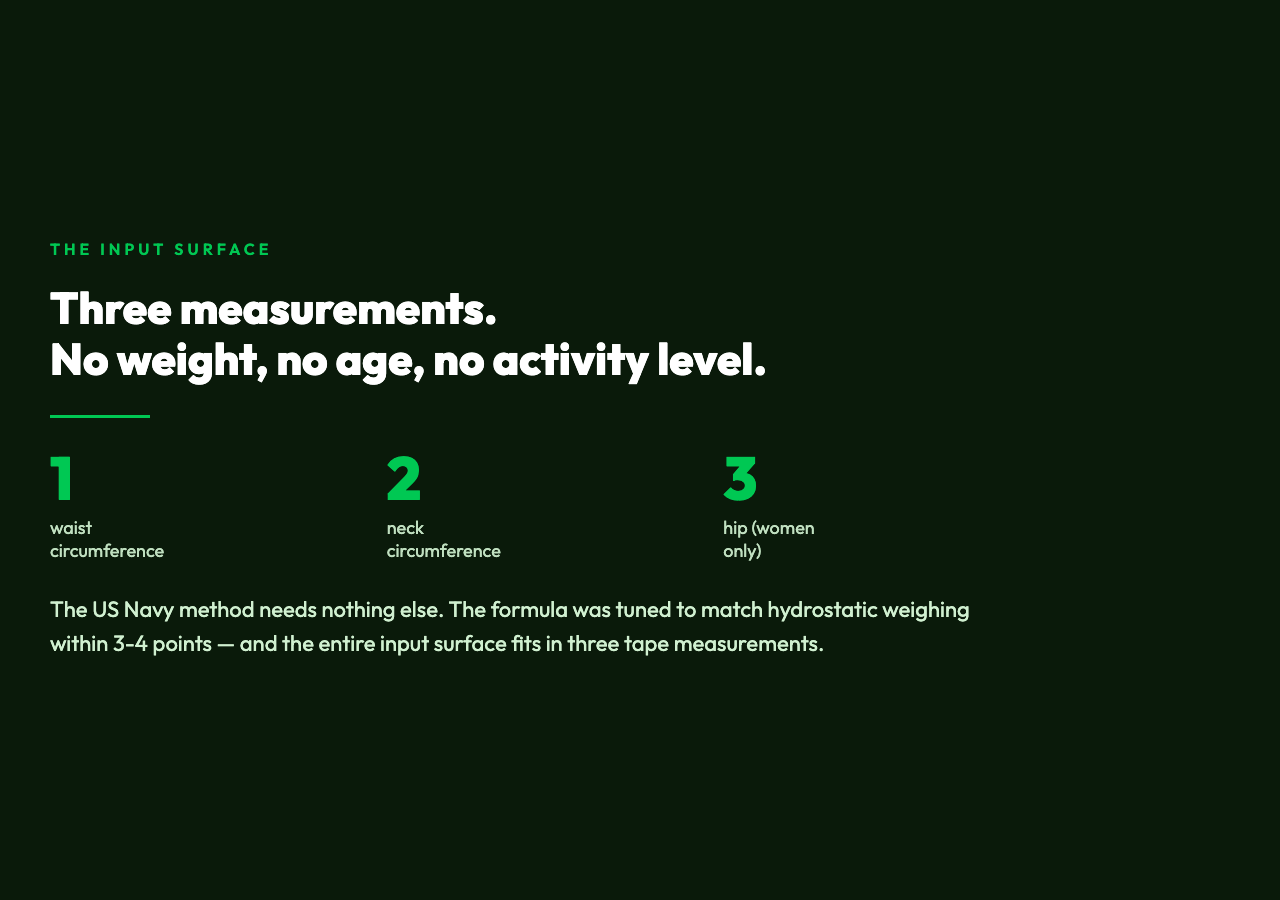
Notice what is missing: weight is not there. The formula does not care if you weigh 65 kg or 95 kg — only the ratio of waist to neck, divided by height, enters the equation. This is what makes the calculator both useful (it works at home with a tape measure) and dangerous (it is also unforgiving about how the tape is positioned).
Where the tape goes: the three rules almost everyone breaks
Each measurement has a single official Navy measurement protocol. Deviating from it shifts the result. None of the online calculators warn you about this — they treat waist: 80 as a number, not a number-collected-a-certain-way.
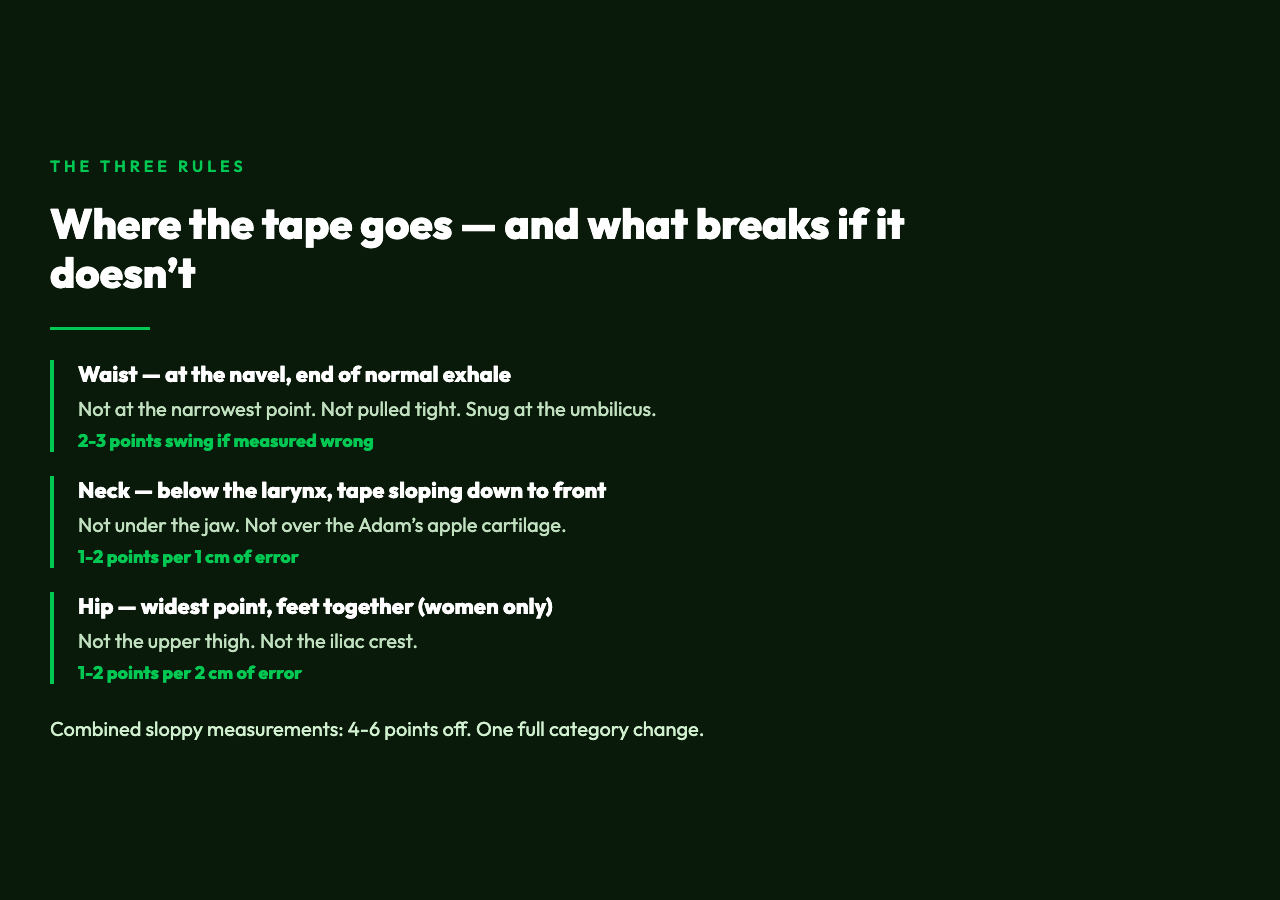
Waist — at the navel, after a normal exhale, without sucking in. The standard is horizontal, around the torso at the level of the umbilicus (belly button), with the tape snug but not compressing the skin, taken at the end of a normal exhale. The most common error is measuring at the narrowest point of the torso, which is usually 2-3 cm above the navel for men and 1-2 cm below for women. That single move can drop a reported body fat percentage by 2-3 points. The second most common error is pulling the tape tight enough to compress soft tissue, which under-measures the waist and the formula then returns a leaner-looking number than reality.
Neck — below the larynx (Adam’s apple), tape sloping slightly down to the front. The tape goes around the neck just below the Adam’s apple, with the front of the tape sloping slightly downward from back to front. The common error is measuring too high (under the jaw) or too low (over the larynx itself, where the cartilage bulges). A neck measurement that is 1 cm too high makes the formula think your neck is bigger than it is, which makes the waist - neck term smaller, which makes the formula return a higher body fat percentage. The same 1 cm error can shift the result by 1.5-2 points in either direction depending on which way the error goes.
Hip (women only) — the widest point around the buttocks, with feet together. This is the most reliable of the three measurements because there is rarely ambiguity about where the widest point is. The error mode is the opposite of waist: people measure too low (around the upper thigh) or too high (around the iliac crest at the hip bones). A 2 cm error on the hip moves the female formula by 1-2 points, less than waist but still significant.
Combined, a sloppy set of measurements can move the reported body fat by 4-6 points. That is the difference between “Fitness” and “Average” in the output category — a full classification change from three small errors.
The waist-to-neck ratio: the single number that matters most
If you only look at one term in the formula, look at waist - neck for men and waist + hip - neck for women. It is the only place waist appears, and it is also the only place neck appears. The formula is essentially a transformation of that one difference.
That means two men with the same height and the same waist-to-neck difference will get the same body fat percentage, regardless of their actual weight. A 70 kg man and a 95 kg man with the same waist-to-neck ratio are reported as having the same body composition — because the Navy method was designed to detect distribution of fat (visceral vs. subcutaneous) more than total mass. A naturally thick-boned person with low body fat and a thin-boned person with higher body fat can land at the same number.
What height does in the formula is act as a normalizer. Taller people tend to have larger circumferences in absolute terms, so dividing by log₁₀(height) scales the result. The constant 0.15456 was chosen so that the formula agrees with hydrostatic weighing across a population sample. Change the height by 10 cm and the formula moves by roughly 1.5 points.
Three categories the calculator will return, and where the boundaries are
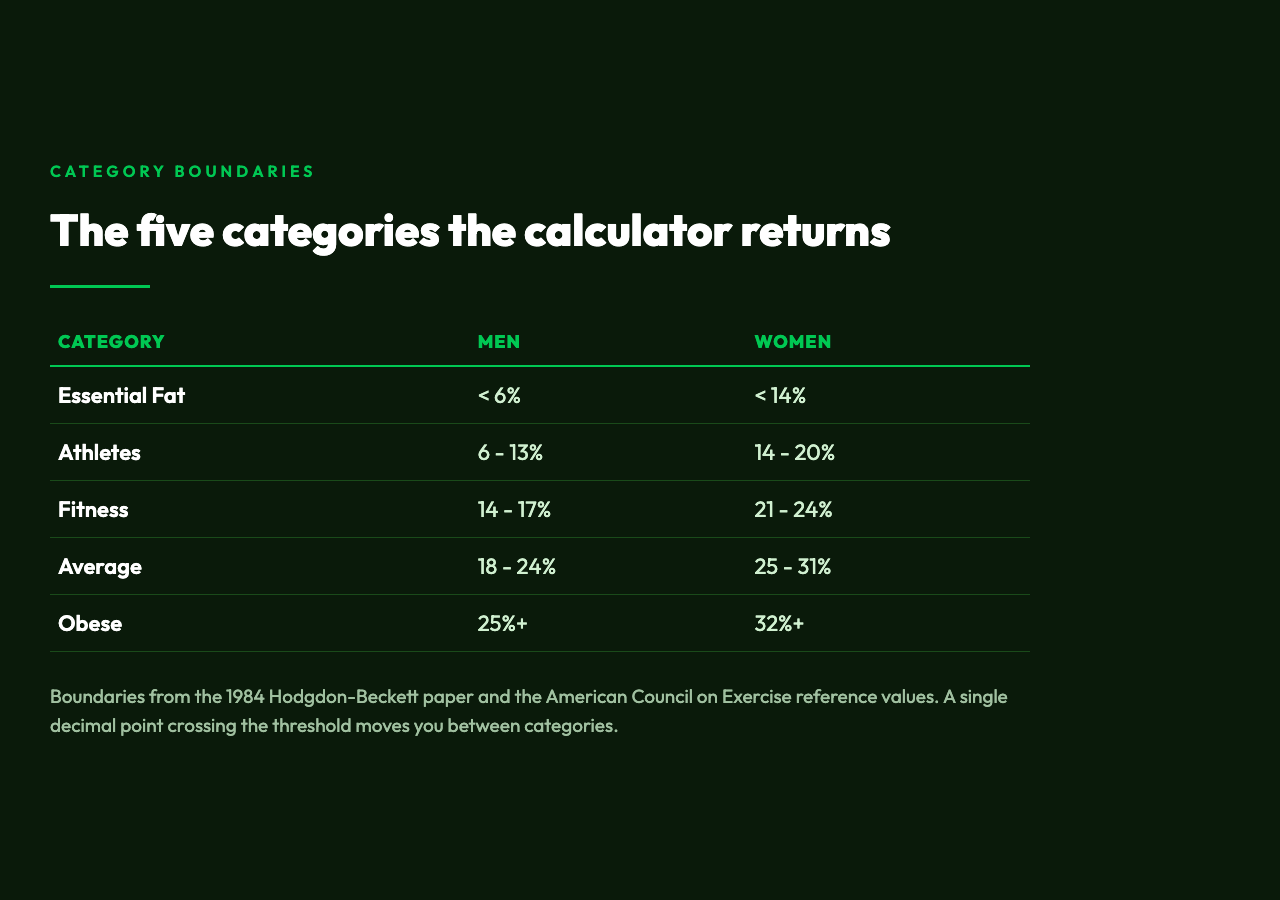
The output is not just a number — the calculator also classifies the result into one of five categories, with different boundaries for men and women:
- Essential Fat — below 6% for men, below 14% for women. The minimum fat needed for hormonal function. Going below this for an extended period has documented health consequences.
- Athletes — 6-13% for men, 14-20% for women. Typical of trained athletes in lean sports. Visible abdominal definition, vascularity in arms.
- Fitness — 14-17% for men, 21-24% for women. Lean, some muscle definition, healthy range for most active people.
- Average — 18-24% for men, 25-31% for women. The statistical center of the population. Not unhealthy, but the typical “room for improvement” range.
- Obese — 25% and above for men, 32% and above for women. Elevated health-risk territory; the calculator’s description will mention consulting a healthcare provider.
The boundaries are not arbitrary — they are based on the original Hodgdon-Beckett 1984 paper and the American Council on Exercise body fat categorization. The calculator uses the same boundaries, so a 17.9% reading for a man is “Fitness” and 18.0% is “Average” — a single decimal point crossing the threshold.
What the formula will not tell you
The US Navy method has three known blind spots that the calculator output does not flag:
- It underestimates body fat in very lean people. The formula was tuned on a population sample that did not include bodybuilders at 5-6% body fat, so the lowest decile tends to read a couple of points high. A 6% reading is probably closer to 8% in reality.
- It overestimates body fat in endomorphs with thick waists and necks. If you naturally carry weight around both waist and neck proportionally, the ratio stays stable, but the formula reads the absolute difference as “more abdominal fat” because it cannot distinguish between bone/muscle and fat at those sites.
- It does not separate visceral from subcutaneous fat. Two men with the same waist measurement can have very different visceral fat levels. The formula treats the waist as a single number, so it cannot tell you about the metabolically dangerous deep abdominal fat specifically.
For a quick home check that is accurate to within 3-4 percentage points, the method is fine. For tracking body composition changes over time (cut, bulk, recomposition), the waist-to-neck ratio itself is a more reliable signal than the absolute body fat number — because the systematic error stays roughly constant for one person as they change.
Using the calculator: the inputs that matter
Three fields drive the entire calculation. The defaults (waist 80, neck 38, height 175, hip 100) are reasonable starting points for an average man, but the calculator does not validate that your inputs are self-consistent. A waist of 40 cm (the minimum) and a neck of 40 cm would give waist - neck = 0, which makes the log term undefined and returns a calculation error. The calculator catches this and returns “Body fat calculation failed” — the only signal you will get that your inputs were invalid.
For women, the hip field is required and has no default submission without it — the formula throws an explicit error. So if you are getting a calculation error on a female input, the first thing to check is whether the hip field is empty.
For a full read of the formula, the category boundaries, and the underlying 1984 paper the calculator is based on, see the Body Fat Calculator (US Navy) tool page — the source uses the same constants as the published Hodgdon-Beckett equations, and the category boundaries match the American Council on Exercise reference values. The calculator returns a JSON object with the percentage, category, and an estimated fat/lean mass split based on a 70 kg reference weight, which is useful for setting body recomposition targets without needing a scale.
The three numbers rule everything. Measure them carefully and the formula is accurate enough to track recomposition over months. Measure them sloppily and you are just watching noise.