You bought a new eyepiece, slid it into the focuser, and pointed the scope at the Andromeda Galaxy. The view came up dim and small. You zoomed in with a Barlow. It got dimmer. You tried a 6mm planetary eyepiece at 333×, the image broke apart into mush, and you spent the next two nights wondering whether the telescope you saved six months for was the wrong one. It wasn’t. The eyepiece math was wrong.
Telescope choice is geometry, not marketing. Once you understand what magnification actually does, what true field of view means, and why exit pupil is the silent killer of deep-sky views, picking eyepieces becomes a 30-second calculation. The Telescope Field of View Calculator at Elysia Tools handles all seven variables at once — aperture, focal length, eyepiece focal length, apparent field, units, target, and distance — and overlays the result against reference discs of the Moon, Jupiter, and Andromeda. This article walks through the four optics rules every observer should internalize before the next eyepiece purchase.
1. Magnification is the least interesting number on the box
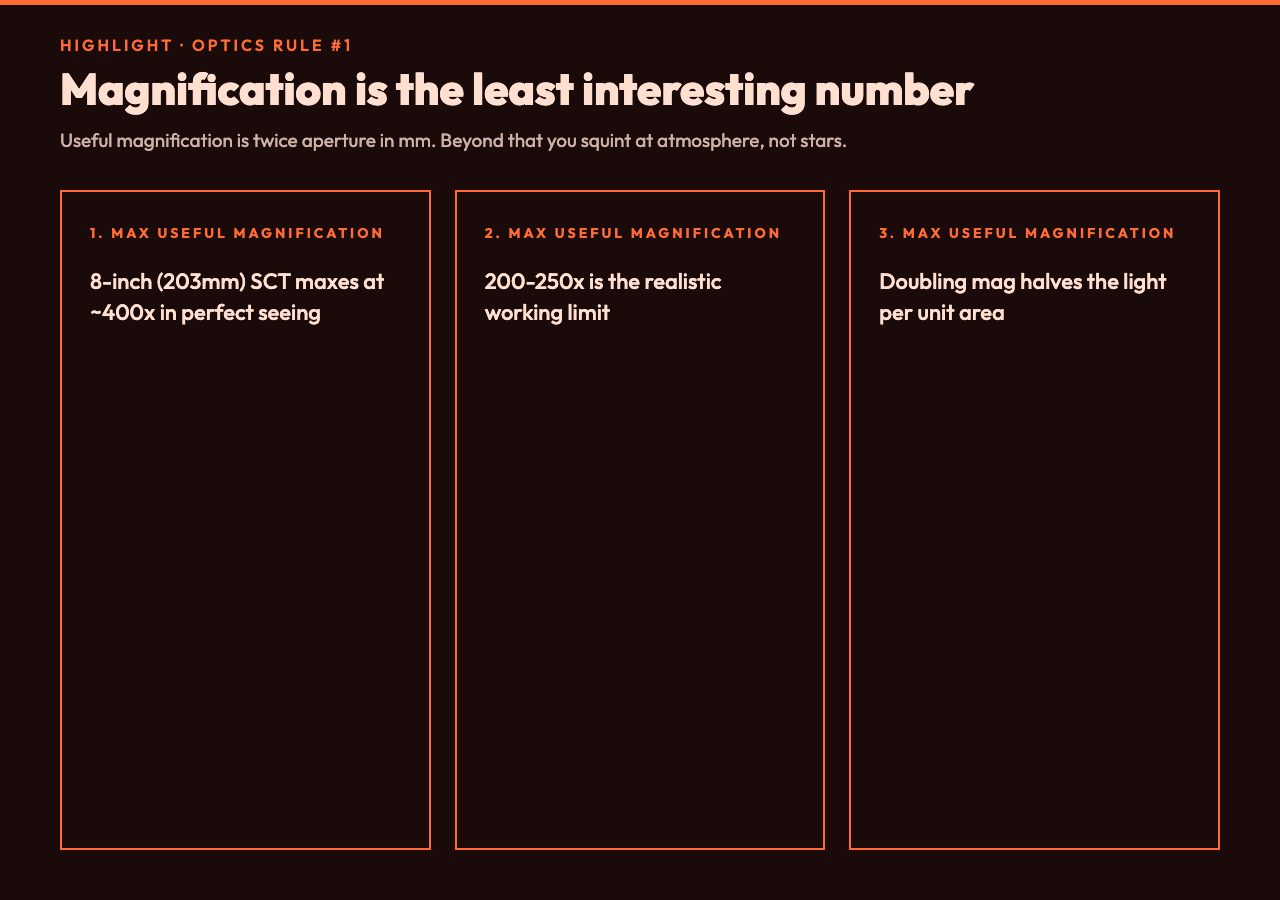
Every telescope ad shouts “675× power!” That number is focal length divided by eyepiece focal length, which is trivial to inflate. Doubling the magnification halves the light per unit area on your retina, doubles the visible抖动 (atmospheric seeing), and reveals every optical imperfection in the scope. The useful magnification ceiling for any telescope is roughly twice its aperture in millimeters: a 203mm (8-inch) scope maxes out around 400× on a perfect night, and 200-250× is a more realistic working limit. Beyond that you are squinting at air, not at stars.
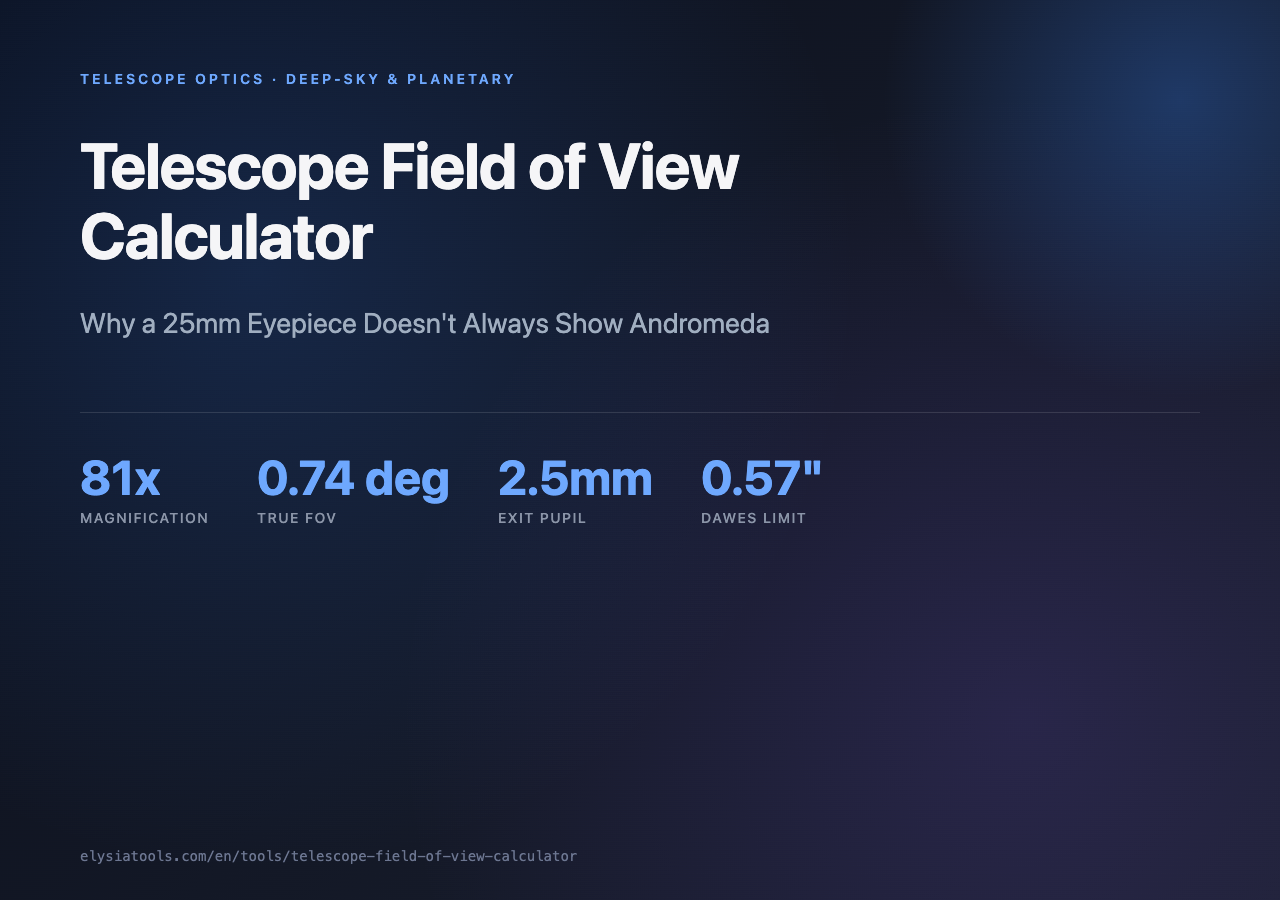
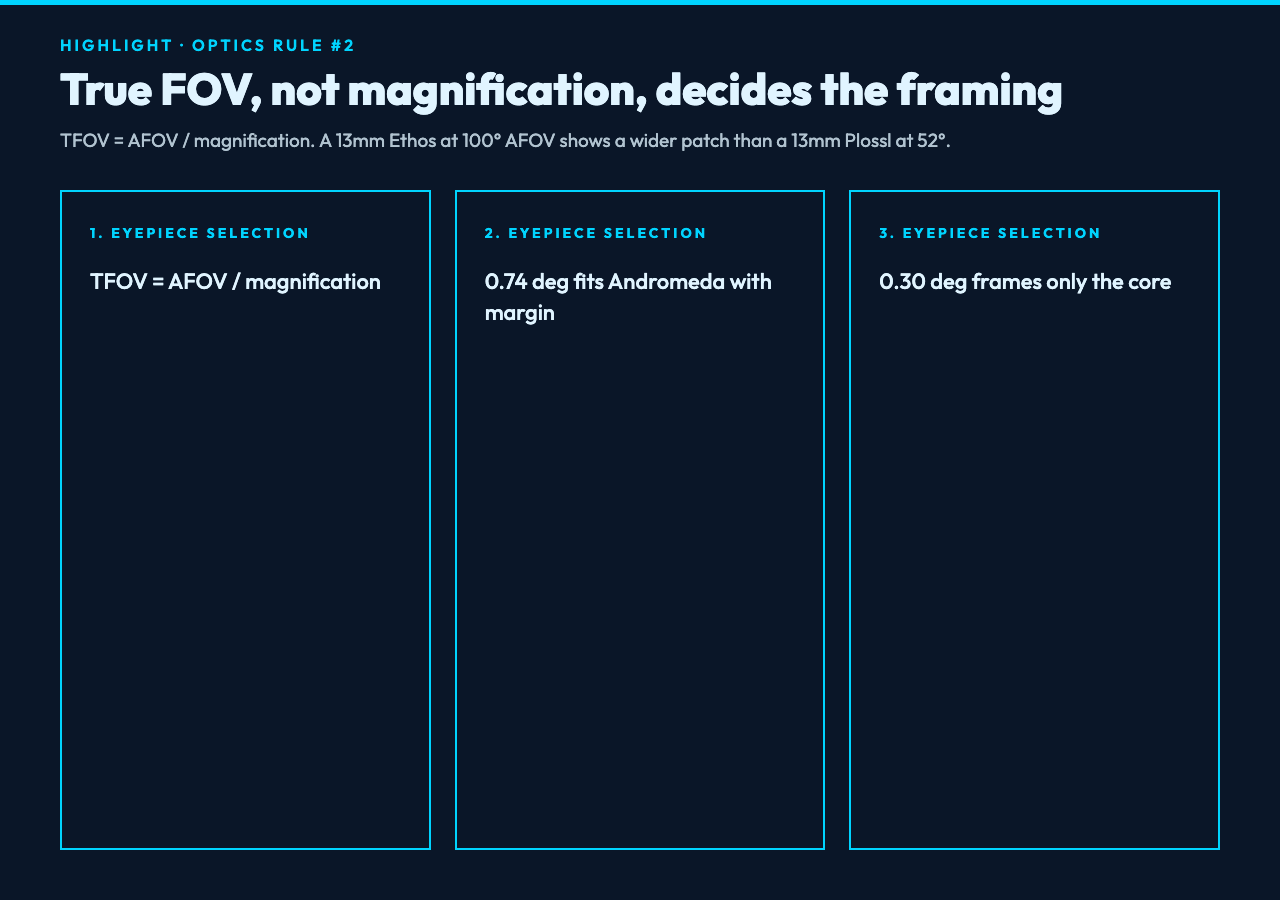
The magnification a calculator returns is also the denominator for the number that actually matters: true field of view. A 25mm Plossl in a 2032mm focal length scope at 81× with a 60° apparent field gives a true field of 0.74°. That’s wide enough to fit the full disc of the Andromeda Galaxy with a thin margin. A 10mm eyepiece at 203× narrows that to 0.30°, which frames the galaxy’s core but cuts off the outer arms. Same scope, same night, totally different target. The Telescope Field of View Calculator draws both overlays against real reference discs so you can see the framing before you climb the ladder.
2. True field of view, not magnification, decides what you see
True field of view (TFOV) is the angular slice of sky the eyepiece shows you, in degrees. The formula is simple: TFOV = AFOV / magnification, where AFOV is the eyepiece’s apparent field of view (typically 50° for a Plossl, 68° for a wide-field, 82° for a premium ultra-wide, 100° for an Ethos-class eyepiece). Eyepiece focal length sets magnification; AFOV sets how much of that magnified patch you can actually see.
This is why a 13mm Ethos (100° AFOV) at 156× shows a wider field than a 13mm Plossl (52° AFOV) at the same magnification. The numbers in catalogs make it sound like wider eyepieces are gimmicks; the math makes it obvious they are not. To convert between degrees and arcminutes when reading these numbers, the Degrees to Arcminutes and Radians to Degrees converters are useful companions — Dawes limit and Rayleigh resolution come back as arcseconds, and the eyepiece AFOV comes back as degrees, and bridging the two manually is where most amateurs get stuck.
3. Exit pupil: the silent rule for deep-sky
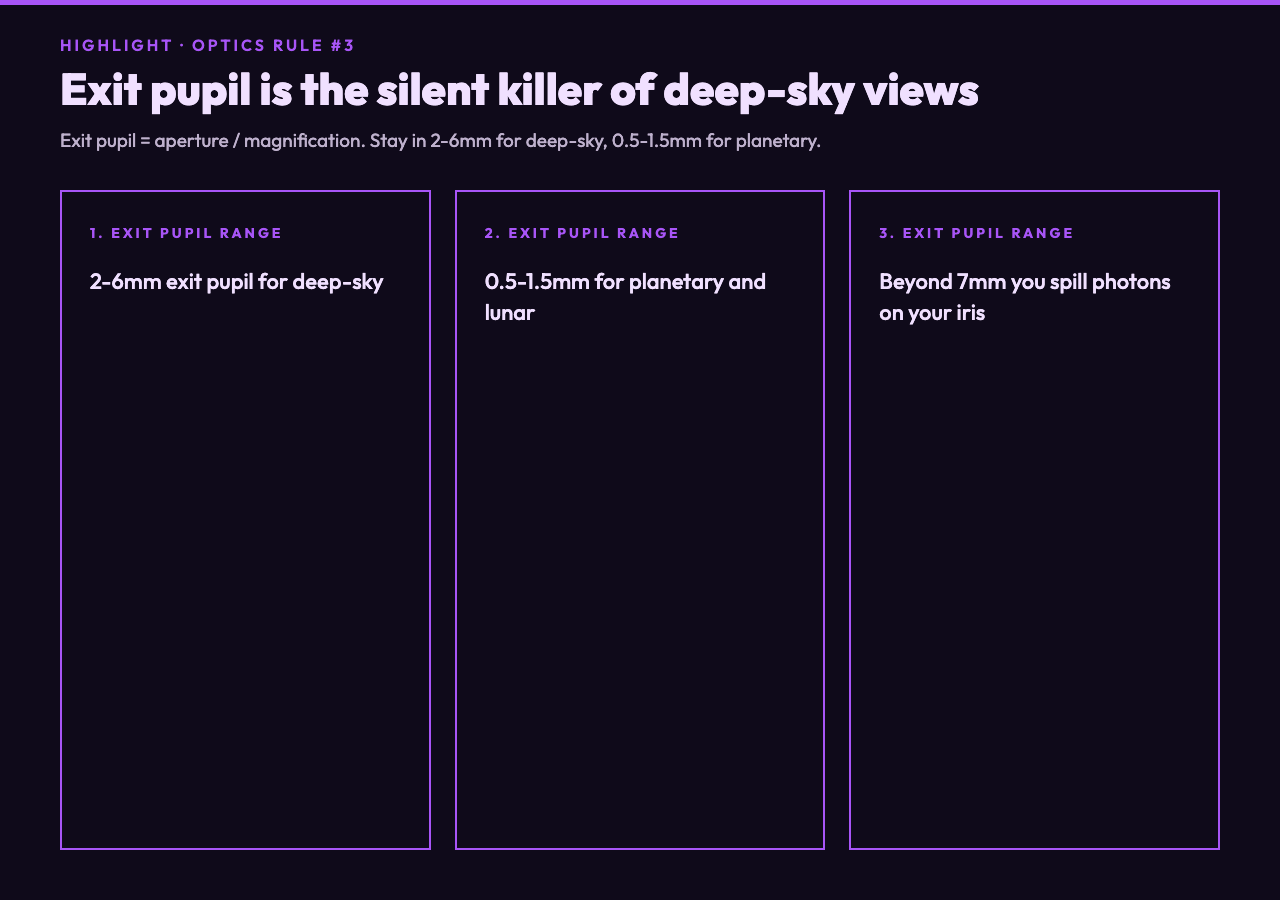
Exit pupil is the diameter of the light beam leaving the eyepiece, measured in millimeters. The formula: exit pupil = aperture / magnification, or equivalently eyepiece focal length / focal ratio. The human eye’s dilated pupil maxes out around 6-7mm for a young observer under dark skies and shrinks to 4-5mm by age 50. Anything larger than your eye’s pupil is wasted light.
For deep-sky, the rule of thumb is an exit pupil between 2mm and 6mm. Below 2mm and the image gets dim and the eye’s floaters become visible. Above 6mm and you are literally spilling photons onto your iris that never enter your pupil. For planetary and lunar observation, exit pupils between 0.5mm and 1.5mm are fine — you want every photon concentrated. The same 2032mm/203mm SCT paired with a 25mm eyepiece at 81× gives a 2.5mm exit pupil (deep-sky friendly); with a 6mm eyepiece at 339× it drops to 0.6mm (planetary-friendly). One scope, two completely different observing modes, and the only variable that flipped was eyepiece focal length.
4. Dawes limit and Rayleigh resolution: when “close” stops mattering
Every telescope has a hard resolution limit set by diffraction. Dawes limit (for visual double stars) is 116 / aperture (mm) in arcseconds; Rayleigh is slightly more conservative at 138 / aperture (mm). An 8-inch scope resolves at 0.57″ (Dawes) or 0.68″ (Rayleigh). That’s the smallest angle between two stars you can ever split under perfect seeing.
In practice, atmospheric seeing limits amateur scopes to 1-2 arcseconds on a typical night, so Dawes is the theoretical ceiling. The calculator shows both numbers; on most nights you are operating at 2-3× the seeing limit, not the diffraction limit, which means chasing ever-smaller exit pupils past 1mm rarely reveals more planetary detail — it just amplifies the atmosphere. The ratio aperture / focal length also gives focal ratio (f-number), which dictates exposure time for astrophotography: f/10 SCTs need long exposures, f/4 Newtonian astrographs gather light four times faster for the same exposure.
Planning a session: target-specific framing
The same scope behaves differently depending on what you point it at. Deep-sky objects (Andromeda at 3° × 1°, Orion Nebula at 1.1° × 1.0°, Veil Nebula at 3° × 3°) want wide-field eyepieces in the 0.7°-1.5° true-field range, so an exit pupil around 3-5mm keeps the background sky dark. Planetary observation (Jupiter at 40″, Saturn at 18″, Mars at 25″ at opposition) wants long focal length eyepieces in the 0.3°-0.5° true-field range, pushing magnification high. Lunar observation sits between, with the half-moon at 0.5° across fitting comfortably in most moderate eyepieces.
Pairing the FOV calculator with a Constellation Finder for planning what’s up tonight and a Moon Phase Calculator for lunar observing windows turns the session from guesswork into a checklist. You decide the target, choose the eyepiece that frames it, and verify the exit pupil is healthy for your age and the sky darkness. That is the entire amateur observing workflow, and it does not require any eyepiece math on a napkin.
Terrestrial use: spotting scopes are telescopes too
The same optics formulas apply to terrestrial spotting scopes — birding, target shooting, surveillance. Set the target to “terrestrial,” enter the distance, and the calculator returns a linear width in meters across the field at that distance. An 80mm refractor at 480mm focal length with a 10mm eyepiece at 65° AFOV gives 48× magnification and a 1.35° true field; at 1000m that covers a 23.6m-wide patch. Useful for confirming whether that distant shape on a ridgeline is a deer or a person without walking the kilometer.
For long-distance terrestrial viewing the same exit-pupil rule applies, but here the eye’s daylight pupil (2-3mm) is the constraint rather than the dilated dark-sky pupil. Picking eyepieces that put you near 2-3mm exit pupil in daylight gives the sharpest, brightest image; going below 1mm just turns the image dim without adding detail.
In the end
In the end, choosing a telescope eyepiece is not about chasing magnification. It’s about choosing the right combination of aperture, focal length, and apparent field for the object you want to see. Use the Telescope Field of View Calculator to dial in true field of view, exit pupil, and Dawes limit before you spend money on eyepieces, and pair it with planning tools that respect real-world geometry. Explore more tools at elysiatools.com.