A securities file can look immaculate and still carry the wrong instrument. Have you ever watched one mistyped digit survive an import because every row had seven characters and every column passed its type check? The file is tidy, but the identifier is wrong. SEDOL validation catches that contradiction early: format, alphabet, and checksum expose the bad value before reconciliation has to explain it.
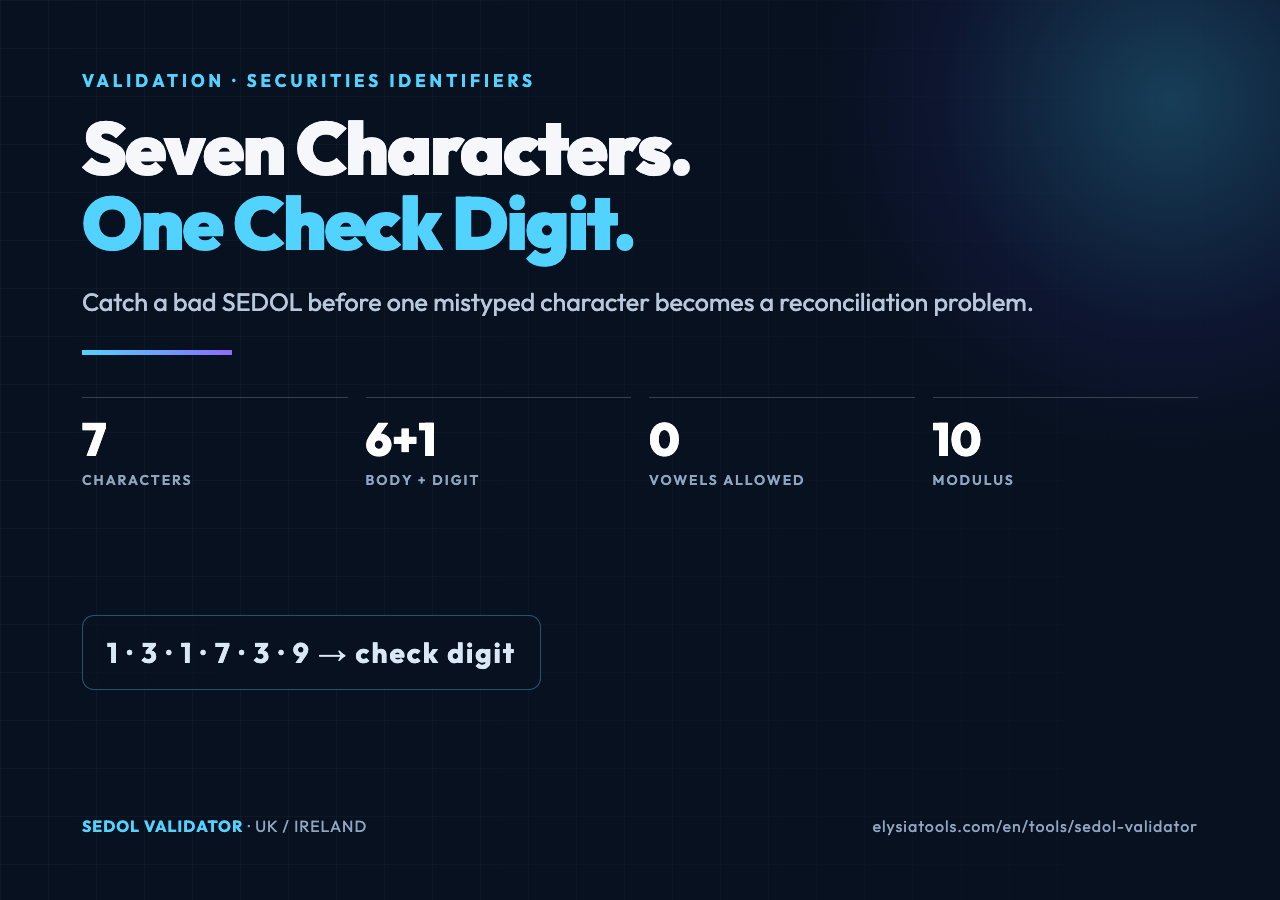
A SEDOL is short, but it is not just a short stock code
SEDOL stands for Stock Exchange Daily Official List. The identifier is used for securities associated with the United Kingdom and Ireland and is issued through the London Stock Exchange’s SEDOL Masterfile. A SEDOL has seven characters: a six-character identifier followed by one decimal check digit.
That compact shape is useful in security-master files, trade confirmations, portfolio exports, and instrument-mapping tables. It is also easy to mistype. A value such as 0263494 looks plausible at a glance because it has the right length and only uses digits. Plausibility, however, is not validity.
The SEDOL Validator checks four independent conditions: the normalized length is seven, the first six characters use the allowed alphanumeric set, no vowels appear, and the seventh character agrees with the weighted mod-10 calculation. That layered test matters because a length check catches truncation, while the checksum catches many substitutions and transpositions that leave length unchanged.
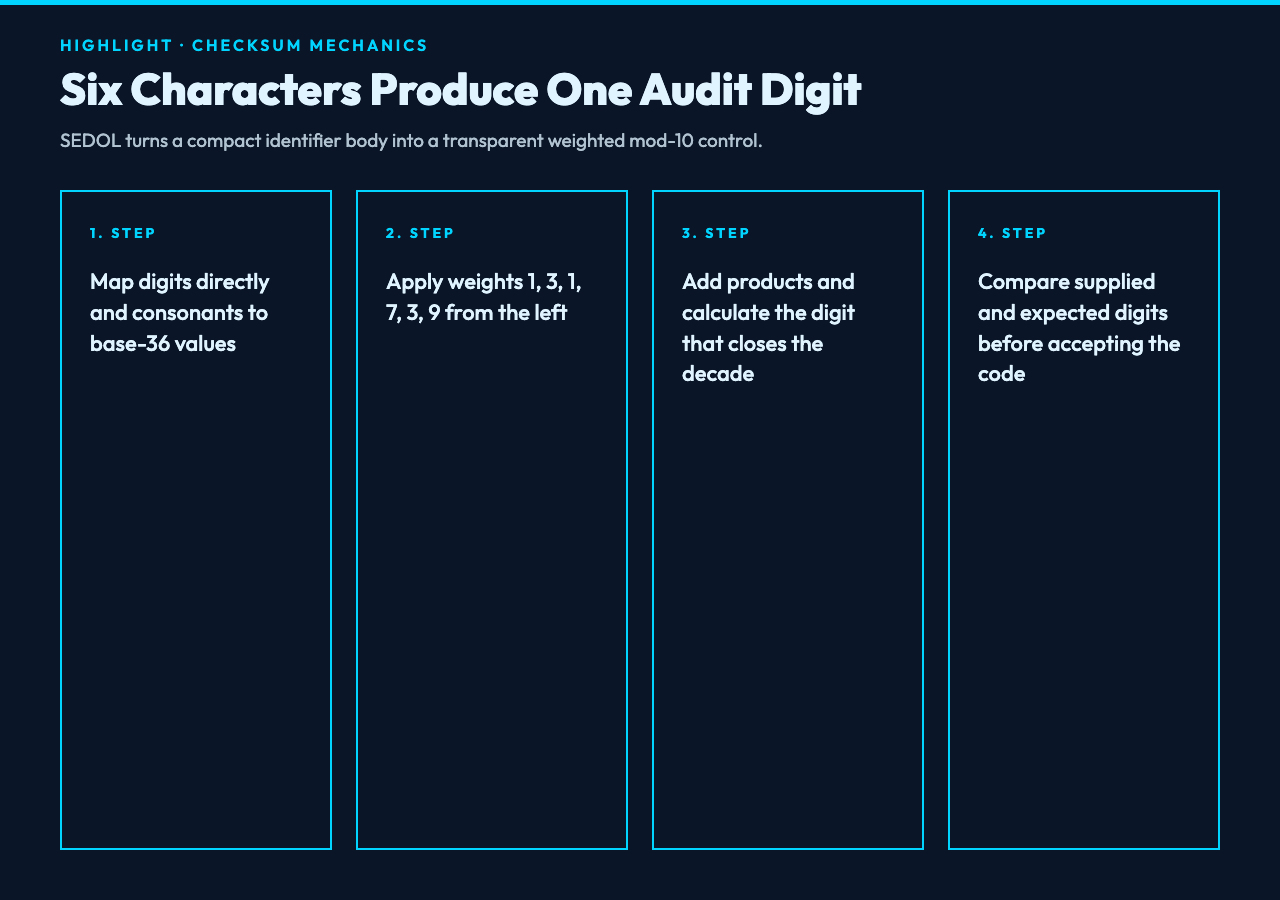
The checksum turns six characters into one audit signal
The algorithm assigns character values first. Digits keep their numeric values. Letters use their base-36 values, so B is 11, C is 12, and Z is 35. The first six values are multiplied from left to right by the weights 1, 3, 1, 7, 3, 9. Add those products, take the result modulo 10, and choose the final digit that makes the total end on a multiple of ten.
For example, use the six-character body 026349:
- Convert the characters. The values are 0, 2, 6, 3, 4, and 9.
- Apply the weights. The products are 0×1, 2×3, 6×1, 3×7, 4×3, and 9×9.
- Add the products. The measured total is 126.
- Close the decade. Because 126 modulo 10 is 6, the required check digit is 4.
The valid result is therefore 0263494. If a feed contains 0263495, the shape still looks correct, but the checksum reports that 4 was expected. You can inspect the calculation and the corrected candidate directly in the online validation report instead of treating the result as an unexplained pass or fail.
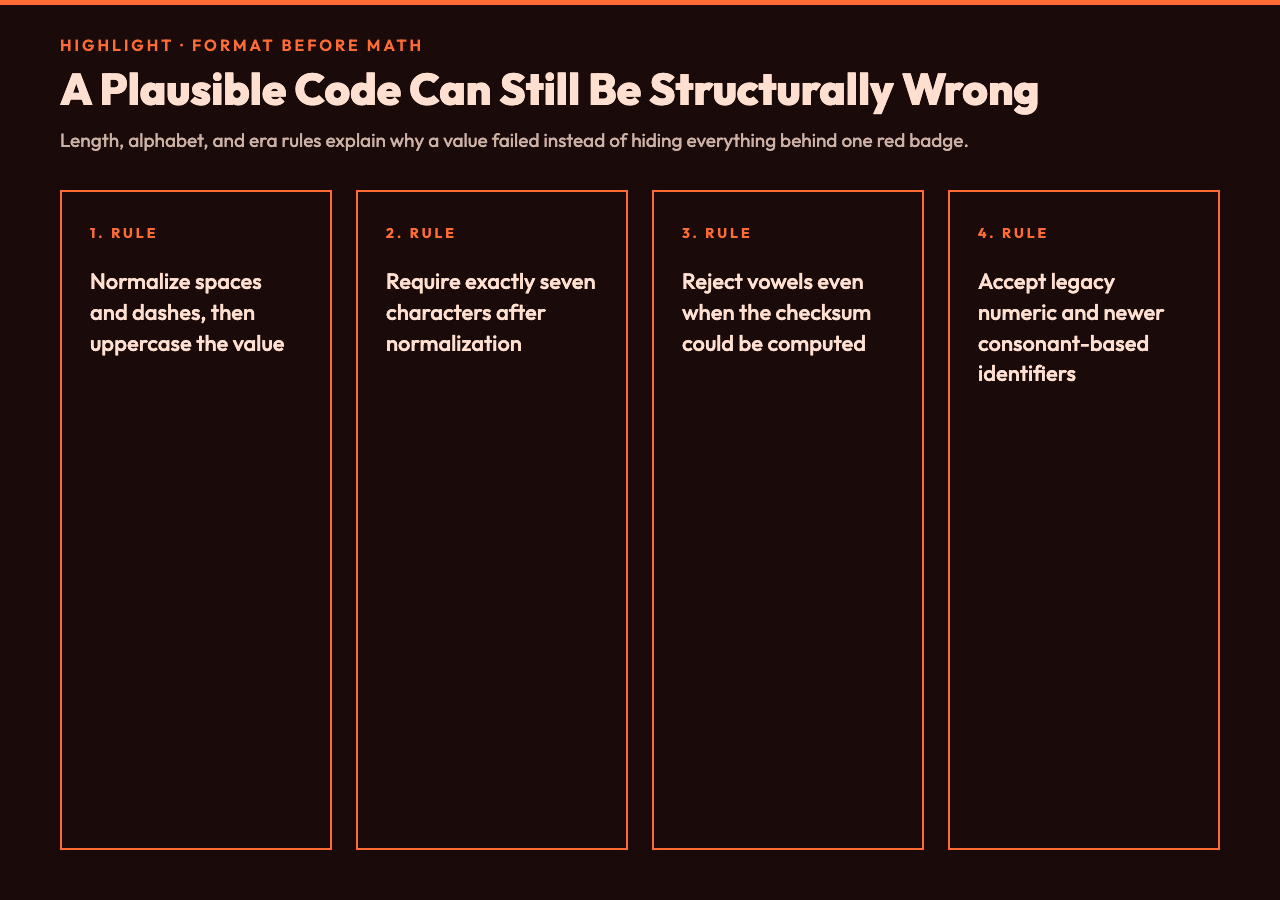
Three format rules catch failures before the math begins
A checksum is the final gate, not the first. The SEDOL-7 format excludes vowels A, E, I, O, and U. It accepts digits and the remaining uppercase letters, and it expects exactly seven normalized characters. The validator tolerates spaces and dashes on input, removes them, and converts letters to uppercase before testing the code.
This sequence gives cleaner error handling. For instance, 02A3494 should not be sent into checksum logic and reported only as a mismatch; it contains a prohibited vowel and is structurally invalid. A six-character value should be reported as truncated. A value with punctuation should be distinguished from one where a harmless separator can be normalized away.
The order matters because each message points to a different repair. A wrong length suggests a broken column boundary or dropped leading zero. A forbidden character suggests OCR noise or a copy-and-paste error. A checksum mismatch suggests a transcription error inside an otherwise well-formed identifier. One red badge cannot tell an operations team which upstream system to inspect.
Old numeric codes and newer alphanumeric codes belong to the same test
Older SEDOLs are numeric, including familiar examples such as 0263494 and 0540528. SEDOL identifiers allocated after the 2004 change can contain consonants in the first six positions. The validation rule still works because letters are converted to values from 10 through 35 before the same weight sequence is applied.
That detail is important in legacy migrations. A regex that accepts only seven digits can appear reliable against an old portfolio and then reject valid newer instruments. By contrast, a permissive seven-character regex may accept vowels and never verify the check digit. In practice, both shortcuts produce silent data-quality debt.
Use the SEDOL-7 structure breakdown when you need to see the cleaned input, the six-character identifier, the supplied digit, the expected digit, and the arithmetic in one result. A transparent report is easier to review than a boolean, especially when the validation sits between a vendor feed and a production security master.
SEDOL, NSIN, and ISIN solve related but different problems
A SEDOL can serve as the national security identifier, or NSIN, inside a British or Irish ISIN. But an ISIN is a separate 12-character identifier with a two-letter country prefix and its own Luhn check digit. Validating one does not automatically validate the other.
For example, a pipeline that receives both fields should run two explicit controls. First, validate the standalone SEDOL with its weighted mod-10 rule. Second, use the ISIN Validator to check the ISO 6166 structure, country prefix, expanded letter values, and Luhn digit. If the business rule says the SEDOL must be embedded as the ISIN’s NSIN, compare the normalized values after both identifiers pass their own checks.
The same separation applies across regional identifier families. A North American CUSIP, a UK or Irish SEDOL, and a global ISIN may describe the same economic instrument in different contexts, but they do not share one checksum. For instance, a cross-market reference-data job can validate the local field with the SEDOL tool and send the international field to the ISIN tool without pretending that one successful result proves the whole row.
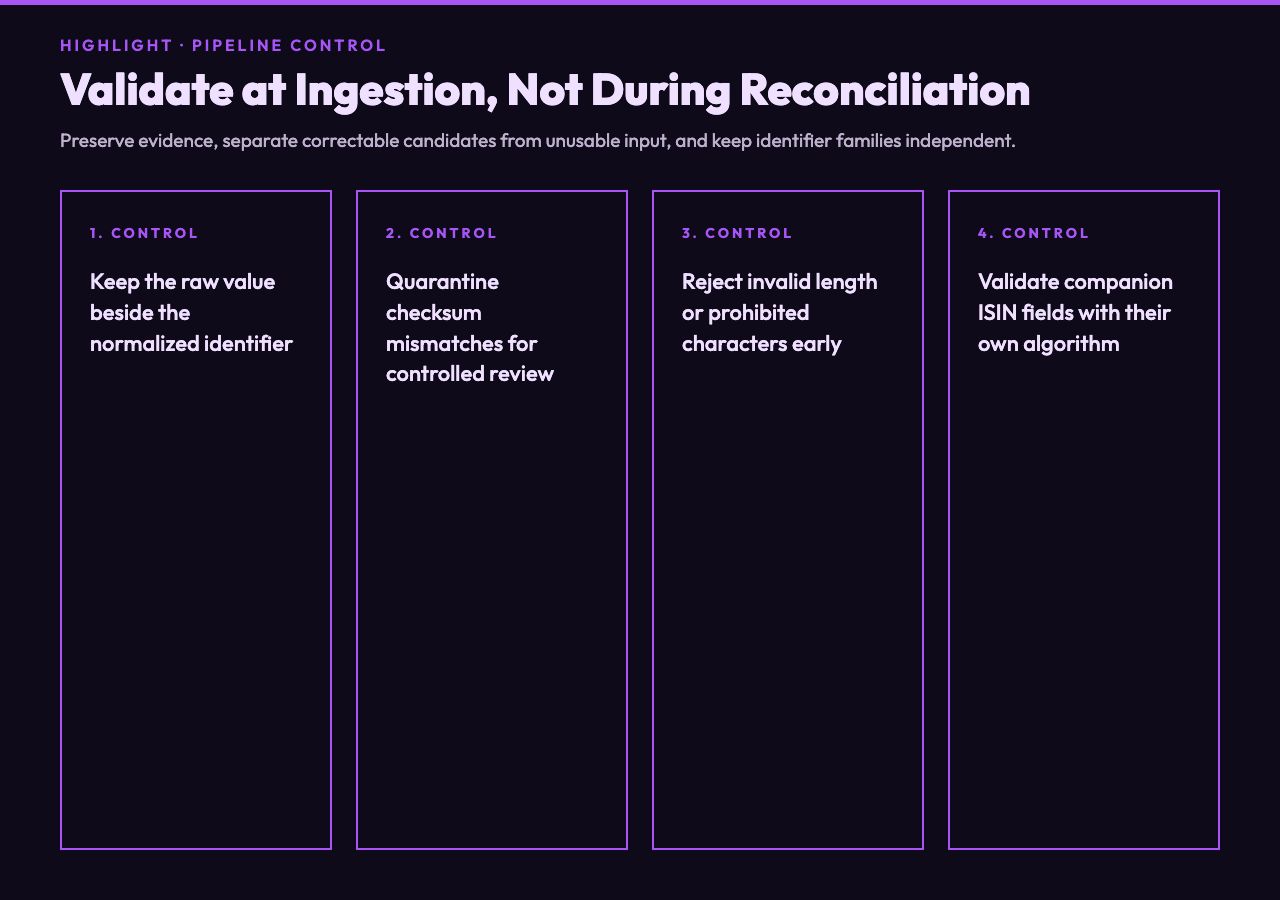
Put validation at the boundary, not in the reconciliation meeting
The best place to check a SEDOL is the earliest boundary where the identifier becomes structured data: a CSV import, a message consumer, an analyst upload, or a vendor API response. Normalize separators, retain the original string for audit, record the expected check digit, and reject or quarantine failures before the code becomes a database key.
According to the tool’s report model, a useful validation record includes the original input, cleaned value, length, status, six-character identifier, supplied check digit, expected check digit, and validation timestamp. Those fields support a clear exception queue. They also make a benchmark or data-quality dashboard more informative than a daily count of generic invalid rows.
A practical batch policy can use three outcomes:
- Accept. Format and checksum both pass.
- Quarantine. The code is seven valid characters but the digit does not match; preserve the corrected candidate for human review.
- Reject. Length or alphabet rules fail, so the source value cannot be interpreted safely.
This is also why validation should not silently overwrite the incoming value. A computed correction is evidence, not authorization. Show the candidate, keep the raw field, and let the owner of the data decide whether the source or the reference master is authoritative.
A small control protects a surprisingly long workflow
A seven-character identifier can pass through portfolio accounting, risk, settlement, performance reporting, and regulatory extracts before anyone notices it points at the wrong record. That is why the next control belongs at ingestion, not in the reconciliation meeting. Run the SEDOL Validator, keep the arithmetic with the exception, and validate any companion ISIN independently. The point is not to make identifiers interesting. It is to stop one character from becoming a multi-team investigation. If the checksum can challenge the row in milliseconds, why wait until people have to challenge it days later? Explore more focused utilities at Elysia Tools.