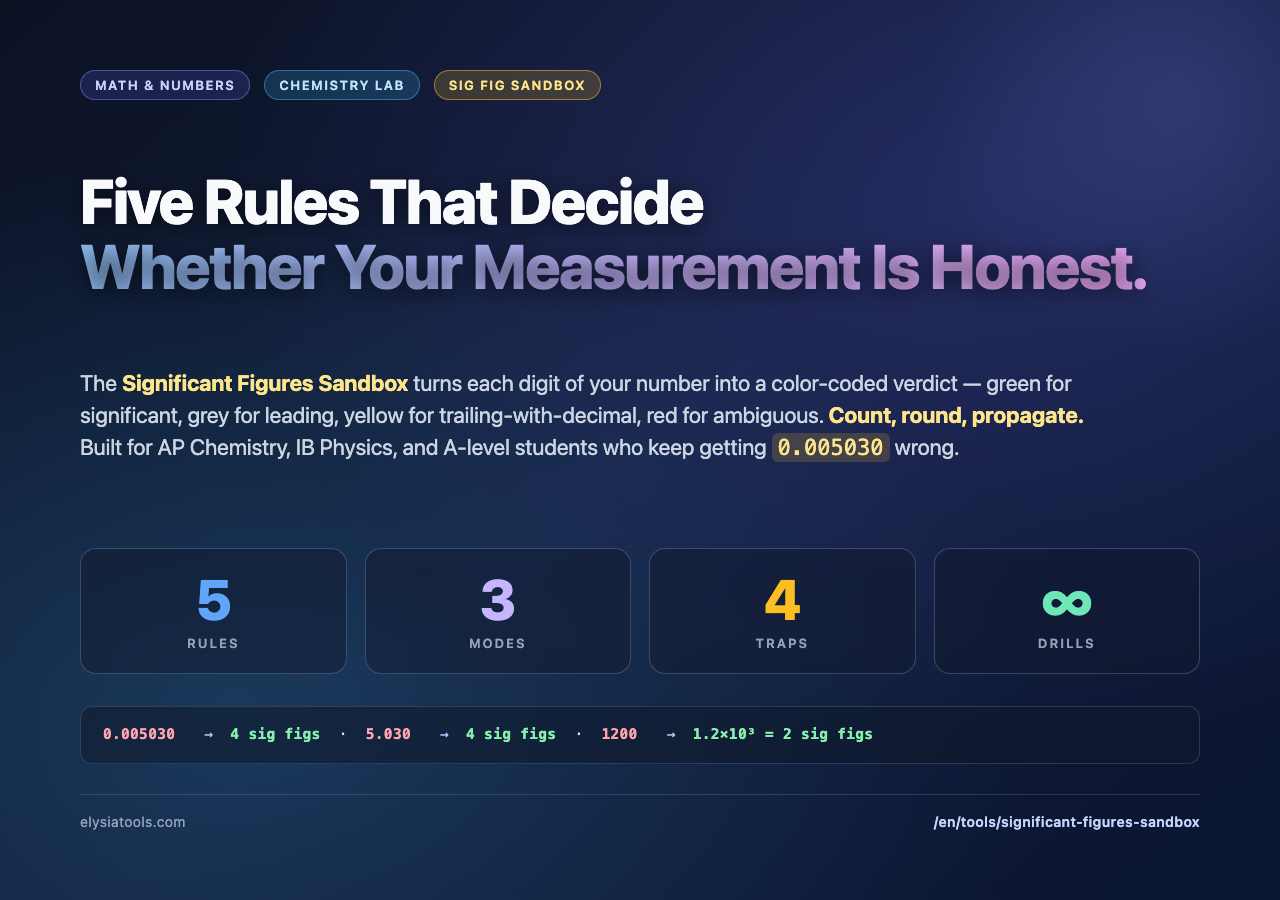
A chemistry student measures 0.005030 grams of a salt on an analytical balance. She types the number into her lab report. Her TA circles it and writes: “How many sig figs?” She counts five. The TA counts four. The answer is four — and the reason is the most important rule in measurement reporting, the rule that every chemistry and physics student gets wrong on their first attempt: leading zeros don’t count, but trailing zeros past a decimal point do.
The Significant Figures Sandbox exists because that single distinction — which zeros matter — trips up nearly everyone learning it. The tool doesn’t just calculate. It grades your guess, color-codes each digit of your number, walks you through the rules one by one, and offers three distinct modes: practice (count + feedback), round (round to N sig figs without losing precision), and propagate (apply the +/−/×/÷ rule to two operands). It accepts integers, decimals, and scientific notation in 1.23e4, 1.23E4, or even 1.23×10^4 form. For any student who has stared at 1200 and not known whether it has two, three, or four sig figs, the sandbox turns that ambiguity into a structured drill.
Why Significant Figures Matter at All
Significant figures are how science reports measurement uncertainty. When you write 5.030, the trailing zero is a promise: I trusted this digit enough to write it down, and I am sure of the value to within ±0.001. When you write 0.005030, the leading zeros are placeholders — they tell you where the decimal point is but carry no precision information. They are not lies; they are not “wrong”. They are simply not measurements. They position the meaningful digits so you can read the number at the resolution the instrument gave you.
This matters whenever you combine measurements. If a lab balance reads to ±0.001 g and a pipette reads to ±0.01 mL, dividing mass by volume to get density inherits the precision of the worse instrument. Reporting density as 1.234567 g/mL when your mass was only ±0.001 precise is a false-precision claim. Significant figures propagate that honesty forward through calculations, and propagation has two distinct rules depending on the operation — which is the second thing every student gets wrong.
The traditional fix is a textbook chapter with ten worked examples and an answer key in the back. The sandbox replaces that with interactive grading: you enter the number, you guess the sig-fig count, and the tool shows you the digit-by-digit breakdown — green for significant, grey strikethrough for leading, yellow for trailing-with-decimal, red for ambiguous trailing. You get the answer and the reason in the same screen.
The Five Rules, and Why Each One Exists
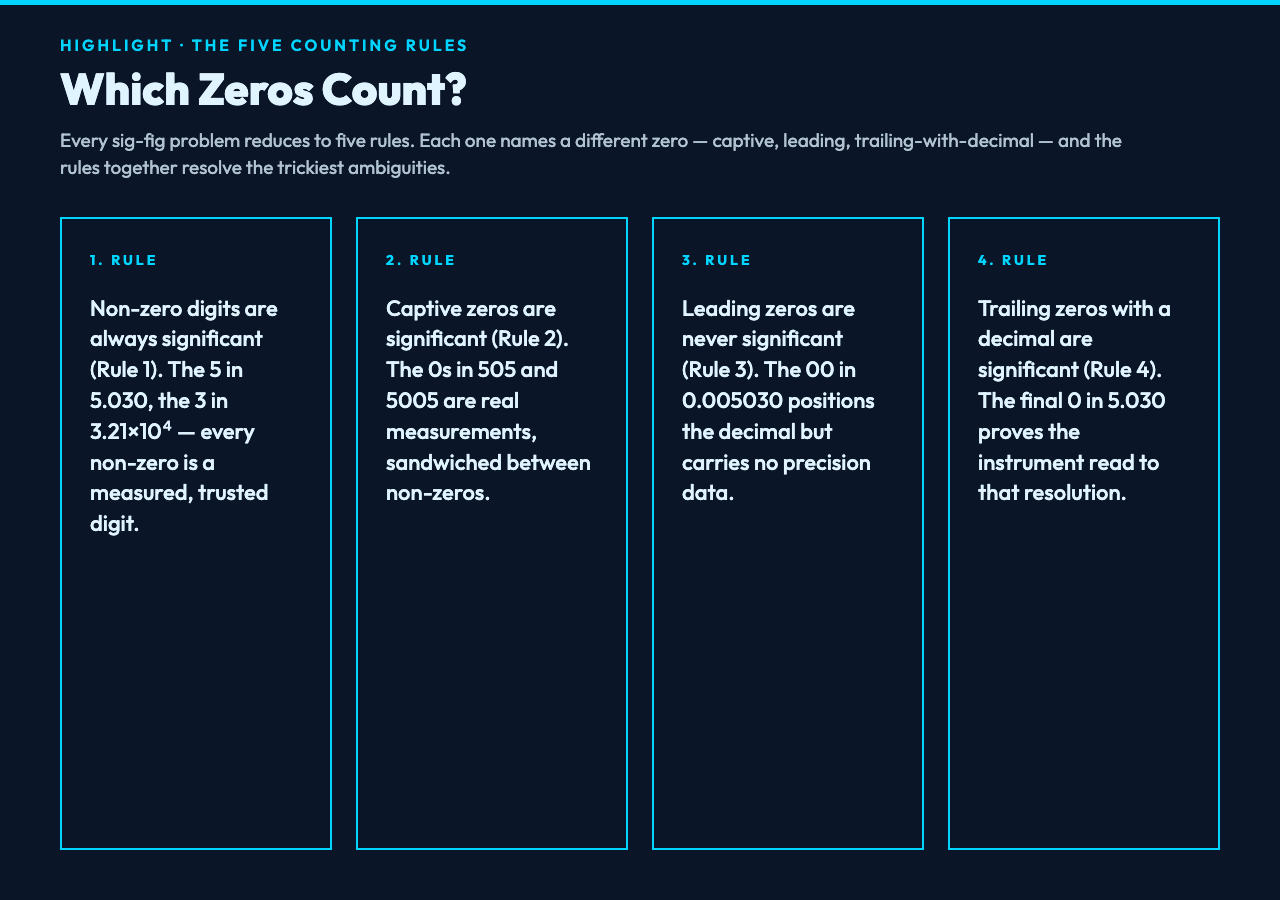
Every sig-fig counting problem reduces to five rules. They are not arbitrary — each one solves a real ambiguity that arises when you record a measurement.
- Non-zero digits are always significant. The
5in5.030, the3and2in3.21×10⁴— every non-zero digit is a measured, trusted digit. This is the safe-default rule; it covers most digits. - Zeros between non-zero digits are significant (captive zeros). The
0in505and the0s in5005are real measurements. You wouldn’t have written them down if you hadn’t trusted them. They are captured between non-zeros, so they count. - Leading zeros are never significant. The
00in0.005030position the decimal point but carry no measurement information. They are placeholders, not data. Deleting them changes nothing about what the instrument actually measured. - Trailing zeros ARE significant when a decimal point is present. The final
0in5.030is significant because the decimal point and the trailing zero together prove that the measurement was taken to that resolution. Without the trailing zero, you’d have written5.03and implied less precision. - Trailing zeros without a decimal point are ambiguous — different conventions disagree.
1200might be 2, 3, or 4 sig figs. The only way to resolve the ambiguity is scientific notation:1.2×10³= 2 sig figs,1.20×10³= 3 sig figs,1.200×10³= 4 sig figs. The sandbox accepts all three forms of e-notation so you can encode the sig-fig count directly into the number.
Those five rules turn 0.005030 into a color-coded breakdown: four leading zeros greyed out, then the 5, the 0 (captive), the 3, and the trailing 0 all green. Four significant figures — the answer the TA wanted.
Mode One — Practice: How the Sandbox Grades You
The practice mode is the heart of the tool. You enter a number like 1.236×10⁻⁴, type in your guess (“is it 4 sig figs?”), and submit. The sandbox compares your count to the truth and walks through every digit:
- Leading zeros (if any): grey strikethrough, marked “leading — not significant”
- Non-zero digits: green, marked “significant”
- Captive zeros: green, marked “captive between non-zeros”
- Trailing zeros with decimal: yellow, marked “trailing with decimal — significant”
- Trailing zeros without decimal: red, marked “ambiguous — see Rule 5”
The color coding is what makes the difference versus just reading the answer. When you see 0.005030 rendered with two grey zeros, then four green digits, the rule lands in a way that reading “leading zeros don’t count” in a textbook never quite does. Students who drill with the sandbox consistently score higher on sig-fig questions than students who rely on memorization, because they pattern-match on the visual decomposition rather than counting from a rule list.
Mode Two — Round: Preserving Honest Precision
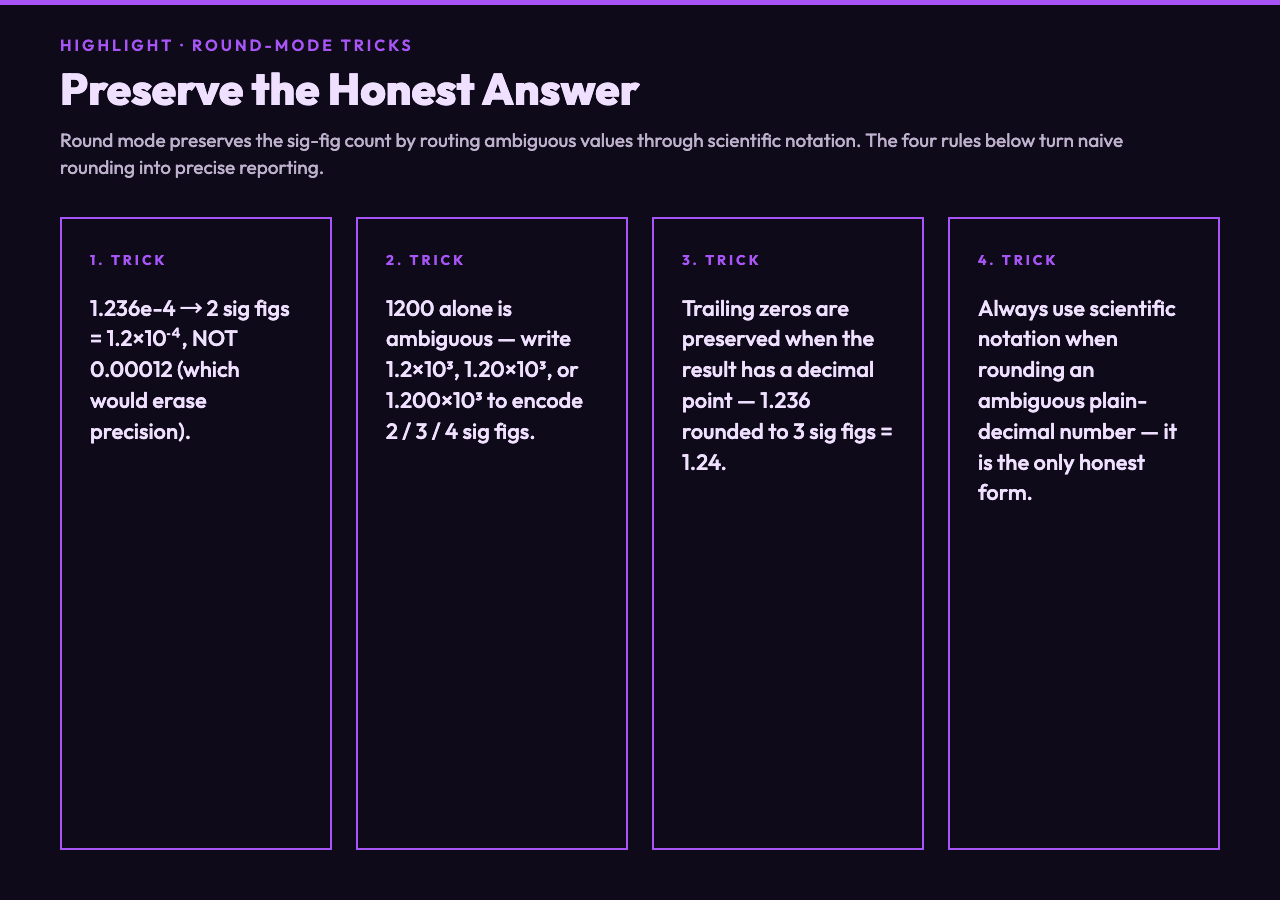
Round mode solves a different problem. Suppose you measured 1.236×10⁻⁴ m and want to report to 2 sig figs. The naive answer is 0.00012 — but that’s wrong in a subtle way. Writing it as a decimal erases your sig-fig intent: 0.00012 looks like 5 or 6 sig figs depending on who reads it. The honest answer is 1.2×10⁻⁴ — scientific notation rounds to 2 sig figs and keeps them.
The sandbox’s round mode does this correctly. You enter 1.236e-4, specify 2 sig figs, and it returns 1.2×10⁻⁴ (not 0.00012). It also handles trailing-zero preservation: if you round 1.236 to 3 sig figs, the answer is 1.24 — the trailing 4 is kept because the result has a decimal point, encoding that 3 sig figs was intentional.
Try a few to feel the difference between the two modes. Round 1200 to 2 sig figs without decimal context: the sandbox returns 1.2×10³ because 1200 alone is ambiguous (Rule 5) — the round mode forces scientific notation precisely because it cannot preserve sig figs in the decimal form. That single behavior is the most common fix-it-once-and-forget mistake in chemistry lab reports: always use scientific notation when rounding an ambiguous number.
Mode Three — Propagate: +/− vs ×/÷ Have Different Rules
Propagation is where the second rule shows up. It is split by operation type, and conflating the two is the most common error in multi-step calculations.
For addition and subtraction, the rule is: round to the fewest decimal places among the operands. If you add 12.34 + 5.6, the answer is 17.9 (one decimal place) not 17.94. The decimal-place rule tracks absolute precision — position of the last trusted digit.
For multiplication and division, the rule is: round to the fewest sig figs among the operands. If you multiply 12.34 × 5.6, the answer is 69 (two sig figs) not 69.104. The sig-fig rule tracks relative precision — proportion of trusted digits.
The asymmetry exists because +/− measure absolute uncertainty (same units, same decimal) while ×/÷ measure relative uncertainty (scaling, ratios, density). The sandbox’s propagate mode takes two operands and an operation, applies the correct rule, and reports the result with its sig-fig count. Try 1.234 + 5.67 (addition → 3 decimals); then try 1.234 × 5.67 (multiplication → 4 sig figs). The mode tells you both answers and which rule was used. It’s the cleanest way to internalize the split.
The Four Traps Students Hit Every Semester
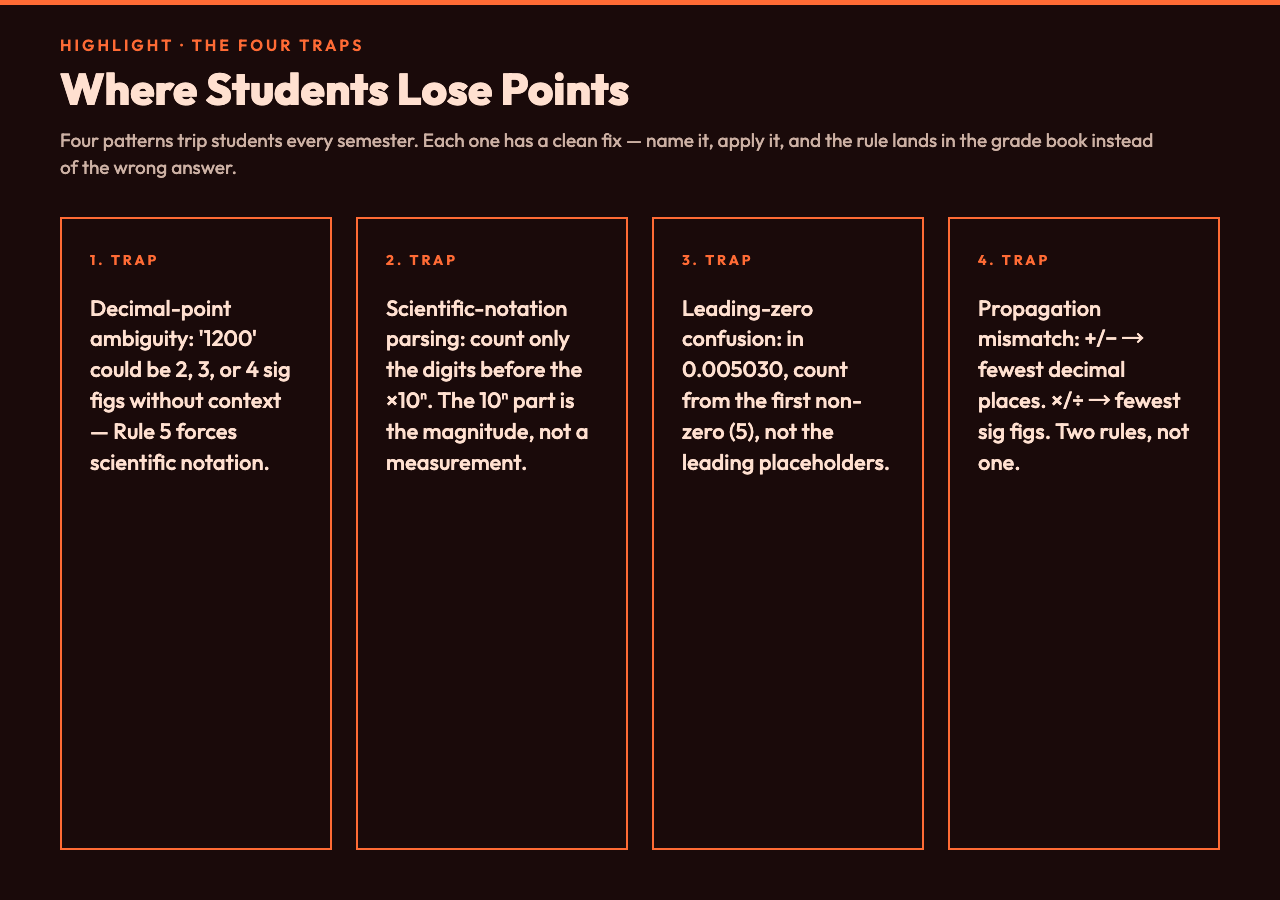
After the rules and modes, the four patterns that consistently trip students are: (1) decimal-point ambiguity — 1200 could be 2, 3, or 4 sig figs without context, which is exactly why Rule 5 forces scientific notation. (2) scientific-notation parsing — counting zeros in 1.20×10⁴ requires ignoring the 10⁴ part entirely; only the digits before the multiplication matter. (3) leading-zero confusion — getting 0.005030 wrong by counting all zeros including the leading ones. (4) propagation-rule mismatch — applying the +/− (decimal-places) rule to a ×/÷ problem or vice versa, which gives answers that look plausible but carry hidden precision errors.
Each trap has a clean fix once you name it. Decimal-point ambiguity → always write large or small numbers in scientific notation. Parsing → ignore everything after the ×10 power. Leading zeros → look for the first non-zero digit, then count from there. Propagation-rule mismatch → memorize the two rules as a pair: decimal places for +/−, sig figs for ×/÷. The Significant Figures Sandbox exposes each trap as a practice question — the mode names and color-coding align with the rule structure, so drilling on it builds the right mental mapping faster than textbook examples can.
Try It on Five Measurements
The fastest way to internalize the rules is to enter five ambiguous-looking measurements into the sandbox and grade yourself before checking. Pick: 1500, 0.00340, 2.700×10³, 5005, and 1.0×10⁻². Each one isolates a different rule. Each one has a “right” count that the sandbox will walk you through. If you can defend your answer on all five — and explain which rule each one belongs to — you have the mental model. If you miss any of them, the color-coding will tell you exactly which rule you skipped.
Sig figs are not a calculation skill. They are a reporting discipline — a way of being honest about what an instrument actually measured, and what your derived values actually know. The tool that lets you practice that discipline, with feedback that names the rule you forgot, is the difference between “I think it’s 4” and “I know it’s 4 because the trailing zero past the decimal is significant per Rule 4.” Try the Significant Figures Sandbox with the five numbers above, then take the same five numbers back to any practice problem and watch the rules click faster than they did the first time.
Explore more measurement and rounding practice tools at elysiatools.com — the Rounding Calculator pairs naturally with the sandbox for arithmetic-rounding drills, and the Scientific Notation Converter extends the propagation logic to powers-of-ten conversions when you need to translate between 1.23e4 and 12300 forms.