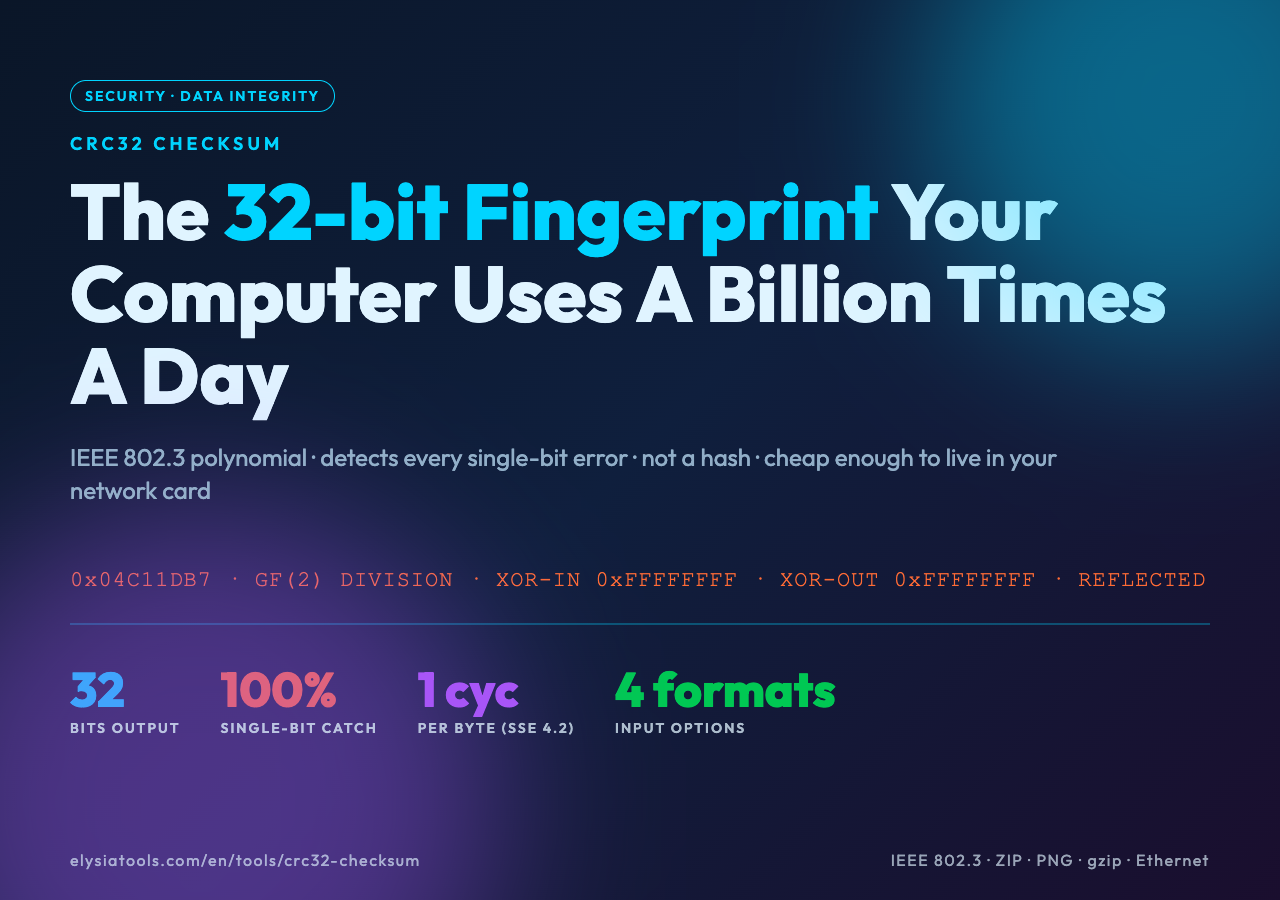
If you have ever unzipped a file, loaded a PNG, or watched a file copy finish without an “are you sure?” dialog, you have already used CRC32. The four bytes of checksum at the end of every ZIP entry, the chunk that lets an Ethernet card throw away a corrupted frame before the CPU ever wakes up, the magic number that lets gzip notice your download is truncated — that is CRC32, the 32-bit fingerprint your computer computes a billion times a day without telling you. It is not a cryptographic hash. It was never meant to be. The reason it is everywhere anyway is the same reason a bar code on a box of cereal works in 30 milliseconds: it is cheap enough to run in hardware, good enough to catch random corruption, and small enough to ignore.
The CRC32 Checksum tool takes any text or raw byte stream and produces the same IEEE 802.3 polynomial value that zlib, pngcheck, and your network card compute internally. Paste a message, pick hex or base64 input if you need to feed raw bytes, and choose the output format your downstream system expects. The number you get back is byte-for-byte compatible with what every CRC32 implementation since 1975 has produced.
What CRC32 Actually Computes
CRC stands for Cyclic Redundancy Check. The “32” is the bit width of the output; the algorithm is polynomial division in GF(2), the finite field where addition and subtraction are both XOR. You take the input message, append 32 zero bits, then divide that extended bit string by a fixed polynomial — the IEEE 802.3 polynomial, 0x04C11DB7 — using XOR instead of subtraction. The remainder is the 32-bit CRC. The math is unchanged whether the input is 4 bytes or 4 gigabytes.
Three properties make CRC32 the right tool for the wrong job most people hire it for:
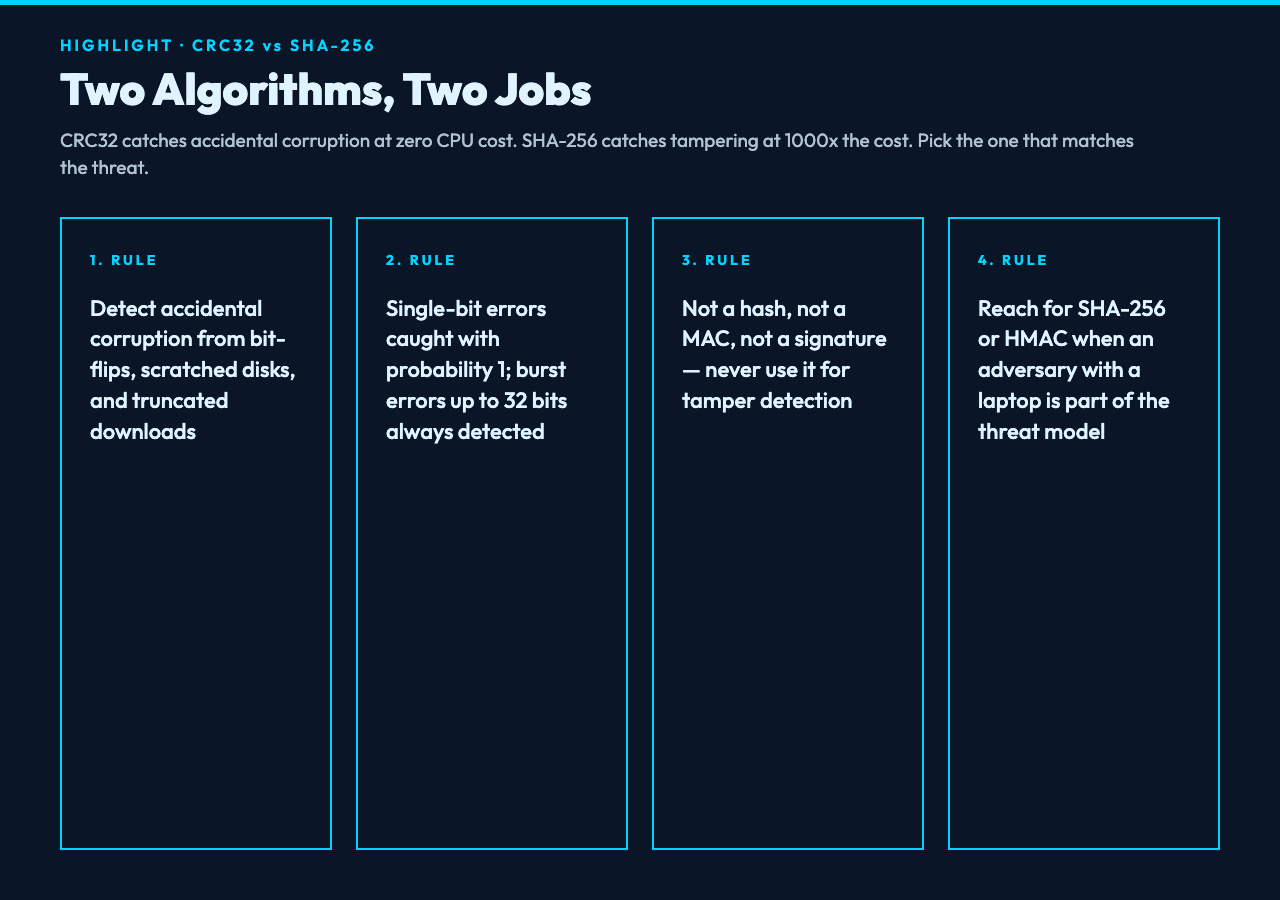
- It detects all single-bit errors. Any single bit flip in the input produces a different CRC with probability 1 — guaranteed, not statistical.
- It detects all burst errors up to 32 bits. A contiguous run of flipped bits shorter than the polynomial degree is always caught, which is why it survives scratched CDs and dropped network packets.
- It is linear in XOR-arithmetic. That is the property that breaks it as a cryptographic hash: if you know
CRC(A)andCRC(B), you can computeCRC(A XOR B)without ever seeing the inputs. That is the same trick that lets an attacker forge a CRC-protected firmware image in a few milliseconds.
CRC32 vs SHA-256: The Confusion That Costs You a CVE
The most common bug in junior code reviews is treating CRC32 as if it were a hash. The two algorithms answer different questions. SHA-256 answers “has anyone with a laptop seen this input before?” CRC32 answers “did this byte stream arrive intact?” A 32-bit space has only four billion possible outputs — the birthday paradox gives you a collision after roughly 65,000 messages, which on a modern GPU is a coffee break. SHA-256 has 2256 possible outputs, a number so large that the entire power output of the sun for its entire lifetime could not count them.
If you need to detect tampering — firmware integrity, signed manifests, password storage — you need a cryptographic hash, an HMAC, or a signature. CRC32 is the wrong tool. The Cryptography and Encryption Samples hub shows the right family for those jobs: SHA-256, BLAKE3, HMAC-SHA-256, Ed25519 signatures.
If you need to detect accidental corruption — a corrupted download, a flipped bit on a serial cable, a torn write in a database page — CRC32 is exactly right, and a cryptographic hash is overkill. The probability that cosmic rays flip enough bits to produce a matching CRC32 is roughly one in four billion per gigabyte, which is a much better deal than the milliseconds SHA-256 costs you per block.
Three Decisions That Decide Your CRC32 Output
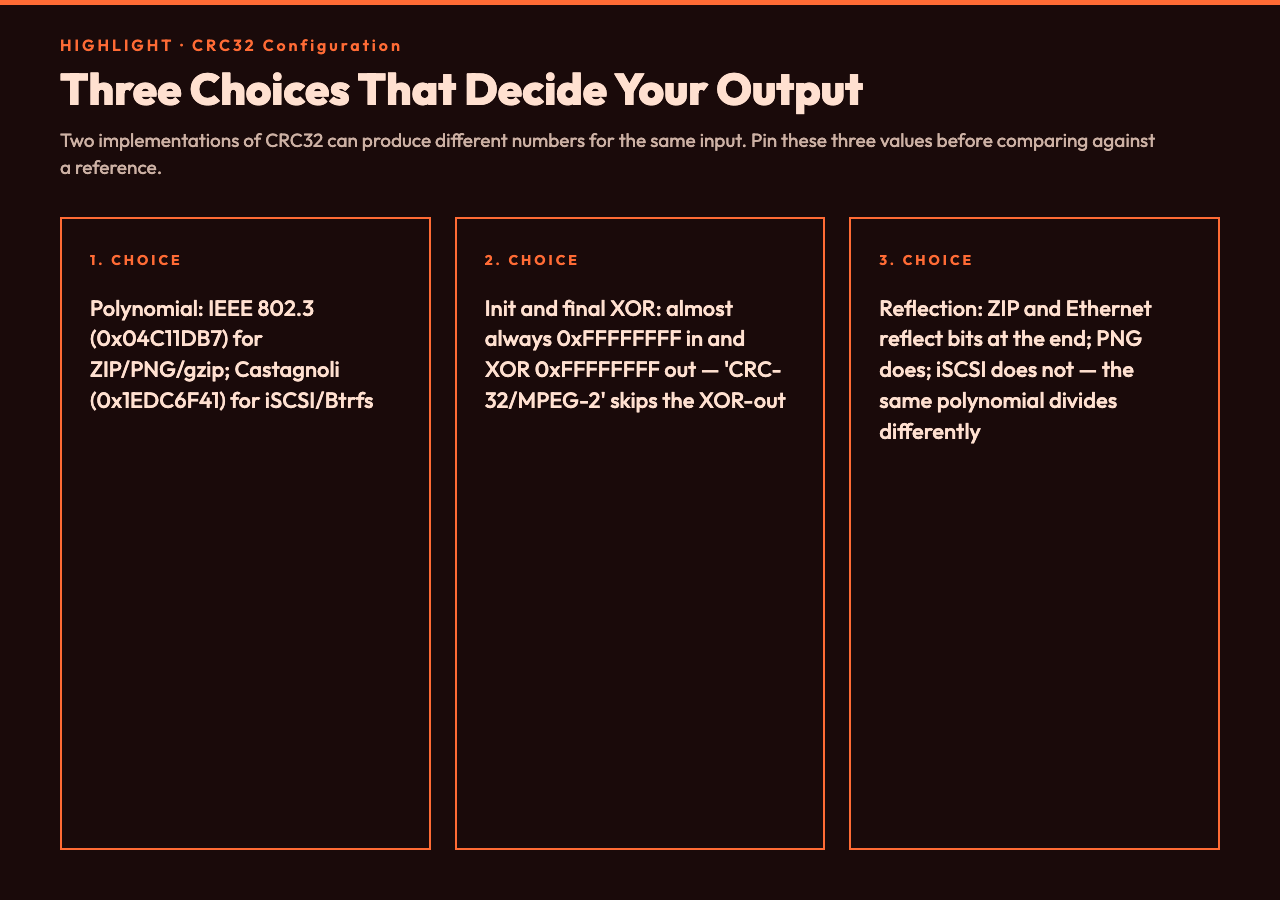
Two CRC32 implementations can produce different numbers for the same input. The differences are not bugs; they are configuration choices. Before you paste anything into the CRC32 Checksum tool, decide these three things.
Polynomial
The IEEE 802.3 polynomial 0x04C11DB7 is what Ethernet, ZIP, PNG, gzip, and zlib use. The Castagnoli polynomial 0x1EDC6F41 is what iSCSI, SCTP, and Btrfs use because its error-detection properties on packets longer than 4 KB are measurably better. The Koopman polynomial 0x741B8CD7 is what some automotive and industrial CAN-bus stacks use for the same reason. The tool defaults to IEEE 802.3 because that is what 99% of consumers want; if your downstream system is Btrfs, you need Castagnoli.
Initial Value and Final XOR
The naive polynomial-division algorithm produces a CRC for the message starting from bit 0. Real protocols almost always feed an initial value — usually all-ones, 0xFFFFFFFF — into the register before processing, and XOR the final register with all-ones afterward. The two XORs together guarantee that a message of all zeros produces a non-zero CRC, which catches the “the wire went silent and we cannot tell” failure mode. The IEEE 802.3 variant is sometimes called CRC-32/MPEG-2 if you skip the XOR-out, which produces a different number for the same input. If the spec says “CRC-32C”, it means Castagnoli with the IEEE XOR-in/XOR-out convention.
Bit Order and Reflection
Ethernet transmits the least-significant bit of each byte first. The CRC it computes is the reflected version of the polynomial division — same math, different bit-reversal convention at the end. ZIP and gzip use the same reflection. iSCSI does not. PNG does. If you compare your output against cksum on macOS, you are getting the reflected IEEE 802.3 variant — which is what the Elysia tool produces by default. If you compare against a reference implementation that documents “no reflection”, you have to XOR the bit-reversed version by hand.
Reading a CRC32 Mismatch in the Wild
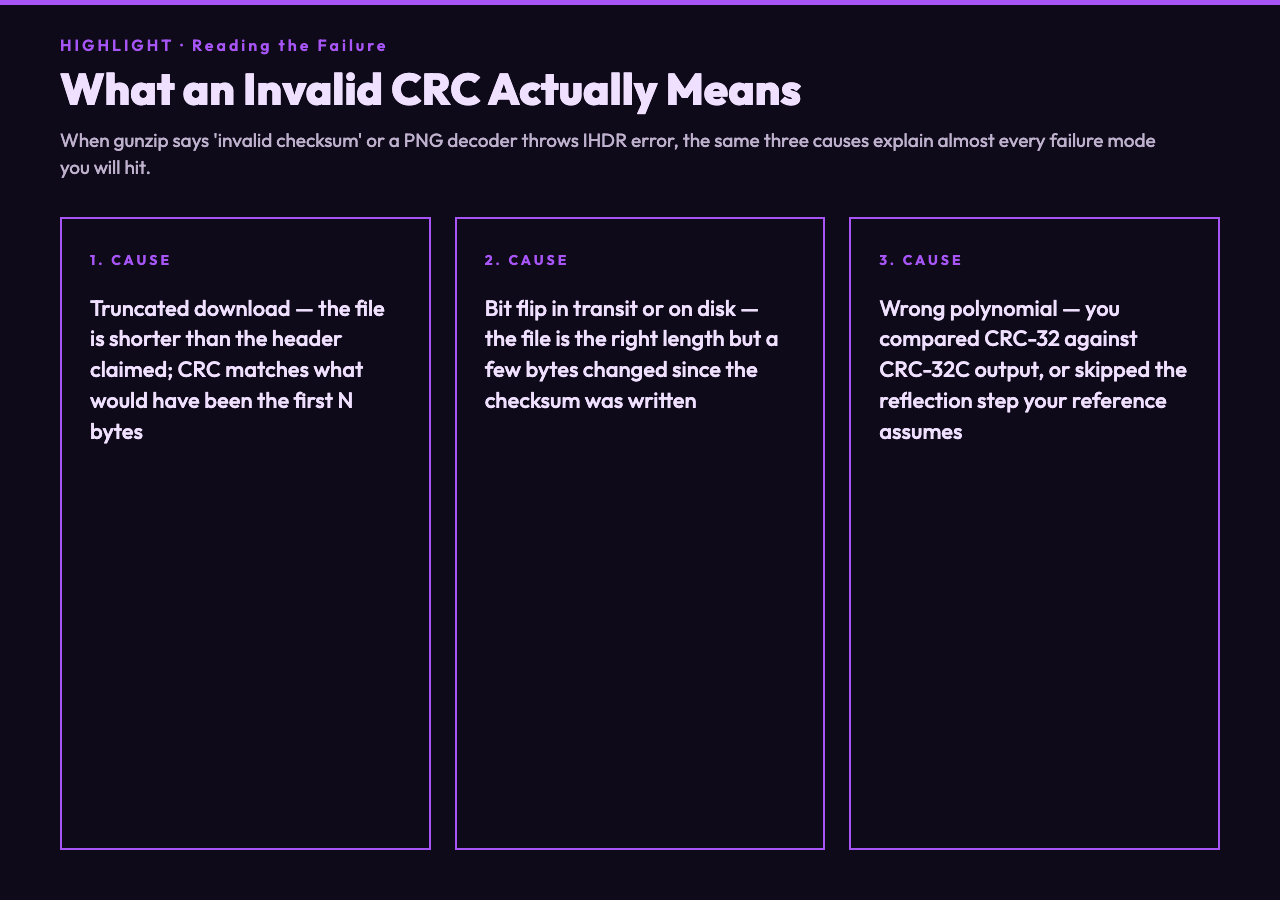
When gunzip says “invalid checksum” on a downloaded tarball, it means the CRC32 stored in the gzip footer does not match the CRC32 the tool just computed over the decompressed bytes. Three things cause this, in roughly decreasing order of frequency:
- Truncated download. The file is shorter than the header claimed. The CRC was correct for the original; you have the first N bytes of it. Re-download.
- Bit flip on disk or in transit. The file is the right length but a few bytes changed. Re-download, or run
sha256sumagainst a checksum the publisher provided. - Wrong tool or wrong polynomial. You used CRC-32C on a file that was checksummed with CRC-32 (IEEE), or vice versa. The tool can tell you which one matches a reference value, but only if you can change the polynomial.
The same logic applies to PNG (“IHDR checksum error”), ZIP (“CRC failed”), and Ethernet frames dropped at the link layer — the receiver computes CRC32 over the payload, compares against the trailing 4 bytes, and discards the frame on mismatch without ever telling the application.
Where CRC32 Shows Up That You Did Not Notice
Everywhere a file format needs to detect accidental corruption without paying for cryptography, CRC32 is the answer. PNG and GIF chunk CRCs let image viewers skip corrupt frames without crashing. ZIP central-directory entries let unzip verify each member before extraction. The gzip footer is what makes streaming decompression safe — curl | tar -xzf - would be unreliable without it. The log files with sensitive data hub demonstrates the same idea applied to a different problem: checksum every log line so a partial-write crash leaves a recoverable trail instead of a corrupted index.
Even in places where the name has been retired, the algorithm lives on. The ZFS fletcher4 checksum is four parallel CRCs over interleaved slices. The ext4 metadata checksum is CRC32C with hardware acceleration through the SSE 4.2 CRC32 instruction — one cycle per byte on a modern CPU. The reason Btrfs picked Castagnoli was specifically that Intel and AMD shipped CRC32C in silicon, turning what used to be a per-block software cost into something the disk controller can do for free.
The Honest Takeaway
CRC32 is one of the most successful algorithms in computing, and it is successful precisely because it refuses to pretend it is something it is not. It is a 32-bit fingerprint for catching accidental corruption. It is not a hash, not a MAC, not a signature, and not a defense against an adversary with a laptop. Used for the first job, it is fast, cheap, ubiquitous, and bit-exact across every implementation that agrees on polynomial, init value, final XOR, and reflection. Used for the second, it is a CVE waiting to be filed.
The CRC32 Checksum tool gives you the IEEE 802.3 variant that ZIP, PNG, gzip, and Ethernet agree on. Paste a payload, paste a hex blob, paste a base64-encoded binary, and the number you get back is the same one zlib and your network card would compute. For everything else, reach for SHA-256, an HMAC, or a real signature — and use the cryptography samples as your test corpus. CRC32 is the bouncer at the door; SHA-256 is the alarm system. You need both, for different jobs.
Explore more of the security and integrity toolkit at elysiatools.com.